

Latest News

McGill, Montreal, News

Judge accepts McGill’s application to appeal reinstatement of archaeological panel in Mohawk Mothers case

The Kanien’kehá:ka Kahnistensera (Mohawk Mothers) and McGill appeared at the Court of Appeal of Quebec on Jan. 16, where McGill presented its application for leave to appeal against Justice Gregory Moore’s Nov. 20 decision to reinstate the court-appointed archaeological panel tasked with overseeing the ongoing investigation into potential unmarked Indigenous graves on the site of McGill’s New Vic Project. This comes after the Mothers asserted that McGill and the Société québécoise des Infrastructures (SQI) had prematurely disbanded the panel on Aug. 3. In court, McGill claimed that the panel was dissolved after its mandate had been completed, as per their interpretation of the settlement agreement and contracts with panel members. Justice Christine Baudouin ruled to accept McGill’s application of appeal on Jan. 19, meaning that the appeal will be heard and debated before the court on June 11. 

McGill’s lawyer, Olga Redko, was the first to speak before Baudouin—one of Quebec’s 22 appeal judges who hears appeals concerning civil trials. Redko argued that the issue before the court was not a dispute over the interpretation of the settlement agreement. She asserted that Justice Moore had rendered a judgment without considering the possibility of further deliberation over the merits of the contract. 

Additionally, Redko stated that Justice Moore’s judgment had a March expiration date, and that he had ignored section 13 of the settlement agreement. McGill, the SQI, and the Mohawk Mothers are bound by the recommendation of the panel regarding which techniques to use and guided by the recommendations regarding which service providers to use in the archaeological investigation. However, section 13 states that McGill and the SQI retain the discretion to acquire other providers if the circumstances warrant. By ignoring this section in his ruling, Redko argued that Justice Moore had “failed to follow jurisprudence.”

Mohawk Mother Kwetiio shared in an interview with The Tribune after the hearing that she felt that McGill’s statement to the court was “very technical” and lacked empathy toward the possibility of Indigenous children’s graves on the site. 

“Everything the [McGill] lawyer was saying, it just felt like she was regurgitating a textbook and order of operations,” Kwetiio said. “Those words didn’t care if it meant killing a child, or throwing someone in the garbage. It didn’t have any of the substance, and I think that’s the difference between our ways.”

In a roundtable discussion with The Tribune, Associate Provost (Equity and Academic Policies) Angela Campbell expanded on the dissolution of the panel, explaining that the panel consisted of three members who were named in the settlement agreement, alongside dates set for the completion of the panel’s work. She recalled that shortly after the panel had delivered its second and final report in late July 2023, one panel member wrote to all parties stating that she considered their work to be done, and she then “stepped away.” 

“I wouldn’t call that quitting because quitting suggests that you’re leaving in the middle of something. From her perspective, the work was done. So, she moved away from the work,” Campbell said. “The position that McGill has taken is [that] the panel is not fired or dissolved. Its work is complete in accordance with the terms of the settlement agreement.” 

Pierre Major, the Executive Director of the New Vic Project, also shared in a roundtable discussion with The Tribune that McGill and the SQI were responsible for paying the panel members and drafted up contracts in April 2023 with predetermined end dates. 

“With anybody that you pay, you need a contract. So, we put together a document with the help of our legal counsel, agreed on an hourly fee, and agreed on the period. We put an end date of July on the basis of when the mandate was to end, and those documents were shared with the Kahnistensera,” Major said. 

Campbell also noted that although the panel’s work was done, the settlement agreement stipulated that the panel must be consulted in the event of an “unexpected discovery,” such as historic human remains detection dogs detecting a scent on the site. 

After a brief break, the Mothers, who legally represent themselves, addressed the court. Mohawk Mother Kahentinetha explained that from her perspective, the spirit of reconciliation has not been upheld between the parties. She argued that Justice Moore determined that the McGill and the SQI’s application of the agreement was too narrow, as the defendant’s interpretation would dissolve the archaeological panel. 

Kwetiio echoed this sentiment, explaining to the court that the potential presence of human remains at the New Vic Project site has not been elucidated and pointing to numerous artifacts found on the site, such as bone fragments and a child’s shoe. She ended her statement by asserting that refusing to reinstate the panel would damage the spirit of reconciliation, and a court appeal of that nature would create a dangerous precedent for other proceedings involving missing Indigenous children and unmarked graves. 

In an interview with The Tribune after the hearing, Kwetiio explained that it felt frustrating to once again be in court where she felt the defendants were manipulating the words of the contract. 

“When you get into a contract with somebody, you’re getting into a relationship, and a contract is that everybody gets what they need to get. They needed to do their construction, we needed to have the clarity of this investigation,” Kwetiio said. “They’re trying to manipulate the intention that was put into that very contract.” 

The Mothers also shared that while they were disheartened, they felt confident based on their presentations to the court. 

“I’m pretty confident because we’re just relying on what we’ve always relied on from the very beginning,” Kahentinetha said in an interview with The Tribune after the hearing. “Now it’s all coming out into the open, and everybody can see what has been going on, what’s happening, and what we’re fighting for.”

Julian Falconer—the lawyer for the Office of the Independent Special Interlocutor, Kimberly Murray—subsequently addressed the court. He stated that Justice Moore continues to manage the trauma and fear that emerges for the Mothers out of this investigation. Falconer explained that if the appeal goes through the Quebec court system, the damage done will be “out of proportion.” He ended his statement by stating that the case should return to Justice Moore to allow him to continue to do the critical work he’s been doing. 

Baudouin adjourned the hearing without a ruling. 

“If it does come to the point where they do have an appeal, we’re just going to be ready like we’re always ready,” Kwetiio said.“We’re always going to have the ways we’ve solved things. We’re always going to have the thought of those children and the thought of my children […] and the thought that we have to show them how to keep doing this and keep living our way.” 

On Jan. 19, Baudouin announced her decision, stating that she would grant the defendants’ admission to appeal. A safeguard order has been automatically granted as the parties wait to debate the appeal, meaning that the panel will not be reinstated in the meantime. The appeal hearing is set for June 11, 2024. 

A previous version of this article stated that McGill is bound by the recommendations of the panel regarding which service providers to use in the archaeological investigation. In fact, McGill is not bound by these recommendations but is rather guided by them. The Tribune regrets this error.


Arts & Entertainment, Film and TV

No show succeeded ‘Succession’ at the Emmys

With awards show season in full swing, the Arts & Entertainment team looks at some of the standout moments from this year’s Emmy Awards.

Genre Categories in a Genreless Age 

In the 2022–2023 television season, most viewers would probably say that they laughed more at Tom Wambsgans’ rant about a “ludicrously capacious bag” that a woman mistakenly brought to Logan Roy’s birthday party in Succession than the stress-inducing character interactions in The Bear. Despite this, these two shows—the most awarded of last week’s Emmys ceremony—were placed in the separate categories of comedy (The Bear) and drama (Succession).

Before the age of streaming, media genres seemed much clearer. Comedies ran for half an hour and rarely tackled serious issues. Dramas ran for an hour and, conversely, limited their moments of levity. However, with the advent of platforms like Netflix and Hulu, these rules have mostly gone out the window. Arbitrary runtimes no longer constrain television, and most shows enjoy increased budgets, all leading to an expectation that TV shows are grander and more impactful than they were 30 years ago. 

So what should the Emmys do in an age of television where there are far fewer rules? Getting rid of the genre-defined categories would result in fewer winners and would likely benefit dramas, which the Television Academy typically considers to be the most prestigious. However, award shows’ insistence on giving out prizes based on arbitrary definitions like “comedy” and “drama” makes shows choose a category and try to convince people that it is the box that they fit into best. There is no clear answer as to what award shows should do, and certainly challenges like renegotiating contracts amidst the writers’ strike is a larger problem. But with TV shows moving further away from conventional genre trappings, the Television Academy will have to deal with this issue sooner rather than later. 

Goodbye to the era of Succession sweeps

After a triumphant awards season, HBO’s Succession swept almost all of the major awards at this past week’s Emmys, including Outstanding Drama Series, lauding the cast, crew, and producers for the final time after a mind-blowing fourth season. 

Succession centres on media mogul Logan Roy and his family, with the story being loosely based on Rupert Murdoch and his family’s corporation. In the Drama Series category, this year’s ceremony recognized cast members Kieran Culkin (Roman Roy) for Outstanding Lead Actor, Sarah Snook (Siobhan “Shiv” Roy) for Outstanding Lead Actress, and Matthew MacFadyen (Tom Wambsgans) for Outstanding Supporting Actor. Jesse Armstrong also took home his fourth trophy for Outstanding Writing—one for each season of the show. This year, it was for the show’s highest-rated and most heartbreaking episode ever, the season’s third episode, “Connor’s Wedding,” which is one of the best episodes of television ever. 

As someone who prides herself on being one of Succession’s biggest fans, I am beyond ecstatic with all of their wins. Snook won her first-ever Emmy, and though she has deserved it for years, this season really showed her embodying her role in a way we hadn’t seen before. Shiv’s marriage took a more central role in the plot, and she made her own final moves to secure a spot in her father’s company. While the show’s ‘star’ Jeremy Strong (Kendall Roy), did not win Outstanding Lead Actor—which he won in 2020—Culkin won his first Emmy, which touched my heart after his incredible performance this season. 


While there are other shows that I would have loved to see take home an award—particularly Better Call Saul, which has never won an Emmy and now never will—I still strongly believe that Succession deserved all of the awards it received. Unlike many dramas that run past their prime, Succession ended on a perfect high note and won the awards to prove it.

Student Life

A love letter to cross-country skiing

I so often find that downhill skiing disappoints—you pay hundreds of dollars to wait in massive lines, be carried to the top of a mountain, and then plopped down among dozens of families, fighting couples, and overconfident first-timers barreling down slopes they shouldn’t be on. I will admit, my lack of coordination may also play into my bitter attitude. No doubt, it’s fun, but the cost, wait time, and crowds are just not my vibe. Cross-country, on the other hand, is much more affordable and accessible, and is a great form of winter exercise. It also provides a true escape not too far from the city: You glide through snow-covered trees, people few and far between, at whatever pace you desire. You can even choose to ski into a cabin or do some winter camping if you’re feeling ambitious. So, without further ado, here are three spots to get out cross-country skiing in and around Montreal this winter.

Mont-Royal

Distance from campus: Five minutes by foot

Cost of entry: Free

Cost of ski rental: $16.50 for one hour, $22.50 for three hours

Although often busy, Mont-Royal boasts an impressive 16 kilometres of groomed cross-country ski trails right next to campus. The convenience of the mountain can’t be overstated—it’s easy to go skiing and get an hour or two of exercise in without having to rent a car and make it a whole-day activity. Les amis de la montagne offers rentals and courses for those who are interested.

Mont-Saint-Bruno

Distance from campus: 35 minutes by car

Cost of entry for students: $14.52 for the day or $10.70 after 3 p.m.

Cost of ski rental: $30.50 for the day

*A bundle of entry and ski rental is available for $40.50 for students

With 35 kilometres of cross-country trails, Mont-Saint-Bruno offers a peaceful escape not too far from the city. Lakes and old buildings dot the park, and two warming huts are available for those who need a break. Equipment is available for rent but must be reserved at least 24 hours in advance, making this park a bit harder to visit on a whim. A fun bonus is that Mont-Saint-Bruno allows nighttime skiing from Wednesday to Friday between Jan. 3 and March 8—and tickets are just $5.78 for students! 

Coureurs de boisés

Distance from campus: 40 minutes by car or one hour and 40 minutes by public transport

Cost of entry for students: $14 on weekdays, $16 on weekends

Cost of ski rental: Not available

This Laval spot claims to be one of the largest ski clubs in Quebec and offers a web of trails that are groomed by volunteers and weave through agricultural land. Students get a discounted rate on day and season passes, but there are unfortunately no equipment rentals available. 

I will leave you with some final, unsolicited advice: 

  1. Make sure to always check the ski conditions before you get your hopes up so you aren’t disappointed. Sites usually rank the conditions on a scale of “excellent” to “don’t come, the trails are closed,” which is info you definitely want before you leave the house.
  2. I’d skip the parks in Montreal that only have about three kilometres of ski trails. Even if you’re a beginner, they likely won’t have enough trails for you to really get into the swing of things, and they might not rent skis.
  3. Compare prices! Being a student can mean having a tight budget, but non-profits, community organizations, and student groups can be great ways to go cross-country skiing for cheap (the McGill Outdoors Club, for example, is a great resource that offers equipment rentals and group trips at a low cost). 
  4. Finally, remember to make time for relaxation as the semester ramps up. It doesn’t have to be cross-country skiing, but it’s important to unplug and do something you find truly enjoyable and calming so that you don’t get too caught up in the hustle and bustle of school and forget to live your life.
Science & Technology

Schoolwide exhibition showcases students’ innovative architectural solutions

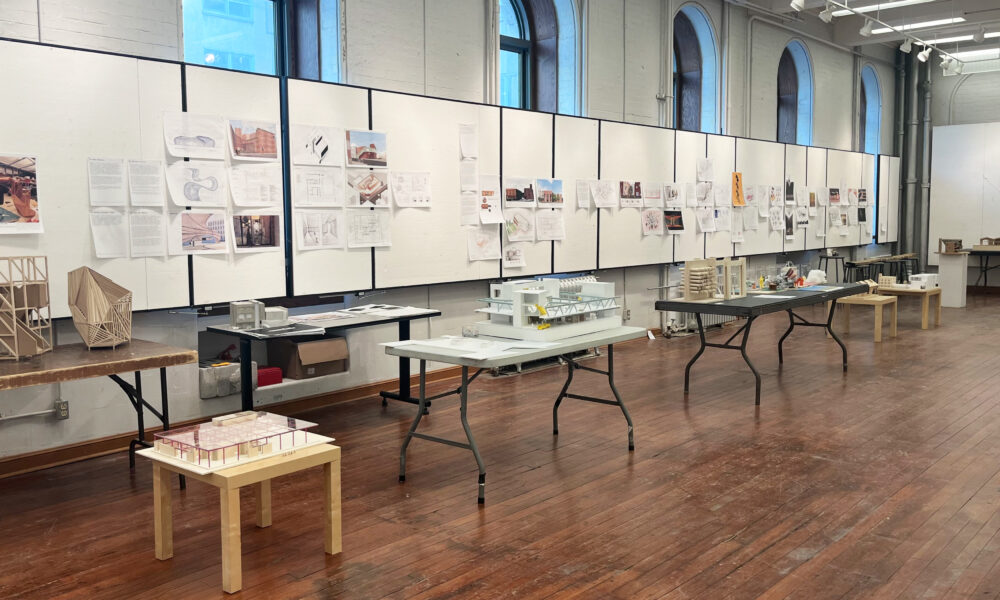
From vibrant 3D multimedia projects to traditional architectural plans, students in McGill’s Peter Guo-hua Fu School of Architecture delivered a range of studio projects for the faculty’s recent schoolwide exhibition. The collection, whose projects seamlessly integrated function and aesthetics, showcased compelling and innovative studio projects completed by U1 students all the way to PhD candidates.

Although the exhibit closed on Jan. 19, the self-directed projects of second-year master’s students are viewable online.

While these projects fulfill one of McGill’s Master of Architecture degree requirements, their framework allows students the opportunity to explore any research question that aligns with their interest without any restrictions regarding employed methodology or potential outcomes. Addressing a research question and developing a design proposal often serve as the starting point. The student then chooses whether to employ traditional concept drawings and models or to explore more modern digital tools such as Building Information Modeling (BIM). The exhibition’s structure allows students to spearhead their project in an experimental manner without the pressure of unnecessary academic constraints, all while benefiting from studio advisors’ expertise.

William Zhou, a master’s student in McGill’s School of Architecture, explored building retrofit strategies in the Quebec social housing sector through his project “Adapt Append Acclimate.” In an interview with The Tribune, he discussed some of the architectural solutions he has conceptualized and carried out in his ongoing research, as well as the potential social impact such a project could have if implemented in Quebec’s low-cost housing. Zhou started working on this last summer when he worked for the ReCONstruct lab.

“Our goal is to do energy retrofits for a lot of buildings in Quebec in partnership with Hydro-Québec,” Zhou said. “We want to reduce [the building infrastructure’s carbon emissions], first by not demolishing a lot of the old buildings and then by finding ways to retrofit and also renovate them so they can have more social values, for example by making them nicer for the residents.”

One of ReCONstruct’s areas of expertise is deep energy retrofits (DERs). 

“Forty per cent of global carbon emissions come from buildings alone,” Zhou stated. 

Compared to the much more complex solely engineering approach, the architectural solution of DERs aims to reduce a building’s energy consumption by 50 to 70 per cent through various forms of renovation. These may include adding additional thermal buffers or modifying the existing ventilation systems, which can be broadly categorized into mechanical ventilation, such as heating, ventilation, and air-conditioning (HVAC), and natural ventilation present in the architectural design, such as interior gardens.

DERs offer numerous advantages beyond mere energy conservation. They contribute to prolonging the lifespan of buildings, enhancing resilience, promoting resident well-being, and alleviating stress on the electricity grid by reducing peak loads. Embracing DERs emerges as a practical and indispensable approach for Canada to achieve its greenhouse gas (GHG) emission targets, leading to significant funding allocations aimed at expediting their widespread implementation.

Zhou’s project explores the ways that passive strategies, such as hybrid ventilation, can significantly enhance the margin of energy savings by diminishing the long-term operative energy consumption. The application of these passive techniques opens avenues for the revitalization of existing spaces and the addition of new spaces to various structures in Quebec. These spaces are designed to prioritize the needs of occupants, foster a health-oriented lifestyle, and bridge current gaps within buildings and neighbourhoods.

In addition to Michael Jemtrud, the Chair in Architecture, Energy and Environment at McGill as well as ReCONstruct’s principal investigator, and participating faculty overseeing the schoolwide architecture exhibition, the McGill Graduate Architecture Students’ Association (GASA) played a key role in organizing this impressive collection. 

Make sure to keep an eye out for their end-of-year exhibition in April when students will present their finalized projects.

Out on the Town, Student Life

Spend a day in Old Montreal

Despite being only a 30-minute walk from McGill’s downtown campus, when done right, a day in Old Montreal can feel like a day trip in a new city. Check out this itinerary for your winter getaway to Old Montreal. 

Begin with breakfast

A hot cup of coffee and a tasty breakfast is the best way to start your day in Old Montreal. 

Try Crew Collective and Café. Located in the old building of the Banque Royal du Canada, this coffee spot is famous for its unique and impressive interior. The domed ceiling laden with golden chandeliers is awe-inspiring, and the menu boasts premium teas, coffees, pastries, and breakfast items. Come early though: Crew Collective can get quite busy in the morning, as it also serves as a popular coworking space

If Crew Collective is indeed packed to the brim, fear not: A short, seven-minute walk eastward along Saint Jacques St. to Place D’Armes will bring you to Marché Saint Laurent. While the interior may not be as breathtaking as that of Crew Collective, the coffee and pastries hit the spot, plus, the little coffee shop hosts a market of items from local designers, ranging from hand-made art to cookbooks and fun postcards. 

Crew Collective: 360 Rue Saint-Jacques.

Marché Saint Laurent: 503 Place d’Armes.

Just a little bit of shopping

Old Montreal has plenty of options for those looking to do a bit of shopping. L’empreinte coopérative features artisanal items from Quebec designers, ranging from fun ceramics and jewelry to soaps

Mimi and August is another good bet. This sustainably-focused store sells home decor items, stationary, and swimwear.

If you’re looking for more of a stereotypical shopping experience in a beautiful location, check out Marché Bonsecours. This historic building modelled after Dublin’s Custom House was home to Montreal’s main public market for over 100 years.

Inside, you’ll find stalls ranging from a quaint épicerie, to fine jewelry, and art galleries.

L’empreinte coopérative: 88 Rue Saint-Paul E.

Mimi and August: 162 Rue Saint-Amable.

Marché Bonsecours: 350 Rue Saint-Paul E.

Refuel with a relaxing lunch

For lunch, there are many options to choose from. If you’re craving a warm lunch, Crêperie Chez Suzette offers both savoury and sweet crepes and fosters a bubbly, conversational atmosphere. 

Alternatively, you can head over to Tommy Café on Saint Paul St. This specific location is more of a sit-down, restaurant-style version of the popular Old Port chain. With an open view of Saint Paul St. and good eats, it’s a great place for some people-watching over a hearty lunch

Crêperie Chez Suzette: 3 Rue Saint-Paul E.

Tommy Café: 151 Rue Saint-Paul O.

The post-lunch promenade

Digest your lunch with a historical walk along the Old Port Promenade. This linear park runs along de la Commune St. and was created in 1981. The promenade follows the path of the eight railway lines that formerly allowed for the loading and unloading of cargo from ships docked at the piers. 

Skating to End the Day

For a fun afternoon activity, continue eastward down the promenade to the Parc du Bassin-Bonsecours Ice Rink for skating. Open until March, this refrigerated rink is a perfect place to skate with a group of friends, or on a date, tucked behind the Grande roue Observation Wheel with wonderful views of the city skyline to the north. Free lockers are available, as are skate rentals, and day passes are $10. If you go on a Thursday between 7:30 and 10 p.m., you can skate during DJ On Ice, featuring a new local DJ each week.

Old Port Skating Rink: 362 Rue de la Commune.

Hockey, Sports

The Tribune tries: PWHL home game at Place Bell

January has been a big month for the Professional Women’s Hockey League (PWHL). Not wanting to miss out on the action, The Tribune stepped out to watch PWHL Montreal take on PWHL New York on Jan. 16 at the Place Bell. And if you are wondering if it was worthwhile, going to watch a Montreal-based team with a winning record was a refreshing experience to say the least. 

On Jan.  13, PWHL Montreal hosted their first home game at the Verdun Auditorium, their principal venue, where they sold out the 4,114-seat arena. Montreal will split their home games between the Verdun Auditorium and  Place Bell––a 10,062-seat arena that is home to the Laval Rocket of the American Hockey League. PWHL Montreal, like the other five teams in the league, is playing without a logo or unique name, a decision that was made so as not to rush the creative process and to use the time to build an identity that reflects the history of women’s hockey and each individual team. 

On a cold Tuesday night, The Tribune arrived at Montmorency station, picked up a quick bite to eat at Five Guys, and walked over to the arena. Our tickets, which were $23 each, were midway up the corner section and offered a clear view of the entire ice. The crowd of 6,334 filled the lower bowl nearly to capacity.

The first period saw Montreal dominate play by controlling the neutral zone and limiting New York’s high-danger chances. The crowd was electric from the get-go but it reached another level  nearing the end of the first period when Montreal scored twice in 17 seconds, setting a PWHL record for fastest consecutive goals. This is the second game Montreal has played against New York, after a 5-2 victory the week before, and it was noticeable, with players finishing their checks and more physicality than in Montreal’s previous games. The rowdy environment in the stands and on the ice lead us to think that a rivalry could be forming. 

After the DJ kept the crowd excited during the intermission, the second period picked up right where the first left off, with lots of good chances for Montreal and strong defensive play before ultimately giving up a shorthanded goal in the final minutes. 

We spent the second intermission walking around the concourse. The gin bar is lovely: It’s a great place to sit and relax before the period starts back up. There is a nice selection of merch available, but my Montreal Maroons sweater was slightly too similar to justify buying their the PWHL Montreal crew neck. Maybe next year, when their new logo adorns the front, I will reconsider. 

Early in the third period, New York scored to tie the game at two, but a dancing competition, the wave, and one fan’s poster saying “Who runs the world?” kept the energy up. In the final five, Montreal captain Marie-Philip Poulin capitalized on a turnover and scored what was ultimately the game-winning goal. The crowd erupted and the noise didn’t wane from that point on. The team gave a salute to the crowd after the final buzzer and Poulin was honoured as the first star.

Going to a PWHL game is worth a trek to Verdun or Laval. From a hockey perspective, the players are skilled, and the game is fast, competitive and physical. The ambiance is exciting, especially when players like Poulin can rally the crowd every time she touches the puck. Sitting behind me was a group of  girls from a youth hockey team, who were talking about their favourite players, waving their posters, and cheering every time Ann-Renée Desbiens made a save. The nicest part of the game is seeing these moments. With its strong financial backing,big sponsors, including historic broadcasting deals, and a proper collective bargaining agreement, it seems like the PWHL will be around for the long-haul. With the future laying in front of us, catching a game during the inaugural season in the league’s Original Six phase is a lovely feeling and The Tribune cannot wait for more to come.

McGill, News

McGill and AGSEM meet to discuss increases in TA wages and healthcare fund

The Association of Graduate Students Employed at McGill (AGSEM) and McGill proceeded with their ninth round of negotiations on Jan. 16. Following the expiration of AGSEM’s last teaching assistants’ (TA) collective agreement with the school in July 2023, negotiations have been ongoing, largely focusing on AGSEM’s non-monetary demands. On Dec. 18, the association presented its monetary proposal to the university.

Before the negotiation meeting started, AGSEM held a rally in front of Roddick Gates where members chanted and spoke to students about the organization’s demands. According to a press release, AGSEM’s monetary proposal consists of increasing TA wages to levels comparable with the wages of TAs at other large Canadian universities and implementing a cost-of-living adjustment in years when inflation exceeds three per cent. Additionally, the union requests that the number of hours that TAs work be indexed to the number of students enrolled in the class. Lastly, the proposal also includes a request for three separate healthcare funds, dedicated to general healthcare, gender-affirming healthcare, and healthcare for international TAs. 

One of the members present at the rally, Emma McKay, a PhD student in the Department of Integrated Studies in Education (DISE) and the Chief Delegate Mobilization at AGSEM explained in an interview with The Tribune that they are interested in seeing McGill’s monetary proposal. 

“What we’re most hoping to hear in this negotiation session is McGill’s counteroffer for our monetary proposal,” McKay said. “How much, in terms of hourly wage, are they willing to offer us out of the gate? In terms of healthcare, are they willing to even consider it? Indexing TA hours to student enrolment, are they even willing to consider that or a modification of it?”

The union’s expectations, outlined by McKay, were not met in the negotiation session. According to AGSEM, McGill was unable to provide a monetary counteroffer at Tuesday’s meeting. According to a press release, McGill’s representatives used the meeting’s time to comment on the proposal made by the union at their previous meeting.

McGill pointed to differences in the Quebec labour market as a justification for the difference in TA wages compared to other Canadian universities. AGSEM responded to this argument by noting McGill’s professed self-inclusion in the “Canadian Ivy League” as a context in which they are comfortable comparing the school to its Canadian counterparts.

According to AGSEM, the current wage of a TA at McGill is $33.03 per hour, compared to $40 to 50 per hour at other Canadian universities such as University of Toronto and Queen’s University. But Queen’s University TA Tai Withers, MSc candidate and member of Public Service Alliance of Canada 901, maintains that their TA wages are not sufficient to cover the rising cost of living in Kingston, Ontario, where the university is located. In an interview with The Tribune, Withers also stated that the workload as a TA can become overwhelming when combined with research and coursework as a graduate student. 

“If you isolate the TA workload, I think that’s fair. In combination with being a graduate student I think it can certainly be more than is entirely reasonable” said Withers. 

At the rally preceding the negotiation, Dallas Jokic, PhD candidate in philosophy and member of AGSEM’s bargaining committee spoke about the unique case of Quebec when it comes to the rising cost of living.

“I think McGill has always advertised itself as ‘Oh, Montreal is so affordable’, but as

we all know the cost of living is getting so much more expensive here. The cost of living is

rising faster in Montreal than almost any other city in Canada,” Jokic said. 

The Canadian Press reported that rents are increasing at a faster rate in Quebec than in the rest of the country.

As discussions moved in the direction of the proposed healthcare funds, McGill 

asserted that the coverage currently provided to graduate students at large is already more expansive than that offered to the majority of McGill employees.

The university expressed an understanding of AGSEM’s desire for a cost-of-living adjustment in years with high inflation. However, McGill said it was unable to meet the demand, citing the uncertain nature of economic activity.

McGill indicated that it plans to share its counter-proposal shortly.

McGill declined to comment on ongoing negotiations.

McGill, News, SSMU

SSMU Legislative Council approves Motion Regarding Action Against Tuition Hikes

The Students’ Society of McGill University (SSMU) held its first Legislative Council meeting of the year on Thursday, Jan. 18. The meeting began with a brief review of the councillors’ holiday activities which, among other things, included knitting a sweater and cat-sitting. The session also included an announcement from the Scarlet Key Society about their annual award for outstanding student leaders, a reminder about this week’s Winter Activities Night, and a debate concerning a Motion Regarding Action Against Tuition Hikes.

The first announcement came from the President of the Scarlet Key Society, Eric van Eyken, (BCL/LLB ‘09). Van Eyken explained their annual Scarlet Key awards, which recognize students who exhibit outstanding leadership and commitment to their peers and community. Awardees are inducted into the Society and invited to events throughout the year. Van Eyken encouraged people to apply before the Feb. 11 deadline.

Next, Vice President (VP) Student Life Nadia Dakdouki reminded those in attendance that Winter Activities Night will take place on Jan. 24 and 25. The event will be held in the University Centre instead of its usual location, Tomlinson Fieldhouse, due to scheduling conflicts with intramural sports and the high cost of alternate venues.

President Alexandre Ashkir celebrated McGill’s commitment to divest from their direct holdings in Carbon Underground 200 fossil fuel companies by 2025, which was reached at the Dec. 14 Board of Governors meeting.

“The fight is not over. There’s many more divestments the Board of Governors needs to accomplish before being equitable. But this is a step in the right direction and the result of a lot of work from the student body,” Ashkir said.


The meeting then entered a question period. Sofie Fournier, a representative for the Science Undergraduate Society, asked if any plans had been made to protest or advocate against the French language requirements proposed by the Quebec government for incoming McGill students. In response, VP External Liam Gaither expressed that though SSMU has a solid position against tuition hikes and for free education, it does not have a clear stance on French language or French-learning policies. However, Gaither stated that he was open to working on this.

After a recess, councillors voted to debate the Motion Regarding Action Against Tuition Hikes. The motion was submitted to the Legislative Council by Rishi Kalaga, U1 Arts, who developed it with law councillor Jacob Shannon. Shannon explained that the approval of the motion would allow SSMU to form a group dedicated to developing a strategy in the fight against the government’s proposed tuition hikes. This could include legal action if it is deemed appropriate following consultations with law firms.

“It’s simply a group to perform consultations, to brainstorm ideas, and to conduct the necessary research that needs to be conducted to determine whether legal action is a possibility,” said Kalaga.

Fournier followed up with a question concerning how the committee would be held accountable to making progress and achieving tangible goals. In response to this, Kalaga explained that the group would determine its goals after consulting lawyers and doing research. Thus, it can not currently lay out a clear timeline and define their goals until the motion passes.

Shannon later highlighted how important it is that this motion was submitted by a constituent.

“[The motion] has constituent input, and it’s the first time all year a constituent has really brought us something they care about, so I do think we should acknowledge that,” Shannon said.

In the end the motion was adopted via a unanimous vote. Then the meeting concluded with a confidential session.

Moment of the Meeting:

Speaker Jonathan Dong recommended that the Council prepare for the upcoming General Assembly by consulting with constituents to learn about their needs and concerns. The General Assembly will take place on Feb. 5.

Soundbite:

“The dais would like to highly encourage more constituent participation in the Legislative Council.” — Dong, as the public portion of the meeting concluded.

All Things Academic, Student Life

The dilemma of add-drop period

For me, the first few weeks of school—the liminal period of add-drop—are emotionally charged and stressful, demanding coordination and thorough planning. In this piece, I offer my internal monologue during add-drop, and some meagre advice on coming to terms with the schedule you end up with.

Last fall, I wrote about going to random lectures and concluded that the ultimate joy of the university experience (to me, at least) is getting to go to a class solely to feed your curiosity for learning. I’ve always been the kind of person who can’t just take any course solely to satisfy my credit minimum. Instead, I’ve imposed on myself a kind of precarious balance between needing to enjoy the content on a deep level but also liking the evaluation scheme, and knowing at least a few people in the class for comfort. This has worked out for me so far, but as I entered my last semester I found myself in an unfamiliarly stressful position: Not knowing what course to take anymore.

It seems I’ve taken every course McGill has to offer within the limits of my program. I’ve always been lucky during add-drop, with the same routine every semester: Thinking my schedule is good on the first day, only to gradually realize that I need to change everything immediately, stressfully composing emails to my extremely kind and caring advisor, ultimately finding a solution that fit my three criteria on the last day. But this semester was different, as I was only missing three credits to graduate, and could not find anything left to take. I settled on a course in an unfamiliar department, deeply interesting in content but heavy on midterms, which I have managed to avoid in most of my classes so far.

To me, add-drop is more stressful than finals week. I’ve always had a hard time explaining it, especially when it comes to my three selection criteria. A lot of my friends and family who are McGill alumni have told me that it doesn’t really matter what courses I take, or that I need to leave my comfort zone. I know I’ve been very lucky to enjoy every course I’ve taken so far, which is why I found it so hard to acknowledge that this semester would have to be different: I would have to take a course that forces me out of my comfortable and predictable degree schedule.

These past few weeks, I realized that I’ve already taken all the classes my friends are taking this semester. In other years, I was more than excited to take classes in my department, where a sense of camaraderie helped me persevere through any kind of evaluation. But this semester, as I asked around, hoping I would be able to take a class with one of my friends, I realized that it wouldn’t be possible. In a way, I have to accept that I’m in my last year of undergrad and that I don’t have the luxury of choice anymore.

This add-drop period, after countless hours of worrying, stressing, and crying over my schedule, I’ve managed to rearrange my thoughts by shifting my perspective. Taking a class outside of my comfort zone isn’t a plight—it’s a wonderful opportunity to see what else McGill has to offer. I’m genuinely excited to take a class where I get to deepen my knowledge in a topic I’ve always been interested in, even if it means writing a humanities midterm for the first time in four years. Enjoy your semester, even if your schedule didn’t turn out the way you thought it would. Try to engage with those unfamiliar courses; you’re only here for so long. Make the most of it.

Horoscopes, Student Life

The Tribune predicts: Winter horoscopes

Snow has fallen, sidewalks have frozen, and you desperately need something to look forward to. You’ve come to the right place because, for better or worse, The Tribune is about to reveal everything you need to know this winter semester.

Aries (March 21 – April 19): Aries, I fear that your eyebags might only get bigger this semester! Slow down and take a nap, because you need to spend more time at home than at your local cutesy coffee shop chugging double espressos. 

Taurus (April 20 – May 20): There’s absolutely nothing that will stop you this semester, Taurus. You were born during finals season for a reason: You will keep being the academic weapon you’ve always been.  

Gemini (May 21 – June 20): Gemini, you should trust your instincts this semester, especially when it comes to choosing the best spot in the library. Stay away from the panicked comp-sci students frantically debugging their programming assignment and the business majors crying over their paint-by-numbers worth 75 percent of their grade. 

Cancer (June 21 – July 22): Cancer, don’t let deadlines and midterms get to you. My sweet summer child, you were made to live and have fun for the rest of us, not to sit at the library worrying about grades. Remember, they’re just a number. You deserve a break, and a little bit of sun. 

Leo (July 23 – August 22): The funny thing with “Leo” is that it rhymes with “zero”… which is going to be your GPA if you keep slacking off. It’s -20 degrees outside and the sun sets at 4 p.m. anyway, so you have no more excuses to not lock yourself inside and study. Come on—get to work, party animal! 

Virgo (August 23 – September 22): Virgo, your prayers have been heard. We know that you’re on the hunt, and the stars have aligned: You will find that perfect aesthetic Montreal apartment with a balcony for the one month of summer. Plus, it will have a sweet rent that will allow you to actually afford food. Yay!

Libra (September 23 – October 22): Libra, this semester, make sure to find the right balance between your social life and your five courses. I know what they say about college being the best years of your life, but don’t forget about the 60 pages of poli-sci readings waiting for you. 

Scorpio (October 23 – November 21): Scorpio, you’re the silent kid at the back of the conference room because you’re obviously too cool to share your thoughts and reflections with the rest of the group. Keep it up if you want, but don’t come crying when you don’t get your A because you were too busy being mysterious. 

Sagittarius (November 22 – December 21): If you’re looking for an adventure to fulfill your unstoppable nature while keeping up with the academic fast-life, just hike up to McMed once or twice a day. It will do the job. 

Capricorn (December 22 – January 19): No one doubts how ambitious you can be, Capricorn. You might need Hermione Granger’s “Time-Turner” so you can fit all your courses and your six clubs into your schedule. But don’t forget to take a deep breath from time to time.

Aquarius (January 20 – February 18): We know how creative you can be, Aquarius. Your ability to imagine new worlds and sweet delusions is unparalleled, and it might come in handy during your next 8:30 a.m. conference when you forget to do your readings. 

Pisces (February 19 – March 20): My crystal ball seems to like you a lot, Pisces. Your innate gift to pretend to take notes in your bird class while actually planning your dream solo Interrail trip will have absolutely no consequences on your grades. Nothing less than A’s this semester. 

Read the latest issue

Read the latest issue