Latest News

Off the Board, Opinion

Ruminating on the kilometres between us

The initial surge of the COVID-19 pandemic in 2020 demanded my partner and I enter a long distance relationship that—unbeknownst to us at the time—would stretch on for over a year. Physically, we were only separated by a few cities, but given the circumstances, it felt like a far-removed idea that we would be able to meet face-to-face for some time. For the better part of this chapter of my life, I felt bitterness toward the world that divided us, that sentenced us to an unfounded punishment. Recently, however, I have entertained the idea that long distance has strengthened our trust in each other and in our relationship—despite, and as a consequence of, being a laborious struggle. 

Though undertaking a long distance relationship risks causing an emotional rift that only worsens with time spent apart, I have found that it is still possible to foster affection. There is even research to show that long distance couples are equivalently, or more, content in their relationships than those living in closer proximity. I have found that the physical blockade between us imposed more accommodations on both ends, ultimately cultivating greater patience and will to compromise. We have discovered during long distance that we have distinct ways of dealing with hardships, and appreciate that eventually, we will be able to talk through our personal and mutual stressors instead of swerving around them. Some conversations, in particular, made for emotionally draining slews of texts and calls. But in the end, it was imperative that we tackle issues that the pandemic brought forth not as arguments against each other, but as opportunities to create a solution in tandem. 

Over the duration of quarantine, many couples we knew had split apart, their relationships too deeply fractured by the absence of physical intimacy in social isolation. Though feeding attachment with a touch and embrace is of pivotal importance for some in the early stages of a relationship, a seedling of emotional intimacy should also be synchronously nurtured. Studies show that fulfillment in a relationship leans on the depth of friendship between those engaged in it—a sense of familiarity and sharing common interests, among other things. Whether it was having lengthy video calls discussing the infinitesimal fingerprint humans leave in the universe or building our three-story mansion in our Minecraft world, we would spend time with each other to whittle away at the boundlessness of social distancing. We made an abundance of pleasant memories together over the last few years, even when we only saw one another as a laggy, two-dimensional image on a small phone screen. 

Although my partner and I came out of the long-distance stage of our relationship relatively unscathed, we still had to surmount many rough patches to reach where we are now. Being unable to see each other in person meant that it took progressively more effort to quench insecurities about one another and the relationship. At times, a small bud of doubt might surface, making us question whether we had committed to long distance due to a sunk cost fallacy, succumbing to the amount of time and effort we had dedicated prior. Yet at the end of the day, living away from my partner reminded me of all the reasons I missed him and all the cracks in my life he filled—the reasons why I was initially devoted to the relationship. 

One aspect that unites long distance couples is focussing on the light at the end of the road: An endpoint, to which the physical gap can be cinched. That was not a benefit we could relish in, as the end date of social isolation kept darting out of our reach just as we neared it. It was increasingly difficult to seek a positive outlook with my bleak state of mind, but with my partner’s support, I felt more secure in tackling my turbulent thoughts. Aside from reinforcing our bonds as a couple, long distance also provided us a chance to grow as individuals and strengthen our own emotional foundations in times of heartache. 

May 2, 2021—the day my partner and I took the train back into this city—was the first time we knew we could be together for longer than half a day. On that night, we sat in the dark, sobbing to the bygone pain of being separated and to the newfound relief and joy of reunion; holding each other tightly to shield against an unease of being divided by distance once more.

McGill, News

McGill takes legal action against former student over Access to Information requests

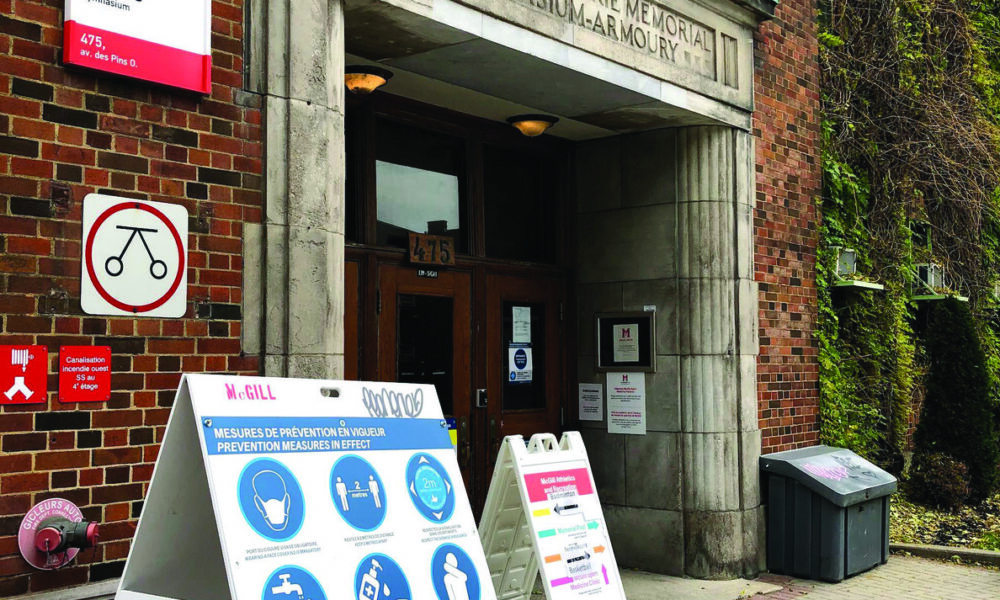
McGill University is scheduled for a hearing before the Commission d’accès à l’information on Feb. 1 to bring a case against a former student. In a legal document obtained by The McGill Tribune, the university claims that the student “is abusing her right of access in an excessive and unreasonable manner” and using the requests to “intimidate McGill staff.” They also claim that the requester has filed applications “whose processing could seriously interfere with the university’s activities.” The university is seeking authorization to disregard three of the student’s ATI requests, after the student withdrew the same three requests in contention on Nov. 16. McGill has fulfilled 12 of 15 past requests filed by the student thus far. The hearing is the third in the process.

Jamie* initially filed an ATI request to inquire about the procedural standards of the McGill SportsMed Clinic where she received treatment for a concussion for a period of 10 months, starting in Nov. 2018. In an interview with Tribune, Jamie* said she experienced five more concussions after the initial one that brought her to the clinic—an outcome she believes could have been prevented had she received proper treatment at the clinic.

“I had gone to the clinic for treatment after a concussion and I got five more in a year,” Jamie* said. “I was really mistreated at the clinic, and there’s also sexual misconduct by the physiotherapist. And basically I became disabled, and had dropped out of school. When I got treatment at other places [in October 2019], the things that were possible to be resolved from a concussion [were] resolved within two months. So, all of the inappropriate treatments […] went on for almost a year [and] I didn’t need to get five concussions.”

After seeking treatment elsewhere, Jamie* began to question her experience at the McGill SportsMed Clinic because it differed significantly from the treatment she received in October 2019. In August 2020, Jamie* confronted the McGill administration, sending a series of emails to the Deputy Provost Fabrice Labeau disclosing her experience at the SportsMed Clinic and asking them to investigate. According to Jamie*, Labeau told her that an investigation would not be pursued, stating that the clinic had acted appropriately and was properly staffed. Jamie* continued to file requests, filing a total of 15 ATIs inquiring about the clinic’s practices, procedures, budgets, and, eventually, the clinic’s communications about her. McGill has fulfilled 12 of her requests. 

On Jan. 6, 2020, the Athletics Department asked Jamie* to sign a contract that would prohibit her from pursuing all university parties involved in her requests in exchange for a refund of the fees she spent at the clinic. The contract specifically mentioned that the reimbursement was not an admission of any wrong-doing. Jamie* did not sign the order. Though the Clinic eventually refunded her and withdrew the contract, she continued to file ATIs because her questions had still not been answered. Subsequently, in November 2020, McGill filed the request to disregard Jamie*’s latest ATIs, citing her requests as “abusive.” 

As a public body in Quebec, McGill is subject to the “Act respecting Access to documents held by public bodies and the Protection of personal information.” Every person has a right to ask for access to documents held by the university under this act, with the exception of documents containing confidential personal information that would expose an individual’s identity or information without their consent. All requests at McGill are handled by the university’s Secretariat

Under sec. 137.1 of the Act, however, the university can request an authorization to disregard a request if it interferes with the public body’s affairs—such as the university’s ability to respond to the COVID-19 pandemic. These requests require hearings before the Commission d’accès à l’information. 

The university’s current request, obtained by the Tribune, claims that Jamie*’s ATIs are repetitive, numerous, and systematic in nature, emphasizing her previous requests. McGill’s request also states that fulfilling Jamie*’s requests would be a strain on resources, due to the number of documents that would need to be pulled, analyzed for redaction, and then submitted to Jamie*. According to documents obtained by the Tribune, McGill estimates that Jamie*’s requests would take a total of 502 to 528 hours to complete—186 to 212 hours to pull the files and 316 hours for the secretariat to analyze them—if the university were to provide them. 

In an email to the Tribune, McGill’s media relations officer Frédérique Mazerolle described the procedures of responding to ATI requests, noting that doing so requires deploying significant university resources. According to Mazerolle, the university receives more than 100 requests a year. 

“Many requests contain several different requests for documents,” Mazerolle wrote. “The University does not often know who the requestors are and whether they are members of the University community—this therefore is not relevant to the way in which the requests are treated.” 

Jamie* was surprised to get the notice about the hearing before the Commission, because according to her, she received no communication from the administration on her requests being improper. Under Division III, section 42, of the act, it is stated that if a request is not precise enough for the institution to properly fulfill it, the person in charge of fulfilling the request must assist the requestor in narrowing down the parameters. 

“Under the act, […] if something is not feasible, you’re supposed to communicate with a requester,” Jamie* said in an interview with the Tribune. “No one ever asked me to narrow down requests or change the request. I would have been happy to do so.” 

McGill also contends—in documents filed with the Commission and in a public hearing—that Jamie*’s requests were made with the intention to compromise certain staff’s careers at the SportsMed Clinic. They argue that the requests were made to intimidate personnel, and that they constitute a “continuous fishing expedition” in which the requestor asks for information without knowing what they are looking for. 

“It is kind of ridiculous, because I was not asking for anything personal,” Jamie* said. “It was all around like, operations and budgets, contracts and qualifications of these people. And the amount of money spent on professional education [and] their funding on different types of objective concussion treatment measures, that sort of thing.”

Due to the trauma and prolonged challenges she said she faced, Jamie* withdrew her requests in an attempt to move on in Nov. 2021. However, her action was ignored, and the hearings proceeded. While speaking with the Tribune, Jamie described that dealing with the power imbalance between herself and McGill led her to suffer physical consequences, and contributed to her post-traumatic stress disorder (PTSD). 

“Even when I agreed to back down, McGill still insisted on spending money and going to this hearing,” said Jamie*. “Everytime I asked for them to investigate, everytime I asked them to make improvements, they muzzled me with gag orders [….] Because of how they treated me I have long-lasting, not only physical, but also psychological, implications. I was diagnosed with PTSD. They are literally forcing me to relive this to counteract their bullshit, which is also just ongoing harm.”

In the university’s request to disregard Jamie*’s ATIs, McGill’s legal counsel disclosed that it would share Jamie’s personal and confidential history with the Sportsmed Clinic during the hearing for context. Her personal and medical history was previously unmentioned in the documents McGill submitted to the Commission, but it had been brought up at a previous hearing on Jan. 2022 when McGill brought up Jamie’s cognitive problems before the judge. Jamie mentioned she thought the clinic would withhold her medical history because a person’s medical history is considered private information

“I objected to them bringing up my medical history, because […] they’re using my own personal information that they shouldn’t have access to,” Jamie said. “[Now] I have to go and explain everything that happened, which again, in the context, […] was also really fucked up [….] It doesn’t actually matter why the person filed the request […] because the public bodies have an obligation if the request is reasonable. So, the fact that they’ve brought up so much personal information about me, and they’ve made it about me and my motivations, it’s actually not appropriate.”

Connor Spencer, BA ‘18 and 2017-2018 Students’ Society of McGill University (SSMU) vice-president External, has experience filing ATIs on behalf of student activist campaigns—including SSMU’s 2018 Open Letter decreeing that McGill failed to support students in the face of allegations of sexual misconduct from professors. Spencer attested that McGill has a track record of being nonchalant with student confidentiality. 

“In my capacity as an elected student leader on campus and a member of campaigns on campus, it also was a pattern that we saw of loose-lippedness with students’ personal information,” Spencer said. “[Jamie’s case] is part of a culture of treating students as clients and not as members of the community. If a member of their ‘student clientele’ does something that they do not want them doing, they try and intimidate everyone else by going hard against [the student].”

Other students have been brought before the Commission by McGill, such as McGill’s case against Demilitarize McGill in 2016, which was dropped the day before the case was to be presented to the Commission. 

David Summerhayes, BA ‘05, filed multiple ATIs on behalf of Divest McGill in 2012. Summerhayes said he was shocked when the first request he filed for Divest McGill got sent directly to the Commission. 

“I don’t think they fully realize how alienating it is and how unnecessary it seems [to involve lawyers],” Summerhayes said. “It’s easy to feel like they are not collaborating with us, because they’re hiring lawyers [….] It is really alienating and impersonal and shocking. For instance, even if that’s their only choice, I think they could do a better job of saying, ‘Hey, this is an official process now, and if we run into a roadblock [….] we’re going to go to the Commission.’ They should warn us.” 

The Tribune reached out to the McGill administration for a comment on Jamie’s case. The administration declined to answer any questions related to her case, stating, “There is a case in front of the Commission d’accès à l’information that raises all of these issues. Consequently, we will not answer questions that are specific to that case.”

* Jamie’s name has been changed to preserve their anonymity.

Art, Arts & Entertainment

‘Just Semantics’ is a trip you take with your eyes

Just Semantics, a group exhibit hosted by the Galerie Robertson Arès, brings together notions of both the familiar and the unknown, guiding viewers through an experience of visual and emotional thrill. Curated by Alysia Yip-Hoi Martin, Just Semantics comprises the work of 14 different artists. Claiming to both intrigue and boggle the mind, Just Semantics delivers on its promise, presenting a multitude of works across a span of mediums: Photography, oil paint, and paper sculptures, to name a few. 

When one enters the gallery’s main room, Just Semantics floods the eye with cathartic stimulation. From Troy Emery’s pink rope poodle to Gibbs Rounsavall’s psychedelic paintings melting into the floor, it is clear that Martin intends to challenge the viewer’s perception of colour and texture. Each individual piece is carefully separated from the next and although some are scattered far apart, the entire collection emanates a cooperative atmosphere.

Photographer Allan Bailey’s piece Girl Dad conveys a perfect balance of love and discomfort. The piece portrays two young hands applying makeup to a masculine figure, his expression playfully afraid. The overall neutral colours of this photograph highlight the brighter notes of the makeup and copious amounts of glitter being applied. Gallery staff explained that the photograph is a self-portrait of Bailey receiving a make-up tutorial from his two daughters. 

Two pieces by painter and printmaker Ryan Crotty hang in close proximity to Girl Dad, yet belong to a completely opposite artistic bracket. Glossy, layered, and extremely pigmented in parts while subtly opaque in others, The subtle influence of you and Boundaries Be Damned achieve an impressive level of three-dimensionality through opposing levels of definition. The subtle influence of you depicts the same colours as a fluorescent sunset or northern lights—the edges of the canvas are so saturated they seem to be beading off the frame. Crotty’s other piece, Boundaries Be Damned, has a more sharply contrasting colour palette: Aquamarine blues and greens interrupted by a jarring Christmas red. This painting is more angular: Two rectangles take the centre stage, their bottommost sides lined in red 

Four paper sculptures by Sebastien Gaudette sit at the back of the hall. Each one is made from a sheet of crumpled paper: Lined, graph, plain, the kind that is carelessly ripped out of a spiral notebook. Gaudette transforms the banality of this medium into a world of doubt and reflection. One piece, Je ne suis pas qu’un poète perdu au milieu des pages blanches (I am nothing but a poet lost in the middle of blank pages), features a wrinkled paper with that exact sentence written neatly and repeatedly from top to bottom. The phrase alone communicates a loss of self, and the repetition tells a story of self-punishment. Gaudette’s other pieces, namely Bleu Froissé (Crumpled Blue), Gribouillis sur Papier (Scribbles on paper), and Jaune Fluorescent (Fluorescent Yellow) succeed in channeling the familiar yet strange aura of Just Semantics.

If there is one piece to spend hours staring at in Just Semantics, it is Untitled 311. Regardless of how long one attempts to interpret this work of art by Derrick Velasquez, their mind will never stop marveling. Countless strips of coloured vinyl sit neatly atop a vertical piece of wood. While the colour palette is harmonious, the layering of the strips definitely breeds some rivalry: Large sections of deep turquoise are only separated by a few layers of white and pastel orange. The disproportionate distribution of this pattern makes for an unsettling viewing experience. Untitled 311 is ambiguous in every sense of the word, but this detail pushes the viewer to accept the piece, and come to terms with the fact that its meaning will stay out of their reach. 

Open Tuesday-Saturday until Feb. 11, Just Semantics is a fun look at how a collection of pieces and artists can come together in their beautiful strangeness. 

Commentary, Opinion

McGill’s COVID-19 response has been a shitshow from the start

As the COVID-19 pandemic nears its second anniversary, McGill’s response to the ongoing health crisis has been thoroughly disappointing and incompetent. It has gotten to the point where many students are taking matters into their own hands to protect themselves, their peers, and their loved ones. Undergraduates from the School of Social Work voted to go on strike after the administration overruled the school’s decision to postpone their return to in-person classes until Feb. 25. The strike came after McGill violated its own Senate resolution allowing faculties to make such decisions for themselves and the academic freedom that it professes to defend. Similarly, students from the Faculty of Law voted to go on strike until the university introduced better hybrid options. Instead of heeding to genuine concerns about the return to in-person activities, the administration has continued their email and video propaganda campaign in a frustrating attempt to pacify the more than 22,000 McGillians who have expressed their demand for changes through an open letter. This is on par for the course of an authoritarian, paternalistic administration, whose COVID-19 response has, frankly, been a disaster since the beginning of the pandemic.

A few days before the university first shut down early in March 2020, in my capacity as the Students’ Society of McGill University (SSMU) president, I remember speaking to Deputy Provost (Student Life and Learning) Fabrice Labeau about student concerns regarding the then-new virus that was spreading across the globe. As the SSMU President is responsible for ensuring the safety and well-being of the student body, I hoped to glean more information from him regarding the university’s plans. Labeau assured me key administrators were meeting regularly as part of the nascent Emergency Operations Centre (EOC), the insular group that has been deciding McGill’s COVID response over the past two years. I asked if students could be a part of that group, as it was important to communicate student concerns in real-time and have students be an active part of guiding the university’s response. In reply, he said that students would not get a seat at the table because the group presides over “operational matters.” To this day, the EOC does not have student representation.

From the very beginning, the administration’s response has failed students. When universities worldwide first began to shut down, students on exchange were left in the dark. Since then, students in residence have reported that the university has fallen short in upholding its own safety guidelines, and floor fellows have stated that they are not receiving the support or communication they need to do their jobs safely. McGill has neither imposed a vaccine mandate, unlike many other Canadian universities, nor, at the very least, required unvaccinated McGillians to undergo regular rapid testing, like the University of British Columbia. Over the final exam period last December, the administration forced students to complete exams in person, despite the University of Toronto, Queen’s University, and Dalhousie University, among others, refusing to do so, as the Omicron variant fomented the fifth wave of COVID-19.

In the two months since the Omicron variant first appeared in Canada, I had hoped the administration would use this time to make campus as safe as possible for those wishing to return to face-to-face learning. I had also hoped that our courses would be made as accessible as possible for those unable to attend, whether they be immunocompromised, infected with COVID-19, or dealing with the multifaceted effects the pandemic has had on our lives. Instead, the administration has resigned itself to letting McGillians get sick en masse and has left students to fend for themselves if they contract COVID-19 or have to quarantine, relying on the goodwill of their professors rather than a guarantee of online educational access. McGillians have lost faith in the administration’s ability to make the best choices for the safety and well-being of the McGill community.

But it’s okay everyone: The McGill administration knows what’s best for you.

McGill, News

Transgender students cite difficulty in changing legal name on Minerva

A month into the Winter 2022 semester and the McGill administration and the Students’ Society of McGill University (SSMU) have begun preparing for the Spring 2022 graduation season, even organizing graduation photos and planning in-person ceremonies. For Ezra-Jean Taylor, U3 Arts, however, the prospect of finishing their degree in two semesters is stressful because she has been unable to change her name in the Minerva system, which means that currently, their diploma will not state their legal name.

Taylor is a transgender student who spent a year going through the process of legally changing their name, which they accomplished in 2021. While Minerva—the platform McGill uses for official student documentation—has an option for students to input their preferred name, changing a legal name in the system is more complicated, Taylor explained in an email to The McGill Tribune.

“I found some confusing information on how to change my legal name [on Minerva] and emailed the Office for Academic records,” Taylor wrote. “I was told I would need a court order stating my legal name has changed as well as proof of that name being used on ID.”

The process proved to be more convoluted than obtaining a court order. McGill requested that Taylor also provide a new Certificate of Acceptance of Quebec (CAQ) and student visa—both of which are issued by the Government of Quebec—demonstrating their new legal name. 

“As far as I am aware, to reapply for the CAQ and student visa, you need to show McGill transcripts and a letter of admission,” Taylor elucidated. “You see where the issue is? If both groups need the other’s documents, nothing can be done.”

Jamie*, an events coordinator for Queer McGill (QM), told the Tribune in an email that while QM has not had any cases such as Taylor’s come to their attention recently, the struggles that trans students face in dealing with the university’s administrative system have existed for years. Specifically, Jamie noted that the systems in place put trans students at risk of being deadnamed—that is, referring to a person by the name they had before they changed their name—which can remind the person of traumatic experiences and induce feelings of anxiety and depression.

“Students often have issues where they are deadnamed in a variety of locations, such as when logging into MyCourses, accessing through Shibboleth, and others,” Jamie wrote. “McGill has made some small concessions to us, such as changing emails from alias emails to legitimate emails, but that is simply not enough for students.”

Taylor views the obstacles that they are facing as less of a problem on Minerva’s part, and more of a problem from McGill, whose actions and policies, in Taylor’s opinion, are behind the times and harmful for trans students.

“Being transgender in Montreal, and particularly at McGill, is quite isolating,” Taylor wrote. “There are groups and activities here or there, but nothing concrete that could help guide trans students through this process.”

SSMU’s gender and sexuality commissioner Grey Cooper underscored that transphobia is still very present at McGill. 

“There are still frequent issues for students in regards to getting their names respected and used, being gendered correctly, and being able to navigate classes in a way that does not misgender them,” Cooper wrote in an email to the Tribune. “More options and ease in the access of name changes, medical support, and mental health support for trans students who have dealt with traumatic interactions due to transphobia, would help improve McGill for the trans community.”

Transgender students and other members of the 2SLGBTQIA+ can find varying types of support on the Project10, Queer McGill, and the Union for Gender Empowerment websites. Students wishing to address struggles they have faced in the McGill community can contact the SSMU Gender and Sexuality Advocacy Committee.

*Jamie’s name has been changed to preserve their anonymity.

Arts & Entertainment, Pop Rhetoric

The price of stardom: When your image is no longer yours

A little over a week ago, a video surfaced of Kanye West, with the swagger of a man who left his sanity on the 2016 VMA stage, confronting a member of the paparazzi. This isn’t a change of pace for Kanye—the man confronts the paparazzi as often as I miss my 8:30 lectures—but he does bring up an important point on image ownership. 

“You guys can follow us, you can stand outside our hotel at any given time, but you don’t give us any percentage of what you’re making off us, off our kids, and I’m going to change that,” West vowed to the photographer. 

The paparazzo didn’t disagree. He did, however, say that celebrities needed the paparazzi—without them, the stars’ histories would be all but forgotten. 

There is an element of truth to this considering that gossip tabloids shape and cement the lives of celebrities in the public eye, keeping them relevant and wealthy—but it’s also not all it’s chalked up to be. For every celebrity’s career the paparazzi’s press might forge, a dozen more lie in ruins, from ousting celebrities still in the closet to scrutinizing marriages till they crumble—and in the case of Princess Diana, ending lives. All of this, in pursuit of the almighty dollar.

Kanye isn’t alone in his outrage over the use of his image, with more and more celebrities voicing their frustration in recent years. Take Ariana Grande, who posted a paparazzi photo of herself repping her merch on a night out, only to get sued by the paparazzo not once, but twice for copyright infringement. 50 Cent, Jessica Simpson, Liam Hemsworth—the list of celebrity lawsuits goes on and on, each for posting paparazzi photos of themselves on Instagram. Lisa Rinna, best known for The Real Housewives of Beverly Hills, is currently fighting back against a $1.2-million lawsuit after posting paparazzi photos of her and her daughters—but she is the exception rather than the rule. Most of these cases end in settlements, since it’s often cheaper to settle than wrack up legal fees.

Model Gigi Hadid’s case is especially interesting, as her lawyers have argued that her photo was “fair use” due to her pose and choice of outfit, making her a contributor to the piece. Still, the case never set legal precedence as it was dismissed before going to trial, the paparazzi agency having only filed their copyright after the lawsuit.

Despite holding an appeal only rivaled by pharmaceutical executives, the paparazzi seem to have the law on their side. The press can publish photos of public figures without their permission; this right is a benchmark of journalism that allows us to stay informed. Yet I fail to understand where celebrities, as public figures, fit into this, especially when it concerns tabloids. Why is the entertainment of the public a necessity when it means treating stars’ private lives like public commodities? This lack of restriction, in tandem with copyright laws, places paparazzi under the same jurisdiction as wildlife photographers.

It is only right that a studio photographer profits when others use their photo, but their models are consenting and compensated. Celebrities, on the other hand, are neither. When it comes to “entertainment”-based press, photographed subjects should have some level of control over the use and profit of their image, because as celebrities, they are their own brand. The tabloids need to realize the difference between celebrities and the action figures that they inspire.

Commentary, Opinion

Groundhog day: Climate change’s age-old scapegoat

Groundhog Day, a tradition dating back to the late 19th century, has long provided respite from many long winter months. Moving from candles, to hedgehogs, and finally, to groundhogs, the holiday has gone through many transformations. Yet predicting the weather has remained its steady focus. On Feb. 2, the possibility of these -20 degree days stretching on for six more weeks will be determined by none other than Phil, the groundhog from Western Pennsylvania, whose full name is actually Punxsutawney Phil, Seer of Seers, Sage of Sages, Prognosticator of Prognosticators and Weather-Prophet Extraordinary. While the prophetic power of Phil provides a fun start to February, it indirectly dismisses the progressive warming of the Earth due to climate change. 

As the tradition goes, if the groundhog sees his shadow on Feb. 2, then we can expect six more weeks of winter, but if not, then spring weather is just around the corner. However, though Phil has been forecasting since 1887, he has just a 39 per cent accuracy rate––less than the roughly 50 percent odds you would get if you flipped a coin. This holiday is largely based on tradition, rather than lore like many others, its purpose is increasingly muddled and fragmented throughout the years. It is also simply not well known, and even if known, not well understood. It turns out that determining whether Phil sees his shadow or not is actually just based off whether or not he casts a shadow at all, rather than whether he catches sight of it. Traditions themselves can be problematic, as they are often stubborn to change, at the expense of modern issues. Climate change is not linear, but exponential, so despite Groundhog Day being a cute tradition, society has outgrown the need for a meteorological scapegoat. 

Over the past 70 years, higher summer temperatures have been arriving earlier and bleeding into autumnal months because of the cumulative warming effects of climate change. Just last summer, there was a heat wave across North America, with Lytton, a small town in British Columbia burning to the ground after being ravaged by forest fires. Shattering Canada’s previous heat record, the temperatures reached a scorching 47.9 C degrees Celsius. Effects were also felt here in Montreal, with humidex values skyrocketing to between 35 and 40 degrees Celsius and nights providing little to no relief from the uncomfortable heat and humidity. Phil provides a distraction for many who refuse to face the realities of climate change, of why bikini season has become increasingly prolonged. It is no secret that temperatures are rising and extreme weather events are increasing in severity and number across the globe. But rather than blaming an early summer on a groundhog, we need to address the real problem. 

So while this holiday might seem like a harmless way to raise spirits and optimism during the seemingly endless cold months, in a world filled with performative activism, keeping Groundhog Day on calendars emphasizes a holiday that bears little cultural significance today that no one understands nor celebrates. The human desire to find an answer for everything finds temporary relief in holidays like this—succumbing to an external locus of control and letting someone, or something, else take the blame. But humans, alone, are responsible for the worsening effects of climate change, on both individual and industrial levels. Simple and dismissive explanations, like letting Phil take the fall for an early spring, are what the fast-paced world of social media thrives on. 

It is easier to enjoy spring when we can accredit it to the prophetic powers of Phil, rather than the exponentially worsening effects of global warming. We have reached a point where we can no longer be passive in the face of climate change: It affects each and every one of us, and we must be proactive. By the end of the century, summers could be six months long, and that’s not groundhog’s fault. It’s ours. 

Arts & Entertainment, Music, Pop Rhetoric

Concept albums and the problem with defining subjective terms

Albums come in a multitude of shapes and sizes, with each crafted with different aims in mind. In 1973, Pink Floyd released their monumental album The Dark Side of the Moon, a progressive rock masterpiece and one of the most acclaimed albums of the decade. But Dark Side was more than just a collection of tracks; overtime, it has become known as a quintessential concept album

A concept album is commonly understood as an album with tracks whose meanings are oriented around specific themes and ideas. In The Dark Side of the Moon, for example, each song represents a different aspect of an unfulfilled life; the track “Time” highlights people’s wasted years, while the track “Brain Damage” focusses on insanity. The Dark Side of the Moon may appear to be a fairly clear example of a concept album, as its tracks are interwoven with the theme of the “dark side” of life. However,  the definition of these types of albums is actually quite tentative, loosely applied, and relatively subjective. Attempting to define exactly what a concept album is with one concrete paradigm is rather counterintuitive.

Take, for instance, Metallica’s Master of Puppets: Each track represents various destructive activities, ranging from drug abuse to war. The binding theme that ties each track together is the lack of control one feels over their life when caught in a cycle of despair. Yet popular music magazines, such as Classic Rock, do not list the album among other great concept albums, with no definitive reason as to why. If Master of Puppets is not a concept album, then the criteria for calling an album one must be more restrictive than the broad definition of unified themes and coordinated, meaningful songs. 

One way to narrow the definition is to specify that the songs have to form a narrative, and that the album’s meaning is best understood when all of the songs are considered together. Similar to the last definition, this framework adds a storyline element, which would explain why Master of Puppets, a meaningful album that lacks a “plot,” is not generally considered to be a concept album.

However, this definition may be too constraining. While it can accurately describe some examples, such as Kendrick Lamar’s To Pimp a Butterfly, it would exclude what some people consider the first concept album: The Beatles’ Sgt. Pepper’s Lonely Hearts Club Band. With Sgt. Pepper’s, there is little thematic connection and overall narrative between the songs to satisfy this definition. And though this has led some to deny it the status of a concept album, many still attribute the label to it. 

These conceptual problems beg an important Euthyphropic question: Is an album called a concept album because it is one, or is it a concept album because it is called one? 

This question, though clarifying the debate, is not easy to answer. There ought to be a reason to call something a concept album, but what should that reason be? In Platonic terms, what is the “form” of the concept album? When analyzing specific albums, such as Master of Puppets and Sgt. Pepper’s, it seems that there is no objective answer and no definite solution. 

Perhaps the debate itself is misleading. Does it really matter if someone thinks that Master of Puppets is not a concept album while The Dark Side of the Moon is? Nailing down the definition of a concept album is the wrong approach. Otherwise, albums would lose their subjective meaning in the face of a futile search for objectivity in music. To continue down this path may lead us to have to declare, in Nietzschean style, that the concept album is dead, and we have killed it. In other words, trying to force an inherent meaning upon a concept album goes against the personal nature of listening to music. 

The history of music is a wonderful and distinctly personal one; being stringent about labels should not be the way forward. 

McGill, News

#McGillOnStrike gains momentum as Law Students Association votes to strike

The Social Work Student Association (SWSA) passed a motion to strike on Jan. 17 after McGill denied the faculty’s decision to continue online learning until Feb. 25. Since then, many other faculty student associations have followed suit, joining forces under the hashtag #McGillOnStrike to protest the timing of McGill’s reopening amid COVID-19 and the lack of accommodations offered to immunocompromised community members. 

On Jan. 25, the Education Graduate Student’s Society (EGSS) successfully passed a motion to extend their strike until Feb. 25 at a General Assembly (GA), with 71 in favour, 13 against, and 16 abstaining. Students taking part in the strike will attend all remote activities, but will withhold in-person participation until the administration complies with their demands. 

Though the initial resolution called for exclusively online classes, the motion was amended to demand a hybrid approach instead, which would give students the choice of attending classes virtually without penalty. Striking students also insist in the resolution that McGill provide safer learning conditions, such as supplying N95 masks and high efficiency particulate air (HEPA) filtration. Additionally, EGSS members ask that instructors be given the option to teach online, independent of what the university had decided.

Emma McKay, a PhD candidate in education and one of the EGSS strike organizers, expressed skepticism over the administration’s handling of the Omicron variant, calling into question its decision to reopen. McKay explained that students pursuing a Master of Arts in Teaching and Learning (MATL)—the largest program in the Faculty of Education—are currently doing internships across Montreal that require them to come into close contact with students lacking sufficient personal protective equipment (PPE).

“Classes in that program […] are continuing online in accordance with the 20 per cent allotment of online classes and with instructors who heard about the strike,” McKay said in an interview with The McGill Tribune. “But, if those classes were to follow McGill’s instructions, McGill would be doing something really dangerous and frankly immoral [by putting] many people in danger of contracting a harmful and possibly deadly virus.”

Bryan Buraga, U4 Arts & Science and 2019-2020 president of Students’ Society of McGill University (SSMU), has called on the Faculty of Arts to implement a hybrid learning system similar to that of the Winter 2021 semester. The Arts Undergraduate Society (AUS) granted Buraga’s request to call a GA after he obtained the 200 signatures required to call an assembly. The meeting is scheduled for Feb. 2 where, if it reaches its 500 person strike quorum, attendees will vote on the motion to strike. 

Buraga expressed frustration with McGill’s continuous stifling of community efforts, such as their shutdown of the law students’ contact-tracing initiative or the School of Social Work’s decision to remain online. 

“[T]he top-down approach that the admin has been leaning on has shown it’s not working. It shows a lack of trust in community members […] but it also ignores the expertise in this university,” Buraga said in an interview with the Tribune. “If we don’t rely on our community members, who the admin continues to use whenever they put out their press releases about how prestigious McGill is, then what are we? I think with the actions that we’re taking in the next few days, it’s really going to start a discussion about who this university is really for.”

On Jan. 28, the Law Students Association (LSA) convened for a GA, after which a ballot was emailed to students to vote on whether to strike at the Faculty of Law. The motion passed with 56.6 per cent in favour of a strike, though instead of a general strike where students refuse to attend both online and in-person classes, LSA is on a targeted strike where students refrain only from attending in-person activities. 

Christopher Ciafro, 3L, who has been independently campaigning for a general strike at the Faculty of Law, shared Buraga’s comments about McGill’s lack of consultation with the student body.  

“We are seen more as consumers and not as contributing members to a greater university society,” Ciafro said. “You see that in the language, I think, from some of the administration who are denouncing strike actions, saying it’s a boycott. Well, if it is a boycott, what does that mean of how you see us? It’s a strike because there’s labour that goes into being a student. We’re contributing to the academic success of the university.”

Formula One, Sports

Looking back on a high-octane Formula One season

The 2021 Formula One season will go down in history as one of the most memorable seasons the sport has ever witnessed, featuring a riveting rivalry, thrilling races, and surprising podium results. Formula One fans around the world held their breath watching a season where the only certainty was that anything could happen.

George Russell’s front row qualification and first podium

On Aug. 28, 2021 at Circuit de Spa-Francorchamps for the Belgian Grand Prix, Williams driver George Russell completed a fantastic Q3 lap that earned him a front-row start in P2. His spectacular qualification came as a result of calculated decisions made by the team and his excellent knowledge of his car’s abilities.

On Aug. 29, terrible weather conditions made the 2021 Belgian Grand Prix the shortest race ever in the history of Formula One. The drivers drove two laps under the safety car and a final lap that ended with a red flag, marking the end of the race. The results were taken from lap one, earning Russell a second-place finish and his first podium in Formula One.

This result highlighted Russell’s potential for success in a stronger car than the Williams, which falls short in comparison to cars developed by Mercedes or Redbull Racing. Not even two weeks later, Mercedes announced that Russell was set to drive alongside Lewis Hamilton as part of the team. This sparked excitement amongst Formula One fans, such as Samuel Nidelli, U1 Engineering, who is looking forward to the start of a new Mercedes driver pairing, noting Hamilton’s long history with the team.

“I’m really happy to see George Russell in a Mercedes seat,” Nidelli said. “I feel like [he] and Hamilton will have some great battles and Hamilton will be able to mentor Russell and make him into the driver he was always meant to be.”

Kimi Raikkonen’s retirement 

The 2021 season also saw the departure of Formula One legend Kimi Raikkonen, who chose to retire after his 349th Grand Prix in Abu Dhabi. The former world champion, known across the grid for his level-headed and cool approach to racing, which earned him the nickname “Iceman,” will be dearly missed by fans. Samuel Jachir, U2 Arts, had hoped to see Raikkonen win some races in his final season.

“I’m very fond of Kimi Raikkonen and the child in me was kind of hoping that he would surprise me,” Jachir said. “But with an Alfa Romeo, it is not surprising that he only managed to score 10 points.”

The Verstappen and Hamilton rivalry

The most memorable motif of the 2021 season was undeniably the rivalry between Mercedes racer Lewis Hamilton and Red Bull racer Max Verstappen. Throughout the season, the two made exciting and sometimes dangerous decisions in the hopes of gaining a championship lead. This rivalry had some fans, like U2 Arts student Maya Sorguc, on the edge of their seats.

“Compared to the seasons before, it was much more exciting because of the intense competition between Hamilton and Verstappen,” Sorguc said. “The viewers were divided into two groups, which made it more fun to watch or talk about it with friends.”

Throughout the season, risky maneuvers led to both drivers colliding or being penalized during certain races, with Hamilton denouncing Verstappen’s driving as dangerous. Nevertheless, both drivers arrived at the last race in Abu Dhabi tied for points, meaning that the championship winner would be decided by whoever passed the checkered flag first. Verstappen overtook Hamilton in the final lap after a safety car procedure change, which allowed racing to resume for the very last lap instead of finishing under a speed limit. The FIA’s additional decision to allow Verstappen to start immediately behind Hamilton, despite originally having to lap several other drivers, presented the Dutch racer a final chance at victory, which he then seized. 

After seven seasons in the sport, Dutchman Max Verstappen became one of the youngest world champions ever, at only 24 years old. This win was highly controversial, as Hamilton had an advantage over Verstappen the entire race. Commentators and fans alike criticized the FIA’s sudden rule change for not accounting for Hamilton’s lengthy advantage. As of today, Hamilton has not commented or discussed the situation, but Mercedes’ boss Toto Wolff described Hamilton’s loss as a robbery. It will certainly be interesting to see the impact of this defeat on Hamilton’s racing in 2022.

Read the latest issue

Read the latest issue