

Latest News

a, Arts & Entertainment, Music

Album Review: T.I. – Paperwork

If T.I., known as the King of the South, has accomplished anything with his latest album, Paperwork, it has arguably been nothing more than demoting him to the title: “Prince of the Disjointed.” The album features a broad spectrum of techniques and musical genres culminating in an uneven sound that is tied together only by the presence of T.I.’s voice.

This is not to suggest that each song is approximately three minutes of wasted talent—“New National Anthem (ft. Skylar Grey)” and “On Doe, On Phil (ft. Trae The Truth)” each make excellent use of the featured artists’ talents for a smooth track with a strong beat and catchy hooks. Unfortunately, the entirely different feel each track has crosses the line of versatility into the realm of messy confusion, forcing what could have been T.I.’s most mature album to date seem more like a singles compilation.

T.I. makes his fatal flaw by wasting Usher’s vocal talents on “At Ya’ Own Risk.” To think that T.I. would have learned his lesson about writing lyrics with rape-undertones after “Blurred Lines” was clearly wishful thinking, as he had Usher warble out, “I don’t care if you’ve got a boyfriend or not, girl/ It’s at ya own risk if you’re kicking with me.”

T.I. claims that Paperwork will be the first instalment of a musical trilogy focused on experimentation and the rapper’s musical development. Let’s hope that in the next two albums, T.I. spends a bit more time focusing on aural unity, allowing for a sound united in its uniqueness, as opposed to divided by its diversity.

a, Arts & Entertainment, Film and TV

Criminal fails to evolve past story-telling tropes

Arguably, the most difficult subject to talk about objectively is yourself. Darius Monroe’s debut documentary feature Evolution of a Criminal confirms this idea. Though he places himself squarely at the centre of the film’s narrative as the titular criminal, Monroe evades revealing the motivation behind his actions, resulting in a film that can be maddeningly vague while still being worthwhile—albeit for reasons that aren’t immediately clear.

Produced by legendary director Spike Lee, the film tracks filmmaker Darius Monroe’s life from childhood until today, trying to reconcile his past with his present. Though he is now a burgeoning filmmaker from the prestigious Tisch School of the Arts at New York University, Monroe was first a kid living in extreme poverty in urban Texas. After a burglary worsened his family’s already dire financial situation, Monroe decided to help however he could—though he had a steady job, he began supplementing his income through petty theft. This early thievery culminated with him and two of his friends robbing a bank. He was eventually caught and tried as an adult—despite being 17 years old when the robbery took place—and took a plea-bargain that allowed for reduced time in prison. 

Evolution of a Criminal takes the Errol Morris approach to documentary, combining highly stylized re-enactments of the past with present-day interview footage. Monroe interviews family members, classmates, teachers, accomplices, victims, and criminal prosecutors, all of whom display different degrees of sympathy for his crime and how willing they are to forgive him. This aspect is, by far, the best part of the film—the emotional rawness that anyone related to Monroe had about his actions is compounded by the fact that he is also the one interviewing them. Subjects on camera refer to him directly, but the fact that we don’t see the filmmaker’s face in these scenes puts the audience member directly in his shoes.   

The flashback and establishing shots throughout the film are remarkably well composed. Scenes from his hometown are shot with a striking orange filter that convey both the nostalgia that comes from reminiscing and the dread that springs from the realization that you can’t change the mistakes of the past, no matter how you frame them. The editing is also uniquely done for what could have been a straightforward documentary. In one of the film’s most powerful moments, Monroe’s drive to prison is intercut with shots of the friends and family he would leave behind, staring pensively away from the camera.

This focus on the supporting players in his life is my main qualm with the film: It never really does what it purports to be doing—which is to show Monroe evolve. Unfortunately, we don’t get to see the evolution of an innocent youth trapped by circumstance into a bank robber, or that of a convicted felon into a talented filmmaker. The problem is that a disproportionate amount of the film’s running time is spent focusing on his bank robbery and the immediate aftermath, allowing no time to delve into how Monroe got from point A to B. Crucial expository information is almost entirely absent—we never find out how much time he spent in prison, what his upbringing was like outside of the fact that he lived in poverty, or how he came to turn his life around. As a result, we never get insight into the crucial decisions that came to define his life beyond a few clichés and platitudes.

Monroe’s strengths as a filmmaker seem to lie more in teasing the emotional truth out of others rather than engaging in deep introspection. Because of this, Evolution of a Criminal can’t claim that it shows the evolution of a criminal—instead it paints a vivid picture of the way one person’s actions affected those around him, something that is emotionally effective in its own right.

Evolution of a Criminal runs until Oct. 30 at 8 p.m. at Cinema du Parc (3575 Parc). Student tickets  are $10.

a, Basketball, Sports

2014 NBA season preview

easternconference westernconference

a, News, SSMU

SSMU Council discusses discretionary funding, library hours, and GA

Motion on restricting discretionary funding

The Students’ Society of McGill University (SSMU) Legislative Council tabled and discussed a motion titled Amendment of the Clubs and Services Portfolio By-Law Book at its meeting last Thursday.

Originally moved by VP Finance and Operations Kathleen Bradley and VP Clubs and Services Stefan Fong, the motion sought to limit discretionary funding for projects and events that were in accordance to the services mandate and directly affected students.

Fong elaborated on the bylaw’s purpose.

“The money that is raised by students [through service fees] should be given back to students through the provision of services,” he said. “If the service would like to donate money toward a project that does not directly benefit students, they are welcome to do the fundraising toward that goal and donate the money that is raised off of their efforts.”

An amendment requiring the VP Finance and VP Clubs and Services to present a report regarding the breakdown of each service’s use of discretionary funding at the end of each semester was also passed and added to the motion.

“I do not see this to be an approval process but merely a way of reporting,” Bradley said in response to concerns over potentially infringing upon the services’ financial autonomy. “It is not a judgment of the Council, but more like a transparency process.”

The motion has been postponed until the next Council meeting for the SSMU services to be consulted regarding the amendment.

Discussion on funding for library extended hours

VP University Affairs Claire Stewart-Kanigan explained that students had helped fund extended library hours during exam season for several years.

“All the hours after midnight that the library is open for has been funded by the SSMU Library Improvement Fund for 10 years now,” Stewart-Kanigan said. “There have been concerns over the lack of consideration of these largely security-based expenses as operational costs that the university should be funding.”

The Library Improvement Fund, to which students and alumni contribute, amounts to $650,000 a year. The fund comprises of contributions of $8.50 per full-time student and $4.25 per part-time student each semester, matched equally by alumni donors. According to Library Improvement Fund Coordinator Erin Sobat, the library’s extended hours cost $250,000 a year.

“Students might not be aware that it’s student money that has been running this,” Stewart-Kanigan said. “The option of using this $250,000 for student projects or specific initiatives to improve the library experience [has been overlooked] because of something the university should be funding.”

There was a general consensus that students must be made aware of SSMU’s funding of the extended hours, and should also be encouraged to explore other initiatives that the Library Improvement Fund could sponsor.

SSMU President Courtney Ayukawa further emphasized the importance of students speaking to the administration about a change for extended hours to be recognized as a part of McGill’s operational budget.

“In my opinion, when students care about something loudly enough, the administration does listen and make changes,” Ayukawa said. “However, I would hate for this demand to be loud enough for the university to care [only] after the 24-hour library access has been lost.”

Informal discussion on last week’s General Assembly

The Council agreed that the GA last Wednesday was a success, despite some logistical and procedural issues.

Physical and Occupational Therapy representative Yasmine Hadifi raised concerns about students’ lack of procedural knowledge regarding Robert’s rules. In response to Hadifi,  Engineering representative Anikke Rioux suggested better access to Robert’s Rules for the students.

“Hosting some sort of online tutorials to explain Robert’s rules beforehand would be conducive to a more fluid GA,”  Rioux suggested. “Assigning councillors certain duties and having us wear an identifiable colour of t-shirts at the GA to help students with questions would [also] be helpful.”

VP Internal Daniel Chaim argued that students’ interest in the motions affected participation in the GA.

“The real conflict wasn’t about the mandate or the program, but that most people were only concerned with one motion,” Chaim said. “A lot of people were upset, but what the SSMU was mandated to do was to entertain the students’ right to voice their opinions at the GA.”

Arts & Science Senator Chloe Rourke applauded the GA’s turnout.

“Being in a building for 10 hours with nearly 800 people is excessive [and] is not really expected of average students [who] showed their commitment towards student politics,” Rourke said.

Arts representative Alexander Kpeglo-Hennessy also commented on the activeness demonstrated by students at the GA.

“[My] constituents were happy that they went in spite of the result because it was an excellent example of students actively participating in a democracy,” Kpeglo-Hennessy said.

Motion to support the #ConsentMcGill campaign

The Council passed a motion supporting the #ConsentMcGill campaign and taking action against sexual violence. Apart from reaffirming SSMU’s support for the campaign, the motion encouraged SSMU to lobby the McGill administration to institutionalize the position of sexual assault response coordinator and to host consent campaigns, education projects, and initiatives based around action against sexual violence in collaboration with student groups on an annual basis. The motion was passed with unanimous support and Council also agreed to be codified as a policy by the end of the year to ensure that its reach remains wide-ranging and effective in the long run.

a, Arts & Entertainment, Music

Deep Cuts: Joyful Hip-Hop

Eye Know

Artist: De La Soul

Album: 3 Feet High and Rising

Released: March 3, 1989

https://youtube.com/watch?v=Me5uEsbX9eU

This is perhaps the most unabashedly romantic song in the history of rap. De La Soul, the original hippies of hip-hop, crafts a song that tracks the trajectory of a relationship from courtship to marriage with the sincerity that only love can bring. Prince Paul’s production puts the song over the top, laying a whistling refrain over a simple, Steely Dan-sampled beat that simultaneously reminisces about the excitement of falling in love while providing a guiding light for the future.

School Spirit

Artist: Kanye West

Album: The College Dropout

Released: February 10, 2004

https://youtube.com/watch?v=pUMd6rFxS34

Before the beautiful narcissism that has come to define Kanye’s recent work, there was “School Spirit,” a song that serves as his victory lap over higher education and the thematic centrepiece of his debut album. He’s dropped out of school and he couldn’t be happier—now his real life can begin. The soul samples used earlier on the album to sympathize with socioeconomic reality that adult life brings are turned into the stuff of dreams on this track as Kanye triumphantly sinks his teeth into every hypocrisy that he faced in school.

Every Ghetto, Every City

Artist: Lauryn Hill

Album: The Miseducation of Lauryn Hill

Released: Auguest 25, 1998

Cheesy? Maybe. Similar in content to Kanye’s “School Spirit”—though not in tone—this song takes a deep look into the past and sends a thank you note rather than a poison-penned letter. Mixing rap, soul, and R&B in a way that only Hill can, she reflects and expresses gratitude for the things that made her who she is today, from the car jackings and economic strife to Saturday morning cartoons and playing in the park. Carlos Santana’s bouncing guitar keeps the song upbeat as Hill tells the listener that where you come from makes you who you are—for better or worse. You can practically hear her smiling the whole time.

The World Is Yours

Artist: Nas

Album: Illmatic

Released: April 19, 1994

Offering a respite from the mostly depressing content of the rest of Nas’ debut album, “The World is Yours” sees Nas delve into his dreams and take an optimistic look towards the future. Though he struggles throughout the song to reconcile the bleakness of today with the beauty of his tomorrow, the song’s refrain encourages the idea that the world is yours and you can make it whatever you want it to be. The darkness of Queens’ that Illmatic presents may seem inescapable, but hip-hop always offers a way out.

a, Opinion

Commentary: Moving beyond nuclear stereotypes

The announcement by Lockheed Martin this week that it is developing a comparatively cost-effective nuclear fusion reactor was met with immediate skepticism by environmental groups.
(more…)

a, Opinion

Commentary: Politics or Palestine: What is McGill’s real problem?

There has been no shortage of commentators and students alike talking about the ‘contention’ of last week’s Fall General Assembly (GA). Many have asserted that the source of this dispute was whether or not the Students’ Society of McGill Union (SSMU) should take a ‘political stance’ on what was deemed a ‘highly emotional and complex foreign policy issue’.

I, however, contend that the true reason for the intensity of the dispute was not because of the choice of SSMU as a political forum, but rather the desire by a small group of students to suppress any discussion related to the Israeli occupation of Palestine.

How else could Kafka-esque idioms such as “in the name of free speech, we shall have no discussion,” be relayed to a skeptical GA? What else explains the fact that hundreds of students who came to vote down discussion on the Palestinian Solidarity motion left almost immediately afterward, obviously having no issue with the resolution standing in solidarity with the Hong Kong student protesters? Where were the same impassioned speeches that the resolution would divide McGill, or marginalize Chinese students?

It then only logically follows that the leaders of this movement were more interested in quickly suppressing any discussion, much less motion, of the Israeli occupation of Palestine, rather than the use of SSMU, our student government, as a political forum.

After all, one must ask why such a concerted effort by an organized group of students was mobilized to denounce SSMU taking a political stance in this situation. Where were they when SSMU condemned South African Apartheid, Canadian military involvement in Iran, or the U.S.-led war in Iraq? Were they not worried of marginalization of American or Canadian students? How come there has been no campaign to reform SSMU’s equity policy which clearly delineates the SSMU’s relationship with speaking out on issues of social justice?

Another assertion by students who spoke in favor of indefinitely tabling the motion before discussion began, as well as insinuated by this newspaper, was that this issue “did not affect McGill students”—and thus SSMU was not an appropriate venue for the conflict to be discussed. In reality, it is important to note that McGill has institutional ties to research universities in Israel in which there is collaboration on weapons research that is used to enforce Israel’s blockade of Gaza and occupation of the West Bank – both illegal under international law. So while “No” students were simultaneously declaring that not only did the resolution “not do anything”—and thus shouldn’t be passed, but that it was also marginalizing Israeli students. They failed to consider the pre-existing divide and marginalization on campus among those who are uncomfortable with the fact that their tuition dollars are spent on research to enforce violations of international law and the human rights of an occupied populace.

Despite efforts to suppress discussion, we move on from this GA with our heads held high. We know it is important for us to continue. We know that we will never ‘normalize’ discussion about Palestine unless average people like us refuse to have our voices silenced—and continue to speak out.

a, Arts & Entertainment, Books

Lena Dunham’s new book offers insights, few surprises

Fans of Girls will rejoice that Lena Dunham’s recently published book, Not That Kind of Girl: A Young Woman Tells You What She’s “Learned,” offers readers the same self-deprecating humour, laugh-out-loud one liners, and stories almost too erratic to be true that made its author’s popular HBO show a megahit.

The book is marketed as a middle-ground between a memoir and a prescriptive book: Tidbits of advice for young women are laced in and out of essays in which she tells intimate stories that touch on themes of sex, feminism, and body image. By recounting her experiences, Dunham hopes to inspire her readers to learn from the mistakes she openly admits to have made. In her introduction, she states, “And if I could take what I’ve learned and make one menial job easier for you, or prevent you from having the kind of sex where you feel you must keep your sneakers on in case you want to run away during the act, then every misstep of mine was worthwhile.”

Dunham certainly does not posit herself as the ultimate insider—even though her credentials could have allowed her to take such an approach. Dunham has been nominated for eight Emmy awards and won two Golden Globes for Girls, and she is the first female to win the Director’s Guild of America Award for a comedy series. In other words: She has been doing something right. And yet, in her book she spends more time on personal topics  than on her public achievements—emphasizing that she is consistently overweight, that she rarely says what is appropriate when it is appropriate to say, and that she admits to using therapy to ease her life-long bouts of chronic anxiety and obsessive compulsive disorder.

At the same time, these factors are essential to the underlying thesis of her book, which is embedded in her statement, “There is nothing gutsier to me than a person announcing that their story is one that deserved to be told, especially if that person is a woman.” Dunham, who has been castigated for her priviledged upbringing and her frequent on-screen nudity in spite of her un-idolized body, contends that her story deserves to be told no matter how unglamorous it may be. To Dunham, telling an imperfect story of an imperfect woman is inspiring and important.

Despite taking a light and humorous stance for the majority of the text, Dunham does tackle serious issues such as sexism in the entertainment industry. In her essay “I Didn’t Fuck Them but They Yelled At Me,” Dunham recalls encounters with men she calls “sunshine stealers”men in the industry who are dismissive of powerful female artists, who say things like, “You’re prettier than you let yourself be” and, “I just want to protect you.” Dunham says that in order to prevent being seen as silly and non-threatening, she pushed herself to move past her discomfort with these men and stand tall against their jabs. It is in these moments that we see Dunham’s strong sense of self and her  unbridled ambitions. 

However, Not That Kind of Girl is not without flaws. Although the intimate stories serve as important means of inspiration, in some cases they feel over-extended and weakly supported. In one chapter titled “Body,” Dunham chronicles what she ate each day for five days, what she vows to cut back on, and what she feels guilty for consuming. Presumably this is to demonstrate that Dunham, whose public image is largely based on the fact that she does not care what people thinks about her body, used to suffer from a tumultuous relationship with food. Yet any lessons about her anorexic behaviour or advice for readers having similar experiences are buried beneath piles of rambling. Dunham’s insistence in writing down every thought she has about a certain topic before she moves past it makes the book seem, at points, more like a self-indulgent, frantically-written diary than something worthy of a $3.5 million book deal.

One of the most interesting parts of Dunham’s novel was, surprisingly, the things she did not include. She spends an entire chapter chronicling her childhood internet boyfriend, but does not address any response to her newfound fame, or the intense and widespread criticism she and her show have garnered, including charges of racism and navel-gazing.

Although Dunham refers to herself as someone who has trouble keeping her private life private, it is evident that what she makes public is carefully constructed and planned out. Approaching the memoir is similar to that of meeting a friend who will ramble on endlessly about their life, good or bad. For some, Not That Kind of Girl will feel long, drawn out, and pointless. But for those willing to sit down and experience life right along with Dunham, the book may just fly by.

a, Editorial, Opinion

Editorial: Divisive General Assembly yet another sign of SSMU-student disconnect

Last Wednesday’s General Assembly (GA) of the Students’ Society of McGill University (SSMU) was every bit as big an event as anticipated; with an attendance of over 700 students, the GA drew several times the attendance of several previous assemblies—which often hover around the 100 person quorum.
(more…)

a, McGill, News

Workshop speaks to rise in youth unemployment

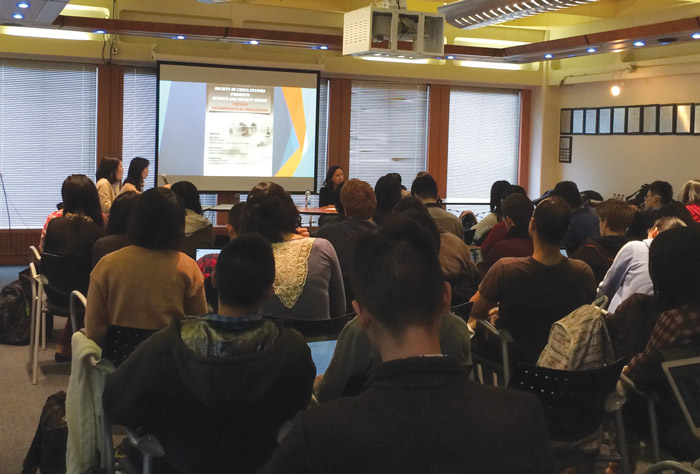
Last Friday, a discussion and workshop on combining global and local perspectives on youth unemployment was co-hosted by the Aga Khan Foundation of Canada (AKFC) and the Institute for the Study of International Development (ISID). The AKFC is a non-profit international development agency that works to improve health, education, rural development, and civil society in Africa and Asia. The panel of speakers at the event included Abdul Malik, general manager of the Aga Khan Rural Support Program in Pakistan; Erin Markel, principal consultant at MarketShare Associates; and Darlene Hnatchuk, director of Career Planning Service (CaPS) at McGill University.

The panel held a moderated discussion following an introduction by Co-organizer and AKFC Public Affairs advisor Sarah Power and a presentation on definitions of youth unemployment and underemployment by Markel. The attendees then participated in a workshop to generate solutions to the global and local problems surrounding youth unemployment, such as incorporating job search skills into school curricula and taking advantage of social media as a platform for sharing ideas.

“[Youth unemployment] is a growing issue, but it also doesn’t just affect youth themselves,” Markel said. “It has a huge economic and social cost to communities as well as to governments and nations, so a lot of people are starting to pay close attention to this on the global scale.”

Markel explained that according to the International Labour Board, young people are more than three times more likely than adults to be unemployed, and about 13 per cent of all young people in the world are unemployed. She also brought up the issue of underemployment and youth inactivity as factors contributing to the global youth unemployment phenomenon.

“Underemployment refers to people who are overqualified for their work,” she said. “Youth who tend to be described as inactive also tend to be at the highest risk of remaining inactive, or at the highest risk of poverty in the long run. This means young people who are not employed and aren’t in school.”

During the moderated discussion, Malik explained the role his program plays in helping improve local economic infrastructure, sector development, and entrepreneurship in remote areas of northern Pakistan. He also described the issues faced by unemployed young people in Pakistan and compared them to the ones facing Canadian youth.

“In terms of challenges for young people in finding jobs, one is the obvious issue of finding economic opportunities,” Malik said. “The second [problem] is the issue of skills. The educated youth who come out of schools come out with a lot of degrees, but not necessarily with marketable skills. A third issue is of social norms. Particularly for women, some parts of the area where we work is very conservative and when it comes to women, their mobility tends to be limited.”

The problem of youth lacking employable skills is one faced in Canada as well, according to Hnatchuk.

“There is an expectation or assumption that graduates will have specifically relevant experience to the job that they are applying for,” Hnatchuk said.

However, ‘soft skills’ appear to often be the missing link between youth and employers, according to Hnatchuk.

“It’s not necessarily always the technical skills that [employers are] missing,” Hnatchuk said. “CEOs, hiring managers, human resources—they’re saying that their priorities in terms of hiring are looking for people who have interpersonal skills, communication skills, problem solving skills, and analytical skills.”

U3 Arts and Science Alicia, who attended the event said she was impressed with how the conference addressed the global context of unemployment, but expressed concerns about career resources and opportunities in Canada.

“I’m also in the job market right now, and I’m finding it frustrating because I was under the impression that the degree I’m getting would [involve] enough tangible skills to be able to fit in the job market,” she said. “But those tangible skills don’t translate into what I want to do.”

Read the latest issue

Read the latest issue