


Latest News

a, News

Faculty of Arts changes People, Processes, and Partnerships plan

Early last week, Dean of the Faculty of Arts Christopher Manfredi announced changes to the plan known as People, Processes, and Partnerships (PPP). While the project was initially slated to restructure how space is used in the Leacock Building, followed by similar reconfiguration in 688 Sherbrooke and the Ferrier Building, Manfredi stated that the PPP project team will now focus its attention first on 688 Sherbrooke and Ferrier, “where solutions are likely to be less disruptive.”

In an email to ARTSMIN—a listserv that includes all faculty and staff in Arts—and an announcement on the PPP section of the McGill website, Manfredi wrote that the project team of over 75 people “will take a few steps back to review [the] issues, risks, constraints, and alternatives with respect to the Leacock Building—and the project overall—with a view toward presenting revised organizational and space scenarios while it continues its work on process mapping.”

Manfredi’s announcement follows a feedback process within the Faculty of Arts that included a Town Hall with faculty members.

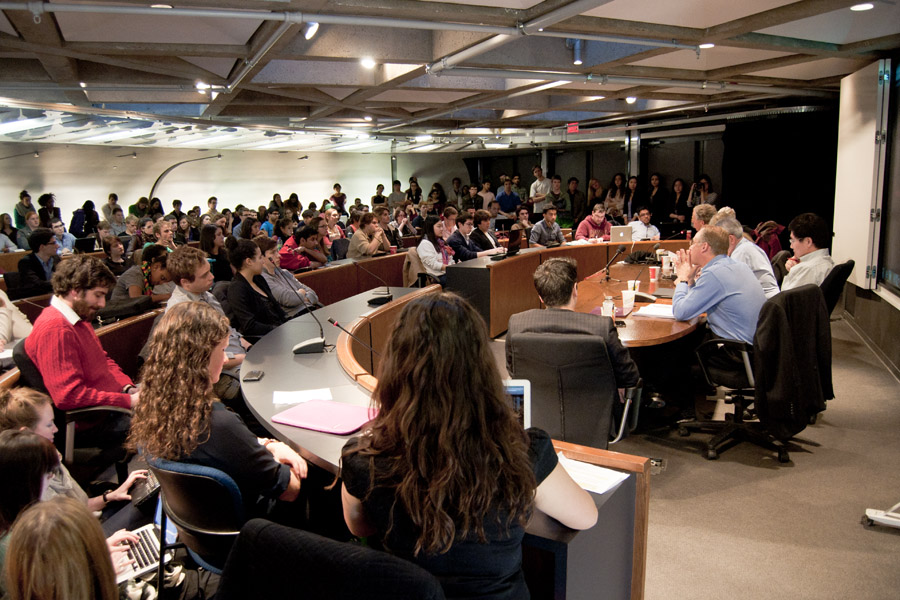
At the Town Hall,  held Monday Mar. 18, the project team presented two potential scenarios for a re-organized Leacock Building. Both scenarios involved rearranging upwards of 50 offices within Leacock or to the McTavish row houses, as well as moving all departmental administrative officers (AOs) onto one floor, and converting the third floor of Leacock into a general administrative ‘welcome centre’ for students.

Criticisms of the plan expressed at the Arts Town Hall and the Mar. 20 Arts Undergraduate Society (AUS) Council meeting included the potential disruption to “soft knowledge” that could occur as a product of moving AOs out of their departments and cross-training them to handle students from a variety of departments.

Manfredi has explained that restructuring is necessary as a result of new university policies that were implemented in response to provincial laws, such as the Quebec government’s Bill 100, which requires that universities cut down on money spent on administrative staff. Additionally, the new government-imposed budget cuts prompted the university to offer a voluntary retirement program to those aged 60 and above—a category under which several AOs in the Faculty of Arts fall.

In his email to ARTSMIN, Manfredi emphasized that the Faculty is taking action out of necessity.

“The project is aimed at meeting real challenges that we currently face and may face in the future, even if there is disagreement with solutions currently proposed,” he wrote.

AUS Vice-President (VP) Internal Justin Fletcher agreed that the Faculty needs to proactively address new realities, but expressed hope that the administration will continue to consult all those who will be affected by changes made to Arts space.

“I think the overall mission of the project People, Processes, and Partnerships is justified,” he said, citing Bill 100 and budget cuts as valid reasons for the project. “Should an [AO] leave a department, they may not have back-up, which can put much strain on a department, which could thus affect the student experience.”

“While I think the intentions of the project are good, I think more consultation needs to be done concerning the floor plan scenarios before proceeding with further aspects of the project,” Fletcher continued.

The AUS also hosted a Town Hall last night, at which Manfredi and two associate deans addressed students’ continued concerns over the project’s consulation process and  how the division of labour among different  advisors will now exist.

VP Internal and Events of the History Students’ Association (HSA) Laure Spake, who was among those who spoke out against the initial plan to restructure Leacock at both the Arts Town Hall and AUS Council, expressed concerns that the new plan to first focus on 688 Sherbrooke and Ferrier may be just a semblance of compromise.

“We hope that the [PPP] project is announcing its step back and re-evaluation in good faith, but so far we are not comfortable backing off and letting this issue slip under the radar,” Spake said.

Spake also noted that she was informed of the change through an email from fellow student Fletcher and not the Faculty.

Associate Professor of Political Science Jacob Levy, whose office is currently located in the Ferrier building, expressed optimism over the new direction the PPP is taking.

“It’s true that Arts/Ferrier is a lot easier to handle than Leacock—the complicated pieces of the Leacock puzzle are much less present here,” Levy said. “I’m expecting little disruption and the possibility of some improvement in our access to administrative support over here.”

Manfredi said he personally received two direct responses to the changes, and that both were positive.  He also noted that two Faculty-wide listservs were notified right away of the changes following the initial announcement made at the Faculty Council on Mar. 26.

“We rely on these recipients to cascade the information out to those they represent, as the department of political science did,” Manfredi said.  “I do not know if student members of Faculty Council who received the message forwarded it to their constituents, which is their responsibility.”

Scenarios for 688 Sherbrooke and the Ferrier building have not been completed and will be released as they become available, according to Manfredi. He also noted that the scenarios will incorporate long-standing plans unconnected to PPP, citing “the necessity of moving the language labs out of McLennan Library and into Ferrier, moving the French Language Centre to Ferrier to put it next to the language labs, moving [the] East Asian studies [department] to 688 Sherbrooke.”

Manfredi anticipates that 688 Sherbrooke will be re-arranged fully this summer and that the whole PPP will be completed by early 2014.
a, News

Students worried about employment opportunities at McGill

15 people attended an open conversation about McGill’s budget cuts and Quebec tuition indexation in the Lev Bukhman Room in the Students’ Society of McGill University (SSMU) building on Mar. 26. The event was hosted by SSMU Vice-President External Robin Reid-Fraser, and many of those in attendance were elected student representatives to SSMU.

SSMU President-Elect Katie Larson read an email from McGill Principal Heather Munroe-Blum, describing McGill’s “measures to address budget challenges,” which was sent moments before last Tuesday’s event began.

Jaime MacLean, president of the Association of McGill University Support Employees (AMUSE)—a labour union that represents half of McGill’s non-academic employees—expressed several concerns about the voluntary retirement package announced in Munroe-Blum’s email, which will be available to “administrative support staff aged 60 and over.”

“It’s really restrictive, because people need to give their answer [soon] and leave work by the end of August,” MacLean said. “From what I’ve heard, there are four to five hundred people who are eligible for that … [and the administration is] planning for around 40 per cent of those staff to take it.”

Last Tuesday’s MRO also announced that the McGill Association of University Teachers (MAUT) agreed to a year-long salary freeze. According to MacLean, professors have no real control over their own salary freezes.

“[MAUT is not a union], so there’s nothing they can do to stop that,” MacLean said. “McGill professors are one of the last faculty groups in Canada to not have a union.”

Reid-Fraser suggested that the relationship between campus unions and the McGill administration has been strained for some time.

“We just had the MUNACA strike [in Fall 2011], which I think raised the tension between [the] McGill administration and the unions,” she said. “There’s always been tension … because of the way [the administration] treats unions in general, and their attempts to unionize.”

Reid-Fraser’s statement referred to the administration’s response to a move by the Association of Graduate Students Employed at McGill (AGSEM) to unionize course lecturers in Fall 2010, which included ordering pro-unionization posters to be removed from campus notice boards.

Another topic of discussion at the event was the fate of student jobs on campus.

A part-time McGill student and full-time employee at the McGill Bookstore, who asked to remain anonymous, commented on the Bookstore’s plan to shorten opening hours.

“We got an email [today] that the bookstore … [which] used to be open nine to seven, Monday to Friday, now is going to be open nine to five,” the student said. “That really kills people’s availability …. Not being able to work three [o’clock] ‘til seven, or four ‘til seven, is going to really cut a lot of people. It’s a way of firing people without firing them.”

MacLean also expressed concern over the expected decrease in student employment opportunities on campus.

“[Students] depend on getting a campus job, [and] there already aren’t that many of them,” she said. “Not only are students losing jobs … it’s [also] reducing access to services for students who need them.”

Larson suggested that McGill’s method of handling these issues might be creating conflict, instead of uniting different members of the McGill community, such as students, administration, faculty, and part-time employees.

“The way the university is approaching the problem is very pro-student,” Larson said. “What they’re trying to do is [please] students by saying, ‘We’re not cutting your classes, we’re cutting our staff.’”

“By doing that, [the administration seem to be] setting students apart from the staff, which … isn’t [effective], because there are many students who are also staff here at McGill,” Larson continued.

Reid-Fraser said she supports the idea of a united approach to budget cuts and tuition indexation, and sees the current situation as a chance to restructure McGill’s employment systems.

“Maybe this is a time to [not] be … thinking about all of these staff as one group taking a pay cut, but thinking about this as an interesting opportunity to have workers and students looking at this bureaucratic environment that they work and live in, and [determining] where are the places where this bureaucracy is bigger than it need to be,” she said.

Professors debate divestment from fossil fuels during an event hosted by ESA. (Simon Poitrimolt / McGill Tribune)
a, News

Divest McGill and economics students host Battle of the Profs

On Mar. 26, professors from the Faculty of Management and the departments of economics, environment, and geography met in Leacock 232 to debate the idea of McGill’s divestment from fossil fuels. The event, which was hosted by the Economics Students’ Association (ESA) and Divest McGill, attracted a large number of students; seating was filled to capacity and many attendees were standing.

Following an introduction from Divest McGill, three professors argued in favour of divestment, and three argued against.

Those who were in favour claimed it was immoral of McGill to invest in fossil fuels when global warming and climate change are such relevant problems.

“We misunderstand the concept of liberty in our political economy,” Peter Brown, a geography professor, said. “Once the carbon sinks are filled up, we have to re-examine the idea of liberty very fundamentally, because we can only exercise liberty within our fair share of resources and sinks.”

Holly Dressel, an adjunct professor from McGill’s School of Environment, argued that in divesting from fossil fuels, McGill would be fulfilling its mission to serve its students and the community.

“We are in one of the rare institutions where we have a bit of wiggle room on [financial issues],” Dressel said. “We don’t have to be totally focused on economic details. We are supposed to look at the social, ethical, and service results of what we do with both our money and our institution for students.”

However, the professors who spoke against divestment cautioned that the results of such an initiative are unpredictable.

“Good intentions don’t always produce intended outcomes,” Economics Professor Licun Xue said.

Another main source of concern on the anti-divestment side was the potential cost of divestment for McGill, which is facing the financial stress of government budget cuts. Christopher Ragan, an associate professor of economics, cited several improvements McGill could make with returns from its investments in fossil fuel companies, such as funding new courses, or creating new scholarships.

Jiro Kondo, an assistant professor in the Faculty of Management, argued that divestment would decrease the diversification of McGill’s investment portfolio.

(Simon Poitrimolt / McGill Tribune)

In response, Dressel proposed that the diversification of investments be increased by re-investing fossil fuel funds in Green Revolving Funds, which could be used to improve energy efficiency on campus and to implement other environmentally sustainable initiatives. According to Dressel, this would yield approximately the same return as 28 to 35 per cent of fossil fuel investments.

The six professors also debated about the effectiveness of divestment. Ragan presented data showing that divestment on McGill’s part would not make a sizable impact on the oil industry.

“The proposed divestment by McGill, [and by] 200 like-sized institutions that we might influence, would represent 25 thousandths of the global market capitalization for oil,” he said. “This is worse than an empty gesture in that it costs something, and affects approximately nothing.”

Ragan proposed that instead of divestment, McGill should use the returns from investment to promote better initiatives to solve the economic, technological, and political problems in advertising sustainability that society faces today.

“Rather than giving away [the returns], let’s keep it, and spend it on doing good research,” he said. “McGill is, after all, about producing good ideas … let’s do what we’re good at.”

Dror Etzion, a professor in the Faculty of Management, disagreed with Ragan, declaring that the point of divestment was not to have a direct financial impact on the fossil fuel industry, but rather to set a precedent.

“By divesting, McGill makes itself a force for democracy, sustainability, and a better future, which is what McGill believes in,” Etzion said. “It demonstrates McGill really sees itself as a community, which truly embraces participatory governance, and [is] especially student activated. Divestment presents itself as a learning opportunity ….  If we don’t try, we’ll never know.”

Students’ Society of McGill University Sustainability Coordinator David Gray-Donald, who attended the debate, asked the six professors to pinpoint how students could get further involved in the conversation surrounding divestment. Following the event, Gray-Donald said he was disappointed that none of the professors provided a direct response to his question.

At the end of the debate, Dressel commended student members of Divest McGill for starting the push for McGill’s divestment from fossil fuels.

“I would like to congratulate those who created this initiative … because whether [divestment] costs this university money or not, it brings to everyone’s attention that this is an unethical, wrong way to invest in our future,” Dressel said.

a, News, SSMU

Highlights from the Mar 28 SSMU Council

Guest speaker: Principal Heather Munroe-Blum

The guest speaker for last week’s Council meeting was Professor Heather Munroe-Blum, principal and vice-chancellor of McGill.  After giving a short introductory speech, she granted most of her allotted 40 minutes to a question and answer period.

When asked how she felt about the new incoming principal, Dr. Suzanne Fortier, Blum responded that she was “thrilled.”

“She has a clear sense of what our mission is,” Munroe-Blum said. “I don’t think there’s anybody better to come in as [principal] at this time.”

SSMU Clubs and Services Representative Zachery Rosentzveig asked Munroe-Blum about the importance of clubs at McGill, emphasizing the recent budget cuts. Munroe-Blum responded by saying that club funding was a business transaction with the university, and said she thought it was unfair “in context of student development and learning to talk about business transactions.”

Munroe-Blum was asked what she thought was her biggest success as Principal. She said that she couldn’t tell for herself, and that “only history could be the judge.” However, Munroe-Blum mentioned that she believed sustainability was a theme that would resonate with her legacy.


Motion Regarding TaCEQ secretary General Position

ed in the approval of an additional Vice-Secretary General position to the Table de concertation étudiante du Québec (TaCEQ).

TaCEQ is a lobbying organization comprised of student groups from universities across Quebec, including the Students’ Society of McGill University (SSMU). The organization has an annual budget of about $40,000, including salaries for the two current positions—Secretary General and Vice-Secretary General.

The motion, which was moved by SSMU Vice-President External Robin Reid-Fraser, proposed that the position of Vice-Secretary General be divided into two positions—Vice-Secretary General of Communications and Internal Relations, and Vice-Secretary General of Finances and Administration.

By creating an additional position, increased funding would have to be used to pay for another salary, to which SSMU would contribute approximately $3,200.

Councillors were divided on the creation of an additional position, with several claiming that TaCEQ lacks organization. Some pointed out that the association has no mandate nor mission statement, that assembly minutes and reports have not been properly administered, and that the organization’s website and all its documents are only available in French.

Furthermore, councillors argued that there was no clear definition of what the position would entail.

“The role of Vice-Secretary lacks a proper definition, and we’re creating a new one? Why should we pay for another one?” Brian Farnan, vice-president external of the Arts Undergraduate Society and incoming SSMU vice-president internal, said.

Reid-Fraser fought hard for the approval of the motion.

“We can get so much more out of TaCEQ if we put a bit more of a dollar amount into it,” she said.

The motion eventually passed, with 13 for, five against, and three abstentions.


Motion regarding creation of ad-bloc campaigns committee 

Council approved the creation of an Ad-hoc Campaigns Committee. According to the notice, the committee will “be responsible for helping to carry out campaigns related to SSMU mandates, including, but not limited to, issues of post-secondary education policy, environmental issues, and social justice issues.“

The idea for the committee was developed by Reid-Fraser in response to the Divest McGill campaign, which has required large amounts of resources and manpower.

The notice says that the Committee would be comprised of SSMU Vice-President External, the SSMU Political Attaché, and the SSMU Political Campaigns Coordinator. The Committee would only come together when needed, in order to lead and consolidate on large SSMU mandated campaigns, such as Divest McGill, according to Reid-Fraser.

a, News

What happened last week in Canada

Canada withdraws from UN drought convention

Last Wednesday, the Government of Canada informed the UN of its withdrawal from the United Nations Convention to Combat Desertification (UNCCD)—an initiative that builds resilience to land degradation and drought in developing countries while increasing security of essential resources.

Foreign Affairs Minister John Baird suggested the withdrawal, which was ordered by the federal cabinet last week.

Prime Minister Stephen Harper said only 18 per cent of Canada’s contribution to the UNCCD goes to programming, while the remainder is spent on bureaucratic measures.

“It’s not an effective way to spend taxpayers’ money,” Harper said during question period in the House of Commons on Thursday.

Following the announcement of the withdrawal, the UNCCD thanked Canada for annually contributing just over three per cent of the Convention’s budget, which amounted to $350,000 last year.

The Convention is the only one of its kind that addresses desertification and drought. Canada is the only country of 193 member states to withdraw from the Convention.


Drug bust on the high seas

A Canadian Armed Forces ship seized approximately 500 kilograms of heroin, valued at $100 million, from a boat in the Indian Ocean on Friday. The heroin, which was seized without incident, will be destroyed.

A boarding team from Her Majesty’s Canadian Ship (HMCS) Toronto found the drugs while performing an inspection of the transport boat. HMCS Toronto tracked the transport boat for some time before boarding it.

“We ascertained [their crew] were not being truthful about their mission, their voyage, so we continued on with a full search of the vessel and discovered the drugs,” Commander David Patchell told CBC News.

In a release from the Department of National Defence, Defence Minister Peter MacKay said this is among the largest heroin confiscations to occur in a marine setting.

HMCS Toronto currently patrols the Indian Ocean and Arabian Sea as part of a Canadian Forces naval task force with a counter-terrorism mission.


Ralph Klein, 12th Premier of Alberta, dies

Ralph Klein, who led Alberta’s Progressive Conservative Party for 14 years, died on Friday at the age of 70 in a long-term care facility.

Before becoming premier, Klein was mayor of Calgary, his hometown, for nine years. He is remembered for bringing the 1988 Winter Olympics to Calgary, as well as striving to balance the provincial budget.

Klein was Premier of Alberta in four consecutive majority governments, during which time he instituted the “Alberta Advantage”—a low-tax, low-regulation stance that paved the way for Alberta to become the only debt-free province in 2005. Klein stepped down as Premier in 2006 due to a decline in his approval ratings, and was subsequently replaced by Ed Stelmach.

Klein was also made an Officer of the Order of Canada in 2012. He leaves behind a wife, five children, and grandchildren. 


Conservative backbenchers stand up against Harper

Four Conservative Members of Parliament (MPs) took a stand against Prime Minister Stephen Harper in the House of Commons last Thursday, and denounced his control over House proceedings.

This backlash comes after Harper denied B.C. MP Mark Warawa permission to read a statement in the House last week, according to The Globe and Mail. The Tory backbenchers expressed frustration with Harper’s ability to control who speaks in the House, and asked Speaker Andrew Scheer to grant MPs more autonomy in this regard.

“The very existence of parliamentary questions and the opportunities that they provide for the representatives of the people to question the government of the day are of constitutional importance,” New Brunswick Southwest MP John Williamson told the House.

According to The Globe, Tory MPs are often assigned the statements they must deliver in the House, and their questions reserved for Question Period are also written by the government, which prevents them from voicing their constituents’ concerns. Williamson has also asked Scheer to change the rules.


PQ abandons L’Hôtel-Dieu renovations for new hospital

Last Wednesday, the Quebec government announced that it has cancelled the former Liberal government’s plans to renovate the L’Hôtel-Dieu hospital in Quebec City. Instead, the government will pursue construction of a modern hospital, which will be built outside the city.

Founded in 1637, L’Hôtel-Dieu is one of three teaching hospitals which form the Centre hospitalier universitaire de Québec (CHUQ). L’Hôtel-Dieu was the first medical institution of its kind in North America.

According to The Globe and Mail, the Hôtel-Dieu renovations were projected to cost the provincial government over $800 million, which was double the original estimate. However, the new hospital’s price tag currently reads upwards of a billion dollars. A more concrete estimate will not be available until June.

Premier Pauline Marois noted that the Parti Québécois will not be receiving financial assistance from the federal government for the new medical centre. Ottawa has also refused to fund several other key infrastructure projects in Quebec, according to The Globe and Mail.

a, Features

Sugar Babies at McGill

“What’s your price? This is Leroy.”

The start to my phone interview with Leroy Velasquez, a press representative for  SeekingArrangement.com, was startling at best.

I am investigating a recent trend of university students using sugar daddy dating websites, like SeekingArrangement.com, to help them pay for their schooling. When asked what exactly SeekingArrangement.com is, Velasquez simply responded: “SeekingArrangement.com is the world’s largest sugar daddy dating website. [It] essentially pairs generous benefactors with attractive members, and they engage in what we call “mutually beneficial relationships.” Whether it be friendship, companionship, or something more romantic, the benefactor takes care of that person, offers them a monthly allowance, and pays for all of their expenses.”

Velasquez explains that there are various terms for the different kinds of people using the site: sugar daddies, sugar mommies, and sugar babies. He describes a sugar daddy as “an older, wealthy man, who is on average 35 years old,” and can make anywhere from half a million to over a million dollars a year. On the other hand, a sugar baby is typically a younger woman— 18-26 years old—whose income is less relevant, but ostensibly much lower. It’s also worth noting that the ratio of sugar daddies to sugar babies on the site is one to 12.

“We don’t discriminate against certain demographics,” Velasquez assures me. “For example, we do have a sugar mommy population that takes care of sugar baby males, and we also cater to the LGBT community. We have gay sugar daddy males [and] gay sugar baby females. We have a wide range of relationships on our website.”

While the service is free for sugar babies to use, sugar daddies and mommies must pay a monthly fee for their membership. There’s no minimum income requirement for sugar daddies, but on average, they make around six figures.

“As long as you have the expendable income to spend on a sugar baby’s monthly allowance, we allow you to use our website,” Velasquez explains.

The website even offers a promotion encouraging sugar babies to register with their university email account, which has enabled them to gather data on which universities boast the most sugar babies. McGill lands at number four on the list of Canada’s fastest growing sugar baby schools. With 148 new accounts created in 2012 alone, it falls behind Ryerson (183 new accounts), University of Ottawa (179 new accounts), and University of Toronto (156 new accounts), which hold the top three spots respectively. L’Université du Québec à  Montréal (UQAM) also made the list at number 13, with 58 new accounts. According to SeekingArrangement.com CEO and founder, Brandon Wade, 38 per cent of all female accounts in Canada belong to university students.

“We actually found a huge trend in college students at the beginning of this year,” Velasquez says, “and I can definitely attribute that to factors involving money. A lot of students can’t afford the tuition, especially with school costs increasing [and] the cost of living, as well as student loans increasing. A sugar daddy just seems like the most ideal and sensible choice when engaging in relationships. The average college sugar baby earns $3000 a month, as well as money to cover tuition.”

It sounds like a pretty sweet deal, right? Aside from the obvious questions it raises, I wondered if it was too good to be true. Unable to find any experienced sugar babies to speak with, I decided to do the next best thing: see for myself. I created a SeekingArrangement.com account; one fake name, a short blurb about myself, and a couple of Facebook photos later, I was ready to see what all the fuss was about. Most of the messages I got were from men living in places outside of Montreal, looking to travel downtown to meet up. Mostly, they were from towns in Quebec and Ontario, but a few were from the states, even as far away as Texas.

As Velasquez explains it, “You have to put in perspective that the traditional sugar daddy is someone who leads a very active business life. He’s successful, he’s wealthy, he’s generous, but he may not have the same schedule as someone who works a nine-to-five. He may be travelling all the time, he may be constantly working so he has to engage in relationships where maybe he’s visiting the area where you live or he could take vacations or time off with you. When [sugar daddies] first engage with these sugar babies, they message them and tell them specifically what they’re looking for, whether it be friendship or companionship. And then, there are times where sugar daddies are looking for someone to seriously date. We’ve actually had numerous members send us wedding invitations over the past year, for those who actually had the chemistry and actually ended up getting engaged and married. There’s a wide range of relationships on SeekingArrangement.com.”

He’s right about the straightforward nature of the website. I received messages proposing shopping trips, dinners, and hotel meet-ups right off the bat, but others simply requesting I message them back to see if there was a connection. It was easy to tell who was looking for what, but almost every message came with a phone number or private email, suggesting we correspond outside of the website.

“When members first sign up and register on our website, they have to agree to a terms of use,” Velasquez tells me, “so our administrative team looks for members who message others and solicit them, and we ban them, no questions asked, on the first offence. At the end of the day, we are a dating website, and members have the ability to flag others if they ever feel uncomfortable, violated, solicited, etc., so we do employ a number of measures to maintain the integrity of our dating website.”

designerscrapbook.blogspot.comCritics of the website accuse it of being similar to an escort service, but legally speaking, as long  as a sugar daddy is paying for a service other than sex, say friendship or companionship, the transaction is perfectly legal. According to the website, any physical relationship that may occur, is beyond the scope of that arrangement.

Whatever sugar daddies are looking for, it seems they use the website to make an initial connection, but would rather their messages not be read by the Seeking Arrangement administrative team. For a service that stresses how honest and straight forward these relationships are, a lot of the profiles I saw mentioned discretion, especially those of married individuals.

Each sugar daddy is required to list their income, net-worth, age, occupation, location, and budget, among other things. Sugar babies must list much of the same, excluding income and net-worth. They also list what they’re expecting in terms of compensation from a sugar daddy. The whole venture comes across as exceedingly mercenary, yet supporters say it’s the safest, easiest way to put yourself through school. Critics argue that it’s like a job, but not quite, and it’s also like dating, but not quite—it’s too much of a grey area. The lines can get blurry enough for the whole thing to feel anything but simple. Success with the website seems to depend on whether or not you have the stomach for it.

According to Velasquez, “It’s what you look for, honestly. Using our website, you’ll see that members look for something different, and they match with someone who has a similar mindset. I’ve spoken with sugar babies who are in a completely platonic relationship with their sugar daddy, and they get the same benefits as someone who’s in a more romantic relationship.  So, if you’re looking for friendship, it’s there. If you’re looking for a more romantic relationship, it’s there.”

U1 international student Chelsea* says she considered a Seeking Arrangement account, but ultimately decided she didn’t want to open that can of worms.

“I mean,  I pay around $15,000 and it’s mostly in loans—my parents don’t help me.  It’s hard [because] a lot of students who don’t have loans can go travel [after graduation], but I can’t, because I have to pay back my loans right after school. Everybody needs money, and it’s an easy way to get money, but it’s weird. You lose something. If someone’s paying you money to be around them, it’s not real. You lose a bit of autonomy,” she said. “I work at Dairy Queen, and I’m much happier making minimum wage than having someone pay me to spend time with them.”

Although McGill students are split on the issue, SeekingArrangement.com is clearly growing in popularity. Despite the financial difficulty faced by many McGill students, one question remains to be answered: can we put a price on ourselves?


*Name has been changed.

*This feature is not part of our joke section.

Check out our full Feature spread! (Click to enlarge)
(www.aceshowbiz.com)
a, Arts & Entertainment

Girls gone wild

For a movie featuring Selena Gomez as a church girl named Faith, and directed by a guy named Harmony,  Spring Breakers sure contains a lot of godless chaos.

Writer/director and cinema enfant terrible Harmony Korine returns with another movie about rebellious youth, with characters who seek the same variety of forbidden fun as the stars in Korine’s screenplay of Kids in 1995. Much like how Kids was intended to be a contemporary mirror of teenage society, depicting bored, young New Yorker hedonists during the mid-’90s HIV epidemic, Spring Breakers is set in a modern Florida, and features 2013 Disney pop starlets, Gucci Mane, and a score by mainstream dubstep producer Skrillex. All of these are great commercial selling points for a bubblegum-pop action flick. Korine, however, takes these qualities further, by exploiting Gomez and co-stars Vanessa Hudgens and Ashley Benson’s teen television backgrounds to comment on the culture that idolizes them.

As a concept, Spring Breakers has enormous satirical potential, and the idea of a biting farce lurks beneath the movie’s shiny surface. But the film doesn’t have such a sharp focus. Instead of using the flashy dream-world hyperbole as a lens into something meaningful, Korine hides the lack of substance in his movie behind substances themselves; drugs are depicted on screen with the same degree of abandon as that of the girls who are using them. This is quite convenient for him—instead of making something constructively provocative, he uses the movie’s existential premise as an excuse to not bother. The film is literally missing content, with flashbacks and montages of the same scenes, coupled with voiceovers of the same eerie refrains of “money” and “spring break forever” taking up more screen time than the original sequences where they first appear. The resulting non-sequential, non-sequitur narrative is not artistically surreal, but rather monotonous. If the film was positioned as purely campy, nihilistic pop entertainment, it might have worked, but a film that uses teenage tedium as a catalyst for its narrative—the girls want to visit Florida because they are “tired of seeing the same things every day”—shouldn’t be boring itself.

Two characters have the potential to redeem Spring Breakers from the dead-end sum of its montages of beach bacchanalia and slow motion shootouts. The scene in which Alien, played by James Franco, tries to manipulate Faith into staying in Florida is genuinely disturbing, and one of the film’s best. Unfortunately, Faith, scared to tears, exits the film early, which leaves it without its most developed female character.

That leaves us with Alien and his girls, whom, for the moment, appear human. Franco adopts the role, obviously modeled after Houston rapper Jody Christian (aka RiFF RAFF), extremely well, and Alien’s motives are surprisingly unpredictable—much to Franco’s credit. Alien walks a line between gangster jester—his ridiculous persona a source of comic relief—and idiot savant, whose brassy musings on the life of a hustler are profound in their own way. “People tell me I should change … I’m about stacking change,” he tells the girls. This line almost directly quotes RiFF RAFF himself, and it feels awkward, highlighting that maybe Christian would better suit the role. While Franco, a method actor, apparently stayed in character while on set, Christian is so committed to his eccentric rapper lifestyle that many still speculate as to whether the act is genuine or not—and this undermines the efficacy of his imitator. Acknowledging his influence, RiFF RAFF has even communicated his eagerness to star in a Spring Breakers 2, but including him in this film might give it the kick of absurdity that would push it over the edge.

Spring Breakers is a concept with potential, and a film that could have been more. Korine should either have toned down its style in favour of more substance, or recklessly pushed its explicit content to its nihilist limit, eschewing any hint at message or meaning. But in trying to balance both, Spring Breakers’ ability to provoke is broken.

a, Arts & Entertainment

Talking street, straight from the heart

It seems as though the notoriously slow Montreal hip-hop world is being jostled awake by up-and-coming powerhouse female rap duo Heart Streets. With their smooth voices, and bold but unassuming presence, they are beginning to create some serious waves on the scene. Heart Streets took to the stage last Friday night at Cabaret du Mile End for the release of their second EP Beats, Blunts, & Broads in front of an enthusiastic crowd.

The group consists of Montrealers Gabrielle Godon and Emma Beko, who founded Heart Streets two years ago. In combining Godon’s soulful, sultry voice with Beko’s swift and raspy rapping, the close friends discovered a unique dynamic that has since captured international attention. With the help of the smooth production of Andre Milton, the girls have developed a style that fills a serious void in the genre.

Godon and Beko say they are often asked what it’s like to be two white girls in the hip-hop industry—and they insist their profiles don’t  change much.  However, they do see that it has a certain power in attracting people to their music.

“It brings curiosity,” explains Godon. “People are like, ‘Who is this girl rapping and this girl singing with a soulful voice?’ [We’re] white, and [we’re] young; they are curious to see what we have to offer.”

This fresh, unapologetic attitude certainly parallels the nature of their music. Their lyrics are edgy and real; in fact, they seem to encapsulate the nature of Montreal. The laid-back music video to their single, “Nonchalant,” takes viewers on a street tour of the city, and features the girls’ friends and favourite local hang-outs. The feel is certainly quite old-school, but they also find inspiration from newer artists such as Azealia Banks and Kendrick Lamar.

Heart Streets has been featured on major music blogs such as Pitchfork, The Fader, and The Mirror Noisemakers Issue. They have gained increasing attention, especially following their collaboration with LOL Boys on the groovy single Changes. Heart Streets’ growing success has brought them to the stages of Pop Montreal and M for Montreal in the last year. They’ve opened for big names like Radio Radio and Bran Van 3000 at L’Olympia, and they continue to fill venues throughout the city.

Five years from now, Heart Streets hopes to be touring around the world.

“[We want] to be living out of the music,” says the duo.

There is no doubt that with their spunky outlook and expansive talent they will go on to redefine Montreal’s hip-hop story and pave the way for future female artists.

What we all think we look like during finals. (Courtesy of Art Mûr)
a, Arts & Entertainment

Art Mûr goes for the jugular and leaves a bloody mess

With the pervasive yet varied theme of the human body, Art Mûr’s latest exhibitions push the social boundaries of comfort and originality. A striking feature of this free contemporary art gallery and studio is its intimate layout, which immediately takes hold of visitors ,and forces them into a new mindset upon entering.

After the first step into the gallery, one is within arm’s reach of an overwhelming piece from Sonny Assu’s #NEVERIDLE exposition. Half of the pieces use drums as a medium, while the other half use unique geometric forms; all, however, are made from real caribou skin. The canvas’ uncommon shapes amplify the abstract patterns’ ambiguity, causing the piece in entirety to reflect personal projections, which may include immense sadness, jocularity, or harmony depending on the viewer. Although well-made and interesting, this exhibit seems like an art class’ textbook definition of abstract art; it does not have anything to distinguish itself from countless past works in the same genre.

The exhibition’s narrow hallway opens up into a room containing Bevan Ramsay’s unsettling (to put it mildly) Soft Tissue. This white room contains four paintings and five sculptures, devoted to displaying meat in ways people would not usually like to think of it. The red paintings portray slabs of meat at different distances—from large, thick, whole pieces, to the meat’s structure at  cellular level. These pieces complement the exhibition well, but are not nearly as attention-grabbing nor emotive as Soft Tissue’s sculptures.

Thankfully not made of real meat, the sculptures combine various parts of humans and animals into    deformed monstrosities. The first piece features a human with bloody pig hooves for hands, kneeling down, appearing to worship the rest of the exhibit. Directly in front of this creature is what appears to be a massive chicken wing with a graphic, gory gash in its side. The wing stands on a beautifully accurate hand. At about eye level, the wing has an open human mouth, reminding the viewer of what one typically does with chicken wings. Whether a statement about vegetarianism, the similarities of man and beast, or simply an attempt to make viewers as uncomfortable as possible, this exhibit’s careful attention to detail—no matter how nauseating—evokes a strong emotional response.

The final room of the first floor contains Renato Garza Cervera’s Springbreaker Tsantsas—a basic display of nine shrunken heads with a video of a child holding several others on string. Each head within a glass jar on a podium, this sterile exhibit does not possess any of the previous room’s impact. One would think that shrunken heads would be more spine-tingling, but, perhaps because only their hair is actually human, they did not elicit any emotional impact. The heads are surprisingly small, about the size of a fist, and look metallic with a few cracks spread across the face. Perhaps somebody with a greater pre-existing affinity for shrunken heads would experience an enhanced appreciation for these pieces, but it certainly did not create one for this critic.

This series aims to create an emotional response, and in some sense, it does succeed. But simply being visceral or ambiguous isn’t enough to be inspiring.

Art Mûr’s current exhibitions are on display until Apr. 27 (5826 rue St-Hubert). Admission is free.

Groenland: The Chase (Bonsound)
a, Arts & Entertainment, Music

Groenland: The Chase

A title like The Chase begs the question: chasing what? The album is purposefully coy in providing an answer, but one can rule out ‘talent’ as a possibility—Groenland already has that in abundance.

The Montreal six-piece’s release is staggeringly accomplished for a first effort. The Chase occupies a nebulous arena between indie-pop and folk—though such labels seem pathetic when applied to tracks that brim with such originality. Melodic mastery and expert songcraft characterize the album, which maintains an undercurrent of unceasing fun—a ‘shout from the mountaintop’ joie de vivre. Inventive and memorable melodies twist, turn, and soar, taking on a life of their own in lead singer Sabrina Halde’s vocals. Iridescent at certain times, smoky and snarly at others, Halde’s voice is always remarkable for its realness, an uncanny relatability and likeability that won this critic over in record time.

There isn’t a single song on this album that is melodically uninspired or poorly arranged, and this collective virtuosity makes it all the more difficult to pick standouts. “Criminals” is one example where all elements work in perfect unison: the light, carefully counterpointed piano chords, alongside the cello and violin as they slide out sly riffs and punchy accents. “Our Hearts Like Gold” begins as a gentle ballad modestly adorned with an impossibly infectious melody, but soon blossoms into a hopeful, upbeat eulogy to conclude the album.

For a debut release, The Chase is incredibly polished and well thought-out. Whatever Groenland is chasing, they’re sure to find it. With artistry such as this, there’s nothing that can stand in the group’s way.

Read the latest issue

Read the latest issue