

Latest News

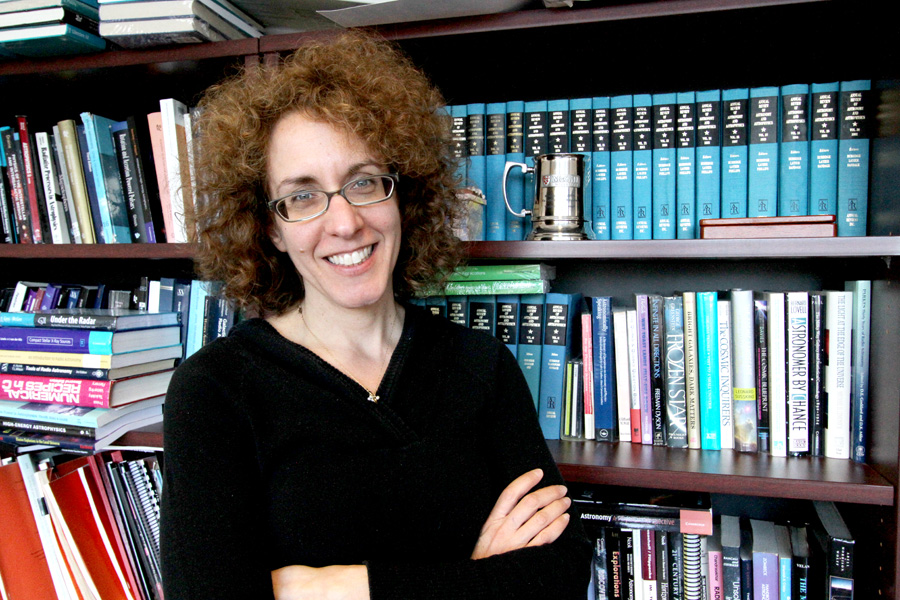
As a faculty member, Kaspi recognizes the challenges faced by female physics students. (Alexandra Allaire / McGill Tribune)
a, Science & Technology

Extreme, observable physics

In honour of “Women’s Month,” the Tribune is profiling different female researchers at McGill, and the story behind their work. 


Imagine walking into a classroom filled entirely with people of the opposite gender. McGill Physics Professor Dr. Victoria Kaspi remembers her shock at the overwhelmingly male cohort during her undergraduate studies at McGill. While a part of the minority, her gender was never an issue until she started graduate school. During her university orientation, she attended a “Women in Physics” luncheon. At the time, Kaspi was surprised by the need for such an event, but in retrospect, she sees it as a hint of the challenges she would later face in her career.

As a faculty member, Kaspi is more aware of these issues than she was as a student, and she is not alone. The need to address gender inequality in the physics department is also felt by her colleagues. The department started a “Women in Physics” program that aims to mentor and foster the community of women in the field. Through organizing various speaker events, including breakfasts featuring host speakers from other universities, students can learn more about the challenges faced by, and opportunities available to women in physics. What’s more, these events provide students with the chance to hear about the career paths of other female physicists, building a stronger sense of community amongst the women enrolled in the physical sciences at McGill, and their professors.

At the faculty level, the proportion of female professors in the physics department at McGill is higher than average. While the department is always interested in more female applicants, Kaspi stressed that there’s no compromising on quality.

“Ultimately, it comes down to research excellence, and teaching ability,” Kaspi said.

With over 200 publications and numerous scientific awards, Dr. Kaspi embodies both of these qualities. Along with her role as a physics professor, she holds the positions of the Lorne Trottier Chair in Astrophysics and Cosmology, Canada Research Chair in Observational Astrophysics, and is a Fellow of the Royal Society, a group of scientists, engineers and technologists from the UK and the Commonwealth, all of whom are elected for life on the basis of excellence in science.

Kaspi’s research focuses on neutron stars—highly dense stars that are the close cousins of black holes.

“It’s a way to study something in an extreme environment, and [with] extreme properties: extremely high density, such that it’s higher than the atomic nucleus; extremely high gravity, so that regular gravity as described by Newton doesn’t work—you need Einstein’s theory of relativity, and extreme magnetic fields, highest in the universe and stars,” Kaspi explained. “You get to study a lot of extreme physics, but [neutron stars] are observable, so it’s not like a black hole, which is hard to observe.”

One subject of Kaspi’s research is pulsars, a type of neutron star characterized by the light they emit at precise time intervals. Based on Kaspi’s research, these stars could potentially act as beacons to guide spaceship navigation in the future.

“They rotate really fast and with a beam of light, almost like a lighthouse,” said Kaspi.

On top of her impressive research accomplishments, Kaspi is also the mother of three young children. She commented that while she has now struck a great work-life balance, juggling her children with her career was one of the hardest challenges in her life that she has faced—and one she never anticipated.

While Kaspi points out the challenges of being a female in the field of physics, she does not mean it as a deterrent. Her career has allowed her to travel all over the world, and engage in amazing opportunities.

“[I’ve been to] mountain peaks in Chile, and spent months in the outback of Australia,” Kaspi recalled, noting that she has also met amazing colleagues through her work. “I feel totally blessed doing it, and I wouldn’t trade it for the world.”

Viruses contain both living and non-living characteristics, making them difficult to classify. (static.ddmcdn)
a, Science & Technology

Viruses develop a life of their own

Researchers have hotly debated the topic of viral classification for the past several decades. While scientists are still undecided as to whether or not viruses should be considered “living,” it is clear that these organisms do not meet the classical definition of life—maintenance of homeostasis, cellular organization, metabolism, growth, adaptation, response to stimuli, and reproduction. Viruses are complicated assemblies of molecules, including proteins, nucleic acids, and lipids; however, they lack some of the defining characteristics of life, such as the ability to replicate without the assistance of a host cell.

Recently, researchers have encountered convincing evidence that demonstrates that viruses may possess more complex immune systems than previously explored. This discovery adds to the ambiguity surrounding the nature of viruses, and presents the possibility that viruses may be gradually evolving into living organisms.

In an interview with Discovery News, Andrew Camilli, a molecular biology and microbiology professor at the Tufts University School of Medicine, noted that his recent research with cholera bacteria might possibly add to the argument that viruses exist as living entities. Camilli’s research focused on the feasibility of this bacteria’s role as a viral predator. However, while analyzing DNA sequences of phages taken from stool samples of  Bangladeshi cholera patients in the lab, postdoctoral fellow Kimberley Seed was presented with persuasive evidence that could potentially accelerate the virus’s classification as a  living species.

Seed discovered genes in these phages, usually present only in a fully operative immune system of different types of bacteria. In search for further evidence, Seed and her fellow team conducted experiments with viruses that did and did not contain immune related genes to infect another new strain of cholera bacteria. The results demonstrated that only the phages with a fully functional immune system were able to successfully kill the cholera bacteria.

The team also conducted research demonstrating that viruses have the capacity to acquire the immune systems of bacteria during their primary stage of infection. Essentially, the virus acts like a thief that invades the home of another living organism, stealing its efficient immune system, and transforming it, so that it is capable of providing an immunologic function for the virus itself.

In NBC’s interview with Gustavo Caetano-Anollés, a researcher at the University of Illinois, further evidence was presented in favour of the virus as a life form. In Caetano-Anollés’ lab, researchers conducted a census of protein folds, present in over 1,000 organisms. They sampled from the three conventional branches of life: bacteria, eukaryotes, and microbes. Different types of large viruses were also present in the study, in order to compare their genomes with genomes of the different life forms sampled.

The proteins and enzymes found in the viruses rivaled some of those of bacteria. For example, a virus called Crov, which originates in the ocean contains genes that repair themselves. Moreover, the virus may produce sugars that aid in the repair of its genome, and this allows it to gain more control over the equipment in host cells that allow the virus to replicate itself.

The research team also looked at the different characteristic features of life forms, and compared them to the structure of a virus. They found several ancient protein folds—present in different living organisms, also in the viruses examined—which exhibited more proof that a virus contains the origins of life.

While the ongoing debate has caused many scientists to ponder over whether viruses are more than simple genetic material, recent advancements are proof enough that viruses may be gradually, but efficiently moving towards being classified as a form of life. On one hand, they are considered parasites because they require the bodies of host cells to survive. However, viruses meet all of the requirements of life when living within the host cells, so some researchers have gone as far to classify them as the simplest living organisms. As for now, in the midst of controversy, viruses seem to exist in a purgatory between living and non-living, containing characteristics from both classifications.

a, News, SSMU Elections 2013

Larson wins SSMU presidency with 60% of the vote

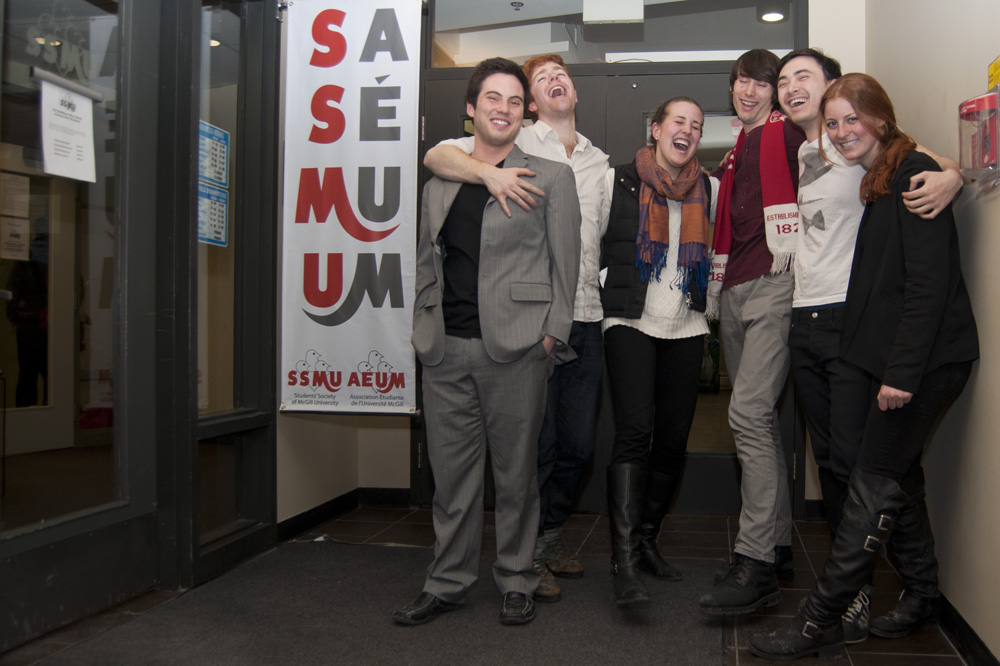
On Friday night, Elections SSMU released the Winter 2013 elections and referendum results to a crowd assembled at Gerts Bar. Katie Larson, Joey Shea, Brian Farnan, Samuel Harris, Tyler Hofmeister, and Stefan Fong will comprise the 2013-2014 Students’ Society of McGill University (SSMU) executive team.

Larson was elected SSMU President with 59.5 per cent of the vote to opponent Chris Bangs’ 40.5 per cent, and Tyler Hofmeister defeated Thomas Kim for the position of Vice-President (VP) Finance and Operations with 71.7 per cent in favour of Hofmeister.

While Larson and Hofmeister claimed solid majorities, the battles for VP University Affairs and VP Internal were neck-and-neck. Shea beat Sam Gregory for the position of VP University Affairs by only 184 votes—or 52.1 per cent of the overall vote— for VP University Affairs. Farnan was elected VP Internal after beating Julia Kryluk by only 160 votes—amassing 51.8 per cent.

Students elected VP External candidate Samuel Harris and VP Clubs and Services candidate Stefan Fong—both of whom ran unopposed—to their positions with 89.3 per cent and 88.5 per cent in favour, respectively.


The campaign

The winning candidates expressed excitement and relief following the announcement of results. Many of them, despite their extreme post-campaign fatigue, said they enjoyed the campaign period.

“The best part of the entire campaign … [was] the opportunity … to meet with people and go to buildings or classes I hadn’t been into before,” Larson said. “I [was able to] sit and have a conversation with a student for 20 minutes about what they’re up to, what they think the university should be … that was so interesting and so valuable. It was a great experience.”

Some candidates chose to avoid conventional campaign methods, such as posters and classroom announcements, and emphasized the importance of interacting with students face-to-face.

“The main tactic that I used was to go talk to as many clubs as I could,” Fong said. “I thought it was really important for them to get to know me. I didn’t [put up posters], I didn’t do any talking in classrooms… the majority of it was really getting into contact with as many people as I could.”

Like Fong, Hofmeister did not invest in campaign flyers.

“I know that a lot of people swear by [flyers], but I was really, really happy that I didn’t,” he said. “Campaigning didn’t actually cost me all that much because I didn’t flyer … and because I didn’t [post flyers], I just talked to people.”


A newly elected Larson takes in her victory at Gerts on Friday night. (Simon Poitrimolt / McGill Tribune).

Surprising voter turnout

6,040 students, or 29.1 per cent of the student body voted in the Winter 2013 elections and referenda.  Elections SSMU Chief Electoral Officer Hubie Yu and several of the candidates expressed satisfaction with the overall turnout.

“I was pleasantly surprised for sure,” Yu said. “There were not as many candidates [this year] … I was also concerned because two positions were unopposed. [But] we matched last year’s [turnout], so I’m pretty happy overall.”

“I think [the turnout was] great,” Larson said. “The fact that … many people [voted] was a testament to how hard everybody worked.”

However, Yu still hopes for larger turnouts in future SSMU elections, and highlighted several tactics used this year that gave visibility to the referendum periods and the elections, such as Elections SSMU contests and the executive candidates’ meet-and-greet, where attendees were provided with free food and refreshments.


Looking forward to next year

Now that the results are out, both Larson and Farnan said they were excited about working with the new SSMU executive team, while Shea and Hofmeister  are anxious
to get started on their portfolios.

“I’m excited to start implementing my platform,” Shea said. “I’m really excited to work on Equity stuff …[and] on wait times for student services. That’s a main priority for me.”

“I’m just thinking of all the cool, little things that happen at McGill, that I wouldn’t normally be privy to, that I can learn about, and be like, ‘Wow, people do that? That’s awesome!’” Hofmeister said. “And obviously, [I’m excited for] helping [to make these projects] happen.”

The new SSMU executive will work with the current executive during a month-long transition period in May, and will begin their term on June 1, 2013.


All referendum questions pass

The Elections SSMU referendum results also revealed the new faculty student senators for the 2013-2014 school year. In addition, students voted in favour of the $7.25 increase of the Athletics Ancillary Fee, the $8.50 increase of the Student Services Ancillary Fee, and the adjustment of both fees to inflation.

Students also voted in favour of the creation of a McGill Writing Ancillary Fee, as well as a SSMU Equity Fund. The renewal of the $0.75 Sexual Assault Centre of the McGill Students’ Society (SACOMSS) fee passed with an overwhelming majority of 83.4 per cent.

Chris Bangs (Sam Reynolds / McGill Tribune)
a, SSMU Elections 2013

Chris Bangs, candidate for President

McGill Tribune: What qualifies you for the position of President?
Chris Bangs: I started my career working with SSMU as the founder of the Independent Student Inquiry. We were a completely autonomous student group; we worked closely with the VP University Affairs, and VP Clubs & Services Alison Cooper was another founder of it, so I had this perspective as an outside student group that worked for SSMU support, and worked for students that way. Now, I’m campaigns coordinator for SSMU, I work with the Equity, Sustainability, Environmental commissioners, et cetera. I’ve worked with all six portfolios to get things done, and I’ve been very lucky to build these strong connections across [the] university. Also I’m on the bylaw review committee, so we are re-writing the constitution right now, getting into what the SSMU governing documents actually are, and that’s a huge portion of the president’s role.

MT: Based on this experience in the last year, what’s the most glaring issue that you think you’ll have to deal with next year?
CB:  The lease. I don’t have any more information than the average student, so I hope that’ll get resolved this year, and they say that it will.
MT: They said that last year too.
CB: Yeah, it’s been three years now, so we’ll see. It could be a glaring issue. But I think the largest one, and the one that’s on students’ minds the most is these budget cuts and this tuition hike. The combination of them, I think, is really disastrous for McGill, for McGill students, and for the university system as a whole.

That’s something I really want to work with: [trying] to stop the hike and the cuts, and then working within McGill to make sure [that] if we have to have the funding cuts, they’re done in an equitable and fair way. I want to make sure that the cuts, if they have to go through, are maybe more confined to expenses like lawyers’ fees and administrators … not contributing to student life or faculty on campus.


MT: Do you have any specific plans for how you’d ensure that, or how you’d work toward that?
CB: First of all, making sure that student senators and faculty associations aren’t trying to prioritize their departments over others, and so [I’m thinking of ] having a policy passed that would be like: “if there are cuts to students’ livelihoods, and to the things that matter to us, they need to be distributed equally, and we want those to be as few as possible.” … I think that people in campus and labour unions were really impressed last year when so many students supported MUNACA in the labour dispute. And so, if we have someone elected who has these connections and history with them … we can get everyone on the same page, and find the things that we agree on, so we can have a united front when we go to the university.


MT: Last year, you played a big role in the Independent Student Inquiry, so how do you foresee actually working with the administration rather than creating something that’s separate from their own policies?

CB: Clearly, the Independent Student Inquiry was independent of McGill, but it wasn’t independent in the context of opportunities to engage. As we worked with the VP UA, we met with the principal, we met with the Deputy Provost Student Life and Learning [Morton J.] Mendelson, Dean Manfredi—who was conducting a review of the provisional protocol—to talk about it with them. I am working very closely with the Board of Governors right now, with Divest McGill, and I probably, as President, would sit on the Board of Governors, and [I’m am] the student, outside of the students on the Board of Governors right now, who has the most experience actually dealing with the body. And so I think that I have very strong allies there, I’ve worked closely with them, and I think that I’m going to approach it with cautious optimism. Especially in the context of the new principal and the new [Deputy Provost Student Life and Learning].


MT: I think one of the issues that always come up is improving the points of contact we have with student government—things like the GA, making them more accessible to students, or encouraging students to actually  participate in them. Where would you see your emphasis on that?

CB: I think that there are two problems. Some of the reasons students don’t participate is because they just don’t know that it’s happening, and so sort of reaching out and giving a sort of basic understanding of what’s going on is definitely necessary, and that’s something we can do much better. We have this huge building, but we don’t really do anything on the outside of it. So I would be interested in seeing large informational material as banners hanging on the outside.

And beyond that I think that the [other] problem this year is that there’s been almost no communication about what’s going on that’s really big in the SSMU world. We need to talk about new channels to engage people, which I think is probably important. I [also] think it’s fundamental to talk about actually [making more SSMU] information public. I think that [not making information easily available is] pretty endemic throughout everything that SSMU does.
MT: What are the most important ways that your platform differs from your opponent’s?
CB: She has a focus on mental and physical health, and I think that’s really great. I think that what I’m most excited about is how to translate these vague ideas into very concrete things. So when I’m talking about mental health, I [have] two very concrete things I want to do:

The first one would be to have a 13 cents per semester, mental health fund, so that would raise $6000 a year, and that could go to fund things that come out of this program but also things like student research and conferences, puppy petting in the library, special support for students with disabilities or disadvantaged students, etc. The other idea is, a motion, or a referendum question [because] student services are paid for entirely by students, McGill doesn’t pay for it at all … they don’t provide any direct funding. And so they charge about 1.5 per cent of the money that students give to student services … and they’re going to try to raise that by a couple of percentage points, and so half the money that we are giving to student services is going straight to James Admin, instead of things that we need. I would want to see, in the future, referendum questions like that come up. So instead of it being McGill giving us the choice of either raising the fees and then having the students pay more and have it go straight to James Admin [or] seeing our services get cut drastically, I’d want to give the choice to support these really great frontline services [without raising the] percentage fee that [the university is] charging.

MT: Is there anything else you’d like to mention?
CB: 
I want to address one thing. I don’t know if you have all seen the Bull and the Bear article yet. There’s an article published saying that I’m deleting comments on my Facebook page, or whatever, and I just want to address that I’m writing something that I’m going to send over to them. Some of the comments I received were very hateful. Some of them were like ‘I heard Chris Bangs hates black people.’ Stuff like that, and so obviously I’m going to delete those. And other things were comments that I did address the first time they came up, I answered them fully and then people would just keep on posting them and posting them and posting them. I didn’t necessarily want to have to engage with people who aren’t willing to have that actual discussion. And so I’m going to be publishing something about that but I just wanted to clear that up.

Click here to see the Tribune’s endorsements.

Katie Larson (Sam Reynolds / McGill Tribune)
a, SSMU Elections 2013

Katie Larson, candidate for President

McGill Tribune: How does your experience working with SSMU qualify you for the position of president?

Katie Larson: I have been working with SSMU for a very long time now, around three years. The second year I started as VP External of Music Undergraduate Student Association, and so I sat on SSMU legislative council. And then last year, as president [of MUSA], I worked with Maggie and the other student presidents. This year, I’m back as legislative councillor and [VP] internal again, and I’ve put a lot more time into committee work, doing events, steering committee, external affairs, and funding. So it’s been a really good experience. The first time I did the SSMU thing I was working a lot for clubs & services … and then I worked there this summer as one of the culture/project coordinators. So I have a pretty good grasp on how it works day to day and what really goes on and where it is really going.


MT: Based on that experience what would you say the most important role of the president is?

KL: I think the president really needs to not only have a good kind of vision and grounding on what they think SSMU should be doing, but also needs to understand their role and responsibility, not only within SSMU, but also [as a representative of SSMU to the university].  They need to have a good grasp of what’s going on and a good understanding of how to say, “This is the situation,” or “this is what’s going on.


MT: What are your vision and grounding and voice for the SSMU president?

KL: Something that I see [not] as a challenge but as an opportunity as well is to really try to get more face time with students, both with SSMU executives as they’re representing so many different students … [I will] try to have as much of an open door as possible.

I also really want to keep the push going towards collaboration between the student associations, [and] the student groups on campus. Since I’ve been here working in them, I’ve seen it really go from the first year I did it … and since that’s where my background is, I’d like to bring that forward and see how we can get services involved in that.

Within the university, I [also] think that the things that the university should be really looking towards are from the student services perspective. Mental and physical health, [are] always an issue here. [There are] ways to improve that, not necessarily from [only] a budget perspective. I think having to commit to better communication about it or just keeping the website updated; just little things to make sure that everybody knows how to help themselves, even possibly asking each other how to partner or work with other things around the community to increase those services would be interesting.

On the academic side, two things that we have discussed at length with Professor Mendelson, have been advising and course evaluations, that is [deciding] when [course] evaluations [should] happen. [And also] making sure professors are following the rules about the syllabi. We’ve discussed different ways that it could be remedied. I think it’s very feasible; it’s just something that needs to be pushed through the channels, especially at Senate and at academic policy committee. I think that could happen next year.

Within SSMU, I’d really like to review the way that we do student staffing executive positions, because as president I’d be in charge of human resources, [I would be] looking for potentially other sources of funding, whether it be government or provincial grants to come in, to have us increase student staff hours or jobs if we can. And for the executive positions, they need to be more clearly defined in the constitution and bylaws so that the mandates can be clear and people can have more of a way to feel that they’re really empowered by legislation for the job to move forward with it.


MT: Speaking of consultation and engagement, do you have any plans to bolster GA participation, or do you have any plans for the GA now?

KL: It’s absolutely a necessity to have [a GA] when we need it. So for example, last year there was a 1,000 people at a GA because there was a serious issue, which was going on strike or not. So that’s an example [that if] people really want to make a strong decision, the platform needs to be available for it to happen. However, I don’t think that it’s necessarily productive or helpful if we’re just telling people, “Oh, come to the GA. Make a motion because we have to have a GA motion.” There’s not really any substance behind it. It’s not really helping anybody.


Click here to see the Tribune’s endorsements.

Brian Farnan (Sam Reynolds / McGill Tribune)
a, SSMU Elections 2013

Brian Farnan, candidate for VP Internal

McGill Tribune: What tangible experiences do you have that qualify you for the position?

Brian Farnan: Going into this year, as VP External for Arts, I gained experience working with an executive team. With regards to Frosh and events planning, I’ve coordinated Arts Frosh, which was one of the biggest [Froshes]. Being both an executive and a coordinator, we cleared $17,000 profit. I knew that I was running for this position since September, so September-December was figuring out logisitics … taking to Mike [Szpejda, current VP Internal] since the beginning of the year, and then attending the working groups that he sits on as well as the larger orientation planning groups.


MT: So, based on all these experiences, what professional and personal skills have you developed that will prepare you for SSMU VP Internal?

BF: First, it’s dealing with people. I think that’s a skill I’d just grown because it’s a skill that you realize you need. It’s being approachable. It’s being open-minded. The other aspect is kind of just breaking with tradition … With my [AUS VP] External position this year, we [were] in charge of philanthropy. So in years past, it’s been like a charity week … a five-day long, isolated event … I took issue with that at the beginning of the year. So what I did was I changed it, so that I created a committee, it’s called the arts community engagement committee, and so just doing that job throughout the year, in smaller, more focused ways.


MT: You said you want to contribute by making tweaks,  rather than overhauling existing programs entirely. You just also said you want to bring a bigger picture and shift things around. How are you going to marry those two goals, and what is going to come out of that?

BF: I have a lot of respect for the process, so at no point do I want to feel like an idiot that is promising something that I can’t deliver on, so I would say that main desire in shadowing Mike, is that, I know from the past couple of months … what is generally possible, what’s not. Some of the things that were brought up in the debate last night were “oh, you can do this. You can change Orientation week completely,” but you can’t do that … I was talking to the coordinator of Rad Frosh, what they do is that they wear bandanas and have people going around essentially making sure everyone is comfortable. They don’t have that in Faculty froshes. It seems like the simplest thing. That’s the kind of stuff you can add. It’s the little things you can put in the cracks to an already functioning mechanism and make it better.

When you go to bigger innovations, I think that’s leaning more towards the communications aspect of the portfolio because it’s under-developed. [Listserv] emails are just obsolete. Letting people know what events [are happening], getting people in contact with stuff, it’s also just not one-way communications. The Simplify McGill thing, is really just sitting down, and out of the communications budget, allotting just one, right-of-the-bat fee for a website designer. I’ve seen crazy things that people can do with websites over a campaign period. If you can do it for a campaign period, you can implement this for the whole Students’ Society. And you just have these interactive maps for each of these various topics or various subjects. So these are the bigger innovations you can bring into the portfolio within reason that I think are tangible or can get accomplished.

MT: What projects would you want to implement next year that are different?

BF: Well, the Simplify McGill is a huge one for me because I think that these are little, simple things you can do that don’t take a lot of manpower, they don’t take a lot of resources… The equitable events protocol is something that the Equity commissioners are working on, that I would really like to get solidified and get included because it kind of links to this other thing that I want to do, which is create a chair on every events committee or at least have a step that is purely consultative before an event gets off the ground … to go through the Equity and Sustainability chair and just see what their thoughts are.

The other thing … is implementing a system that essentially makes the application process for orientation staff and leaders, a lot more thorough … what someone brought up at this meeting, and that I would love to jump on and push with all my might, is a certificate program for Orientation staff and Frosh leaders. The certificate program would just essentially be, whether it be a certificate or a letter from a faculty or the Dean of your faculty or the Dean of Students, whatever, it can just be a photocopied signature, essentially just adding more credibility to these positions … essentially just setting that tone and set that expectation right away works because when  they think that they are something important, then they usually reciprocate with behaviour that reflects that.

What were you for Halloween?

I was a baby. I wore a man diaper and stuff. It was great. Hopefully that picture doesn’t make it into this issue.

Click here to see the Tribune’s endorsements.

Julia Kryluk (Sam Reynolds / McGill Tribune)
a, SSMU Elections 2013

Julia Kryluk, candidate for VP Internal

McGill Tribune: Why are you a good candidate for this position?

Julia Kryluk: I work extensively with the current VP Internal, and I was on the Student Programming Network Committee, which is the main committee that the VP Internal oversees, so it plans SSMU’s events. And so I planned all the events for last year and this year. Also I’ve done a lot of events for the Science [faculty]. I was a Frosh coordinator this past summer. I was also the Science Carnival coordinator last January. I also sat as the Science councillor coordinator, so I have a lot of experience within SSMU … I’ve seen all the exec reports, what it’s really like to be an internal. And also working with all the events, having coordinated them before gave me firsthand experience of actually doing these events, as opposed to only observational experience.

Within my platform, I talk about more than planning events. Within my platform, I talk about incorporating, accountability, sustainability, and equity, which I think is something that has really been lacking. Especially with equity … sometimes the average student does not know what is an equitable costume, or if this or that event is making someone uncomfortable.

Also part of my platform is integrating all ages events because each year there’s many students that can’t participate because they are underage … So I introduced the idea of an all-ages Frosh—at the same time as faculty frosh—run by SSMU that would alleviate the pressure of faculties to decide to plan all these different events where there’s no drinking on top of their other events. I really don’t think that this would deter [students] from going to Rad Frosh or Fish Frosh because usually those also fill up very quickly. Here are a lot of students in residence that just don’t do Frosh because they feel there’s no place for them.

MT: You mentioned that equity is a big part of your platform. What specific ideas do you have to promote it on campus?

JK: Definitely educating students about what is equity and what is an equitable event. That includes, first and foremost, educating events leaders and coordinators because they are the ones who interact one on one with the students … they are the point of contact with the students … What matters is to make the average student familiar with that term.

MT: You mentioned the idea of having an all-ages Frosh. This year, SSMU incorporated Orientation Week, which had a lot of non-drinking events. Do you see this Frosh as being part of this week or completely different?

JK: Orientation Week was a great step forward … my idea follows that stream of thought and expands it even bigger. So Faculty Frosh is three days … but about 20 per cent of undergrads are under 18, and so [the idea is that] when the student comes to the registration table for [their faculty], we offer him this other program that is happening at the same time. They will have their own leaders and their own activities for [the same] three days. They will be doing fun activities that everyone can enjoy and feel safe doing. Things like going to the Biodome, or hiking up to a mountain, or making a bus trip to somewhere, doing a laser tag game, or playing a game of survivor. It gives them something fun to do and if you present it in a fun way a lot of students will be interested.

MT: During the debates, you discusse instituting a calendar of events. How are you planning to move this forward?

JK: The first step would be deciding the format … deciding the information we need from science, arts, clubs, and athletics and asking them “do you want to be included in this? …and then, there’s someone already at SSMU who does things like these and who works on the interactive calendar for Frosh where students can pick the events that they want to go to.  Even getting it forward … getting most of the events done by September and then moving forward from that [would be great].  Often students don’t know what’s going on. [They] cannot find it in the listserv, or the website had no information …putting it all in one place, and making it inclusive and accessible [would make everything easier].

MT: In what way is this better than the listservs? Because at least in the listservs you get information delivered to your inbox—with the calendar students, will have to go and find it.

JK: The listervs are a good tool but also people don’t always read them. Also, especially this year they aren’t really regular … I think that having a second tool is very useful, and where everything is in one place, can also become a primary tool in the future.

MT: Is there anything else that you would like our readers to know about your platform?

JK: I definitely think that you need to look at the facts, to see who has direct experience as opposed to observational experience. It’s great to see someone do things, but actually doing it is quite a different thing. My vision for more inclusive and equitable events is a very exciting thing. I just want people to have good spirit and bring a sense of community.


Click here to see the Tribune’s endorsements.

Sam Gregory (Simon Poitrimolt / McGill Tribune)
a, SSMU Elections 2013

Sam Gregory, candidate for VP UA

McGill Tribune: How does your experience qualify you for the position of VP UA?

Sam Gregory: [There are] two experiences which I bring to the table that I think qualify me the best: the first is this year I’m working as  … an ombudsman … for McGill food and dining services. McGill Food and Dining Administration recognized me as someone who was able to work and both represent students and understand where the administration was coming from. We had to find compromises or solutions that would work for everyone when issues arise for McGill Food and Dining. Secondly, this year I’m working at SSMU as the Senate and Committee Secretary General for Haley Dinel, the current VP UA. I’m in the office almost every day, I know the key issues I know the methods to address them, I’ve got a very good understanding of the university and the different communities that exist, what they do, and what they’re supposed to address.


MT: In your opinion, what is the significance of consultation fairs and how do you see SSMU getting more students to attend?

SG: This is difficult. The issue is how do you get students involved and engage them. We need to bring the consultation fairs back to the university-wide level. I think there are two ways we can make it more effective. One, we can have a day with two consultation fairs, one where students can just attend and a second where students are invited by the administration to bring their points of view and maybe the administration selects students of lower academic rankings, higher academic rankings from each faculty, so that they can get a broad perspective of students and so they can move forward on issues like that. The second thing I think we should do is move consultation fairs to a much more accessible location. What about the new group study area in Redpath? Locations that are open to students, where students who are just walking by in their day-to-day life can come in and participate in the consultation fair.


MT: What do you consider to be the most important part of your platform?

SG: I think it’s very hard to pinpoint one. One of the things that I really want to try to work on next year, though, is trying to make SSMU relevant for all students. That’s one of the things that we really struggle with, when it’s more controversial issues, and then students become disengaged because of that. I know it’s a little bit dry and boring for students, but we need to find ways to communicate it, so they realize that SSMU is more than just debating controversial issues and I think that will really engage students more in the conversation.


MT: Do you have a plan for the communication aspect of it?

SG: I think using the social media outlets that already exist; if you look at the SSMU Facebook page, it’s very much to do with events that are going on with SSMU. I think it could also use a once a week update, maybe the VP UA portfolio itself could do a short video of what we’ve done this week, and it could be posted to the Facebook account. One thing that existed last year was a website called “Senators Corner,” but it was separate from the SSMU website, and this year it has been taken off, so trying to find some way to reincorporate that.


MT: If you had a super power, which one would it be?

SG: My first thought was laser eyes but maybe like, to fly? Then I could go around the world.


MT: And what were you for Halloween?

SG: I was a palm tree. I had this big thing on my head and like hula stuff.


Click here to see the Tribune’s endorsements.


Joey Shea (Sam Reynolds / McGill Tribune)
a, SSMU Elections 2013

Joey Shea, candidate for VP UA

MT: What experiences qualify you for the position of VP UA?
JS: I’m the VP Academic for the PSSA and last semester I chaired two of the hiring committees for the new political theory prof and the new international relations prof, and the new comparative politics prof—I wasn’t the undergraduate chair, but I did help the chair conduct the interviews—so I have a lot of experience dealing with faculty. So, on a faculty level, I think that experience directly relates to being able to deal with administration, and also representing student interests. Obviously there were a lot of course selection meetings last semester about courses they want to hold for next year, and we send out surveys trying to get opinions. One big one was trying to get a “Women in Politics” course, because it is really ridiculous that McGill poli sci doesn’t have a “Women in Politics” course, so that experience of dealing with faculty on that level is directly related to being able to deal with administration.
MT: Your platform talks about professionalizing SSMU in a sense. How specifically is this going to strengthen the link between students and administration?
JS: The Internship Offices Network is the network that coordinates internships for sciences, agricultural sciences, arts, management and engineering. I want to coordinate with them so that students can do academic internships at SSMU. At the last GA, one of the really good motions that was passed was one on conflict minerals by the girls in the STAND club, and it was a really good motion, really well researched. I want to have the opportunity to have those really well researched motions at SSMU, and so I think coordinating with the internships office would not only be providing students with internships at SSMU, but it would also be able to have more policy documents on the desk of the administration, and strengthen our policy that way. It’s sort of a two-pronged approach.

I have some other ideas about engaging admin, too. One of my ideas is to invite admin to the GAs. Just like Haley and all the execs presented what they’ve been doing over the course of the year and over the course of the semester at the beginning, it would be really cool if we had HMB presenting what was going on with the budget cuts at the GA. Most students, they don’t have time to sit through two hours of Masi talking about his PowerPoint presentation in the middle of the day, but a GA is [on] our terms. It doesn’t happen very often, so if we can bridge that gap and invite the administration to present then it would not only engage more students, but get everyone a bit more involved in the process and opening up that dialogue between the two parties. I also want to create joint Senate-admin committees, because the reason we have senators is [because] students don’t have time to sit through town halls, and consultation fairs. I went to the advising one last semester, and the one on the protocol, and there were more students from the press there than there were actually regular students giving their opinions, so … creating direct SSMU-admin committees utilizing our student representatives is also another part of my ‘engaging admin’ strategy.

MT: Do you have any ideas of how to get more students to attend GAs?
JS: Well I think that by inviting administrators, that would definitely increase interest. I think that there would have been a lot more people if we had advertised that [Principal Heather Munroe-Blum] was coming. Getting people to come to GAs—it’s a hard issue. SSMU this year tried really hard to get people involved, and they did the great thing before about having the workshops on Robert’s Rules and I think it was well-advertised, but it is hard and I have one idea—obviously the admin thing—but I think that needs to continually be worked on and debated and discussed to try to get more students involved.

MT: So why are you the candidate best suited for the position?
JS: I think that, being U3, I’m really familiar with this school, I know all the different execs—engineering, management [for example]. By the time you’re in fourth year, you’ve understood how the McGill community works together and how it doesn’t work together. And I think that my direct experience with faculty and having that real experience of trying to represent political science students’ interests to the faculty directly, I think that those two things really make me the best candidate for the position, and my ideas too.

MT: What were you for halloween this year?
JS: Oh my god, I was so many things for halloween. Halloween is my favourite holiday. Okay. I was Carrie, if you’ve seen the horror film, the 1970s Steven King, the one where she’s covered in blood. I was Nietzsche, on Oct. 31 which was a Wednesday, I had an existentialism exam on Nietzsche so I dressed up as Nietzsche, it was pretty cool, I was like the only one actually dressed up on campus. I dressed up as the Cheshire Cat from Alice in Wonderland and—what was my other thing? Maybe that was it, maybe there were only three things. But yeah, I love Halloween. Halloween is literally my favourite holiday, it’s better than Christmas.

Click here to see the Tribune’s endorsements.

Tyler Hofmeister (Sam Reynolds / McGill Tribune)
a, SSMU Elections 2013

Tyler Hofmeister, candidate for VP Finance and Operations

MT: What experience do you have, specifically that makes you apt for this position?

TH: I co-chaired MUS Carnival. It’s an event that has a budget around $100,000 … I oversaw a committee of 16 people to make sure it went well and I think it went very smoothly. I was chief of staff for my faculty frosh. I oversaw 32 frosh staffers for that. I’ve had numerous involvements in business competitions, Model UN. I was sent to West Point last year and I was a director and McMUN chair. On top of that, before I came to McGill, I worked in a bar. I was a manager and I oversaw well over $100,000 of sales and inventory. I took care of daily sales reports. In summation, this is right along what I’ve been doing for a long time. I really think the skills I’ve developed over the past four-plus years are really going to translate well to this position.

MT: Do you have any particular visions on projects you will bring to McGill?

TH: I think my focus is going to be getting tangible things done. I’ve noticed that student governance has a fair amount of bureaucracy to it, which is fair. In the same sense, there is no way that has to hinder progress. Things like the student-run café, I think it’s absolutely realistic to set tangible goals for that, like having renovations begin starting next summer. I’ve actually spoken to [current VP Finance] J.P. about that at length and we both agree that it’s something that can actually happen.

Currently, there isn’t a formularized method to determine the order of how the committee goes through all the funding applications. So I talked about formulizing a triage process for that and actually publicizing the process. […] I think this will help it significantly, specifically for events that have deadlines which require that funding. The second thing was looking at multiple deadlines … I think having multiple deadlines will really change it. Instead of one giant pile of funding applications, they will come in a more manageable pace.

MT: What are your plans with the student-run café and the other space that is becoming available?

TH: I’m kind of putting the café on hold because that will depend on whether or not students want that. After looking through the [student space] survey results, I assume the café will still be at the top of the list. If it is, the first step would be going over the current business plan, which would break down exactly what needs to be done into a series of steps. For example, going to the architecture students’ society and get them to draw out floor plans. Then looking at what the overhead would be, so what would it actually cost, what supplies we need. Currently, J.P. is drafting one of those, and I’ve talked to him at length about it … This would allow me to fast track it and make sure that it does happen.

MT: What were you for Halloween?

TH: I was originally Max from Where the Wild Things Are, but I had the wrong jumpsuit, so I traded with a friend of mine for Tintin. He had the little dog and he safety pinned it to his shoulder and I had the similar coloured shirt he wears; so it was really great.

See TVM’s interview with Hofmeister here.

Read the latest issue

Read the latest issue