Latest News

Creative

Meet Your SSMU Presidential Candidates | 2020

Jemark Earle and Ruth Silcoff are running to be the President of the Student Society of McGill University of 2020. Our Multimedia Team asked them a few questions about their campaigns, relevant experience, and goals for SSMU if elected.

Video by McGill Tribune Multimedia Team

Science & Technology

Teaching AI to learn by positive reinforcement

Training conscious beings to complete a task often entails offering a reward as an incentive: You might offer a puppy a treat if it sits, or you might give a child a lollipop if they stay quiet at a concert. In the realm of computer science, the same is true for unconscious beings. Known as reinforcement learning (RL), the process of incentivizing the machine to complete desired tasks allows artificial intelligence (AI) agents, or autonomous intelligent entities, to ‘learn’ by reward. Thus, when given the goal to maximize their reward function, the machine learns to do the task repeatedly. 

Doina Precup, a professor in McGill’s School of Computer Science, compares training AI agents to training animals, where the machines are offered a reward when the task is done correctly and denied it when the task is not.

In contrast with other ways that machines can learn to process information like supervised and unsupervised learning, Precup describes RL as the middle ground between the two. RL does not use massive amounts of hand-labelled data in order to learn something new, as supervised learning entails,  nor does it set the agent loose amongst large pools of unprocessed data for the purpose of discovering new or interesting patterns, as in unsupervised learning. Instead, RL takes a novel approach that is becoming increasingly common in computer scientists’ toolkits. 

“You’re not holding the hand of the agent at every step, but you are providing some feedback to help it understand [the task at hand],” Precup said in an interview with The McGill Tribune

The intuitive reward function, though easy to understand and implement in straightforward, game-like settings, becomes a challenge when the desired goal is multifaceted and complex. One such reward function exists in medicine. A dynamic, long-term medical treatment strategy called an adaptive treatment method is made up of a sequence of treatments that each depend on the patient’s response to previous therapies. According to Precup, the reward should aim to juggle different objectives. 

“The reward should balance the efficacy of the treatment with other considerations, such as side effects or the costs of medication,” Precup said. 

However, incentivizing a computer to take such factors into consideration is not an easy task. Precup described a solution where the AI agent can interact directly with humans while it is operating. 

“When the agent arrives at a situation which it is uncertain about, […] it has the option to ask a person,” Precup said. 

Employing this system of teaching, the agent can then take the feedback from a human operator and use this information to learn.

Precup foresees AI-human interaction as a major field for future research. The emerging narrative is becoming more focussed on determining human preferences in real time and tailoring AI algorithms to match these preferences. 

Stuart Russell, a professor of computer science at the University of California at Berkeley, echoes these sentiments in his three principles of beneficial machines. As Russell notes, the first and foremost job of a ‘beneficial machine’—that is, one which works to the advantage of its human operator—should be to maximize the realization of human preferences. If the machine is initially uncertain about what those preferences are, then Russell proposes that the ultimate source of information about human preferences must come from human behaviour itself. 

Though these general principles in no way address every potential concern about AI, it is encouraging to see that researchers remain optimistic about creating computer systems that are aligned with the goals of humanity.

Science & Technology

The wonderful world of plant communication

Animals are not the only organisms capable of communication: Plants, too, are remarkably adept at exchanging information and sharing resources. By releasing volatile organic compounds (VOCs) into the air or secreting chemicals into the soil, plants can communicate with one another, transport water and nutrients to nearby companions, protect themselves against predators, and even invoke ripening in other plants. 

Mother trees and forest networks

In towering forests filled with thousands of species, it may seem that all trees are constantly competing with one another in a quest for sunlight and water. A growing body of scientific research, however, demonstrates that trees live communally and form alliances, exchanging water and nutrients, sending distress signals, and altering behaviour accordingly, thanks to a magical fungal network endearingly referred to as the ‘wood-wide web.’

These fungal extensions of the root system, called mycorrhizal networks, allow for the transfer of water, nutrients, minerals, and even alarm signals between plants. In return, plants provide the fungi with a carbohydrate diet. Young trees often rely on this network, as their larger mother trees pump water and nutrients into their root systems, a phenomenon that German forester and author Peter Wohlleben describes as ‘suckling their young.’ Mother trees are the largest plants in the forest, with the deepest roots and the most fungal connections, so they can afford to distribute their heavy supply of water and sugars to surrounding younger trees.

Allelopathy and competition

Some species have developed a type of chemical warfare called allelopathy to claim territory and force other plants off their land. By releasing toxic compounds known as allelochemicals, plants can inhibit the growth and development of competitors. Many invasive species can successfully take over a foreign environment using this technique. Originating from South America, the water hyacinth has invaded every continent except Antarctica thanks to its ability to chemically suppress its competition.

Allelopathic plants can also benefit agriculture. In companion cropping, allelopathic plants are planted next to crop plants to suppress the growth of certain weeds, allowing the crop plants to thrive. Basil, for example, can act as a natural pesticide and has been shown to help tomatoes overcome disease and improve growth rate.

Plants can also react to competition with their own chemical responses. After an animal eats a leaf, some plant species might produce defensive chemicals to repel pests or send signals to warn their roots or other leaves. Others signal nearby plants or even animals for help. The coyote tobacco plant, for example, deals with caterpillar predation by sending distress signals to insects that eat the caterpillars, thus ridding the plant of its pesky predator. 

Species recognition

Plants can detect when other plants are around them, which is important when it comes to competing for resources, knowing when there’s not enough sunlight, and sensing danger. Furthermore, research shows that plants, like animals, recognize their relatives and preferentially help them survive, a phenomenon known as kin recognition. Although kin recognition is still understudied in the plant world, there are varied examples of it at work. A 2017 study showed that the roots of soybean plants avoid less related neighbours’ roots, while those of more related plants grow closer together. In the wild, parasitic plants that depend on their host for their survival have evolved ways of sensing where their host species are, which can be a matter of life of death for the parasite.

Fruit ripening

A plant hormone known as ethylene is essential for the ripening of fruits such as tomatoes, peaches, apples, and bananas. As these fruits develop, they produce greater amounts of ethylene, which then evokes a ripening response. This forms an amplifying feedback loop: As fruits produce ethylene in increasing quantities, they become riper, causing them to produce more ethylene. This process explains why putting a ripe apple next to a banana in your lunch box results in a brown banana later that day—it was all because of plant communication.

Sports

In conversation with Shireen Ahmed

Shireen Ahmed, a Toronto-based activist and sports journalist, is a powerful voice in Canadian sports journalism. Her work covering stories about equity and inclusivity across various sports has been published in The Guardian, The Globe and Mail, and SB Nation, among others. Ahmed values the role of social media in building her career and portfolio in sports journalism. 

“The opportunities to publish in those traditional outlets came because of social media,” Ahmed said in an interview with The McGill Tribune. “I had no connections in Canadian media whatsoever. I didn’t go to [journalism] school, so I didn’t have those traditional connections [….] I know from being in the industry for almost a decade [that] people really rely on [those connections], and they create shortcuts [….] [But,] I’ve been on Twitter since 2011, it’s not like any of this came overnight [….] [You just have to] engage with people, there’s no secret. I love [Twitter]. I love engaging with people.”

Ahmed’s start in sports writing came in the form of a Tumblr blog. 

“Often, I would pitch stuff and no one would publish it,” Ahmed said. “As opposed to pitching to […] someone who might take my idea, I thought I would self-publish [….] I tried to [write the] stories that were important to me. One of the most important stories, journalistically speaking, was only ever published on my Tumblr blog [….] Everyone loves a feel-good story, […] but there’s ways to use social media as a tool of amplification and of story telling.”

Examining sports and broader social systems critically, while necessary, can sometimes be disheartening. Ahmed points out that it is important to remember that being critical of systemic injustice comes from a place of love for sports and wanting to make the space more inclusive.

“I talk about the issues within the systems in sports,” Ahmed said. “It can be exhausting. I love love love soccer. It is in my blood. I’ve been playing for over three decades. I am very torn about going to Qatar [for the FIFA World Cup] in 2022 because, on the one hand, I have the opportunity to be a part of a media team, […but] I can’t help reading about mega-events and feel sick.”

Ahmed cited Dr. Jules Boykoff and Dave Zirin’s writing about the degradation of society, the environmental impact, and the militarization that come as a result of mega-events. Ahmed believes, however, that the balance between loving the sports and teams that we do, and wanting them to make them better does exist. 

“[I love] the World Cup,” Ahmed said. “There is a place for us to be critical of the problems with something and love it at the same time. There has to be [….] We don’t need to let corporations define who we are and how we love sports [….] The biggest part of this is unlearning what we’ve been told, as women in this industry, as marginalized communities, and racialized communities. We’re not ruining the sport by talking about it, it comes from a place of care and a place of concern and a place of love [….] You’re inconveniencing the people in power, that’s the first thing to get over.” 

Positive change is happening in sports, and sometimes it comes in places one would not necessarily expect. 

“People are going to be shocked that I’m going to say this, [but] I feel like the NHL is doing some work here,” Ahmed said. “I see some teams in the NHL doing massive collaborations with Black Girls Hockey Club [….] There’s a movement happening. Not everybody is at the same level, not everybody is going to unlearn at the same time, but I feel like the conversations that I did not expect to happen in my lifetime have begun [….] It’s one thing when people apologize, but there’s another point that shifts the dynamic when people start to understand their accountability piece and they start to go ‘Okay, we know this is bad, but we really need to fix this shit.’”

Ahmed can be found on Twitter (@_shireenahmed_) and on Tumblr (footybedsheets.tumblr.com). 

Science & Technology

Defining the modern hacker

The hacker has gained a mythic status in modern tech-centric pop culture, simultaneously defining a righteous activist and a chaotic criminal. Despite the mystery shrouding the affairs of hackers and their collectives, Gabriella Coleman has dedicated her life’s research to uncovering and unravelling the real story behind hacker culture. A cultural anthropologist and professor in the Department of Communication Studies at McGill, Coleman’s work is centred on the history of hacktivism, the combinatory term for computer hackers and digital activism. At a recent talk for SUS Academia Week 2020, Coleman presented the website Hack_Curio, a unique effort to share the realities of hacking brought to life by the joint effort of contributors as is hacker custom.

Hack_Curio is, first and foremost, a virtual museum. It features a diverse collection of short videos and accompanying blurbs spanning a wide range of topics from hacktivism to piracy and trolling. 

We have to think about how we convince people of things, and text is not enough, and reason and logic is never enough,” Coleman said. “You have to add compelling stories, visual material.” 

Hack_Curio is also Coleman’s attempt at breaking down the societal stereotypes and stigmas that have defined hackers and hacker culture. Contrary to the conventional image of a hoodie-wearing ‘lone wolf’ typing away in his mother’s basement, Coleman wants viewers of Hack_Curio to understand that much of hacking and broader tech culture is extremely social and collaborative. 

“Free software projects [for example] are often quite big and quite collaborative,” Coleman said. “You’ll have up to 1,000 people [contributing to] a project.” 

Among her other goals for the project are preserving history, showcasing diversity, and experimenting with platforms.

One piece of history that Coleman highlighted was the intriguing trend of phone phreaking, a 1960s precursor to hacking that was notably practiced by Apple founders Steve Jobs and Steve Wozniak. Coleman’s video featured Josef ‘Joybubbles’ Engressia, born blind but with perfect pitch, whistling a series of notes into a phone receiver. This unconventional technique allowed the so-called phreaker to hack into the telephone system and connect to whichever number they chose, completely free of charge. Despite the technique no longer being viable today, phreaking provides insight into the creative and rule-bending attitude that is an essential part of modern hacking culture. 

In the political sphere, hacking is subject to great scrutiny. Following the revelation that Russian hackers interfered in American elections, Vladimir Putin chose to outrightly deny his country’s involvement. In a featured press conference, he declared that hackers have their own agency, akin to that of an artist who simply wakes up and decides to start a painting. Despite the partial truth of such an assertion, playing into such tropes mainly serves a political agenda which exonerates himself and his government from the affair. In reality, although many hackers and hacker collectives are independent in their political projects, many are also key assets to various powers who often use them for their own advantage with little regard for ethics.

One might wonder whether hacking has lost its edge in the modern era of the tech industry if the golden age of hacking has been given way to sell-outs and corporate culture. Coleman, for one, disagrees. 

“There’s always cycles,” Coleman said. “At the same time, you have some current in hacking that become the establishment, and other currents that are pushing against it. [Hackers] have a very strong sense of history [and] of their past.”

Research Briefs, Science & Technology

A new treatment for Alzheimer’s

Alzheimer’s disease currently affects around 44 million people worldwide. The disease destroys cells in the brain, inducing symptoms such as memory loss, mood swings, poor judgement, and a shortened attention span. The number of Canadians suffering from this debilitating illness is rising, but no cure or treatment currently exists to alleviate their suffering. A team of McGill researchers led by Dr. Claudio Cuello, a professor in McGill’s Department of Pharmacology and Therapeutics, is attempting to change this grim reality. 

Their research has shown that, in small doses, the metal lithium is capable of reducing Alzheimer’s symptoms and could prevent the emergence of Alzheimer’s in people with a genetic predisposition to the disease.  

Lithium has long been used in the medical field to treat mood disorders such as bipolar depression. However, conventional lithium solutions have a very narrow therapeutic window and carry severe side effects that prevent their long-term use in elderly patients. Side effects include nausea; tremor; weight gain; polyuria, a condition when a person’s body urines more than normal; and polydipsia, or excessive thirst

Cuello and former PhD student Edward Wilson instead turned to NP03, a new low-dose lithium formulation created by a French pharmaceutical company that avoids the negative side effects associated with conventional lithium. The NP03 preparation traps a compound called lithium citrate within another material in a process known as nanoencapsulation. NP03 has previously been shown to protect mice from neurological effects associated with Huntington disease.

“Compounds [that] are lipidic in nature pass more readily [through the blood-brain barrier],” Cuello said in an interview with The McGill Tribune. “This nanoencapsulation is a […] lipidic trapping formulation […] that allows us to use doses [that] are at least 200 times lower than the conventional lithium.”

Cuello and his team conducted an animal study to test the effectiveness of NP03 against Alzheimer’s. They administered the NP03 formula to genetically-modified rats with the amyloid precursor protein (APP) gene. APP is the hallmark of Alzheimer’s disease in humans. 

“We [reduced the symptoms] at fairly advanced stages [and found that] the cognitive impairments induced by the [lithium] therapy were spectacularly positive,” Cuello said.

Indeed, the NP03 treatments reduced levels of amyloid plaquesaggregated proteins that are thought to disrupt cell connectionsand reversed memory deficits in the rats. Yet the treatment cannot remedy the symptoms of Alzheimer’s once severe cognitive decline has set in; it is only effective in low doses over sustained periods before dementia symptoms appear.

“[If a person has] a profile [that] is Alzheimer’s-like and [their] cognition is going down, this is in my view, and in the view of many, a perfect opportunity to start therapy before the structural changes in the brain are such that they will be totally irreversible,” Cuello said.

The next step for Cuello and his team are human trials. 

“[The human trial] opportunity is with Down syndrome [patients],” Cuello said. “We can anticipate in cohorts of Down syndrome [patients] when the Alzheimer’s [symptoms are] activated.”

Individuals with Down syndrome are perfect candidates because they have a triplication of the gene carrying the APP protein. 

“Down syndrome [patients] have trisomy on chromosome 21, which causes the typical syndrome, but […] it means duplication of a protein called amyloid precursor protein,” Cuello said. 

Due to increased levels of APP, Down syndrome patients nearly always develop Alzheimer’s symptoms at an early age, making the onset of the disease more predictable and the importance of the trial succeeding in treating such symptoms even greater. 

Cuello believes that, in the next few years, it will become possible to understand early stages of the disease and successfully treat it. For the first time, there is hope for the millions of people suffering from Alzheimer’s disease. 

“I’m optimistic,” Cuello said. “I think we are at the verge of great discoveries in Alzheimer’s.”

Sports

Female coaches deserve equal opportunity, too

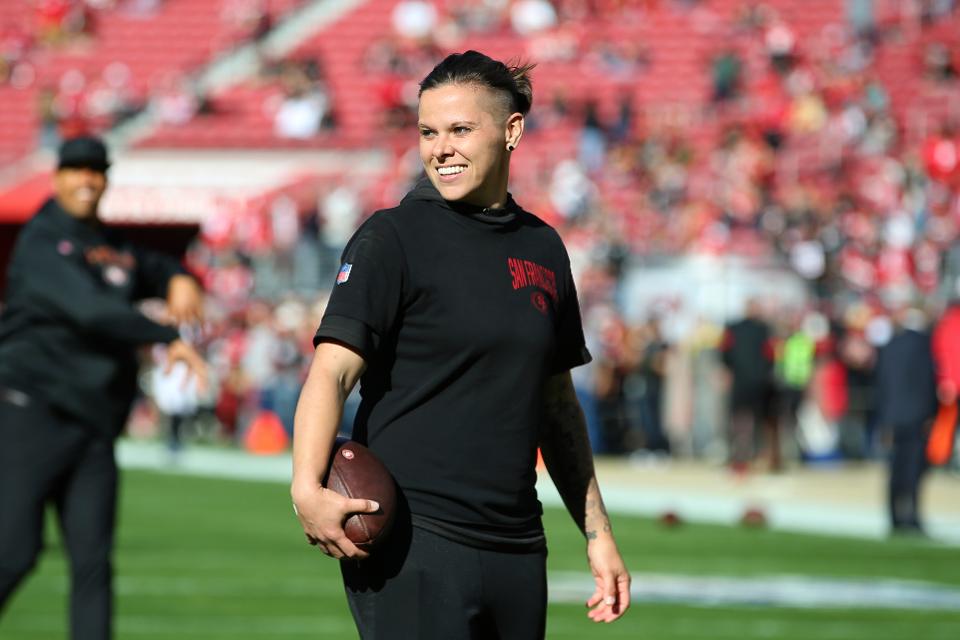
San Francisco 49ers Offensive Assistant Coach San Francisco 49ers Offensive Assistant Coach Katie Sowers made history at Super Bowl LIV when she became the first female coach to ever appear in the competition. Two weeks earlier, the 49ers’ next-door neighbours, the San Francisco Giants, hired Alyssa Nakken, the first female full-time coach in the MLB. Several other women have made headlines throughout the years for breaking into the professional men’s sports scene, including Bernadette Madox, who was the first full-time assistant coach for a men’s NCAA Division I basketball team. Though these breakthroughs represent crucial progress, they also serve as a painful reminder of how unequal the world of sports remains.

Eight of the nine current head coaches in the National Women’s Soccer League (NWSL) are men. More than half of the former head coaches of the Canadian women’s national ice hockey team are men. At McGill, out of 30 men’s and women’s varsity sports, 26 have a male head coach. These numbers don’t make headlines, however, because they are the norm. Throughout every level of women’s sports, men are present, from coaching and administrative roles to officials and media. 

The impact of women’s involvement in sports as more than just athletes is multi-dimensional. Both in and out of athletics, women face discrimination in the workplace. In the US, women actually used to comprise nearly all coaching positions for women’s teams before Title IX—a civil rights law intended to protect individuals from discrimination on the basis of sex in education programs or activities receiving federal funding—was passed in 1972. The law succeeded in improving women’s sports but attracted men to these coaching positions as they now offered better pay. In this world, once men decide that they want something, they get it, so the 90 per cent of NCAA women’s teams coaches that were female prior to the passing of Title IX has since dropped to just 40 per cent. 

There is nothing about men as a group that inherently makes them better coaches than women, so there is no reason that men should be disproportionately considered for—and subsequently awarded—coaching jobs. Additionally, the double standard presents another barrier to female coaches. Anyone in a position of power, such as a head coach, is subject to criticism, but for women, there is often no way to win. Female coaches are more likely to be faulted for factors outside of their control and given fewer resources than their male counterparts, leading to shorter tenures and less successful careers. Women can have more knowledge and experience and still lose out on a job to a man. Thus, administrators, media, and fans alike must be more cognizant of their implicit biases before they make judgements or decisions that could unfairly damage a female coach’s reputation. They should also keep in mind that the barrier is even higher for women of colour. Among coaches of both men’s and women’s teams, the majority are white, so there needs to be a greater effort to combat prejudicial hiring by implementing better policies for correcting implicit bias. 

Even at the lowest level of competition when girls are just beginning to play a sport, having female coaches can make a difference. As an eager, young athlete, I looked up to national stars like Mia Hamm and Cat Ostermann, but my true role models were the 20-something-year-old college players who spent their summers coaching and inspiring the next generation of female athletes. While famous stars are important for women’s sports, they can’t make a critical in-person connection with a young athlete like her coach can. Creating more opportunities for older players to return to their youth leagues as coaches and mentors will only increase the number of girls playing sports, which will, in turn, help improve the most competitive levels of women’s sports globally. 

Women’s sports matter, and slowly but surely women are levelling the playing field. Parity, however, means more than creating equal opportunity for female athletes—the goal is equal opportunity for all women in sports.  

Off the Board, Opinion

Reflecting on my “Mamma Mia” Years

I grew up hearing that university would be the best years of my life, where I would figure everything out. I would come out the other end with a better understanding of myself and the world, and after graduating, my friends and I would look back on these years fondly. Now, in my final semester at McGill, I am realizing that while my university experience has not always been smooth sailing, this may well be the time of my life so far.  My time in university is not done yet, but I already find myself missing it. 

Nostalgia is odd: I can’t really find another word to describe the bittersweetness of reminiscing over good memories. Nostalgia for the present, for something that is not finished yet, is even stranger. There is something unsettling about being acutely aware of the fact that the present moment is temporary, making it both beautiful and heartbreaking. I know that I will, in all likelihood, never again have as much freedom as I do now. The ability to work different jobs throughout the year, to take any of the classes I want, and to crash on my friend’s couch when I accidentally stay past the last metro’s run will not last forever. 

A good friend of mine coined the term “Mamma Mia years” to describe this chapter of our lives. Although it started out as a joking reference to the young and carefree attitudes of the characters in the 2018 movie Mamma Mia 2: Here We Go Again, I have come to find that the term perfectly encapsulates how I feel about my time at university. It is easy to mock––and I do––the naïveté that comes with being 20-years-old. We devote hours and hours each week to activities like improv theatre and hackathons. Though they may one day seem inconsequential, there is also something special about the genuine thrill of watching your friends do everything from performing in an adaptation of Medea, to organizing campus labour unions, and climate protests, and knowing that, right now, at 21 years old, all of these things do matter immensely. It is the people that I have surrounded myself with, and the opportunity to see them grow and prosper, that will make this part of my life so hard to leave behind. 

I have done my best to experience the past three years as they happened, but I still find myself obsessing over remembering every detail of a night spent at a birthday party or summer walks up Mont Royal. Pages upon pages of journal entries detail the exact chronological order of events from nights spent watching movies and playing Jenga with people I may never again see after graduation. The awareness of the temporary nature of young adulthood has made me both more appreciative of all of the joyful moments, and more anxious about the change that comes with next steps. I don’t know if I will ever find a resolution to this duality, but I am also learning that maybe it does not need to be resolved. Nostalgia for the present can give an experience an extra layer of significance that I have come to appreciate. 

“The awareness of the temporary nature of young adulthood has made me both more appreciative of all of the joyful moments, and more anxious about the change that comes with next steps.”

With all of this in mind, it is important to remember that my own university experiences, as well as those of many other students, have not always been easy. McGill makes seeking and receiving mental health care difficult and inaccessible, balancing jobs and school is a reality for plenty of us, and institutional barriers to accommodations are something that many marginalized students have to navigate their way around. I believe my “Mamma Mia years” have been in spite of the university, not because of it. 

I have accepted that this may be as good as it gets, but that doesn’t necessarily bother me anymore. I know that the next chapter of my life can still bring me joy, even with the inevitable changes. 

“Standing clearly at the crossroads, no desire to run. There’s no hurry anymore, when all is said and done.” —Andersson, Ulvaeus.


Arts & Entertainment, Books

Finding the right place to read

A university lecture or a book club: By way of discussion, both bring the personal act of reading into an academic or social realm. However, these cultural spaces don’t necessarily motivate the same types of discussion. Barring other factors, like contextual formality or accessibility, an individual moves through these spaces carrying their own reading habits. In having to tailor their individual practices to a group setting, the question remains as to how a given setting influences the reader, and whether or not the reader feels satisfied by its literary provisions.

From a young age, Emily Matuska, U1 Arts, has always loved reading, and she came to McGill to pursue her passion.

“I’m just drawn to the ethereal beauty of language,” Matuska said. “Genuinely, as an art form, I think [that] I resonated with words and language more than anything else.”

Studying English literature at McGill, however, has so far been a double-edged sword for her. On the one hand, Matuska cherishes her classroom for situating her with like-minded students, all as eager to engage in thoughtful discussions about novels and poetry as she is. On the other hand, Matuska notes that the rigour of McGill’s academic atmosphere has demanded most of her readerly attention, often in ways opposite to how she engages with literature in her personal reading life. 

“There is a really huge focus on, ‘Why do you study literature, why is it important, why is it useful for society, how has it affected the world around you?’” Matuska said. “But that doesn’t have much bearing on why I would want to study literature. For me, and I think, for a lot of other literature students, you read because you love to read. […] I kind of get a little fed up with the emphasis [on] making it so didactic.”

In Matuska’s eyes, ascribing value to a text by virtue of its association to scholarly theories and traditions sterilizes literature as an artform. She worries that university, in part, depersonalizes the act of reading; in the classroom, discussions often weigh the importance of a text based on its impact in the canon, not by its capacity to deeply connect with someone, even if only on a personal level. 

Nevertheless, Matuska acknowledged that the serious study of literature requires concentrated discussions on canonized texts. This is especially the case at McGill, which has a highly traditional curriculum.

“You know [that] you miss things [when] just sticking to the canon but then you have to ask, how do you study time periods of literature if you don’t have a canon? How do you gain a certain knowledge of a vast expanse of time?” Matuska said. “I don’t think you really can.”

For those readers who seek community and intellectual stimulation outside of the classroom, the question remains as to where readers can find more diverse, informal spaces to share their love of literature. Librairie Drawn & Quarterly (D+Q), a staple of independent bookstores in Montreal since 2008, provides a possible solution to academic stiffling. 

Though the concept of a book club is certainly not exclusive to Librairie D+Q, the bookstore is unique to Montreal because of its sustained commitment to engaging communal literacy. Every month, in addition to author talks and book launches, Librairie D+Q hosts several different public book clubs in the Mile End. With clubs focusing on Indigeneous literature, science fiction, graphic novels, and children’s literature—among many others—each one highlights a diverse selection of contemporary authors across multiple media and genres. 

For Luke Langille, Librairie D+Q’s manager, the bookstore’s strengths come from its hybrid status, both in terms of the cohort of readers it draws in, and of the types of discussions it promotes. 

“The way I like to make my pitch […] to members of the public who have yet come to one of our book clubs is that it’s pretty laid back as an environment,” Langille said. “But it’s also somewhat similar to a studious discussion because of the fact that we have so many smart people who show up and talk about books. It’s really lively and informative. It’s stimulating enough […] but definitely a departure from an academic setting.”

While students do attend the book discussions, D+Q’s accessibility welcomes readers of all walks of life. Without the pressures of specific schools of thought for discussions to adhere to, the book club mediates conversations where opinions stem from personal insights in as much as they do academic ones. Without an evaluative or formal spirit, anecdotes related to the text’s plot bring as much to the conversation as comments about its creative use of form. What often motivates a lively discussion at D+Q, is therefore, a text’s relevance to the lives of the readers discussing it. That a reader can choose which books to read—thus curating their own syllabus for discussion—only adds to the possibility for genuine connection to a text, which often leads to impassioned discussion.

What book clubs have to contend with, and what universities tend to avoid, is the overriding conception that the most productive book discussions occur only within dedicated academic contexts. Taken to an extreme, value judgments about a reader’s connection to a text, improperly assumed based on the context in which they read that text, create a hierarchy of literacy. The notion of “proper reading” dismisses anything that doesn’t align with an institutionally established version of literacy as inferior. It renders the fundamentally democratic act of reading insulated, reserved for an imagined elite. 

Still, many educators recognize the value of less traditional forms of analysis. In an interview with //The McGill Tribune//, Professor Alexander Manshel, who teaches 20th Century and Contemporary American Literature at McGill, spoke about why the segmentation of reading is a fallacy. Invested readers hold an inherent bias to quality, no matter what they read. Rather than a ladder on which different types of readers or genres can be ranked, Manshel contended that all readers generally seek to be rewarded for the attention they devote to a text. 

“Whether you study the pinnacle of a canon […] or you study pulp fiction and best-sellers, both of which you can do in a classroom, close reading undergirds both of those practices,” Manshel said. “But I don’t think the university, while it does emphasize close reading, has a monopoly on close reading. […] It may not sound the same, it may not use the same terms, but close attention to detail is something that committed readers, whether inside the university or outside, employ in different ways.”

Different contexts value different kinds of reading, but that does not need to be seen as limiting to a reader’s connection with a text. It is inevitable that different contexts will stress different priorities as regards literature. Though the way in which discussions manifest may differ from place to place, close readerly attention—across all genres and contexts—will always deepen a reader’s connection with that text. The variety of contexts and genres that a reader will encounter, and the variety of discussions to participate in, are ultimately differences to be treasured.


Arts & Entertainment, Music

Where do I begin?: Vaporwave

Sounds and images from the era of Windows 95 and peak mall culture manipulated to a degree that is both recognizable of its past roots yet remarkably separate from its source material; this is the spirit of the internet-born subculture, vaporwave.  The aesthetics of vaporwave revolve mainly around the popular technologies and media from the late 70s to the early 00s. The genre allows for an anti-consumerist or a nostalgic interpretation of its music through its distortion, which makes it worth a listen. Here are some albums from four subgenres of vaporwave that capture different aspects of their ‘aesthetic.’

Greek Busts and Dolphins  – Classic Vaporwave

Floral Shoppe – Macintosh Plus (2011), Chuck Person – Eccojams Vol. 1 (2010)

Eccojams Vol. 1 (2010) by Chuck Person (a pseudonym of American experimental musician Daniel Lopatin) is allegedly the first vaporwave album. The ‘ecco’ is a double entendre on two aspects of the album that play a defining role in the vaporwave aesthetic: The echo effect that comes from the glitching of 80s mainstream pop songs, and the use of “Ecco the Dolphin,” a video game character from the 90s, who is featured in the album’s surrealist cover art. 

 Eccojams became a major influence for 2011’s  Floral Shoppe  by Macintosh Plus, the alias of American music producer Ramona Xavier. This album would eventually popularize vaporwave, with the track “Lisa Frank 420 / Modern Computing,” becoming arguably the most well-known song of the genre. Chuck Person is not completely forgotten in this iconic album with Xavier including the song, ‘Chill Divin’ with ECCO’, an homage to Eccojams and the aforementioned dolphin. 

Sailor Moon and Japanese Pop – Future funk

MACROSS 82-99 – SAILORWAVE (2013)

Future funk is the most accessible strain of vaporwave. With heavy influences from 80s Japanese city pop, future funk follows the vaporwave’s nostalgic aesthetic and critique of consumerism from material derided as cheesy and commercial in its time. 2013’s Sailorwave by Macross 82-99, a pseudonym for a Mexican producer known only by their first name, ‘Gerald,’ is a staple of the subgenre, with tracks filled with catchy melodies at a high tempo. Furthermore, the title Sailorwave references the iconic anime character Sailor Moon, emphasizing vaporwave’s fixation of the era. 

Department Stores and Food Courts – Mall Soft

Cat System Corp – Palm Mall (2014), North Shore Memory Gardens – The Orchards (2019)

Focussing on the mall as a defining symbol of consumerism emblematic of the past, mall soft contrasts the energetic nature of future funk. The most well-known album from this subgenre is 2014’s Palm Mall by Dutch vaporwave producer Jornt Elzinga under the alias Cat System Corp. The main piece is its opening 22-minute track, ‘Palm Mall’, which simulates a walk through a mall complete with samples of announcements from department stores and faint conversations to emulate passersby. A more recent addition is The Orchards by North Shore Memory Gardens. The Orchards also samples sound elements of a mall, such as arcade noises and people talking, but forgoes simulation for a more casual electronic and jazz sound; this distances it from the ‘background music’ feel found within Palm Mall

Commercials and Weather Channels  – Signalwave / Broken Transmission

New Dreams Unlimited – Fuji Grid TV EX (2011), Blizzard 96 – Blizzard 96 (2019)

Probably one of the most abstract subgenres of vaporwave, Broken Transmission is characterized by the splicing of random and often contrasting samples from retro television—breaking each other’s ‘transmission’—to create the sound that comes from flipping through channels on a television. The hallmark album of this subgenre is Fuji Grid TV EX from 2011, a project by pioneering producer Ramona Xavier under the pseudonym New Dreams Unlimited. Xavier leans into the anti-consumerist philosophy through the album’s heavy use of jarring and haunting distortion of ad tunes that are continuously spliced together. The final product emulates the feeling of an uninterrupted bombardment of commercials. Another approach to Broken Transmission is Blizzard 96’s self-titled project released last year. This album slows down and distorts recordings from the Weather Channel during a monumental blizzard that affected the Northeast in January 1996. As explained in the artist’s bandcamp, this album represents a special childhood memory that can be captured as nostalgia through the distortions of vaporwave.

Read the latest issue

Read the latest issue