

On May 14, 429 activists carrying more than 11,000 kilograms of humanitarian aid set sail to Gaza from Marmaris, Türkiye, to protest against Israel’s blockade of the Gaza Strip and ongoing genocide of Palestinians. Two Palestinian solidarity activist coalitions—the Global Sumud Flotilla (GSF) and the Freedom Flotilla Coalition (FFC)—organized this mission in tandem; the sailing activists represented the largest-ever civilian-led maritime mobilisation project in support of Palestine.
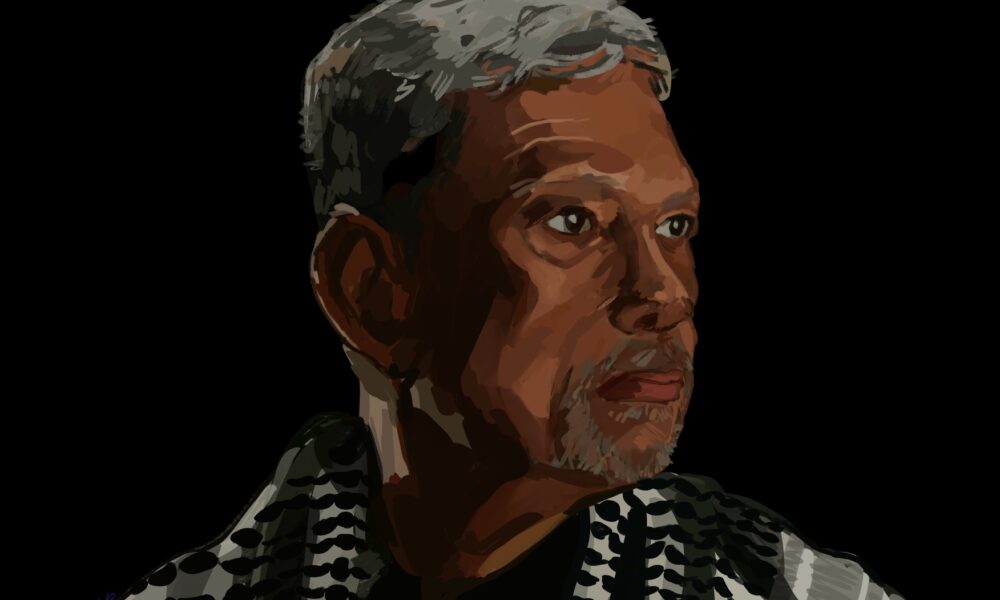
On May 18, the Israel Defense Forces (IDF) raided over 50 boats from the GSF-FFC fleet in international waters and detained all of the activists aboard, transferring them to Israeli naval vessels containing makeshift prisons constructed from barbed wire and metal shipping containers. Detained activists have since testified against the IDF, speaking to the brutal acts of physical, sexual, and psychological torture the IDF inflicted during this period—abuse that continued until Israel deported the activists on May 21. Among these activists was Ehab Lotayef: FFC organizer, local Montreal activist, poet, and IT and Technical Services manager at McGill University.
Lotayef was born in Cairo, Egypt, and moved to Montreal in 1989. Throughout his career in activism, Lotayef’s work has spanned international, national, and local fronts. Alongside his advocacy for Palestinian rights, he has campaigned against the 2003 Iraq war, served on the boards of the Muslim Council of Montreal and the Egyptian Canadian Coalition for Democracy, and organized locally against Bill 21, a 2019 Quebec law that prohibits public-sector workers from wearing visible religious symbols while on the job, among a myriad of other causes. In honour of his late mother, Lotayef also founded the Dr. Fatma Amer Educational Charity, which seeks to provide financial support to women and girls completing higher education in Egypt. In an interview with The Tribune, Lotayef shed light on the roots of this decades-long, intersectional advocacy.
“My involvement in activism has always been related to my late mother, who herself was a trailblazer in her own way,” he shared. “She was one of the [first] women in Egypt to get a PhD from England [….] She was somebody who didn’t accept injustice […] [and raised] me as a single mother with this strict moral code, […] so I cannot look the other way when I see [injustice].”
Lotayef first became involved in flotilla missions to Gaza in 2010, following the IDF’s raid of Mavi Marmara, the lead flotilla vessel in the 600-person Gaza Freedom Flotilla mission. During the raid, Israeli soldiers killed nine civilian activists and injured over 50 more. In response, Lotayef and 25 other Canadian activists founded the Canadian Boat to Gaza (CBG), a national division of the FFC. The CBG has since taken part in over 10 humanitarian missions to Gaza, including the May 2026 flotilla. According to Lotayef, the purpose of such voyages to Gaza lies far beyond the cargo the fleet transports.
“If all the boats that attempted to break [Israel’s] blockade since 2008 till today were filled to the brim [with aid] to the point where they risk sinking due to the load on them, […] they would [still] not be [carrying] enough [to support] the people of Gaza for even a day,” he said. “Our destination on the map may be Gaza, but our real destination is the conscience of humanity.”
Lotayef further noted that flotilla missions to Gaza do not occur spontaneously, but rather require months of research and training. In the days leading up to the May 14 mission he participated in, legal experts convened for the Civilian Resistance Against Genocide: Global Sumud Flotilla and International Law conference to finalize a global accountability strategy in response to Israel’s prior attack on the April 2026 GSF mission. GSF and FFC organizers also distributed updated risk and impact assessments to all flotilla participants, and participants convened for a general assembly for final discussions regarding risk, strategy, and feasibility. The GSF website described the mission as a “moving body of law.”
Lotayef recounted the extensive preparations that individuals involved in a flotilla mission to Gaza must undergo before ever boarding a boat.
“We have a participant committee that interviews people that are interested [in joining], social workers [who] screen people to make sure they are suitable for such a mission,” he stated. “Preparation [for] Israeli attack, confrontation, and imprisonment also [happen] again and again in different forms during different phases of the mission, some theoretical, some practical role-playing.”
Lotayef highlighted the scale of international coordination the mission required, with activists from over 40 countries working together to break Israel’s blockade of Gaza.
“Anybody who works in activism knows that one activist group has 10 opinions [within it]. 15 [international] campaigns […] worked together [on the latest flotilla mission to Gaza], and that was a success in itself [….] They put their differences aside and united on one goal, pooling their meagre resources,” he said. “It’s a very big collective action, and that is one of the things that I personally am very proud to be a part of.”
Lotayef’s voyage on a vessel named ‘PERSEVERANCE’ was his third flotilla mission since 2010 and his second time being captured by Israeli forces. He underscored that the IDF inflicted violence on this latest mission at levels incomparable to its prior aggression against activists.
“In our worst expectations, we did not expect Israel to be as violent and intentionally harmful to us as it was in this May [2026] flotilla,” Lotayef stated. “[Activists showed] no physical resistance, even when [Israeli soldiers] were taking us from our own vessels in international waters. The hurt, the harm, the physical torture, the psychological torture, the starving of [activists], subjecting [activists] to cold and heat, […] the sexual abuse […] all that was done [by Israel] for one reason, to punish us and teach us a lesson.”
Lotayef recounted how an IDF soldier stabbed him in the hand as he attempted to distribute water and assist a fellow activist on the verge of losing consciousness.
“One person was collapsing, and I realized that he had his heart medicine in his pocket, but he was so weak that he could not put his hand in his pocket to get it out, so he asked me to do that,” he said. “I [had some] freedom of movement, so I used it to help people in whatever way I [could]. When I got my hand slashed, I did not regret it for a second. That I could’ve avoided that […] didn’t even cross my mind.”
Lotayef maintained that despite IDF-inflicted violence against activists, the focus must remain on Palestinian suffering under Israel’s genocide.
“If the price of what we have gone through is getting back some Palestinian rights that have been ignored and denied for decades, I think we’re all very happy to pay that price,” he said. “If we’re serious about human rights, we need to do more, as a country, on the Palestinian file. It is not because a group of Canadians were subjected to [torture]. We do not want to be the story. Our story is the story of the Palestinian suffering, and that’s what we want the attention to be directed to.”
On May 20, prior to Israel’s deportation of the flotilla participants, Israeli National Security Minister Itamar Ben-Gvir released a video in which he personally mocked and abused handcuffed flotilla detainees. According to Lotayef, Prime Minister Mark Carney not only neglected to adequately condemn this public torture of civilian activists; he also failed to intervene to prevent further abuse following Ben-Gvir’s post.
“Canada failed us. I […] say that without hesitation,” Lotayef stated. “What happened to us was known to Canada and to other Western countries while it was happening. It is not that we told [our] stories after we were released [….] Itamar Ben-Gvir released [the video] himself […] during the time we were being subjected to the worst torture [….] Other countries like Australia, Spain, and Ireland [are] speaking much more strongly about what’s happened, […] but we are still screaming […] to get a meeting with [Canada’s] Prime Minister or Minister of Foreign Affairs.”
Although flotilla organizing remains a defining part of Lotayef’s advocacy for Palestinian liberation, he argued that meaningful change depends on a diversity of activism tactics and consistent engagement, rather than on a single form of resistance.
“I hate it very much when people say that any particular form of activism is the [only] right way to fight for justice for Palestinians, or for the Palestinian cause,” he explained. “There is not [only] one way to achieve results. [Results are] an accumulation of different ways of action [….] I don’t belittle any kind of work […] [and] this is something that is absent in many activist circles [….] The important thing is not to withdraw from the justice scene altogether.”
Lotayef’s activism also extended to his time at McGill. In 2021, Lotayef resigned from his role as a member of McGill’s Board of Governors (BoG) after three years of service. He cited the BoG’s decision not to table a motion that would mandate McGill to display a statement acknowledging the university’s ties to colonialism and enslavement and expressing a commitment to equity as his reason for resigning.
According to Lotayef, the BoG failed to follow its own democratic protocol—an issue he still observes at McGill in the form of administrative misconduct.
“I couldn’t live with myself staying on the Board,” he said. “We’ve […] seen, many times, the [Students’ Society of McGill University] being threatened by [McGill] cancelling or putting on hold [their shared] Memorandum of Agreement [….] McGill uses any tools at their disposal to […] keep [the university] as this conservative bastion of old-school ways of thinking and doing things.”
In a written statement to The Tribune, a spokesperson from the McGill Media Relations Office (MRO) stated that the BoG did not bring forward the motion regarding the statement because it had not undergone the proper review process, rather than for a content-related reason.
“McGill University recognizes that the wealth leading to its establishment was derived, in part, from James McGill’s engagement in the colonial economic system and the transatlantic slave trade […] [and] is proud to welcome exceptional students, faculty, and staff of all identities, beliefs, and origins,” the MRO wrote. “The University thanks Mr. Lotayef for his work on the Board of Governors and for his continued contributions to [the McGill] community.”
Alongside his formal experience in activist organizing, Lotayef has also practiced art as a mechanism of advocacy. He described how his poetry and lyricism were key to maintaining morale throughout the May 2026 flotilla mission.
“When I was on the boat, and we were sailing, […] my art saved me,” he shared. “I wrote, ‘Do you sail to free Palestine or sail to free yourself? You sail to break a siege while under siege yourself.’ It was a saviour for me. Maybe I would have been disillusioned [if] I wouldn’t have expressed myself in that song.”
For Lotayef, this recent journey to Gaza reaffirmed a lesson learned over decades of activism: Despite reprisal and regardless of potential shifts in the form of resistance, persistence will remain so long as Israel’s siege on Gaza continues.
“Many incidents during those three days [in Israeli detainment] have shown me how weak the powerful can be and how strong the determined person can be,” he stated. “After years of self-disciplining and focus, […] I have managed to [be at] total, internal peace, [knowing] that whatever [the IDF] does to my body is not going to reach my soul, my mind.”