
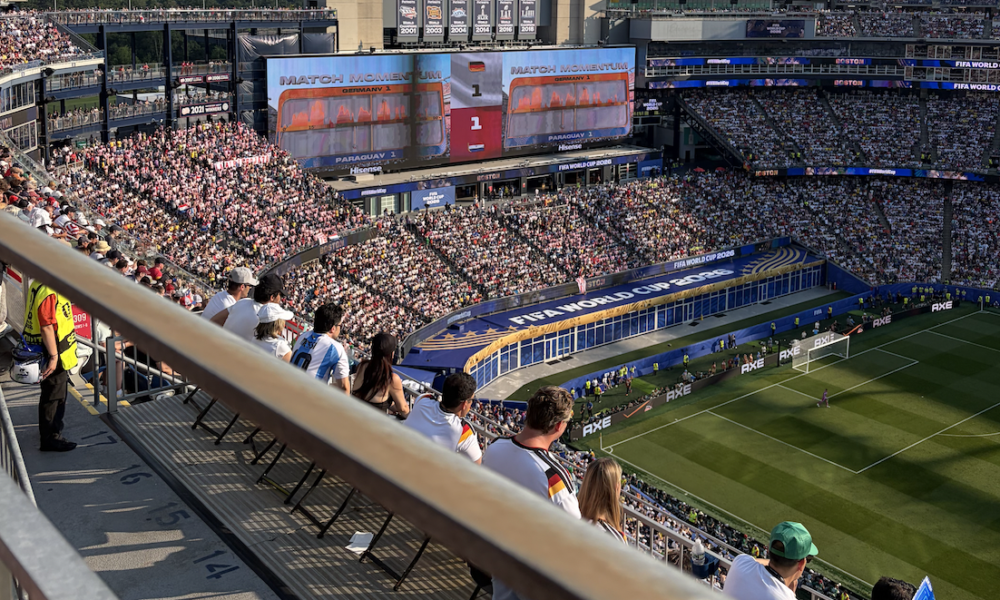

On July 2, Folarin Balogun, star forward for the United States Men’s National Team (USMNT), received a straight red card in the 64th minute of the USA vs. Bosnia and Herzegovina Round of 32 match in the Fédération Internationale de Football Association (FIFA) World Cup 2026. Balogun stepped on Bosnia and Herzegovina defender Tarik Muharemović’s ankle, leading to the automatic consequence of a red card under the FIFA Disciplinary Code (FDC): A one-game suspension. The FIFA Disciplinary Committee also issued Balogun a $40,000 USD fine, as the player ignored the conditions of his red card when he joined his team’s post-game victory celebration on the pitch.
However, just hours after the match, U.S. President Donald Trump contacted FIFA president Gianni Infantino, demanding the association revoke Balogun’s suspension. Three days later, the FIFA Disciplinary Committee invoked Article 27 of the FDC, deferring Balogun’s one-game suspension by a year-long probationary period to exceptionally allow the USMNT’s leading player to compete in the USA vs. Belgium Round of 16 match. FIFA’s decision was met with significant global backlash, with the Union of European Football Associations and the Royal Belgian Football Association issuing public statements questioning whether the federation was upholding its duty to impartially administer the World Cup tournament.
Although FIFA insists the Balogun decision is in line with FDC protocol, FIFA has not postponed a World Cup red card suspension since Manoel Francisco dos Santos—famously known as Garrincha—earned a red card in 1962. This was another incident where extensive lobbying by the politically powerful enabled a beloved, penalized player to compete.
Political interference in the federation’s operations has taken more ideologically charged forms too: During the 1934 World Cup in Italy, former Italian prime minister Benito Mussolini routinely dined with referees and officials the night before crucial matches for his country, including before Italy’s victory in the World Cup final. Mussolini also used the tournament as a stage from which to propagandize fascist Italy. Clearly, pressure from world leaders, whether due to love for a star player or ideological ambition, routinely coincides with a lack of adherence to the FDC—Trump seems to be an example of both.
Despite frequently capitulating to unequal global power politics, FIFA has positioned soccer—and, by extension, itself—as a force for unity, dialogue, and peace. In February, FIFA announced a $75 million USD collaboration with Trump’s Board of Peace, a transnational political organization seeking to make progress toward peace in the Middle East—notably, with minimal substantive Palestinian representation. FIFA has described its role in the Board of Peace project as “harnessing the power of football to support recovery, stability, and long-term development” in Gaza by aiming to construct 50 mini-pitches, five full-size pitches, a FIFA Academy, and a 20,000-seat national stadium in the region.
This act of sportswashing is a blatant attempt to distract from the United States’ complicity in Israel’s genocide in Gaza. The FIFA-Board-of-Peace collaboration joins countless “infrastructural” initiatives spearheaded by Trump, including his vision of the Gaza Strip as a beach-front investment hub and travel destination. Infantino is equally complicit, basking in the importance vested in his organization’s sport through collaboration with the Board of Peace.
In June, Infantino proposed a symbolic Israel-Palestine soccer match to serve as the opener for FIFA’s newly-instituted under-15s soccer festival, positioning the sport as the peacemaking solution to the decades-long, intractable divide between the nations. This proposal perversely calls on Palestinian athletes to play against their colonial oppressor and genocidaire, and completely disregards Israel’s systematic targeting of Palestinian athletes and sports infrastructure. Since October 7, 2023, Israel’s genocide has killed 1,012 Palestinian athletes and destroyed 285 sports facilities in the Gaza Strip.
When a world leader can decide the verdict of a soccer match, the FIFA World Cup becomes nothing more than an extension of realpolitik, paradoxically surrendering to the powerful while casting the sport of soccer as the idealized, apolitical peace broker. The Balogun incident is a mere reminder that FIFA must finally decide if it will remain a political pawn or a genuine sports association.