
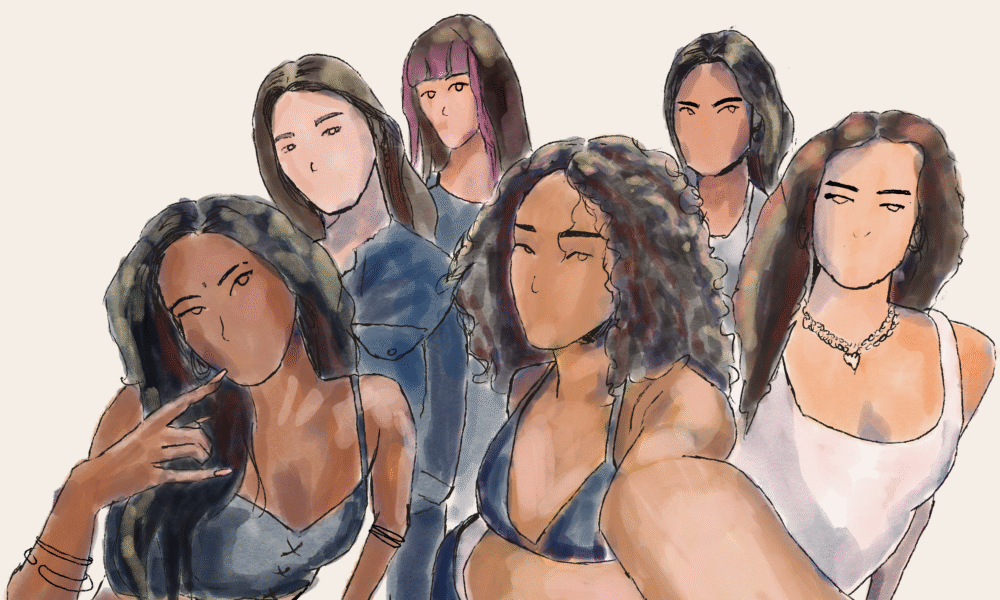


Since their 2023 debut, KATSEYE have skyrocketed into the mainstream. After a year of silence, the group resurfaced in 2025 with their second EP, Beautiful Chaos. Their hyperpop sound, paired with intricate choreography, marks a departure from their previous K-pop-inspired, teen girl music and aesthetic. Fans often celebrate KATSEYE as a symbol of empowerment, but the group’s carefully manufactured image raises questions about how much agency the members actually hold.
The group was created by HYBE—the South Korean entertainment giant behind BTS and TXT—and the American record label GEFFEN. KATSEYE’s formation was documented in Netflix’s Pop Star Academy: KATSEYE, which explains how a handful of trainees went through an intensive training and development program, packed with singing, dancing, and performance lessons. After over a year of rankings and monthly evaluations, 20 girls were selected by the producers to advance to the global survival show, The Debut: Dream Academy. The finalists were pitted against each other in a popularity contest for a spot in the six-member group. The final group consists of Daniela Avanzini, from Atlanta with a Cuban and Venezuelan background; Lara Rajagopalan, from LA with Indian roots; Manon Bannerman, from Switzerland, born to Swiss-Italian and Ghanaian parents; Megan Skiendiel, from Hawaii with Chinese ancestry; Sophia Laforteza, from the Philippines; and Yoonchae Jeung, the only member born and raised in Korea.
From the start, KATSEYE’s most marketable quality has been its diversity. The six girls come from diverse ethnic and national backgrounds, attracting a broad international audience as each member proudly embraces their cultural identity. HYBExGEFFEN have co-opted the demands for diversity—a significant absence in K-pop—to expand their global reach. The members’ different backgrounds are marketed as proof of progressiveness, instead of addressing the industry’s exploitative power imbalances, tokenistic use of diversity, and beauty standards imposed on female idols.
Though KATSEYE were designed to globalize the K-pop methodology by stripping the Korean from K-pop, their popularity is built not only on talent but also on the immense corporate machinery shaping their every move. The KATSEYE brand, which is centred on inclusivity, is a facade for capitalist greed—exploiting the hard work and pain of the girls who make up the group.
On their second EP, KATSEYE embraced more mature sounds and visuals. Their image, like countless other girl groups, is inseparable from the commodification of the female body. “Gnarly,” the lead single of their EP, was the catalyst for this provocative rebranding. The music video and song are meant to be off-putting and ‘cringey,’ while refusing to shy away from the sexual innuendos. With the choreography incorporating twerking, porn soundbites inserted into the soundtrack, and a visual of bees having sexual intercourse, it is clear that the members’ sex appeal is a crucial selling point of the group. This serves as a reminder that the talented girls who make up KATSEYE are merely employees whose songs are written and choreographed by professionals, whose outfits are chosen by stylists, and whose image is crafted by executives. This commodification of sex becomes more unsettling upon realizing that the youngest member of the group, Yoonchae, is still 17 years old.
Their corporate partnerships reinforce this dynamic, especially their recent collaboration with GAP. The “Better in Denim” ad campaign presents a dichotomy between the ideal of global cooperation that KATSEYE embodies and the very product they promote: A fast-fashion company built on an underpaid, exploited workforce with high environmental costs. With new sponsorship, partnerships, and ad campaigns every other month, KATSEYE increasingly serves corporate interests. Their racialized bodies are treated as marketable assets, revealing the moral decay embedded within the global pop music industry.
Ultimately, KATSEYE represent the contradiction of global pop: A celebration of womanhood, diversity, and hard work, all while constrained by the structures of capitalism and the male gaze. The success of this girl group proves that diversity is not enough to dismantle these systems of oppression. KATSEYE shine on the global stage, but its brilliance only reveals how much of pop’s empowerment is scripted.