
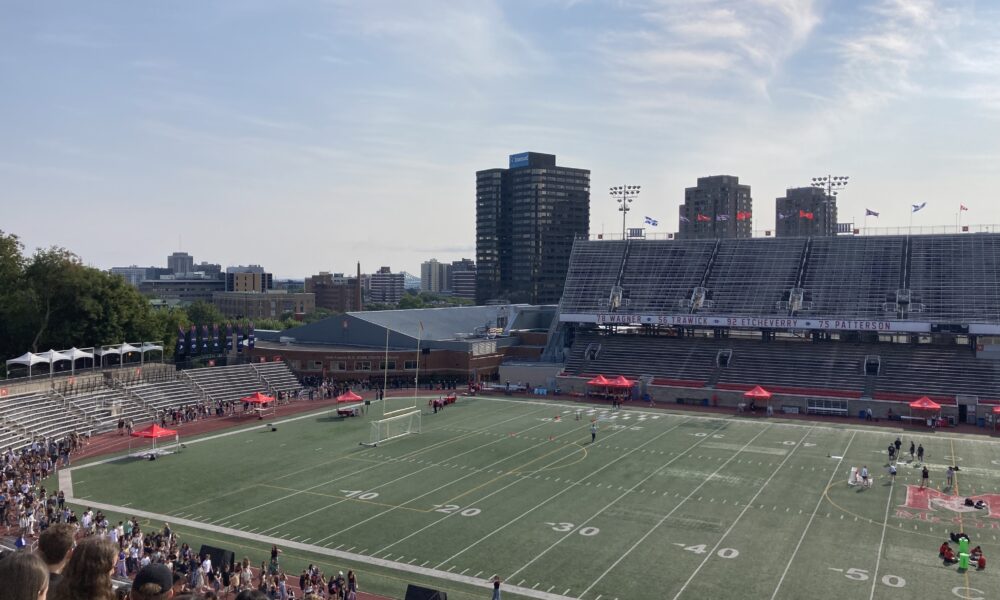




Recent provincial pressures on McGill’s finances—from government limits on how many international students McGill can accept, to government-mandated tuition hikes for out-of-province students—have led the university to cut costs. Most recently, McGill cut 25 McGill Athletics varsity and club programs.
As McGill Athletics announced on Nov. 20, the teams that McGill has cut beyond this season are men’s and women’s varsity Badminton, men’s varsity Baseball, men’s and women’s Fencing, women’s varsity Field Hockey, men’s and women’s Figure Skating, men’s and women’s varsity Golf, women’s Lacrosse, men’s and women’s Logger Sports, men’s and women’s Nordic Ski, women’s varsity Rugby, men’s and women’s Sailing, men’s and women’s Squash, men’s and women’s Tennis, men’s and women’s varsity Track and Field, and men’s Volleyball.
Teams that will still compete beyond the end of the 2025–2026 academic year are co-ed varsity Artistic Swimming, men’s and women’s varsity Basketball, co-ed Cheerleading, men’s and women’s varsity Cross Country, women’s Flag Football, men’s varsity Football, men’s and women’s varsity Hockey, men’s varsity Lacrosse, men’s and women’s varsity Rowing, men’s varsity Rugby, men’s and women’s varsity Soccer, men’s and women’s varsity Swimming, and women’s varsity Volleyball.
Community members immediately criticized the university for what they called an “unbelievable” decision. In an interview with The Tribune, varsity Track and Field Co-Captain Ashleigh Brown, U4 Arts, affirmed being “completely blindsided” by the results of the varsity review.
“To give you an idea of how blindsided we were, our head coach was in the middle of doing tours for [potential recruits when cuts were announced],” she said. “Given the standards that [McGill Athletics] set, we thought that we fit most of [the review] criteria, so most of us were confident that our team would be staying. We were never told explicitly that the Track and Field team was under [any] scrutiny.”
Similarly, Vice President Competitive of McGill’s Nordic Ski Club, Matthew Randall, U3 Science, emphasized in an interview with The Tribune that McGill Athletics warned Nordic Ski they would be restructuring only two weeks prior to the decision’s announcement.
“We still don’t have more information about how teams were compared concretely [when] McGill Athletics went about making this decision very quickly,” Randall emphasized. “Nov. 3 is when [McGill Athletics] first told [Nordic Ski] that they were going to be making cuts [….] They told us the review process was sort of months in the making, but this [was] the first we were hearing formally of it.”
In a written statement to The Tribune, McGill Athletics shared some of the main factors they took into account in their review decisions, emphasizing a potential provincial focus.
“[We looked at] overall competitive performance and future potential, [….] availability and suitability of competition venues, […] financial and administrative requirements, […] [and McGill Athletics’] ability to provide appropriate and sustainable support […] while ensuring compliance with McGill University policies,” McGill Athletics wrote. “Through a rigorous review process guided by the new RSEQ model, [we are] aligning [our] programming with the future of sport in Quebec.”
McGill Athletics also outlined the post-restructuring supports they have offered to impacted athletes.
“Administrators continue to meet with affected sports to […] discuss potential pathways for continued participation, including the possibility of transitioning to SSMU club status,” McGill Athletics wrote. “We continue to encourage our students to seek support through the [Athletics] Local Wellness Advisor.”
However, Martlets Field Hockey vice captain Grace Hodges, U3 Arts, expressed in an interview with The Tribune that the mental health resources recommended by McGill Athletics are inadequate.
“[McGill Athletics has] one therapist on staff who [is] obviously wonderful at their [job], but can’t possibly be expected to account for all the athletes [cut], particularly given that trying to get an appointment with them [regularly] takes a month [already],” she stated.
Hodges further shared that the reactive measures of support McGill Athletics has provided to impacted athletes feel performative.
“They’ve offered meetings with all the teams that were cut,” she stated. “I think that is a response to the media blowback that there’s been [….] You have Olympians who are talking about how embarrassing this is for McGill, […] [so] I don’t think there’s a genuine concern for the athletes. I think [McGill is concerned] for their image and damage control.”
Sports Editor Clara Smyrski and Sports Staff Writer Jenna Payette are members of the McGill Women’s Field Hockey team. Neither was involved in the writing, editing, or publication of this article.