
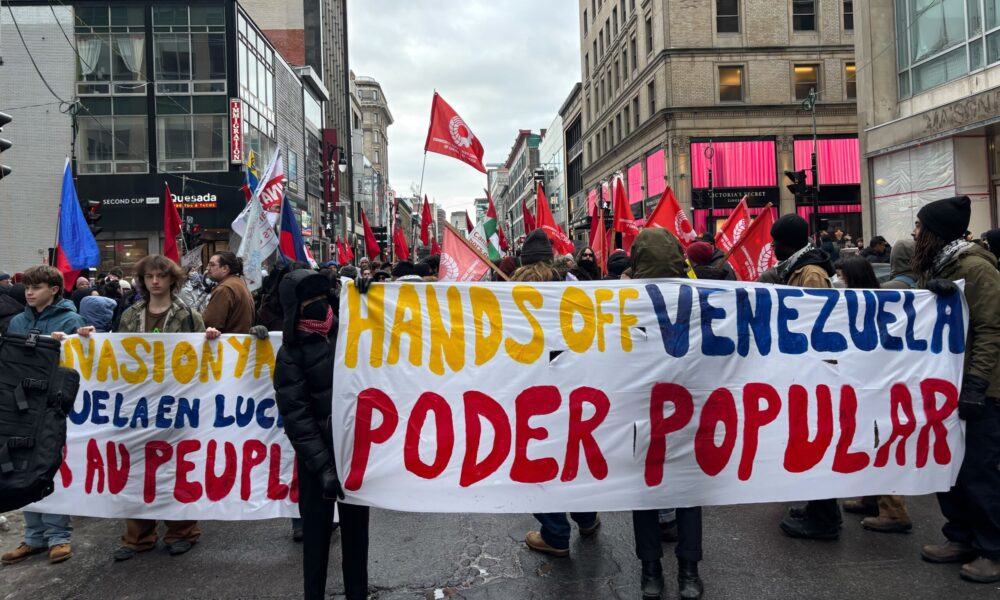


On Jan. 11, 10 activist groups in Montreal joined together for a demonstration against the military invasion of Venezuela. The protest began at 2:00 p.m. at 1134 rue St.-Catherine Ouest, with members of each group holding signs representing their organizations and condemning the United States’ recent actions in Venezuela.
The United States Army’s Delta Force unit conducted ‘Operation Absolute Resolve’ on Jan. 3. The military mission captured and transported the president of Venezuela Nicolás Maduro and First Lady Cilia Flores to Manhattan for prosecution on charges of conspiracy to possess and the possession of machine guns and destructive devices, as well as conspiracy to import cocaine. Maduro has also been charged with narco-terrorism.
Operation Absolute Resolve follows escalating U.S. military interventions in Venezuela, with the intention to curb drug trafficking from South America into the U.S. On Sept. 2, U.S. President Donald Trump carried out the first military strike on a water vessel connected to the drug trade. All 11 people on board were killed in what Democratic senators have likened to execution without trial. 34 additional strikes were conducted between then and Jan. 3, killing at least 115 people. The United Nations has described it as a violation of international human rights law.
Following Maduro’s capture, there have been mixed reactions among Venezuelans. While some citizens have expressed gratitude for the United States’ interference given Maduro’s history of corruption, others have expressed deep concern for Trump’s plans for the U.S. to run Venezuela in Maduro’s absence.
In Montreal, protesters focused on how U.S. interference could harm the already shaky democratic system in Venezuela, allowing the U.S. to take advantage of the power vacuum for its own economic gain.
The Revolutionary Communist Party (RCI) held a table on the corner of rue St.-Catherine and rue Stanley, where the demonstration was set to begin. They offered informative pamphlets on their mission as well as reading materials on capitalism and imperialism across the globe.
In an interview with The Tribune, a representative from the RCI, who wished to remain anonymous, explained that the United States’ intervention in Venezuela is directly tied to capitalistic motives, claiming that Trump was not seeking to free those in Venezuela from dictatorship, but to instead gain access to the largest oil reserves in the world.
“We know that there are people in Venezuela who are partying right now because Maduro is gone, but I believe that this positive energy will soon go away because the conditions there will not get better,” the representative said. “If you kidnap some politician, or you kill them, it’s not gonna make a change.”
At around 2:30 p.m., an event organizer made a speech to launch the march. The organizer explained that while demonstrations such as this one are effective at rallying the public, they often go unnoticed by government officials who can take meaningful legal action.
“I thank you for your camaraderie, for coming out, but we need to think about what comes next,” the organizer said. “We don’t want to just keep doing the same thing and going through the motions and sending petitions to a government that, quite frankly, doesn’t give a single fuck about us.”
The event organizer also emphasized the need for Canadians to take a more vocal stance against imperialism in their daily lives, calling for citizens to observe and criticize the country’s own colonial history alongside that of the United States.
“I wanted to speak to our position here in the imperial core, or at least in the embarrassing appendage to the imperial court that is the USA,” they said. “We have no moral high ground to take, […] especially if you are a settler here, accepting comfort at the expense of Indigenous Peoples or any peoples throughout the world.”
The crowd of protesters began to march down rue St.-Catherine, periodically pausing to light American flags on fire. At the corner of rue St.-Catherine and av. Union, the march came into contact with a separate protest for Palestine. The two joined together as one voice, both crowds chanting, “Free, free Palestine.” One protester brought an Israeli flag to be burned alongside the American one. The march continued on, with the pro-Palestinian crowd moving in a separate direction.
A demonstration organizer from Socialist Unity who wished to remain anonymous shared with The Tribune that this meeting was coincidental, and that the solidarity between the two groups is a naturally occurring outcome of similar fights against imperialism across the globe.
“There is a role for every person on Canadian soil to play, to stand in solidarity with the Venezuelan people, to defend the achievements of the Bolivarian revolution, and to resist imperial aggression,” they said. “Everybody who’s here needs to be talking to the people in their lives […] to come up with the strategies that are going to make a difference beyond just protesting in the streets [….] It’s good to bring people together, but if we keep only protesting, then we’re not going to make any significant difference.”
The march concluded at Complexe Guy-Favreau, where protesters gathered to hear speeches from each activist group before departing.
Jela de la Peña, a representative of Anakbayan Montreal, a Filipino youth organization dedicated to fighting for social democracy with a socialist perspective, told the crowd that working-class people bear the hardest consequences of imperialist action. She further stated that exploitation through conquest, such as that of the United States’ intervention in Venezuela, is a tactic often used by imperialist forces.
“Filipinos and Venezuela are bound by the same imperialist fists. The same system that drove bombs on Mindoro, Philippines, is the same system that has bombed, sanctioned, and strangled Venezuela for decades,” de la Peña said. “This is about silence. Venezuelans know this pattern well, just like we are told Venezuela is a narco state, that its leaders are criminals. These are old lies. These are recycled propaganda […] used to justify invasion, sanctions, coup and plunder.”
De la Peña continued, echoing the sentiments of several other activist groups present.
“Why Venezuela? Because it holds the largest proven oil reserves in the world […] The U.S. monopoly capitalists do not care about Venezuela. It does not care about people. It only cares about profit, about control, about domination. This is why […] Filipino and Venezuelan struggles are inseparable. Our shared enemy is U.S. imperialism,” de la Peña said. “Together, we say our lives are not collateral, our lands are not for sale, and together, across borders, we refuse to be silenced.”