
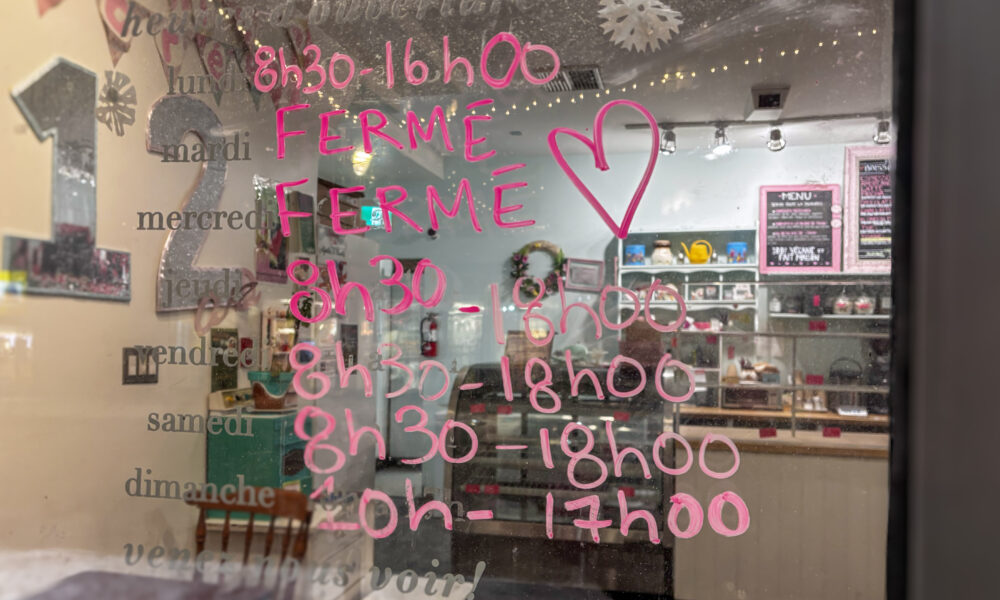



It’s 7 p.m. on a Saturday night, and you have nothing to wear. Rushing out the door, you take to St. Laurent in search of the perfect, innovative solution to a closet lacking inspiration: Another black top. Yet, no matter where you look, every store is closed: La Caravane, CUL-DE-SAC, even Throwback Vault—they’re all lit by the neon luminescence of a sign reading “fermé.”
Your shopping misfortune isn’t new. It dates back to June 22, 1990, when the Quebec government passed the ‘Act Respecting Hours and Days of Admission to Commercial Establishments,’ or Bill H-2.1. Originally framed as a way to promote time with family and protect small businesses from burnout, Bill H-2.1 requires that all businesses close at 9 p.m. on weekdays and 5 p.m. on weekends.
The bill makes exceptions for establishments serving food and drink, cultural centres, businesses operating in airports, and pharmacies, but most major retailers are forced to close well before the feeling of an impending wardrobe malfunction sets in.
However, on Dec. 8, the Quebec government announced a major revision to Bill H-2.1, allowing retailers to remain open until 9 p.m. on weekends, effectively standardizing weekday hours across the entire week.
In a city like Montreal, defined by spontaneity and a vibrant nightlife, the regulations that exist under Bill H-2.1 undermine the very local establishments they claim to protect, pushing consumers online instead.
Samuel Poulin, Quebec’s Minister for the Economy and Small and Medium Enterprises, explained that the shift in hours became necessary as local and small businesses were increasingly forced to compete with major online sellers, including ultra-fast fashion retailers like Shein and Temu. In fact, nearly 60 per cent of businesses in Quebec have reported drops in sales due to competition with foreign e-retailers.
When small businesses lose foot-traffic because shoppers aren’t able to make purchases in person, they do not merely lose profit. They are replaced by massive online fulfillment warehouses. An outdated relic of Quebec’s past, Bill H-2.1 incentivizes consumers to seek less environmentally conscious—and less ethically-produced—options when in-person stores are closed at inconvenient hours.
With textiles being the fifth-largest category of plastic waste sent to landfills in Canada, and the fashion industry representing 10 per cent of Canadian greenhouse gas emissions, it is critical that in-person shopping experiences are protected to ensure accessibility. Without them, shoppers default to online fast-fashion, with its familiar waste-generating refrains: “This doesn’t fit,” “this doesn’t look like the picture,” or “this isn’t comfortable to wear.” When customers are able to shop in person, avoidable problems relating to garment quality and fit no longer lead to the discarding of usable fashion items. Instead, these unfavourable items are merely returned to the rack.
Even the original motivation behind Bill H-2.1 of “promoting family time” no longer reflects the needs of individuals working in Quebec. Many Montrealers—from students, to part-time workers, to those with irregular working schedules—are forced to adapt their lives around arbitrary, outdated closing times instead of relishing the flexibility to shop ethically and conveniently. What was once framed as protection for the working class has evolved to impose constraints on both consumers and small businesses, limiting economic opportunity and Montreal’s social and cultural dynamism.
Montreal’s streets—lovingly pedestrianized during the summer months, and in some cases, all year round—lose their charm as sites of cultural events, social interaction, and, of course, window-shopping. Bill H-2.1’s provisions encourage the city’s social nature to come to a stiff halt at 5 p.m.—far before a ‘move’ for the night even emerges.
Poulin’s plan, a welcome revision to existing business hours standards, realigns the accessibility of retail shopping with Montreal’s social fabric. This amended policy allows late-night foot traffic, spontaneous window-shopping, and engagement with local neighbourhoods to strengthen and sustain the economic survival of small businesses.