
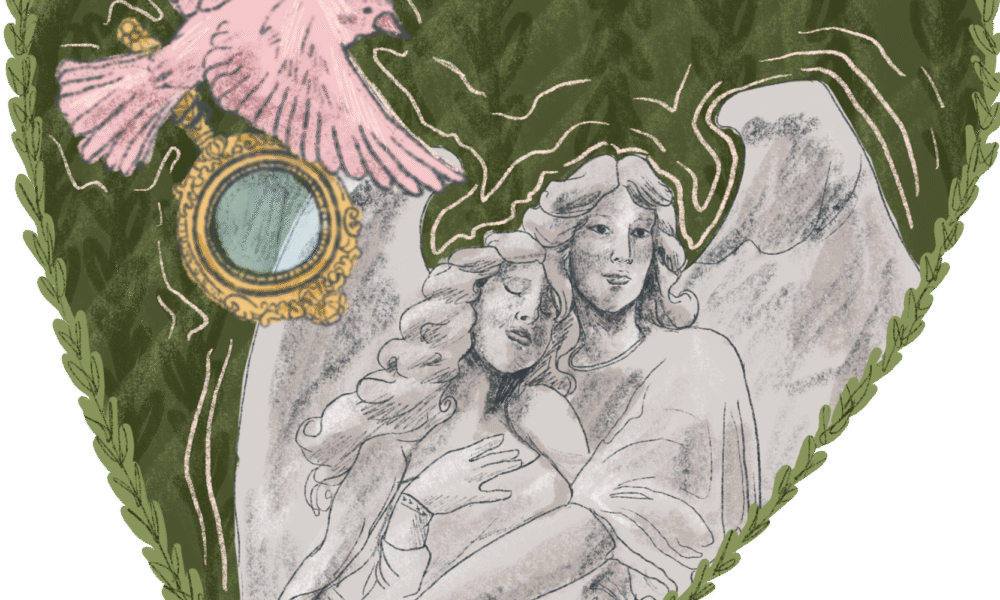




Greek mythology has traversed themes of love across eons. Although the stories themselves may have evolved through modern times, their passion, yearning, and grief still ring true today. In honour of Valentine’s Day, The Tribune presents two everlasting love stories to pierce the hearts of all Greek mythology lovers.
The Story of Patroclus and Achilles — “I would know him in death, at the end of the world,” The Song of Achilles, Madeline Miller
Poised on the edge of Achilles’s impetuous blade, Patroclus was his balancing force. Their story began as boys when Patroclus was banished from Opus after accidentally killing a man in a game of dice. He then travelled to Phthia and resided under the command of King Peleus. There, he became acquainted with Peleus’ son, the famed Achilles.
Like fire and water, the two became opposing sides of a coin—their fellowship lasting a lifetime. Achilles’s precipitous nature was often soothed by Patroclus’ resolute hand. During the Trojan War, the lovers joined the Greek attack force. Achilles, quick to anger, got into a quarrel with Mycenaean leader Agamemnon and refused to continue leading charges in battle.
In an ill-fated attempt to bolster the Greek troops after Achilles’s refusal, Patroclus donned his paramour’s armour and rode into battle underneath his lover’s helm. Achilles emerged from his brooding to find his dearest companion slaughtered.
He contorted with grief, instilling fear even in the gods. Sullying himself with dirt and grime, he tore at his shining golden locks. Half of his heart had been cleaved clean away. He had valued Patroclus above all others and loved him as dearly as his own life.
Achilles’s anguish recast itself as acidic rage as he turned his attention to Patroclus’s executioner. After killing Prince Hector in single combat, Achilles fastened his corpse to the chariot by its heels and dragged it through the dirt until he returned to the Greek battle camp. He denied his adversary a proper burial as penance for his sin.
The lovers were reunited in death at Achilles’s request to have his own ashes mixed with Patroclus’s. They rest together, encased in a golden urn.
The Myth of Eros and Psyche — “For I love and cherish you passionately, whoever you are, as much as my own life,” Metamorphoses, Apuleius
The irresistible Psyche, constantly mistaken for the goddess Aphrodite, lived a lonely life, too beautiful for anyone to approach her. It was as though she was trapped in a case of glass, an ornament at which to marvel but not understand.
Her revered countenance attracted Aphrodite’s censorious eye, and the goddess became chagrined that a mortal was being worshipped as a god. She commanded her son, Eros, to punish Psyche by compelling her to fall in love with a hideous creature. Eros obediently transformed into a serpentine beast, but as he turned to face Psyche, it was his heart that flooded with love. He bid Zephyr, the west wind, to whisk Psyche to his opulent palace, where she might rest to wait for him. But when Eros came to call upon her, he insisted they embrace only in darkness. He begged her to have faith in their vulnerability even without the security of appearances.
As the nights passed, Psyche and Eros conjoined in darkness but never beneath the sun of day. Wishing for companionship, Psyche innocently invited her sisters to visit, despite Eros’s warnings of their ill intentions. Tarnished with envy at Psyche’s happiness, her sisters schemed to sow doubt in her faith in Eros; they claimed that if she properly looked, she would see the vile creature that he was. Although Psyche’s hands may have known the shape of her husband’s love, seeds of uncertainty festered in her mind.
As night fell, Psyche waited for Eros to succumb to slumber. She then lit a candle, allowing its glow to flicker across his seraphic features. She became so entranced that she did not see the melting wax dripping onto his lustrous skin. Awake and betrayed, Eros fled, his love scorned by distrust.
Psyche wandered across the countryside looking for her lover, pining for Eros. Cunning and still ensconced with indignation, Aphrodite promised to assist Psyche only after she completed a set of impossible tasks. She completed the first of the two, swift in her earnest intentions. But in the third trial, she finally faltered, falling into an endless sleep. Eros, stricken with pain, appealed despairingly to Zeus. He woke Psyche from her sleep and even granted her immortality so she and Eros might be reunited forever. Their daughter, Hedone, a conjoinment of heart and mind, was born the goddess of pleasure.