


Sophocles is having a moment. The Ancient Greek playwright may be well over two millennia old, but his plays are seeing new life; his famed Oedipus Rex was recently adapted for an acclaimed Broadway run, and, here at McGill, his terrifying Antigone could not have been a more fitting choice for this year’s Classics Play.
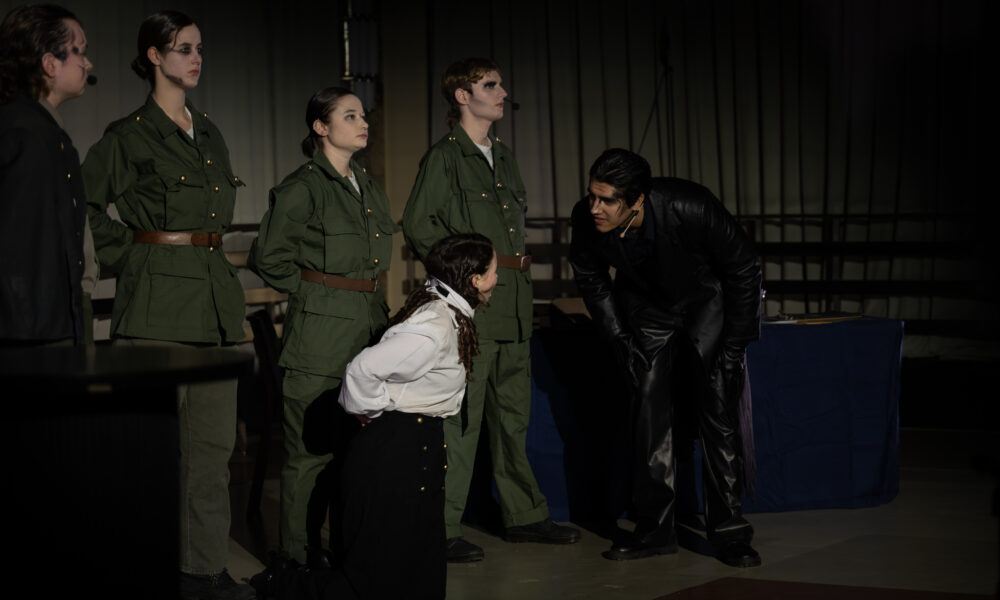
Antigone, chronologically the last of Sophocles’s three Theban plays, culminates the story chronicled in Oedipus Rex and Oedipus at Colonus. In a move to modernize the work, translator Adam Zanin, adapter Caroline Little and director Madelyn Mackintosh set this production in the 1930s, on the heels of European fascism.
Starring Anelia Stanek, U2 Arts, as the eponymous daughter of Oedipus, the tragedy follows the rise of Oedipus’s advisor, Creon (Nikhil Girard, U3 Arts), to the throne of the city of Thebes after a violent civil war. His first act is to honour the fallen Eteocles, brother of Antigone, who fought to protect Thebes against their rebellious brother Polynices. For his treason, however, Creon denies the latter traditional Greek burial rites. The play’s conflict surrounds Antigone’s choice to bury her brother in spite of the edict.
Antigone’s actions create a storm in Thebes: Her sister, Ismene (Neela Perceval-Maxwell, U1 Arts), disagrees with her, fearful of Creon’s wrath. It can be easy to scorn her as cowardly, but in an interview with The Tribune, Mackintosh provided a more sympathetic perspective on the character.
“Most of us, maybe, would like to be Antigone but are Ismene, and would not necessarily accept execution, even for the strongest principles,” Mackintosh said. “But I don’t think that makes Ismene or anyone else weak […] and I don’t think it’s a responsibility to all be martyrs, or to all be some unforeseen level of bravery. I think it is our responsibility to be as courageous as we can.”
Mackintosh’s direction brings out the play’s debate over what loyalty entails, humanizing the struggle of the fight for the audience. Much of it feels familiar even now; many of the play’s subjects, such as the tempting of fate and the idolization of leaders, resonate brightly.
“The show was written 2500 years ago, it’s set a hundred years ago,” Mackintosh said. “And it pulls on references from today, and I think it is demonstrative of the way that tyranny is cyclical and destructive that the same story is applicable in all of those contexts.”
In this regard, Sam Snyders, U4 Arts, takes his part as “The Bartender” seriously. His near-constant presence throughout the production, as a spectator and aide to those in need, anchors him as the man who has witnessed and endured the cycle of tyranny. As the closest figure to a narrator, Snyder’s passionate performance brings with it anticipation and a will to fight.
While staying generally true to Sophocles’s original plot, there were several notable changes. One of them is the adaptation of the traditional Greek Chorus into a more modern ensemble; another is the introduction of death scenes, which were never performed in Ancient Greece. Together, these changes heighten drama in the production, resulting in a powerfully modern show that treats its source not just as history, but as a warning of what might be coming.
Ruminating on how Antigone mirrored the current state of U.S. politics, Mackintosh shared mixed emotions regarding global politics. Still, she highlighted a silver lining—that so many are willing to help keep Antigone’s fire alive through their work.
“A very significant part of me wishes the show was not as prescient as I feel it is, but at the same time, I also think that is why it is necessary and why I’m really proud of it […] a lot of people have put a lot of heart into the production, and I’m so incredibly proud of them.”