




As of Nov. 19, 2025, international graduates of Quebec universities and temporary foreign workers are no longer eligible to apply through the accelerated immigration pathway to obtain a Certificat de sélection du Québec for permanent residence. This pathway, known as the Programme de l’expérience québécoise (PEQ), was abolished by Immigration Minister Jean-François Roberge under the François Legault administration, leaving previously eligible individuals with shattered hopes of obtaining permanent residency in Quebec.
The Programme de sélection des travailleurs qualifiés (PSTQ), which replaced the PEQ program, is a competitive, points-based system with stringent requirements regarding French language proficiency, certified job offers, and alignment with the specific labour market needs. Since its establishment, the new program has been heavily scrutinized by immigration experts, municipalities, and businesses. Those who had moved to Quebec planning to apply for permanent residence through the now-abolished PEQ pathway—known as ‘PEQ orphans’—are now placed at the mercy of the PSTQ guidelines.
The abolition of the PEQ is not simply an administrative reform but a breach of trust between Quebec and the people it invited to build their lives in the province. In narrowing immigration to serve short‑term labour goals, the government has undermined both its moral authority and its long‑term economic interests.
This change cannot be understood solely as an economic adjustment. It reflects a broader policy approach under Quebec Premier Legault, whose administration consistently pushed for restrictions, cultural protection, and linguistic conformity. This pattern is evident in recent legislation such as Bill 21, which enforces secularism by banning certain public-sector employees from wearing visible religious symbols, disproportionately targeting religious minorities, and Bill 96, which toughens French language requirements for new immigrants, international students, and institutions under the guise of preserving francophone identity.
These decisions are part of a long-standing legislative pattern in Quebec, led by political figures such as Legault, who have repeatedly denied the presence of systemic racism in provincial institutions. That pattern is now being reinforced by Roberge’s refusal to implement a grandfather clause for the PEQ, which would have allowed current applicants to retain eligibility for permanent residence.
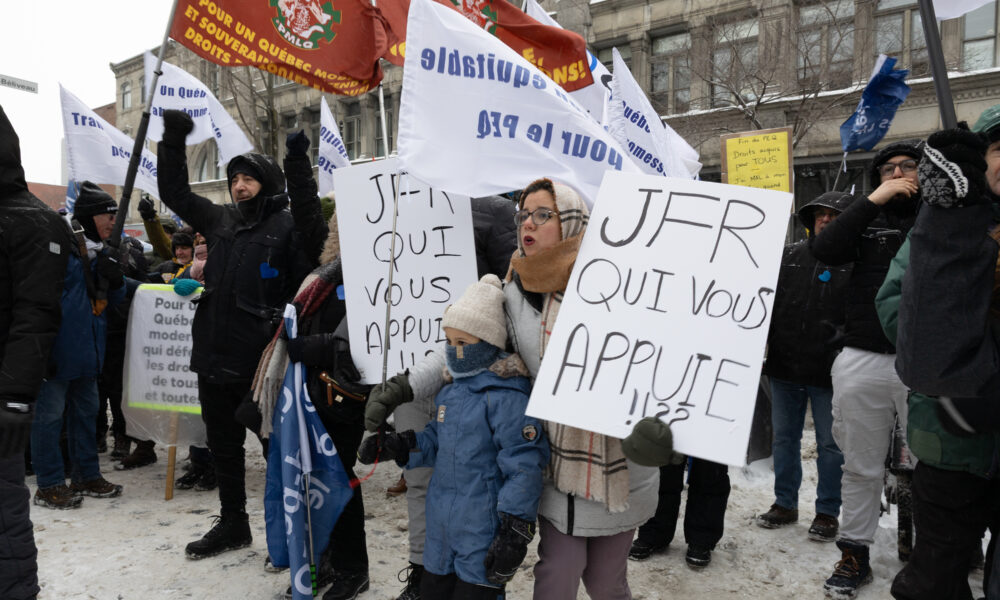
On Feb. 7, protesters marched in Montreal, articulating the impact of the PEQ’s abolition. A psychology PhD graduate held a sign that read “Assez bonne pour travailler pour le Québec, pas assez pour rester” (Good enough to work for Quebec, not good enough to stay). Others echoed similar sentiments: “Je suis venu donner de la valeur, pas demander une faveur” (I came to contribute value, not to ask for a favour).
The government insists that the PSTQ is necessary to better align immigration with labour shortages, reduce pressure on housing and public services, and distribute newcomers more evenly across the province. These concerns are not irrational, yet by dismantling a predictable pathway for already‑integrated workers and graduates, the government risks deepening precisely the labour shortages it claims to address, particularly in sectors such as healthcare, where over 6,300 temporary foreign workers face expiring permits by 2026.
At its core, this shift raises deeper concerns about the nature of Quebec’s immigration policies. Immigration is not merely an economic tool; it is a system built on integration and trust. When governments change the rules, they reshape the relationship between the state and those who choose to build their lives within it. Instead of addressing the anxieties and expectations of Quebec immigrants by implementing a grandfather clause or equivalent measure, Roberge and his cabinet have merely replaced one immigration pathway for another—a solution that serves administrative priorities while leaving human realities unaccounted for.
Quebec must not make promises it cannot—or will not—honour; to do so is a failure of governance. At its most basic level, effective governance requires listening to the people whose lives are shaped by political decisions and recognizing the weight those decisions carry. Immigrants are not interchangeable economic units to be recalibrated according to the province’s shifting priorities. They are people who have spent years building their lives in Quebec, contributing through work, study, and engagement. Any policy that ignores this reality risks undermining not only individual futures, but the very trust upon which effective and legitimate governance depends.