
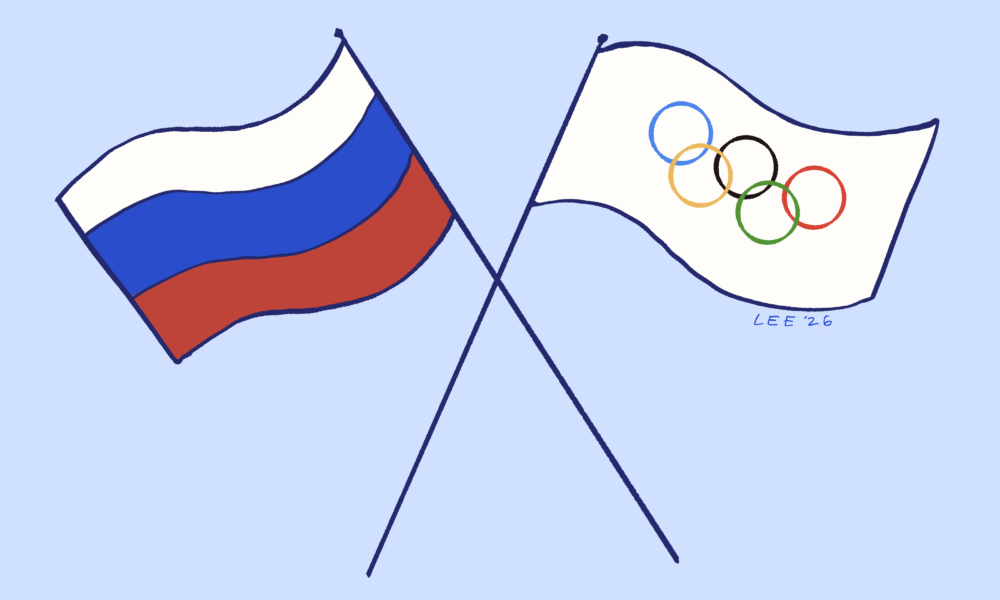




Since 1924, nations have come together to celebrate athletic excellence every fourth winter. This year, the Olympic Winter Games in Milan and Cortina mark a century of such tradition, setting record viewership just one week in. Amid the exciting celebrations of record-breaking athleticism, competing Olympians can hardly escape the political turmoil that is unfolding alongside the Games. Sports are inherently intertwined with politics, and the Olympic Committee must enforce rules governing participation consistently. Penalizing athletes of certain nationalities because of their government’s politics, all the while ignoring other ongoing injustices, reflects an unsettling selectiveness that further perpetuates political divides, corroding the three values on which the Olympics were founded—excellence, respect, and friendship.
The International Olympic Committee (IOC) has banned 14 countries from competing in the past due to various political issues: South Africa had been repeatedly banned due to Apartheid, while Germany and Japan had been excluded for their involvement in the Second World War. Most recently, the IOC banned Russia and Belarus from the Winter Olympics due to their war crimes in Ukraine, which forced many athletes to compete as individual neutral athletes (INA).
The IOC framed such bans as moral obligations, but also as a consequence of Russia’s repeated violations of the Olympic Truce—a United Nations-backed policy that calls for ceasefires immediately before, during, and after the Olympic Games. However, frameworks like the Olympic Truce hardly ever compel substantive political change. For example, Apartheid in South Africa did not end solely because athletes were barred from competing—it ended after decades of civil disobedience and activism, including widespread pressure from economic boycotts and sanctions. While sporting bans may be symbolic to advancing world peace through their role in broader international pressure campaigns, their selective application cannot be justified as a tool for achieving justice.
What these bans do achieve, however, is reducing athletes to a monolithic identity. When athletes’ only option to compete is to strip themselves of any national symbol, their pride in representing their homeland and their culture is treated as complicity in their government’s actions.
Such tension is further exemplified by Ukrainian Skeleton Athlete Vladyslav Heraskevych’s “memory helmet” featuring portraits of athletes killed in the Russo-Ukraine War, which led the IOC to ban Heraskevych from competing. This act was deemed a violation of Rule 50 of the Olympic Charter, which aims to keep the sport podium neutral. But sports are political. Heraskevych did not introduce politics into the Olympics; he merely commemorated the many Ukrainian athletes whose lives were lost. The IOC cannot act as the inconsistent arbiter of geopolitical morality while claiming that its arenas are neutral.
Global actors and human rights organizations have condemned Israel’s genocide in Palestine. Iran’s brutal crackdown on protestors is likewise criticized. Even the United States’ military invasion of Venezuela has been denounced as a violation of international law. These conflicts and their impacts have persisted through multiple Olympic Games, yet none of these countries were barred from the Olympics, and none of their athletes have been forced to compete as INAs. When athletes cannot represent their nation through the craft they dedicate themselves to, the IOF directly undermines the Olympics’ founding principles of excellence, respect, and friendship, setting inconsistent and unfair rules by which athletes must play the Games.
Excellence should be measured by athletic merit, not nationality. Respect requires the acknowledgement that athletes are global citizens, not campaigns of their government’s complicity. Friendship calls for the cultivation of athletic connection even amid adverse political conditions. When some athletes’ identities are written off as an extension of their government’s actions while others’ are overlooked, some national identities become politically unfavourable while others are affirmed as diplomatically tolerable.
The Olympics’ immense visibility comes with great responsibility: If the IOC chooses to invoke morality as grounds for participatory bans, sanctioning countries that have committed international crimes, they must lay out transparent criteria and enforce them consistently, regardless of global negligence or diplomatic alliances. Otherwise, the IOC should acknowledge the limits of sporting sanctions. Sports are inevitably political, but sporting sanctions carry limited power outside of moral symbolism. Symbolism cannot uphold justice when applied selectively.