
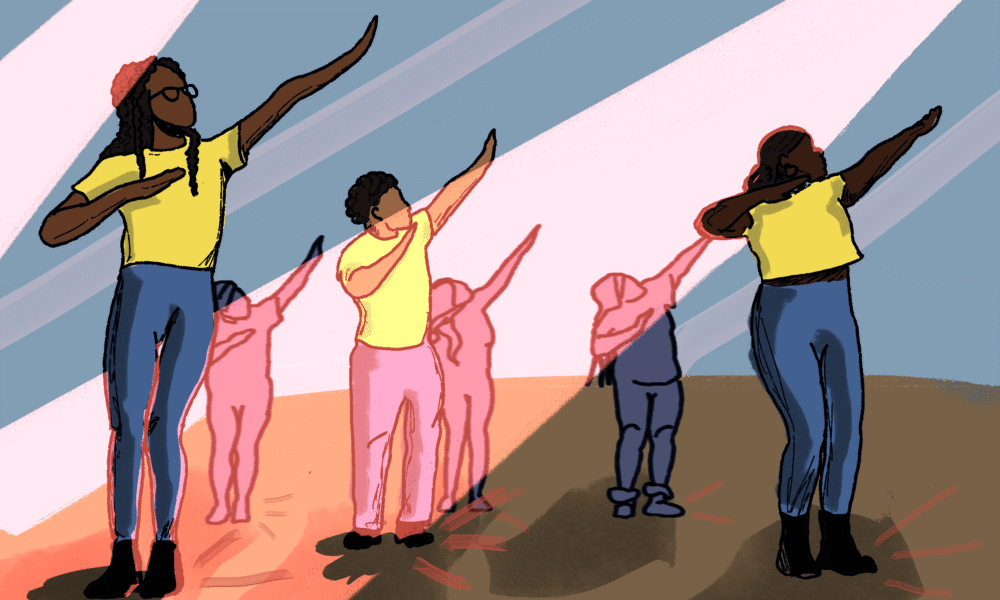


Body-based art forms have long served as forms of resistance in Black communities, and stepping is one of its most powerful expressions. It is a Black diasporic art form that uses clapping, stomping, body slapping, and vocalization to create rhythm and beats through movement.
The Montreal Steppers, a nonprofit organization founded in 2019, carry on this legacy by teaching stepping across Montreal and beyond. Kayin Queeley, founder and director, explained his motivation for creating the organization in an interview with The Tribune.
“When I came to Montreal, I was surprised at how little […] awareness [there was] about stepping,” Queeley said. “So what I thought of doing is creating different workshops that would marry learning step with learning […] elements of Black history, like how stepping started, what it was about, why it was important.”
Although many may be tempted to describe stepping as a dance, Queeley clarified that it is a distinct art form.
“Stepping is an art form because of its history, because of its lineages, because of its movement, because of its expansion, and […] because of those elements that bring together the new music, the sharing of sounds, the synchronization, […] [and] the polyrhythmic beats,” he said.
By shifting dialogues about Black culture and history, creating original productions, and collaborating with various communities, the organization does more than just teach step.
“We worked with close to 25,000 students across the province since we started. We’ve written original productions that centre Black life after slavery, and we do a lot of community collaborations,” Queely said. “We’re [also] working with seniors and adults and people who might have limited access and mobility, but to give them the sense that the body still has power.”
The Montreal Steppers offer introductory and advanced workshops, as well as courses in several schools, such as the National Theatre School of Canada. The group also shares stepping with college and university students through workshops and performances; they have staged productions all over Canada and have even gone on an exchange to South Africa.
“We don’t compromise our workshops by just focusing on teaching step [….] We focus on what is critical to the work we do, [which] is making sure that people at least leave with the knowledge being presented to them,” Queeley explained.
During performances, audiences are invited to try stepping movements. This collectivity of movement, sound, action, and momentum gives the art its meaning.
“When we’re working together, moving at the same [time] in the same direction, there’s impact, and it gives nod and recognition to the art form of people mobilizing together to make a difference, because [Black people] came together to create this music to resist and to push back against narratives and beliefs that people held,” Queeley said.
The Montreal Steppers also honour Black history by honouring the cultural roots of stepping in each space they enter.
“We thank the ancestors in every space to say ‘thank you for creating this art form out of resistance that we get to share as performance, that we get to share as teaching, that we get to share as community,’” he shared.
Queeley expressed that the organization also acknowledges the land and people present at each event.
“Once we’re in a space, we give acknowledgement to the land, recognition to the Indigenous Peoples […] the land, the music with it and the ground, and then the final acknowledgement is to the people.”
Beyond enjoyment, the Montreal Steppers hope that their workshops and performances help audiences learn or relearn new elements of Black history.
“It’s not just performance. It’s a ritual, it’s a practice, and that’s why we talk about it as ancestral, because it comes with that level of weight and influence and impact,” Queeley said. “It’s important that we celebrate it, and we don’t shy away from what is ours.”
Anyone interested in joining a stepping class or learning more about this art can reach out to the Montreal Steppers through their website and Instagram.