
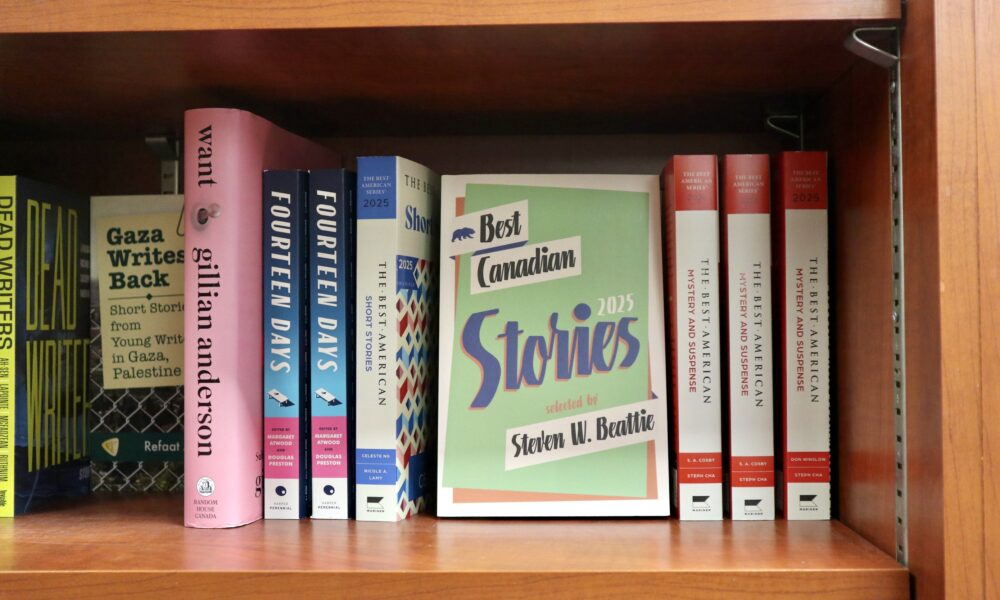


The lived reality of an apocalypse is a daunting thought, yet one that Biblioasis’ Best Canadian Stories 2026, edited by Zsuzsi Gartner, confronts at length. The collection gathers a world of beautiful and provocative literature, each unique in writing yet united by shared thematic currents. Apocalypse—destruction on a catastrophic scale—appears here as an everyday occurrence, with stories exploring friendship, loneliness, and the stubborn resilience of life. Gartner’s collection puts the stories in conversation, creating new meanings between them while introducing readers to the breadth of talent in the Canadian creative writing landscape.
The collection opens with Rishi Midha’s “We Are Busy Being Alive,” which follows a newly affluent family struggling to understand one another and their place in their community. Midha undermines their self-image as activists by repeatedly reminding readers that their mansion sits at a crisp 64 degrees during a brutal heat wave. The upheaval around them is not explicitly described, highlighting the family’s privilege to drift in and out of movements while maintaining their ability to fall asleep comfortably every night. Their shallow bond introduces a question that recurs throughout the anthology: How does connection exist in times of difficulty?
Kaitlin Ruether’s “A Language of Shrugs and Sparks” turns to the digital world as an escape from the loneliness of reality. Ruether infuses every sentence with vitality and motion as she describes a woman who pours her energy into a vibrant virtual life, while her physical existence remains still and stagnant. Her only tangible relationship is unstable and shallow, thus emphasizing her need for an online community of anonymous friends.
Alex Leslie’s “The Formula” similarly explores the strangeness of connection. Two teenagers forge a deep bond, united by their shared experiences, yet unable to communicate directly. Instead, they rely on their perfected formula of emoji strings meant to convey all that cannot be said.
The space between words is further explored in Margaret Sweatman’s “Sounding a Name,” which creates kinship without familiarity. This story examines an anonymous connection between two people visiting Russia before the war with Ukraine. Their friendship is built on witty remarks and dark humour, supporting the sporadic sharing of fragments of identity. Their friendship offers both of them solace, yet never comfort. The looming war creates an ominous atmosphere around the story, yet Sweatman only mentions it a sentence at a time, allowing dread to fester beneath the narrative.
The beauty of community is best explored in Bill Gaston’s “Jack’s Christmas Dinner,” a touching tale of found friendship. In a cold town during Thanksgiving, a solitary man’s eccentric neighbour prepares a feast out of roadkill. An eclectic group forms around the holiday, united simply by their desire to attend. The effects of the pandemic and the man’s fractured family life cast a shadow of loneliness that the feast ultimately dissolves. Even the revelation that the presumed turkey is actually a vulture does not spoil the evening but instead amplifies the strange yet tender charm of strangers becoming unlikely friends. Gaston’s warm and witty writing makes this story a standout in the collection.
The anthology closes with Julie Bouchard’s “What Burns,” a tale that boldly confronts the climate crisis rather than placing catastrophe in the background. No longer is societal destruction backgrounded in favour of succinct plots and individual character arcs. A cool, objective tone weaves statistics into an account of forest fires and arson. The narrator introduces a mystery, yet deliberately refuses to deliver narrative satisfaction, insisting that the climate crisis outweighs any one person’s story. By switching between first, second, and third person narration, Bouchard merges reader and narrator, revealing the frightening truth that we will all eventually face the climate apocalypse.
As an art form, the short story collection uniquely allows readers to sample many authors while creating a discourse between each tale. This anthology is enjoyable to read, and I found myself wanting more from the selected authors.