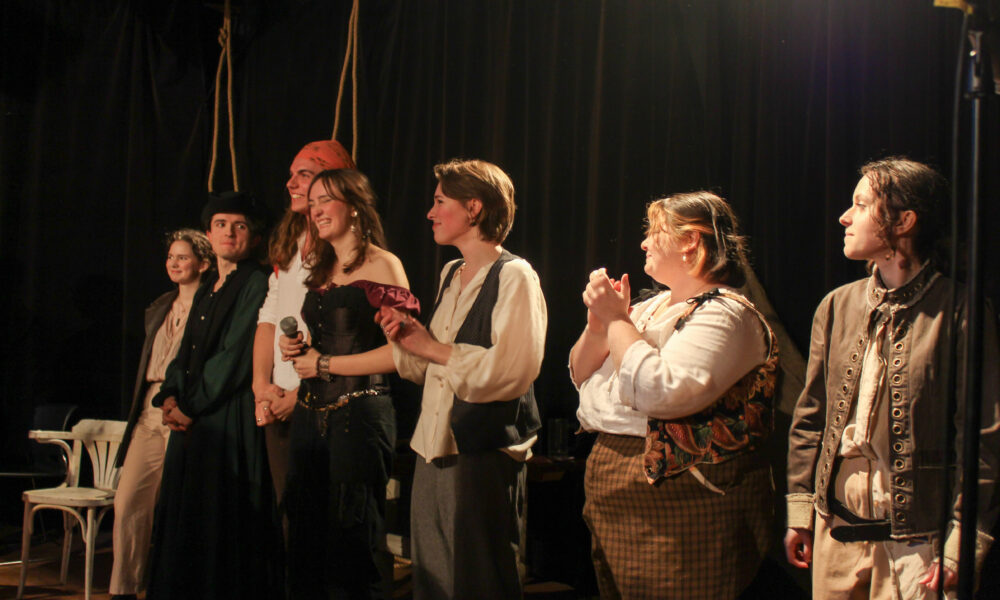


Jan. 15 marked the opening night for Cutlass’s debut workshop performance at Tuesday Night Café Theatre, directed by Ruby Isaacs and written by Elise Holbrook. The show follows pirates Anne Bonny (Elise Holbrook, U2 Music Composition) and Mary Read (Abby Wyland, U3 Art History Honours), who sailed the Caribbean in the summer of 1720. Both Anne and Mary disguised themselves as men on their excursion to ensure their safety, but the moment they discovered their mutual secret, their relationship ignited.
The show features a live band of cello, violin, and piano, which elevates the drama in each scene. The score spans a wide range of emotions, with the cello evoking a dark moodiness while the piano uplifts the score, conveying excitement. The dialogue also drives the emotional rollercoaster: You’ll laugh at the absurd jokes made by the comedic-relief pirates, then cry as Anne and Mary’s relationship faces its tragic fate.
Anne is a complex character whose story completely enraptures the audience. She is eccentric and angry, yet her chaotic humour makes her lovable. Among the crew of pirates, she stands out as the life of the party and excites the other crew members with her stories. Mary, on the other hand, is awkward, making her passionate love for Anne result in tears for the audience. The physicality between the two pirates emphasizes their chemistry. Specifically, the staging of their duets highlighted their relationship dynamic. Starting from opposite ends of the stage, they would get closer with each note, illustrating their attempted restraint overpowered by the strength of their feelings for each other.
Their love story is particularly important because, throughout history, queer romance has been criminalized and erased from literary narratives. The love between these two women was written off as “a close friendship,” concealing the truth. Learning about sapphics from the 1700s is critical in modern times because it emphasizes the fact that queer people have always existed. Queer people have made history—and will continue to make history—just as these two women have. Seeing this musical offers both a learning experience and a chance for audience members to connect with both the story and queer historical figures.
The music in the show is ethereal. Anne and Mary have several duets throughout the musical, with many moments of mystical harmonization, capturing their intense feelings. Their siren-like voices blend together beautifully, with Anne’s soprano voice balancing well with Mary’s longing alto voice.
“If you burn, I burn with you.” This powerful line spoken just before a kiss illustrates their willingness to face the danger that their love brings. They accept the risk of punishment for their queerness, choosing to endure it together forever.
The costumes and set are also astonishing. These are the types of outfits you can imagine a pirate from the 1700s wearing; the details of each outfit both convey the time period and reflect each character’s personality. The small, intimate theatre invites the audience onto the ship.
The end of the show took my breath away. The pirate ship gets seized, the crewmates are hanged, and the two women are imprisoned. The final scene was brought to life by Golbrook’s heartbreaking scream upon realizing that Mary is dead. This devastating ending highlights the impermanence of love, reminding us to appreciate those we love, even if it means rejecting social boundaries.
25 per cent of Cutlass ticket sale proceeds went to Watermelon Sisters, an organization based in Chicago that provides humanitarian aid in Gaza.


