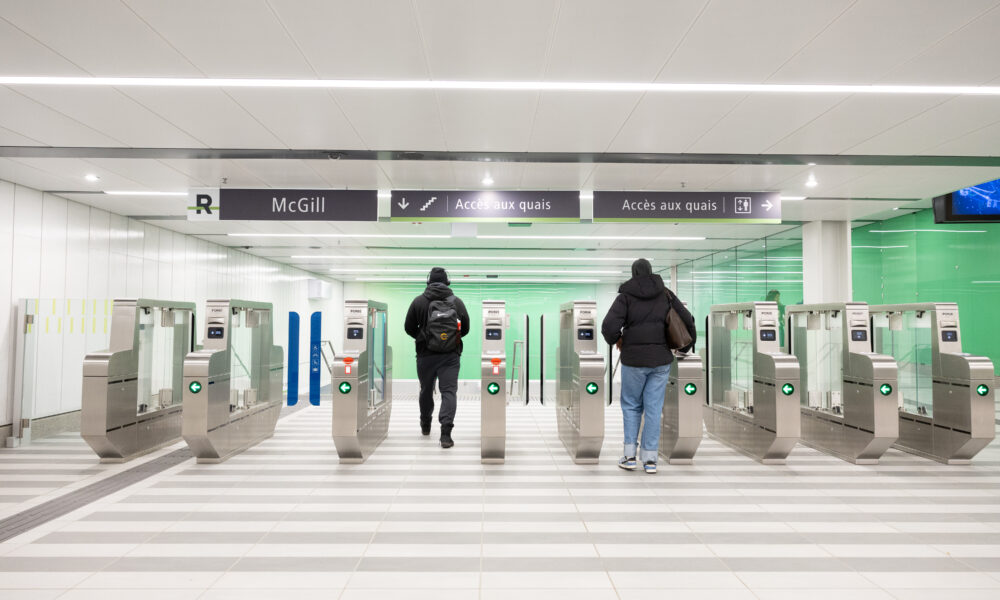

The expanded Réseau Express Métropolitain (REM) network officially opened on Nov. 17, unveiling 14 stations that stretch service from Montreal’s South Shore up to Deux-Montagnes. This expansion includes a newly shared McGill station, now a stop on both the REM and the Société de transport de Montréal (STM)’s metro lines.
The REM, a driverless light-rail system operated by private corporation CDPQ Infra, first opened in 2023 with just five stations between Brossard and Gare Centrale. Its new launch unfolded amid STM strikes that have caused disruptions in metro service, including a full shutdown of the system on Nov. 1.
For many South Shore commuters, the REM expansion marks a welcome improvement. Aïsha Nsiempba, U3 Accounting, takes the light-rail daily from Brossard to downtown Montreal and McGill’s main campus. In an interview with The Tribune, she explained how the REM allows South Shore residents to reach their destinations faster.
“I am pleased with the recent expansion of the REM, as it makes my commute more convenient and shortens travel times to areas that used to take over an hour and a half to reach,” she said.
Despite the REM’s convenience, Nsiempba expressed concern over how it has eliminated other transportation alternatives for many South Shore commuters.
“The buses that used to take us from the South Shore to Montreal were completely cut and replaced by the REM, which would have been acceptable if the [REM] system had worked optimally from the start,” Nsiempba continued.
Privately operated, the REM has a non-compete clause with Montreal’s public transit systems that prevents the REM from operating along existing municipal transit routes. In the wake of the REM’s frequent service disruptions, commuters therefore have no alternative option to get to Montreal—other than driving. Doreen Assaad, the mayor of Brossard, has called for the reinstatement of several express bus lines as a solution. Meanwhile, REM officials claim, moving forward, their system should experience shorter wait times if service interruptions occur.
In an interview with The Tribune, Meredith Alousi-Jones, PhD student at McGill’s School of Urban Planning and graduate research assistant with Transportation Research at McGill (TRAM), offered insight into how the surrounding environments of the new REM stations affect use of the system. Local government investment, which varies by municipality, strongly influences whether a station supports increased ridership and economic activity in the region.
“Ease of access to stations is a key factor in travellers’ choice to take the REM,” Alousi-Jones explained. “Features such as well-connected sidewalks, nearby activities and services, and efficient transfers between modes [of transit] can all encourage REM use.”
Alousi-Jones also explained how introducing another transit solution to the greater Montreal area can help increase social accessibility.
“At TRAM, we conducted a survey in June during the first [STM] strike and found that [its] negative impacts were particularly pronounced among women, low-income individuals, and people living with disabilities,” Alousi-Jones explained.
She stressed that the extra costs of Ubers, taxis, and BIXIs can put a financial strain on people as their everyday expenses increase.
“Circumstantial switches to other travel modes during these strikes such as vehicles, walking or bicycles, can become more permanent,” Alousi-Jones added.
In an interview with The Tribune, Students’ Society of McGill University (SSMU) Vice-President University Affairs Susan Aloudat explained that the SSMU is committed to supporting students’ transportational expenses to counteract STM service disruptions. During the most recent strike, students could request reimbursement for these expenses by submitting transportation payment receipts through a designated form.
“Examples of acceptable submissions [included] BIXI fees, rides between campus and your home address, parking passes, or other transportation passes,” Aloudat said.
Alousi-Jones emphasized that despite the coincidental expansion of the REM while the STM was on hold, reliability, not ownership structure, will remain the key factor in how riders judge transit quality.
“Since fares are aligned across both systems, riders will expect comparable levels [of] high-quality service,” she highlighted.
Nsiempba expressed cautious optimism that the new line will make getting to campus even a little easier.
“I plan to continue using the REM and hope it keeps improving,” she said. “It seems to be on a positive trajectory, and I genuinely hope that continues.”


