
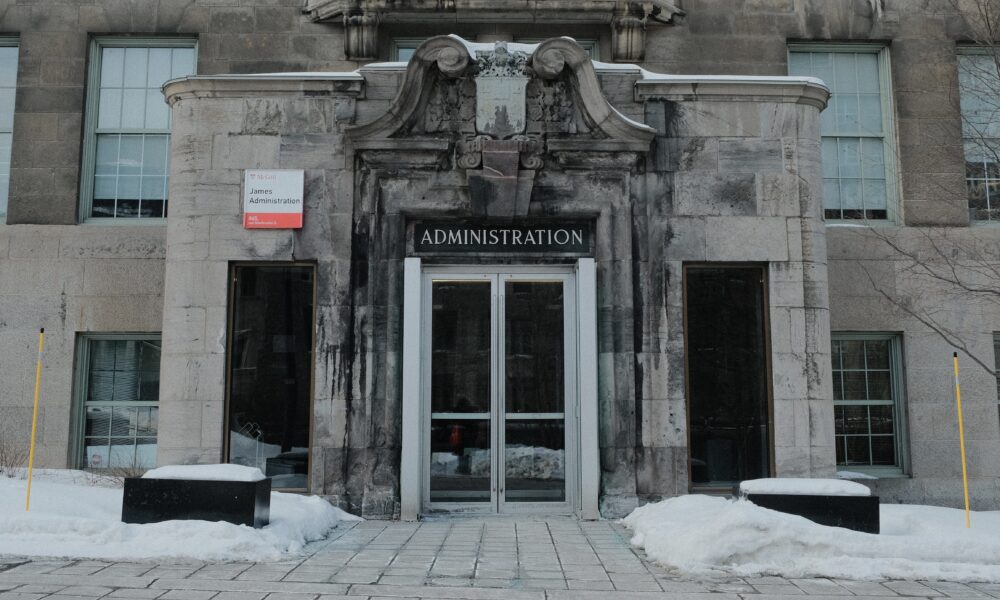




This past November, McGill’s Advisory Panel on Campus Expression (APCE) delivered a report on the state of academic freedom and expression at the university. The report recommended that McGill exercise “institutional restraint” and refrain from responding publicly to controversial geopolitical issues in order to preserve academic freedom. This policy encourages McGill to prioritize its reputation over critical advocacy, neglecting global responsibility under the pretense of protecting free thought.
Following the report’s publication, President and Vice Chancellor Deep Saini issued an enthusiastic statement affirming the APCE’s recommendations on campus expression. However, the report’s call for political neutrality undercuts McGill’s stated commitments to responsibility and global engagement. By extricating itself from political discourse, McGill forfeits its power to catalyze meaningful community discussion.
Just last week, in light of the brutalization of Iranian protestors, McGill released an email directing students to mental health resources. Strikingly, this email was sent only to students on McGill records as Iranian passport holders and did not include a clear condemnation of the Iranian government’s actions. This message exemplifies McGill’s reticence to speak publicly on issues with global reach and disturbing human rights implications.
While the university is eager to embrace its reputation as a globally-renowned institution, it engages selectively with the world around it, prioritizing its own reputation over advocacy. Because McGill’s priorities are not transparently reflected in its mission statements, the university’s decision to implement institutional restraint rings particularly dissonant.
In its report, the APCE draws a false contrast between academic freedom and institutional positions, weaponizing this manufactured dichotomy to justify McGill’s silence on geopolitical issues. The report does not offer a clear definition of academic freedom, but merely describes the concept as “associational to freedom of expression” and bound by “the standards of scholarly research and inquiry.” The APCE’s intentional vagueness in defining academic freedom obscures the fact that official university stances and academic freedom are not inherently at odds with one another. Arguably, academic freedom is epitomized when educational authority figures can simultaneously espouse opinions and encourage community dissent. It is dangerous to conflate neutrality with equity and tolerance, as such practices vilify the expression of opinions. Additionally, if academic freedom extends only so far as “scholarly standards,” then opinions, institutional or otherwise, are protected only when they reinforce McGill’s pre-existing party lines.
This outcome—where the McGill administration’s biases are preached as nonpartisan and student voices are made political—is at clear odds with the APCE’s overarching goal of maintaining a vibrant academic and intellectual culture at McGill.
The APCE advocates that McGill assume a neutral stance on all geopolitical issues. However, maintaining neutrality is a position in and of itself. In today’s polarized climate, acknowledging facts can be perceived as a political act. Institutional restraint enables McGill to refrain from affirming vital truths as suits the university’s agenda. In its report, McGill repeatedly refused to acknowledge genocide in Gaza, instead referring to the conflict as the “Israel-Gaza War.” Although intergovernmental organizations and NGO’s, including the UN, have repeatedly stated that the Israeli government’s actions align with the definition of genocide, in its report, the APCE employs misleading alternative terminology that downplays the conflict’s severity.
Yet, McGill doesn’t stray from all political conviction. In 2022, the Provost issued a statement denouncing Russia’s invasion of Ukraine and expressing “shock and sorrow” over the conflict. Herein lies just one example of how the concept of neutrality can be selectively applied to uphold some truths while obscuring those deemed “too controversial” for public endorsement. In many critical instances, McGill, a school that prides itself on promoting the “dissemination of knowledge,” chooses to remain silent and protect its reputation.
The APCE cited community outrage regarding previous university-issued geopolitical statements as a pretense for the necessity of institutional restraint. The report stated that, on an individual level, many faculty and staff members felt discouraged from voicing their opinions on political issues because they fear being negatively misinterpreted. Thus, the students are burdened with the responsibility to foster a campus environment that promotes constructive conversation and institution-level dialogue over ‘cancel culture,’ whereas professors—hired with a duty to protect academic freedom and promote discourse—are absolved of this duty.
The APCE portrays institutional restraint as promoting academic freedom, drawing a false contrast between the declaration of political views and the protection of free thought. Yet, in today’s polarized social climate, even the truth has become politicized. Truth is imperative to freedom, both academic and otherwise. McGill would be wise to remember this.