
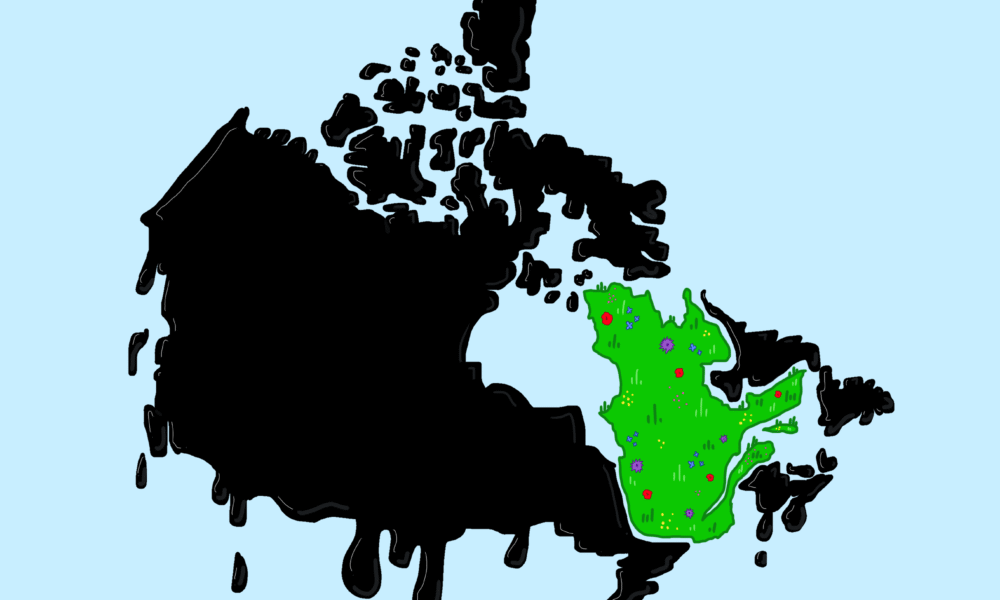



Hundreds of Quebec separatists—predominantly younger Quebecers—gathered in Montreal on Oct. 25 for a rally reaffirming their desire for independence 30 years after the 1995 Referendum for Quebec sovereignty, which failed by less than one per cent.
The young Quebecers at the front of this movement not only argue that secession would better protect the French language, but also that it would power climate action. The latter justification demonstrates a frustration with Canada’s ineffective and increasingly destructive climate policies. While this dissatisfaction is understandable, demanding independence for the climate agenda overlooks the need for collective action in climate protection, and fails to consider the social and economic consequences intertwined with the creation of a sovereign Quebec—setbacks which will, in fact, exacerbate climate inaction.
Émile Simard, leader of the youth wing of the separatist Parti Québécois, stated that it was nonsensical that Quebecers had to contribute to Alberta’s large fossil fuel industry through taxes. Complicity with the destructive national energy sector appears to be an important concern for young protesters, with some even referring to Canada as a ‘petro-monarchy.’
Sovereignists view independence as an opportunity for Quebec to disentangle itself from involvement in Alberta oil production, which accounted for 84 per cent of national output in 2023. However, they fail to recognize that Quebec’s departure will not stop Canada from remaining a major actor in climate change.
In their urgency to lead environmental initiatives, young Quebecers lose sight of the necessity of cooperation in effective climate action. ‘Separatism for climate sustainability’ sends the message that climate change is better addressed independently, thereby undermining the international community’s commitment to collective action for ecological protection.
Emphasizing the importance of cooperation to fight climate change is critical now more than ever: President Donald Trump withdrew the United States—the second-largest greenhouse gas emitter in the world—from the Paris Agreement last January. More recently, he refused to send a delegation to the COP30 launched on Nov. 10. Economists say American disengagement from the Paris Agreement could reduce global emission //cuts// by about a third.
Rhetoric preaching secession for climate protection does not have its place in a context where division could sabotage a union’s efforts towards a pressing goal. Rallying for Quebec separatism in the name of more effective climate action is misguided; it rationalizes the easy way out of the laborious task of collaborating with other provinces to achieve salient environmental progress.
Additionally, nothing guarantees that a sovereign Quebec government will tackle climate change. The creation of fundamental institutions and infrastructures, such as an army, a potential new currency, new trade deal negotiations, and international agreements—because of their indispensability in a country’s operation—will most likely take precedence in the Quebec political agenda. Moreover, Quebec will have to face complex financial challenges: Negotiating its share of the national debt and assuming its costs, managing uncertain investors, and living without federal transfers.
These political and financial difficulties would be compounded by preexisting issues. Between the housing crisis, the doctor shortage, and inflation, independence seems risky—but outright utopian if one expects it to also adequately revolutionize the way the government approaches climate action. Right now, environmental protection is urgent, and a major political transition does not promise favourable grounds on which to rapidly build sustainable environmental governance.
The Parti Québécois is currently pushing for a new sovereignty referendum in 2030. This initiative is supported largely by the younger generation: Polls show that almost half of Quebecers aged 18-34 would vote in favour. Nonetheless, when surveying all Quebecers, two-thirds say they would oppose independence. More than half of Quebecers believe that sovereignty would harm public finances and would not improve health and educational services. Evidently, regardless of the climate-centred rationale, Quebec independence is not a priority for the majority of Quebecers.
However, renewed calls for sovereignty reflect widespread discontent with governance and its inaction on addressing climate change. Although Quebec independence might be unfeasible, the reasons driving the protests underline legitimate frustrations with Canada’s flippancy toward the environment—concerns that the federal government must address proactively and wholeheartedly.