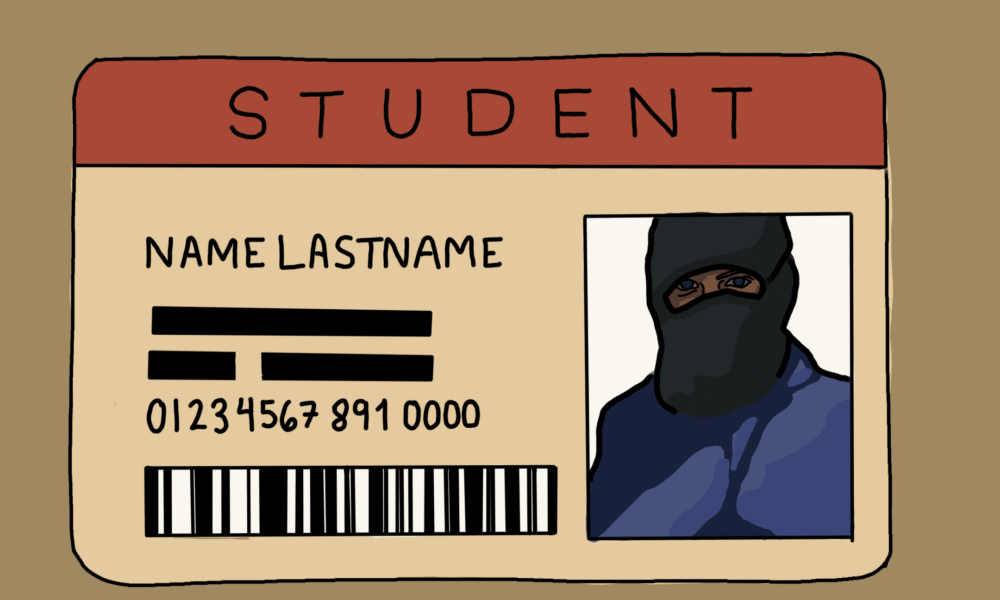



McGill proposed an Identification Policy for Access to Properties Owned, Occupied, or Used by the University to the Senate in January 2026. If approved, it would allow authorized personnel to require individuals on campus to present a McGill or government-issued ID “for a legitimate purpose.” These aims include safeguarding the integrity of the university’s academic and administrative activities and protecting McGill property, while also ensuring the safety of members of the McGill community and others on campus.
In a written exchange with The Tribune, McGill’s Media Relations Office (MRO) wrote that there is currently no university-wide policy for governing identification requirements, and that the proposal aims to provide a comprehensive framework only. The MRO asserts the policy is intended to complement existing university policies rather than override them.
“[The policy] does not change or diminish rights and protections already in place, including to lawful protest and those set out in the Charter of Students’ Rights and the Statement of Principles Concerning Freedom of Expression and Peaceful Assembly,” MRO wrote.
The policy has, however, drawn pushback from student activist groups. On Feb. 23, Divest McGill issued an open letter for students to sign, which will be submitted to the Senate for discussion at its next meeting on March 18. As of 3:00 p.m. on March 5, 474 undergraduates, graduate students, faculty, and alumni had added their signatures.
Divest McGill hopes this campaign will mobilize the Senate to push back against the policy. In a written statement to The Tribune, a representative from Divest McGill explained that the policy regulates behaviour through a framework of risk—one that assumes suspicion rather than fairness or justice—which may discourage students from expressing dissent.
“The ambiguity of the policy particularly in areas of training leaves room for violence and racial profiling, almost all treatment of the student seems to be up to the ‘authorized personnel’s’ discretion,” the representative wrote. “There is more than enough room in this policy for authorized personnel to imbue it with their own personal biases and allow for possibly hateful actions to be taken and validated by this general discretion provided.”
Further, Divest McGill worries these policy developments suggest McGill has increasingly taken steps to limit protest on campus, and the proposed policy appears to be part of this.
Barry Eidlin, associate professor in the Department of Sociology, said in an interview with The Tribune that this policy would leave a chilling effect on campus. He argued the mandate is counter to the university’s intellectual mission and its commitment to free expression.
“For the university to have these tools at their disposal, to threaten and intimidate people engaged in protest, is going to hamper or restrict our own scope of action, and so it’s important for us to take a stand, to protect our own rights as well,” Eidlin said.
Regarding free speech, Eildin further described the proposed identification policy as part of a broader pattern of administrative overreach.
“We don’t know what other contexts they might feel that it’s appropriate to use this [policy],” Eidlin explained. “Part of the problem with the policy is that it is overly broad […] so it’s going to be applied in arbitrary ways without any sort of clear criteria to determine when it’s used.”
The representative from Divest McGill quoted the open letter, expressing that the policy, if approved, would instill a fear of surveillance in students.
“Under this policy, McGill community members’ right to learn, work, and research can be interrupted without any evidence of wrongdoing. Not even the police, who must have reasonable suspicion of a crime having been committed to request identification, have this much discretionary power.”


