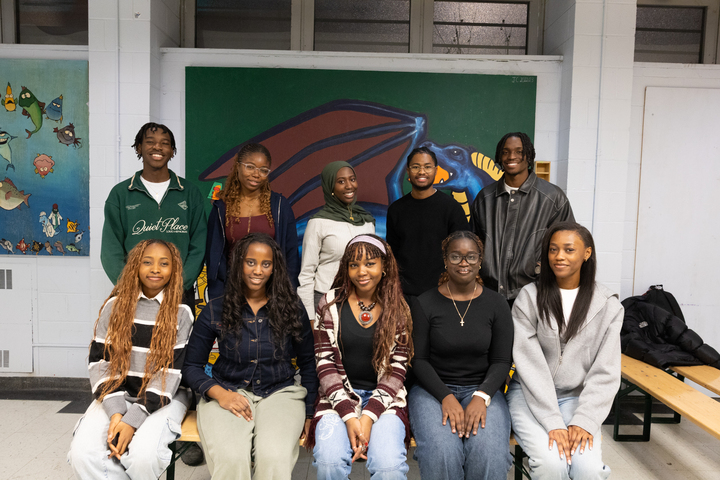



For many Black engineering students at McGill, finding community can be just as important as academic success. The McGill chapter of the National Society of Black Engineers (NSBE) aims to provide that support through camaraderie, mentorship, and leadership.
One of the students helping lead these efforts is Fatima Janneh, a third-year student in McGill’s Department of Bioengineering, and the current Vice President of NSBE McGill. Janneh has been involved with NSBE since her first year at McGill, but her connection to the organization began even earlier. While still in high school, she attended a summer program at the University of Toronto (UofT) and heard a guest speaker—then president of UofT’s NSBE chapter—talk about how the organization provided networking and professional opportunities. At the time, Janneh was interested in STEM but unsure about pursuing engineering. Seeing Black engineers, particularly women, changed that perspective.
“People of colour, Black people like me, a woman who wears a hijab—I was not seeing that in engineering,” Janneh said in an interview with The Tribune. “Other people in that panel who were also Black inspired me to pursue this career. I was 16 years old at the time. Fast forward a couple of years, and now I am in my first year of university.”
One of NSBE McGill’s most anticipated events is the Black Legacy Dinner, held annually during Black History Month. The event brings together students, professionals, and sponsors from across the Greater Montreal Area to discuss experiences in the professional world as Black individuals. This year’s dinner will take place on Feb. 16, and is themed “Yes We Can”—a reference to former U.S. President Barack Obama. The dinner features up to 100 participants and a panel of speakers from different backgrounds, including engineering, social work, philanthropy, and startups.
Janneh also discussed how NSBE’s internal culture plays a central role in its impact. General meetings include informal discussions about members’ weeks and shared experiences, alongside event and logistic planning, which helps create an environment where members feel comfortable speaking openly.
NSBE McGill collaborates regularly with other Black student organizations at McGill, including the Black Student Network, the African Students Society, and the Caribbean Students Society. These collaborations aim to bring together different Black student communities at McGill through social and cultural events.
NSBE McGill is also connected to other chapters across North America. Each year, members attend the NSBE Convention, which brings together more than 10,000 students. This year’s convention will take place in Baltimore from March 17 to 22. The event offers networking opportunities with major companies and allows students to connect with peers from other chapters. Additionally, NSBE McGill participates in the East Canada Zone conference and was recently named Chapter of the Season for its involvement in student life.
While NSBE McGill has grown since its founding in 2005, Janneh noted that challenges related to representation remain.
“When I walk in a room, not many people will know the feeling of being a Black student. The Black identity can be very different for others [….] There are certain prejudices that people might have in their minds but that they will never voice, though you can still feel them,” Janneh explained. “In the past, NSBE had to struggle with visibility and member count. But now, every single year, I see it grow more.”
Janneh stressed that her presence at McGill is tied to a broader sense of responsibility.
“I am here for more than just my degree. I am here to learn, grow, develop my skills [….] There is a pressure on me to be able to grow. I know my parents came here for us to have a better education, for us to have a better future. I can’t just throw this down the drain.”
To first-year students who may be questioning their place in engineering, Janneh offered one piece of advice: Avoid isolation.
“Just because you do not see representation in your class does not mean you won’t find representation anywhere else. I know it is difficult to go to those events when you don’t know anybody, but reaching out will bring you where you need to go.”


