
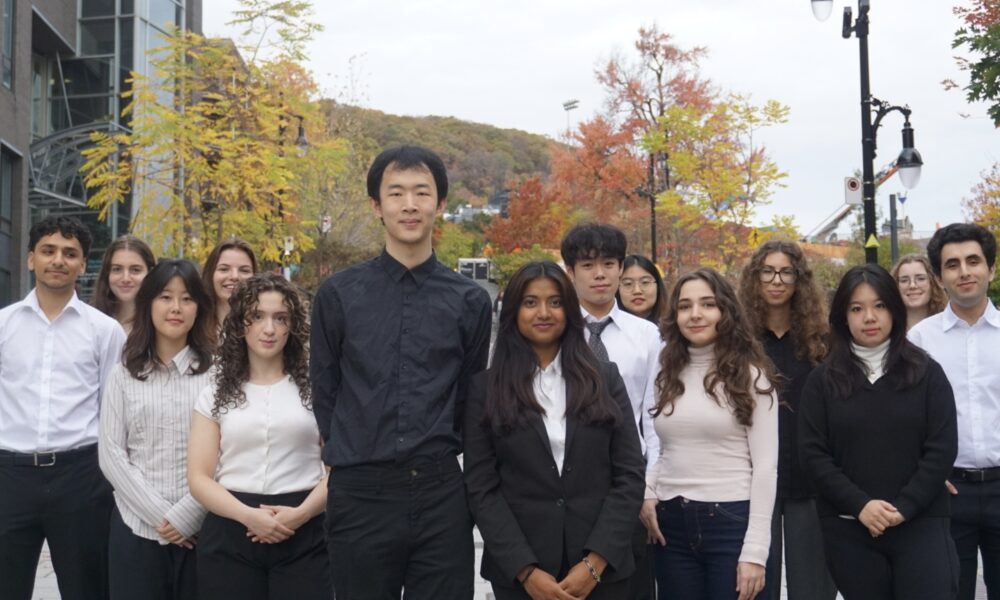




McGill BioDesign is one of McGill University’s premier bioengineering design teams. Based on engineering design practices, the team tackles an array of projects in medtech and sustainability, affording students the opportunity to collaborate in research laboratories across campus and compete internationally. For many, McGill BioDesign provides a unique learning environment outside of traditional coursework.
In an interview with The Tribune, project lead and U3 Faculty of Science student Siqi Mi—who joined McGill BioDesign as a research member and currently serves as Team Lead for the SensUs project—praised the team’s open-minded ethos and push to pursue individual interests.
“For me, BioDesign is a place [where] you can implement your thoughts,” Mi said. “When you feel like there’s a problem outside […] you can just come in and bring it up, and people will do the research and implement it into a protocol.”
Each year, McGill BioDesign runs approximately five projects, with teams of roughly 15 to 25 members. Projects begin with an ideation phase, followed by a literature review and protocol designs. Teams often start by replicating methods described in previous research before modifying them to meet specific project goals.
“We definitely follow the path of what the previous paper has done […], and oftentimes we will add our new stuff in it to improve for certain goals,” Mi explained.
A distinctive feature of BioDesign lies in its internal structure. Similar to the scientific industry, projects at BioDesign are divided into research and translational potential groups. The research group handles experiment ideation, laboratory testing, and result optimization for competition. The translational potential group focuses on the projects’ real-world applications, consulting with industry professionals and collaborating with the research team on commercial aspects. The two groups meet weekly to update one another on progress and constraints.
In addition to developing practical skills, BioDesign allows its members to see how research unfolds outside a classroom setting.
“Oftentimes, research fails. You go into lab, and whatever you make doesn’t work,” said Alan Fu, BioDesign’s Co-President and a U3 student in the Faculty of Engineering, in an interview with The Tribune. “But you slowly iterate, you slowly improve, and finally achieving something that gets some nice results is quite satisfactory.”
BioDesign also emphasizes global exposure. Each year, the team sends projects to international competitions, including the SensUs competition in the Netherlands and the BioDesign Challenge in New York City. SensUs is a biosensor competition that provides teams with a specific challenge; one recent prompt involved developing a monitoring system for levodopa, a medication used as a dopamine replacement in Parkinson’s patients. In addition to international events, BioDesign participates in local competitions such as the TechIdea Pitch Competition, where the team recently placed third.
On campus, BioDesign hosts the Biocase competition, inviting undergraduate teams to design solutions to bioengineering-related dilemmas over the course of a weekend. According to organizers, hosting Biocase serves as a way for BioDesign to give back to the student competition community.
Beyond research and competition, members consistently praise the club’s sense of community. Students come from a range of academic backgrounds, which allows projects to benefit from different perspectives. Fu noted that the club fosters close friendships through shared lab work and team social events.
“I joined BioDesign in my first year, and that was when I met some of my closest friends from university,” Fu recalled.
Over the past four years, BioDesign has grown from approximately 40 members and around two projects to more than 100 members across five projects. Certain initiatives continue for longer than an academic year, and one team is currently in the peer-review process for publication through Cambridge University Press.
For students interested in applied science and design, BioDesign offers a clear pathway into hands-on research.
“Getting involved in a design team is a really amazing way to get actual hands-on experience on what industry or research might actually look like,” Fu said.
Interested students should note that recruitment for research roles typically occurs in the fall, while executive positions open later in the academic year.