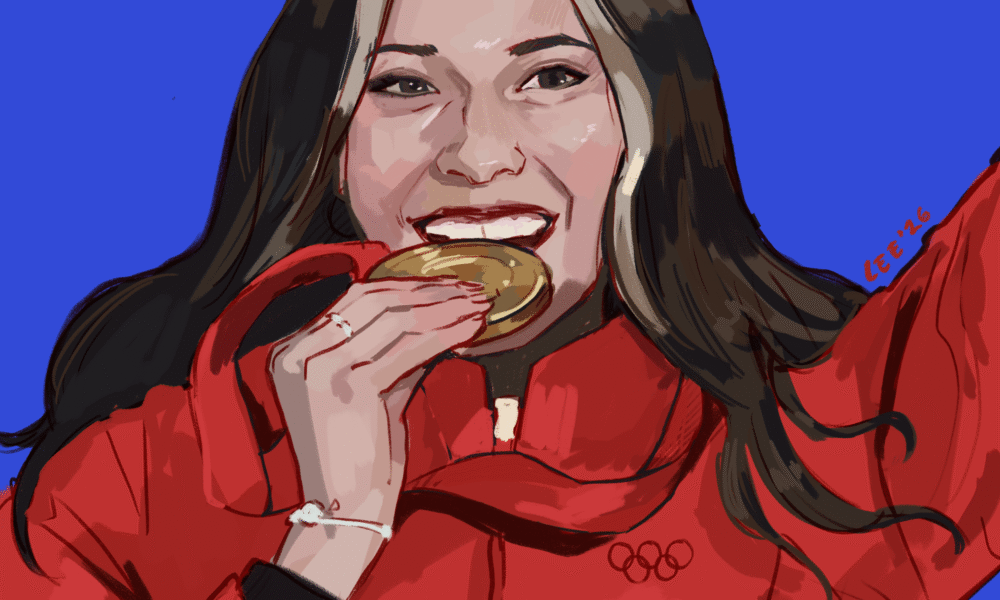



On Feb. 22, the 2026 Milano Cortina Winter Olympics came to an end. While the Olympic Games featured talented athletes from all over the globe, some aspects of the event sparked controversy. One of these conversations was centred on American-born freestyle skier Eileen Gu.
Gu is an international superstar: A superb athlete, a fashion model, and a student of quantum physics at Stanford University. At 22, Gu has become one of the most decorated skiers of all time. In 2022, she made her debut at the Beijing Winter Olympic Games, making history as the youngest Olympic freestyle skiing champion. Gu was the first freestyle skier to win three medals in one Olympic Games, winning gold in the big air and halfpipe events and silver in slopestyle.
At this year’s Games, Gu built on past successes, adding three more medals to her collection—two silvers and one gold—and defending her title in the women’s freeski halfpipe event. She left the Milano Cortina Games as the single most-decorated freestyle skier in history.
However, while Gu is the pinnacle of success on the slopes, her achievements have created a great divide between supporters and critics. Back in 2019, after competing for Team USA in three World Cups, Gu took to Instagram to announce that she would no longer be competing for the United States and would instead represent the People’s Republic of China.
Her decision faced major backlash at the time. She claimed that by honouring her mother’s identity and her biracial background, she wanted to inspire young girls in China, acting as a representation of a successful Chinese-American woman athlete in an underrepresented sport. Her goal was “to unite people, promote common understanding, create communication, and forge friendships between nations.”
Gu’s decision continues to spark debate seven years after her initial announcement. Some applaud Gu for embracing both her American and Chinese identities, but others criticize the decision, questioning her choice to ski for China given their complicated human rights history and fragile relationship with the United States. US Vice President JD Vance claims that she is the product of an American system but is choosing not to compete for her country. Others are taking to social media to brand her as a “traitor.”
Many of these criticisms are rooted in the compensation Gu receives from the Chinese Olympic Committee. As a Chinese athlete, she is paid more than she would be if she continued to compete under Team USA. However, a majority of her current earnings come from partnerships rather than the Chinese government. She is also a symbol of the fight to close the gender pay gap in sports, as she is one of the highest-paid female athletes in the world.
While questioning Gu’s decision to compete for Team China is reasonable, these critiques walk a fine line between questioning and aggression. In 2022, Gu reported that the criticism escalated to harassment: She was physically assaulted, received death threats, and her dormitory at Stanford was robbed. Beyond this escalation, critics have unfairly compared her to other Asian-American athletes from similar backgrounds who chose to compete for Team USA, like figure skater Alysa Liu. These comparisons assume that athletes with similar ethnic backgrounds should make the same choices, ignoring personal and cultural factors that shape each athlete’s identity.
Instead of pitting high-achieving women athletes like Liu and Gu against one another, the media needs to uplift the narratives of two women athletes with similar stories, both achieving greatness. Liu and Gu are models for future generations, not rival stories.
Gu’s decision to represent China will likely always remain controversial. But framing her choice as just a matter of financial incentives or resources overlooks the context in which it was made. Gu’s decision reflects her genuine connection to her Chinese identity and heritage. Instead of reducing her choice to opportunism, we need to ask more nuanced questions: Why do athletes sometimes feel compelled to represent countries other than their birthplace? What does this reveal about the political climate of the United States, particularly as anti-immigration and xenophobic sentiments resurface? Gu’s decision shows that nationality in sport is not just about opportunity or funding, but is centred on belonging and identity.