
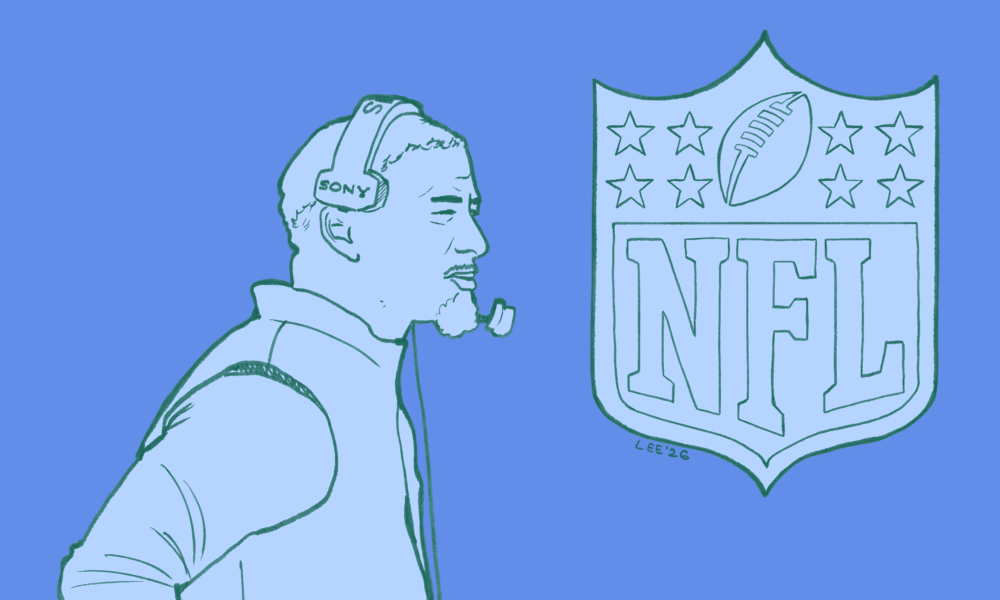


On Feb. 8, the National Football League (NFL)’s 2026 hiring cycle concluded. The 2025 season left 10 head coaching positions vacant, and no Black head coaches were hired to fill them for the upcoming season. The hiring cycle resulted in one minority hire, Tennessee Titans’ head coach Robert Saleh, who is of Lebanese descent. There are now only three Black head coaches in the league: The New York Jets’ Aaron Glenn, the Tampa Bay Buccaneers’ Todd Bowles, and the Houston Texans’ DeMeco Ryans. This marks the fifth time since 2003—the start of the Rooney Rule—during which no Black coaches were hired during a coaching cycle.
The Rooney Rule was adopted following the unjust firings of Black coaches Tony Dungy and Dennis Green, aiming to counteract the historically low number of minorities in head coaching positions. Originally, the policy required that every team with a head coach vacancy must interview at least one Black candidate before making a new hire.
After several changes over the following years, the current policy outlines three main rules. First, teams must interview at least two external minority candidates for head coaching vacancies and at least one external minority candidate for coordinator positions. In addition, they must interview at least one minority and/or female candidate for senior-level positions, such as team president and senior executive.
Second, as of 2022, clubs must conduct external interviews with a minority and/or female candidate for open quarterback coach positions, which are often a stepping stone to coordinator and head coaching jobs. The rule was implemented to help increase the pool of qualified minority coaches in the future.
Finally, the league introduced incentives for developing diverse talent. Teams with minority candidates who are later hired as head coaches or general managers will receive third-round compensatory picks for two years, with an additional year awarded if both a coach and executive are hired elsewhere.
While the Rooney Rule aims to balance representation and diverse hiring within the league, its regulations ultimately do not dictate who occupies positions of power. According to a survey conducted in 2023 by The Institute for Diversity and Ethics in Sport (TIDES), Black athletes make up 53.5 per cent of the players in the NFL. However, in this season alone, the number of Black head coaches remains less than 10 per cent, occupying just three of 32 positions. The last time Black representation was this low was in 2002, before the adoption of the Rooney Rule, when there were just two Black coaches in the entire league. The imbalance in head coaching roles highlights a broader power dynamic within the NFL: Black athletes overwhelmingly populate the field, yet decision-making authority remains in the hands of white coaches.
In a period when the United States is growing increasingly conservative, the issue of representation in sports is at the forefront of the conversation. Recently, U.S. President Donald J. Trump has moved to end federal government diversity, equity, and inclusion (DEI) programs, while many large companies are following suit.
While NFL commissioner Roger Goodell has stated his continuous commitment to “diversity efforts” in the league, it is clear that the NFL has failed to deliver on its promise of DEI.
Following the backlash of the recent hiring cycle, Goodell has reflected that the league needs to reevaluate its approaches to minority hiring. Yet, the shortcomings of the Rooney Rule should not be taken as proof that diversity policies are unnecessary. Rather, they expose the limits of such rules in confronting and dismantling deeply embedded institutional racism. Interview mandates alone cannot dismantle power structures that have historically excluded Black leadership. If anything, the NFL’s continued disparities underscore that these policies are a starting point, and that more meaningful reform is needed.