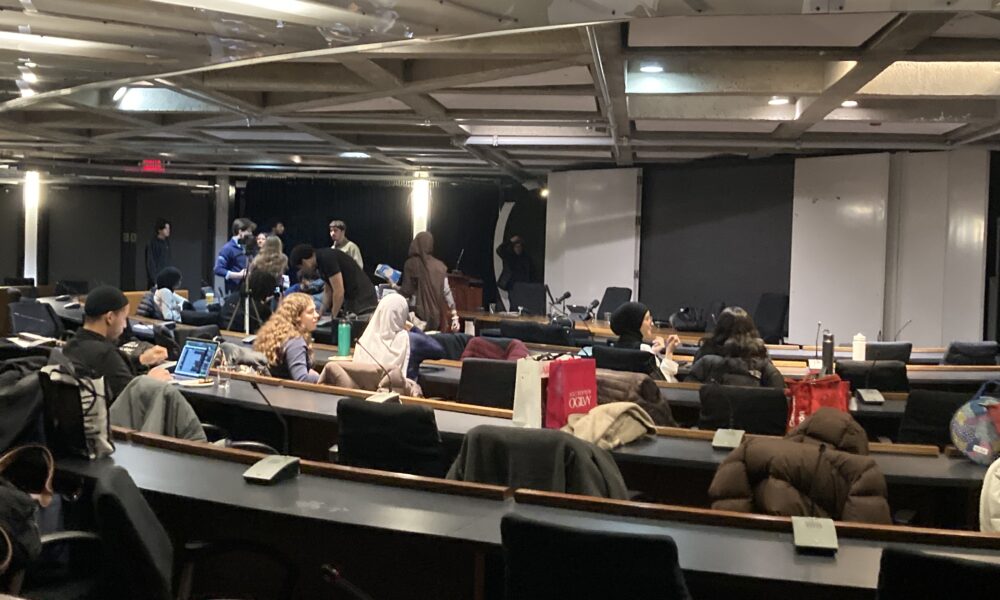


On Nov. 26, Amnesty McGill hosted a speaker panel that brought attention to the ongoing genocide in Sudan—an issue that remains largely absent from mainstream media coverage. The panel featured Professor Jon Unruh from McGill’s Department of Geography and graduate student James Achuli, both of whom study conflict and development in East Africa. Together, they provided important context regarding the history behind the violence in Sudan today, why the conflict has continued, and what makes peace so difficult to achieve.
Amnesty McGill co-president Anna Sophia Everett, U3 Arts, opened the panel, welcoming attendees and introducing the two speakers.
In an interview with The Tribune, Everett explained why a panel like this matters; actively raising awareness about Sudan is crucial because many students simply do not learn about the crisis anywhere else.
“There’s not any immediate benefit for a Global North actor to involve itself in a conflict like this,” she said, pointing to how geopolitical interests—rather than dire humanitarian need—tend to drive international intervention.
During the panel, Professor Unruh walked students through the history of conflict in Sudan. He explained how Arab militias’ seizure of land from Black farming communities, government corruption, and the rise of armed groups have all contributed to large-scale violence and displacement. He traced how the genocide is inflicted and targeted upon Black, non-Arab ethnic groups, a pattern that began with the Janjeweed militias under al-Bashir and continues today with the Rapid Support Forces (RSF), many of whose fighters were former Janjaweed members. He stated that groups were pushed out of their land, farming communities were neglected, and the interests of colonial powers—including the pursuit of gold and other resources—made the region even more unstable.
Unruh emphasized that stories and messaging play a major role in framing the conflict as militia groups in Sudan seek to justify the acts of violence they commit.
“Narratives prevail in conflict,” he said. “Each group in the armed conflict has a narrative, a story they tell themselves. It’s a narrative of grievance always. They’re the victims, and those people over there are at fault against us.”
Unruh emphasized that the presence and messaging of organizations like Amnesty International can reshape conflict dynamics in unexpected ways. While Amnesty’s reports are directed at international audiences—calling for sanctions or intervention—combatants in the field hear them too.
“Even the presence of Amnesty International, [a] well known and powerful group with a powerful voice internationally, weighed in here,” he said. “Even when the organization is simply present in a conflict zone, its reputation in messaging can influence how combatants frame their own actions.”
While Amnesty International’s messaging was aimed at the international community—calling for sanctions and intervention—it had an unintended effect on combatants in the field who were listening, too. When news of al-Bashir’s indictment for war crimes filtered down to Janjaweed fighters, it disrupted their narrative—suddenly, they questioned whether they would actually keep the land they’d seized through violence. The threat of accountability, even if distant, altered calculations on the ground, he explained. Without mechanisms to hold perpetrators responsible, crimes against humanity fueled by anti-Black racism remain unchecked.
After Unruh’s presentation, the panel opened the floor for questions. Students asked about the role of international actors, how climate and land use shape conflict, and what meaningful intervention could look like. The discussion gave attendees space to connect Unruh’s analysis to other humanitarian issues unfolding today.
When asked about the relationship between the UAE and the RSF, Unruh traced the connection back to Yemen.
“The RSF actually loaned itself out to the UAE in its international conflict,” he explained. “These are Sudanese fighters that ended up fighting at the behest of the UAE in Yemen.” That relationship, he noted, evolved into an arrangement in which gold flows out of Darfur and weapons flow back in.
The second speaker, James Achuli, began by grounding the conflict in lived experience. He explained how decades of instability in Sudan and South Sudan have shaped daily life for families in the region, especially those who have endured multiple experiences of displacement. He explained that displacement is not just a single event—it fractures communities, interrupts education, separates families, and forces people to rebuild their lives with very few resources or guarantees of safety.
Achuli also spoke about the difficulty of creating long-term stability. In his opinion, international actors often respond too slowly or focus on short-term relief rather than supporting structures that foster lasting peace. He stressed that real change cannot come from the outside alone—peace requires both global engagement and local leadership to have sustainable results.
“It’s up to the South Sudanese people and an international community coming together to create genuine peace in South Sudan,” he said.
To close, Achuli emphasized the importance of humanitarian aid and how organizations like UNICEF help by providing basic literacy, teacher training, and safe spaces for children in Sudan. After his remarks, the floor was once again open for discussion, giving attendees the chance to ask further questions.
During the question period, Achuli was asked more about his personal story. He shared how he grew up when Sudan and South Sudan were still one country, spending his youth in a southern region where educational infrastructure was severely underdeveloped relative to Sudan’s capital, Khartoum. The disparity was a legacy of colonial-era policies that had systematically marginalized southern Sudan, leaving communities without the schools, teachers, and resources that were more readily available in the capital. While the British developed government schools in the north, they left education in the south to Christian missionaries with minimal resources. This colonial policy heavily invested in northern Sudan, creating pervasive disparities. By the time Achuli was born, southern Sudan remained one of the country’s most underdeveloped regions. When civil war erupted in 2013, he was just ten years old and found himself internally displaced, separated from his family while trying to continue his education.
His story underscored why events like this panel matter: They connect abstract policy discussions to the real experiences of those affected by conflict. Closing his remarks, Achuli addressed the event attendees directly.
“When you sit in here, I’m wondering, what are you going to do with this information?” The question reframed awareness as a responsibility—not an endpoint, but a call to action.
In an interview with The Tribune, Everett shared what makes Amnesty McGill distinct on campus. She explained that the club offers a space where students can engage with human rights issues beyond academic analysis in a class setting.
“I love school, I love academics,” she said. “But I think the best part about Amnesty is really focusing less on putting the perfect spin on something or trying to analyze it.”
She stated that Amnesty’s strength comes from pairing strong research with meaningful advocacy. What matters most, she added, is the commitment of the students who attend.
“The nice part is that people do show up. They really care. It’s more so feeling like you’re taking an action on a day-to-day basis, even if it’s on campus.”
The event elucidates the criticality of keeping conversations about Sudan visible at McGill. By creating space for students to learn, ask questions, and hear from experts, Amnesty McGill aims to highlight a deeply pressing genocide, transforming a conflict that is often ignored by mainstream media into a campus conversation that demands response. As Unruh emphasized throughout his presentation, narratives—including the stories combatants tell themselves, the frameworks international actors use to justify intervention or inaction, the language that shapes whether atrocities are recognized or minimized—determine how conflicts unfold. Keeping Sudan visible on campus is the first step toward holding institutions accountable for their role in perpetuating violence.


