
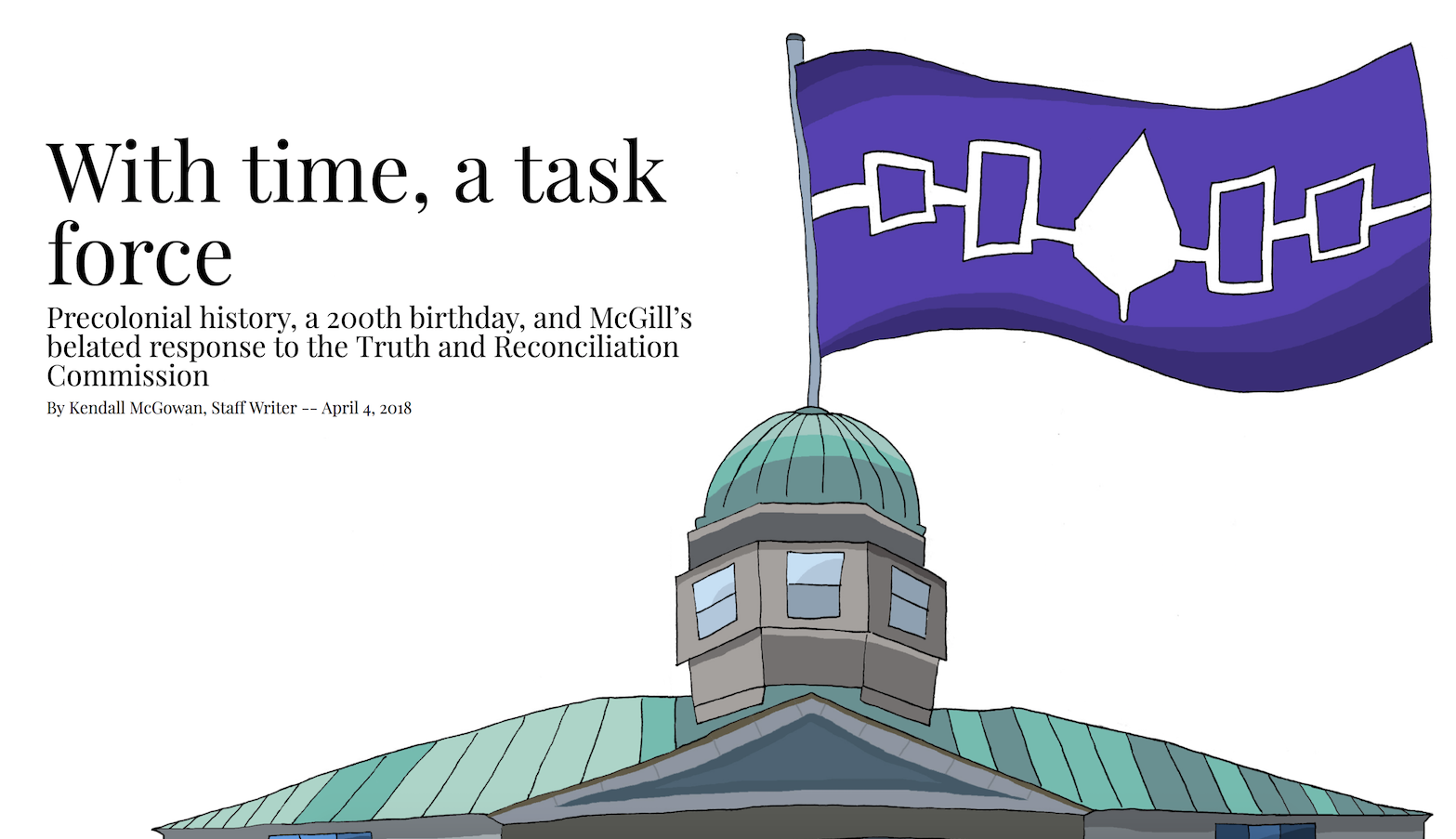

Nearly 200 years ago, James McGill, a fur trader and one of the most prominent slave owners in Quebec’s history, founded McGill University on land traditionally held by Indigenous peoples. On that land, enslaved Indigenous and Black labourers built many of the edifices which still stand on campus, including the Arts building. To this day, the university has not ceded the land that it stands on and during the 2015-2016 academic year, Indigenous students received just 46 of the 9,022 degrees granted by McGill. Last year, a task force created by McGill’s Provost Christopher Manfredi proposed 52 calls to action in order to address this history and the ways in which it continues to harm students on campus.
Part I: History
In 1859, McGill president and leading Canadian geologist Sir John William Dawson was called to a construction site at the corner of Metcalfe Street and De Maisonneuve Boulevard West, a block away from where McGill’s Bronfman Building stands today. Construction workers uncovered long-buried artifacts indicating the former presence of an Iroquois village: Fire pits, the infrastructure of longhouses, human skeletons, pottery, stone implements, and more. Some of these items are now visible at the McCord Museum.
Dawson spent a few months examining the evidence and eventually suggested that the site—which came to be known as the Dawson Site—represents the remains of the village of Hochelaga, populated by the St. Lawrence Iroquoians. In 1535, Jacques Cartier was the first European to discover Hochelaga when he reached the island that is today known as Montreal, after the French King Francis I tasked him with exploring what became New France. As he described it in his writings, Hochelaga was a large village of approximately 3,000 people living in 50 longhouses in a fortified enclosure surrounded by cornfields at the base of a mountain which he called Mount Royal. Scholars still dispute the exact location of Hochelaga, but because of Cartier’s description, most contemporary literature places it in the vicinity of McGill Downtown campus. Regardless, the village disappeared shortly after Cartier’s first visit; it was already gone by the time of his second, and no subsequent explorers were able to find it.