
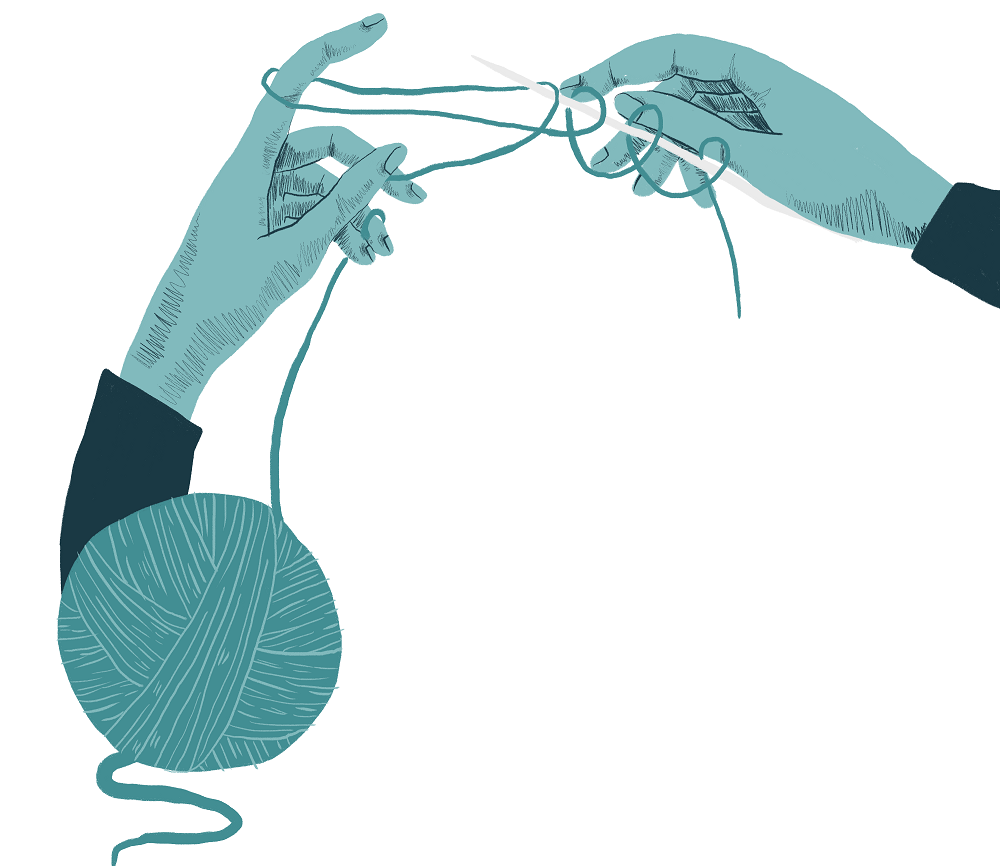

Crocheting is a balancing act. To make each stitch, one hand grips the hook and the other controls the tension of the yarn: Too taut, and the project will turn out cramped, stunted; too loose, and it will be flimsy, undefined.
I was 10 when my Oma taught me to crochet, and it took a full week. Each day we practiced together, her worn but still-deft hands guiding mine until I could yarnover, chain stitch, and single crochet. I marveled at the diversity in her repertoire, from delicate lace doilies made with thread to bulky crewneck sweaters spun from Icelandic sheep’s wool. My first project was restricted to a simple square (though it looked more trapezoidal), but it felt like mine—here, at last, was something I had made.
There’s something magnetic about crafting, whether it’s crocheting a scarf or knitting a sweater. For many students, it becomes a reprieve from the hustle of everyday life, a chance to wretch our hands from the vice of our keyboards. Just as uniform stitches require careful attention to balance, students too must work to manage their personal and academic lives during remote learning semesters and beyond. While academics may in some ways prove a hindrance to crafting, they are also a conduit by which to channel creative energy. Unlike nebulous professional or personal aspirations, which may prove fruitless despite best efforts, crafting is foolproof: Learn the technique, follow the instructions, and voila—a handmade, three-dimensional scarf, sweater, blanket, or amigurumi has been transformed from a simple ball of yarn.
Crafting becomes a meditation, a mindfulness that rewards the practitioner not only with a creative outlet but a physical, meaningful result. Although crocheting and knitting was once pegged as tedious monotony, it is this very consistency that offers a sanctuary from the difficulties of present life.