
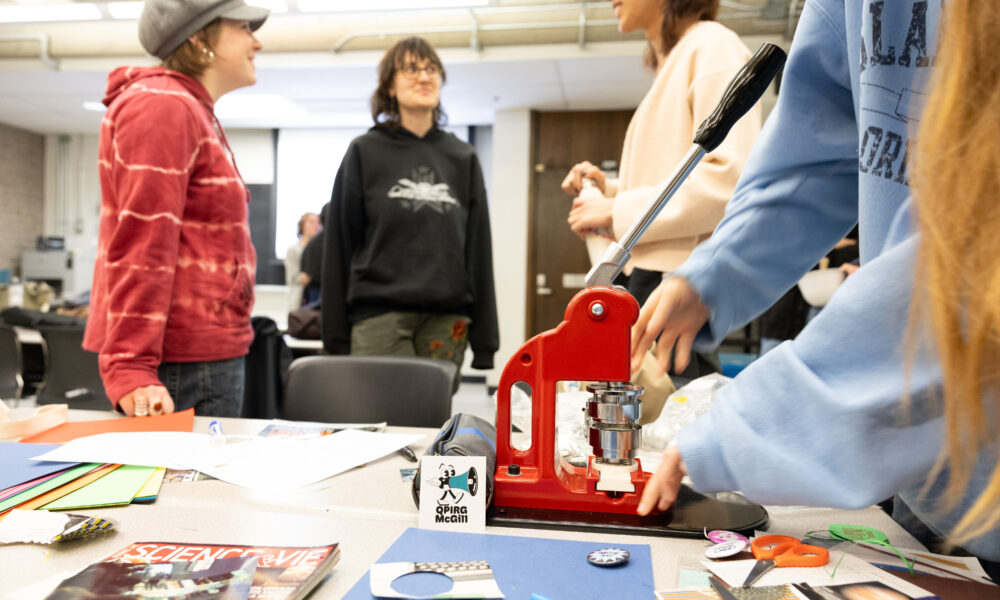


On Jan. 22, McGill’s Quebec Public Interest Research Group (QPIRG-McGill) chapter held an information session on how to run for student government positions at the Students’ Society of McGill University (SSMU), titled “Fix Student Democracy.” The talks explored how student involvement in these administrative positions can enact positive change for the undergraduate student body.
In an interview with The Tribune, Nelly Wat, outreach coordinator at QPIRG-McGill, emphasized the importance of holding educational events.
“QPIRG really tries to serve as a hub for students who are really invested in social and environmental justice,” Wat said. “What we try to do is keep students politically engaged and connected with their community.”
Former SSMU Vice-President External Hugo-Victor Solomon began the talk with an overview of how the SSMU is run, illustrating how students can pursue their passions through student government.
Throughout his tenure, Solomon pursued goals such as increasing visibility of the Mohawk Mothers, ratifying the Policy Against Genocide in Palestine, and implementing a fee for Francophone initiatives. Solomon described these projects as part of his vision to run SSMU as a union.
“A union has an obligation to deliver for its membership. A business has an obligation to deliver for its shareholders to protect its own kind of commercial well-being,” Solomon said. “You should not accept that type of framework, even though it might feel a bit more easy.”
Solomon also cautioned potential candidates against overworking themselves for a SSMU position. He advised that candidates should instead economize their work.
“Understanding where your [political] pressure is most effective will be kind of the difference between burning out and getting nothing done and accomplishing as many of your goals as possible,” Solomon said. “There’s a large number of people [on the External Affairs] team, and if you can cultivate a shared team identity and pursue goals that everybody already cares about, it can actually be really fun.”
Some SSMU representatives, however, find it difficult to optimize political authority due to perceived systemic issues. The next presenter, a SSMU employee who wished to remain anonymous, criticized SSMU for its alleged restructuring of political power, moving authority from General Assemblies (GAs) to the Legislative Council. The member argued that this change is detrimental to student democracy.
“GAs are the highest governing body of a student union,” the member explained. “One of the most telling things about how bad SSMU is right now is that they never hit quorum with their GAs unless there’s a vote on Palestine happening. So there are a bunch of democratic things that have been pushed to the side in SSMU.”
They also expressed their discontent toward SSMU’s handling of Midnight Kitchen (MK)—which SSMU shut down in October 2025 without consulting the kitchen’s staff. The member stated that, after MK was shut down, SSMU reappropriated its democratically allocated funding to instead hire private catering companies.
The member was also alarmed by the new Student Code of Conduct, which was approved by both student senators and the SSMU executive team on Nov. 12. They claimed that the new Code of Conduct facilitates punishments for students involved in political activism, citing an alleged uptick in the number of disciplinary cases made against students by the university.
However, SSMU President Dymetri Taylor disputes these claims, writing in an email to The Tribune that, had student senators not engaged with the administration, the outcomes for undergraduates would have been worse. He also explained that if the Code is causing too many issues for students, then student senators will petition for amendments.
“On the claim that there’s been a sudden increase in disciplinary cases this semester, that’s not accurate,” Taylor wrote. “There was definitely more enforcement activity around the [pro-Palestine] strikes, but that’s because people were blocking classes from taking place, which has always been against the Code.”
The member also alleged that these issues stem from the McGill administration’s intervention in SSMU, stating that these systemic changes were made at the request of President and Vice-Chancellor Deep Saini and Interim Deputy Provost (Student Life and Learning) Angela Campbell. They alleged that issues such as limited student services funding and strikes became more difficult to organize as a result of these changes.
However, Taylor asserted that these framings are incorrect. He stated that the lack of student funding is due to the student body voting against an increase and that SSMU, as a student society, cannot legally mandate strikes like a union can.
“We’ve been working more productively with [McGill] in order to get results and make sure student voices are heard. But the idea that people are doing this for personal gain isn’t true,” Taylor wrote. “In my experience, only a couple of executives in prior years approached the role that way, and they’re, thankfully, no longer here.”
Due to these issues, the member believes that SSMU finds itself in a precarious situation. They listed how many other organizations, such as the Concordia Student Union and Co-op Bar Milton-Parc, are more hesitant to work with SSMU now because of this paradigm shift. Despite this, the member is still optimistic about SSMU’s future.
“Those systems, those relationships are all being eroded really, really quickly in a way that is going to be hard to come back from,” the member said. “But it will just take people who are elected, who are motivated, who are excited about political change to change that and undo the damage that’s been done.”