
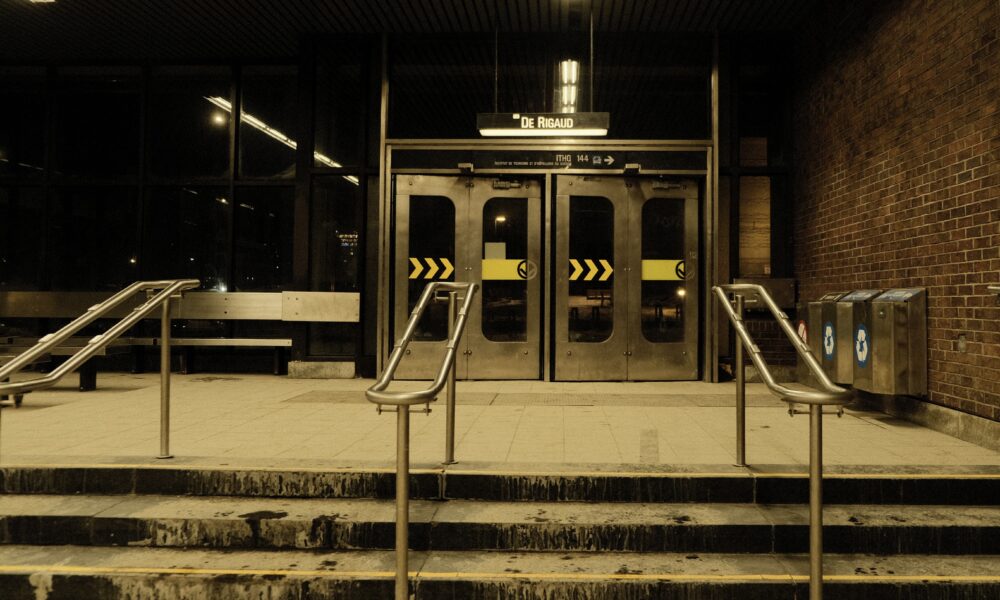




Lost jobs, accumulated tardies, and expensive Ubers are just some of the effects of the Société de transport de Montréal (STM) strikes that froze public transit from 2025 until the beginning of 2026. On four separate occasions, bus drivers, train operators, and maintenance workers, led by their respective unions, went on strike. The strikes followed over 100 failed negotiation efforts between unions and the STM, with employees seeking a 25 per cent wage increase and compensation for time spent doing peripheral tasks such as snow-cleaning or moving from station to station, which the STM currently does not recognize as salaried labour.
On the surface, it seems the STM strikes merely hurt the public and farebox revenue, as ridership dropped approximately 6.4 per cent compared to 2024, and monthly pass sales dropped 10 per cent between June and December 2025 alone.
However, to avoid labelling the strikes as merely an inconvenience or aberration, it is important to look at not just their effects but the grievances from which they arise. These concerns—low salaries, private subcontracting, and overtime—are all consequences of the systemic underfunding of the STM; the root source of rider discontentment is the transit system’s budget failings, not the decision of workers to strike.
The STM’s $1.8 billion CAD budget announced for 2026—and funded almost entirely by the Autorité régionale de transport métropolitain—includes major austerity measures, eliminating 300 jobs. Although maintenance cutbacks address budget deficits, they counterintuitively put further strain on metro assets, 42 per cent of which are already in poor condition. Furthermore, STM projects aimed at modernizing transit offerings—repairing aging infrastructure (tunnels, stations, and MR-73 trains), electrifying buses, extending the Blue Line, and making every station accessible—are in need of funding. Given that day-to-day operation of the transit system is shrinking, the STM’s service interruptions and drop in ridership that these infrastructure projects are trying to address will only deepen.
The STM depends on provincial and federal funding for these infrastructure projects. Under the 2025-2035 Quebec Infrastructure Plan (QIP), $14.5 billion CAD is allocated for public transit. This is $258 million CAD less than the STM requested for supporting the metro system, and $21.3 billion CAD less than was allocated for road networks. An additional $37.8 billion CAD in public transit investment is allocated under the QIP, but these funds are designated for electrification and the Metropolitan Express Network (REM), not asset maintenance in the STM. In fact, only $2.8 billion CAD out of the $15.2 billion CAD designated by the STM as priority investments in maintenance and service has actually been confirmed.
The Legault administration has prioritized flashy non-QIP projects over the basic functioning of the transit sector: Projects like the REM are designed to be profitable, whereas the STM, which is a public good, is less so.
A solution that avoids deepening Quebec’s deficit is to reallocate a portion of provincial and federal funding currently devoted to road systems toward both the infrastructure and the operations of the STM. Any shortfall in road funding can then be covered through congestion pricing for vehicles driving on busier, downtown streets. These fiscal reforms would increase the reliability and expansiveness of the transit system while simultaneously reducing traffic in cities and decreasing the costs of road maintenance.
The reason you are late to your class is not because of strikers, but because our government has not invested in you getting there on time.