
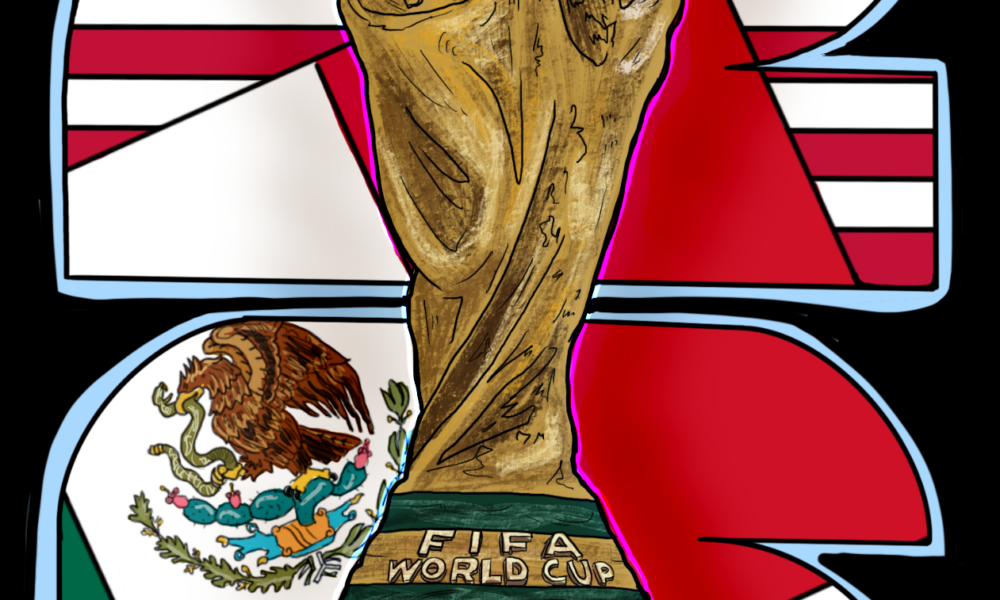




Last July, a father and asylum-seeker took his two children to the Fédération Internationale de Football Association (FIFA) Club World Cup final at MetLife Stadium in New Jersey. He was cited for a minor drone ordinance violation in a nearby parking lot. Instead of releasing him, officers handed him to Immigration and Customs Enforcement (ICE) agents. He spent 11 weeks in arbitrary detention before self-deporting to Colombia. The 2026 World Cup final will be played on the same field this summer, just over one year later.
The 2026 edition promises the largest World Cup yet: 48 teams and 104 matches across 16 host cities—11 in the U.S. and five split between Canada and Mexico. FIFA’s infamous slogan is that “football unites the world,” but as the tournament grows in size and spectacle, the world it claims to welcome is shrinking, staged behind the most restrictive entry regime in World Cup history. Fans from Haiti—who will compete for the first time in 52 years— Iran, Senegal, and the Ivory Coast face almost a complete travel ban that suspends tourist visas for those without one already in hand. Fans from Algeria, Tunisia, and Cape Verde—which qualified for its first-ever World Cup this year—must deposit up to $15,000 USD per person under the State Department’s Visa Bond Pilot Program just to obtain a tourist visa. Under a new rule expected to take effect before the tournament, travellers from 42 additional countries will be required to provide five-year social media disclosures as a condition of entry.
This is not what was promised. The U.S., Canada, and Mexico pitched the 2026 tournament to FIFA in 2018 as the United Bid—a trilateral showcase of continental cooperation. For the first time, human rights commitments were embedded directly into the hosting agreement. Each host city was required to develop action plans addressing discrimination, workers’ rights, and protections for vulnerable populations. The bid’s campaign video declared the tournament would be “more inclusive [and] more universal than ever.”
Those commitments have been hollowed out, pressing FIFA to match its rhetoric with action. As of March 2026, only four of the 16 U.S. host cities had published their plans, and Amnesty International found that none of them addressed protections from ICE operations. ICE’s acting director, Todd Lyons, testified this February that the agency would be a “key part of the overall security apparatus for the World Cup” and refused to rule out enforcement at venues. From January to October 2025, ICE arrested at least 92,392 people in and around the 11 U.S. cities hosting World Cup matches. Of these arrests, 65.1 per cent involved immigrants with no criminal convictions. Amnesty International’s March 2026 report described the U.S. as facing a “human rights emergency” and warned that the tournament was drifting far from the safe and inclusive event promised eight years ago.
FIFA is not a neutral arbiter of these failures. President Gianni Infantino has met with U.S. President Donald Trump at least a dozen times since January 2025. In December 2025, Infantino created the FIFA Peace Prize and awarded it to Trump at the World Cup draw for his “tireless efforts to promote peace.” An institution so closely aligned with the administration producing immigration policies that leave so many human rights organizations and fans in fear is in no position to challenge them.
In 2018, Infantino gifted Trump a referee kit with yellow and red cards, joking that the red card could be useful for Trump if he wanted to kick anyone out. Trump picked it up, grinning, and pretended to throw it at the press. Today, that ‘joke’ has hardened into reality. A tournament that bars, targets, and surveils the very fans it is supposed to unite is a bigoted red card being wielded before the games have even begun.