

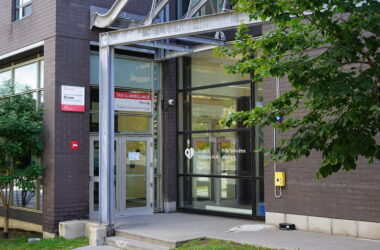


Across the 18 months she has lived in her Plateau apartment, Alice Lee, U3 Arts & Science, has had her water shut off 13 times. Most recently—in February 2026—she turned on her tap to find the water running yellow, as she recounted in an interview with The Tribune. Lee explained that her building’s maintenance worker was unequipped to deal with the problem.
“He came into our apartment and didn’t have any tools, he just had a can of WD-40,” Lee said. “It was the same when we had problems with our electricity.”
Lee lives in a building owned and managed by InterRent, which is a Real Estate Investment Trust (REIT)—a type of company that owns and operates for-profit real estate. For the past three years, McGill Athletics has partnered with InterRent’s property at 625 rue Milton, an agreement set to end in May 2026. Throughout the agreement, InterRent served as McGill Athletics’ official private student housing partner, and funded renovations to the Athletics student lounge in Tomlinson Hall.
REITs such as InterRent have been rapidly expanding their share of Canada’s rental housing market, growing from owning zero rental units in 1996 to roughly 200,000 by 2021. Over the same period, their total assets ballooned from $80 million CAD in 1993 to $76 billion CAD in 2021. REITs raise capital from investors to purchase rental buildings, and distribute rental profits as dividends to investors. Unlike most investment trusts, they benefit from a tax structure that allows them to avoid paying taxes on the income they distribute, which makes them appealing investment vehicles.
Critics argue that the REIT model worsens a societal housing system that treats housing as a vehicle of wealth accumulation for landlords, rather than a universal need. REITs are a driving force behind the ‘financialization’ of housing, which tenant unions, academics, and the Canadian Human Rights Commission have identified as a threat to the human right to housing.
The Hamilton Tenants Solidarity Network (HTSN) explains that InterRent uses the term ‘repositioning’ to describe their practice of replacing lower-paying, often lower-income tenants with higher-paying, higher-income ones. In InterRent’s 2024 annual report, President and CEO Brad Cutsey stated that 90 per cent of the company’s portfolio has been repositioned, enabling the company to “attract stronger residents.”
A survey conducted by community union ACORN Canada found that up to 80 per cent of tenants with financialized or corporate landlords—such as InterRent—experience urgent repair needs. The HTSN claims that some landlords avoid addressing these repairs on purpose, in order to displace long-term tenants by making their living conditions “unbearable.”
In a written statement to The Tribune, Anna Kramer, assistant professor at McGill’s School of Urban Planning with a research focus on housing, similarly described strategies of displacement.
“The financialization of housing is exacerbating the precarity of tenants,” Kramer wrote. “By buying up apartment buildings and using strategies such as neglect, superficial renovations and above guideline rent increases to push out long-term tenants, [REITs] are raising rents rapidly and setting precedents for other landlords to follow.”
Tenants have pushed back against these strategies. In 2018, long-time residents of InterRent-owned buildings in Hamilton went on a seven-month rent strike, in response to rising rents and poor conditions. The action resulted in InterRent making some repairs to the disputed rental units.
Kramer described InterRent’s specific role in Montreal’s current housing crisis.
“Although Montreal has some of the highest tenant protections and rent control de jure, de facto rents are rising much faster than inflation and the set guidelines for increases,” Kramer wrote. “Rents in Montreal have increased by 70 [per cent] between 2019 and 2025, and […] over 41,000 eviction cases [were] filed in 2024 in Quebec. Given these trends, McGill’s partnership with [InterRent] REIT is a slap in the face to students and tenant solidarity in general.”
In a written statement to The Tribune, McGill’s Media Relations Office (MRO) stated that the university will provide more details to the McGill community regarding their InterRent partnership at a later date.
“As [the three-year] agreement [between McGill Athletics and InterRent] has now expired, the University will have more to say in due course,” the MRO wrote.
Lee explained that she initially believed renting in a large apartment building would provide her with more reliable services as a tenant. While her building management has attributed the water disruptions she has experienced to problems with Montreal’s city system, she has never been able to find any record online of issues in her area. She suggests that students considering renting from a corporate landlord proceed with caution.
“Be careful,” Lee said. “You think, because you’re signing up for an apartment building with utilities, […] that you’ll have everything provided for you, and then you overlook some of the details [….] And they’re probably, definitely, overcharging you for what you’re going to get.”
A previous, incomplete version of this article was unintentionally published online on April 18, 2026, and removed on April 20, 2026 until wholly ready for publication. The Tribune regrets this error.