
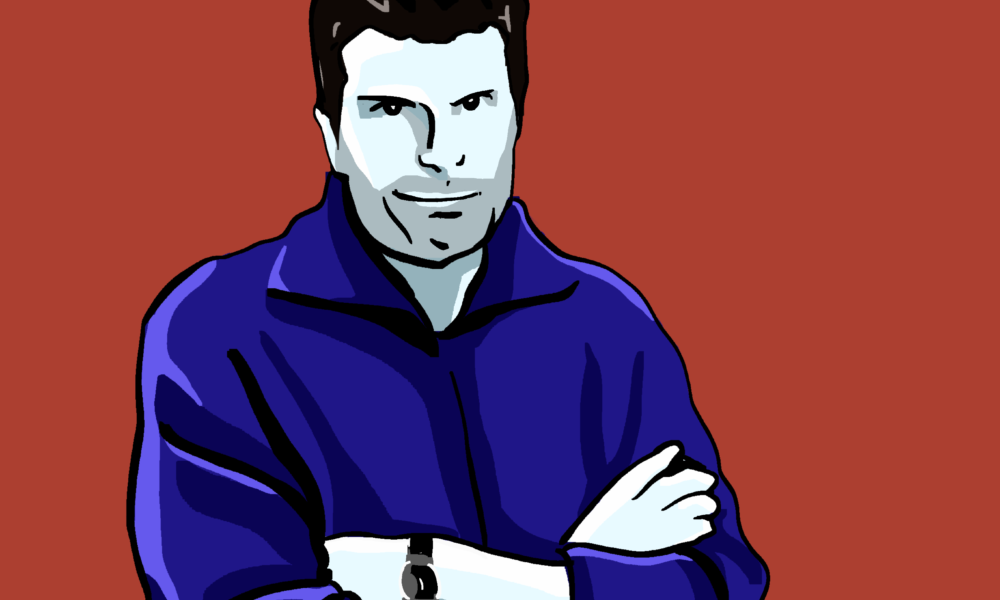
Long before his tenure scientifically fighting cancer at McGill, Professor Ivan Topisirovic wanted to be a soccer player. However, a youth coach at a Belgrade club settled the matter early, telling him he would never make even a low-tier team. While it may have hurt at the time, looking back, Topisirovic now calls it one of the most useful things he has ever been told, and it continues to shape how he understands the world and how he approaches his research.
A professor in McGill’s Department of Biochemistry, Topisirovic studies how cancer cells withstand stress—from triggers such as fluctuating oxygen and nutrient levels, to cancer treatments—in the hope that understanding how these cells adapt to adversity could reveal ways to stop them from growing into deadly cancers.
“We’re interested in how cells adapt to stress [….] And then we’re interested in how things within the [cancer] cell are coordinated in response to different stressors and so on,” Topisirovic explained in an interview with The Tribune. “If we can understand these mechanisms of adaptation to stress, we could maybe find therapeutically-actionable things within this space to target cancer cells and prevent them from adapting to all these stressful conditions.”
Decades into this work, Topisirovic still describes research the same way he describes that fateful childhood soccer tryout. For him, failure is not an obstacle to his work: It is the work. Being cut from soccer as a boy taught Topisirovic what he was not good at, which is how he found what he was made of. In the lab, he argues, the same process runs with intention—a hypothesis is often destroyed by the first experiment, meaning the researcher keeps failing until something holds. What makes the failure worth it is the moment on the other side of it.
“It is hard to do science, and it is about failure all the time,” Topisirovic said. “You fail and fail and fail, but eventually you come up with the discovery, and in that moment, you are the only person on the face of the earth who knows this.”
Getting through these setbacks earns a researcher the right to push past what has already been encoded in scientific history: which, Topisirovic argues, is the researcher’s obligation.
“The way I see it is that mistakes [in scientific research] do happen, [and] you should do everything in your power to avoid [them], but I think if they happen, you should learn everything [you can] from them,” Topisirovic said. “Failures and mistakes are not the same thing, because you can fail by not making a mistake [….] You should be failing in research consistently.”
For Topisirovic, mistakes are also what separates science from more comfortable work. A scientist has to be creative, he asserts, where plenty of well-paid professions reward the opposite. He pushes the same idea further when it comes to artificial intelligence (AI). Topisirovic recalls how the songwriter and musician Nick Cave was sent a track written by AI in his own style and dismissed it; Cave felt that a machine that has never failed, never suffered, and has never been in love has no business writing a song. A scientific discovery, in Topisirovic’s view, works the same way. It has to come from someone who has actually lived and looked.
“What is the point of regurgitating something that does not come from personal experience or vision?” he asked.
Topisirovic’s grandfather introduced him to Erich Fromm’s On Disobedience as a child, and its argument stuck with him: Progress depends on a willingness to question what one is told. That streak runs through how Topisirovic teaches. Having grown up in Serbia, a socialist country, he says he never took to rigid hierarchy, and he runs his research group as a shared effort, taking more of a hands-off approach to supervising his students.
“My job is to tell [my students] that nothing makes sense, and [that] they have to convince me that it does,” Topisirovic said.
For Topisirovic, that independence to think past the structure you were handed—combined with a willingness to fail—is essentially what divides a scientist from a machine.
“Now it is time to write textbooks, not to read them,” Topisirovic said. “If you just follow the guidelines, you end up being ChatGPT.”