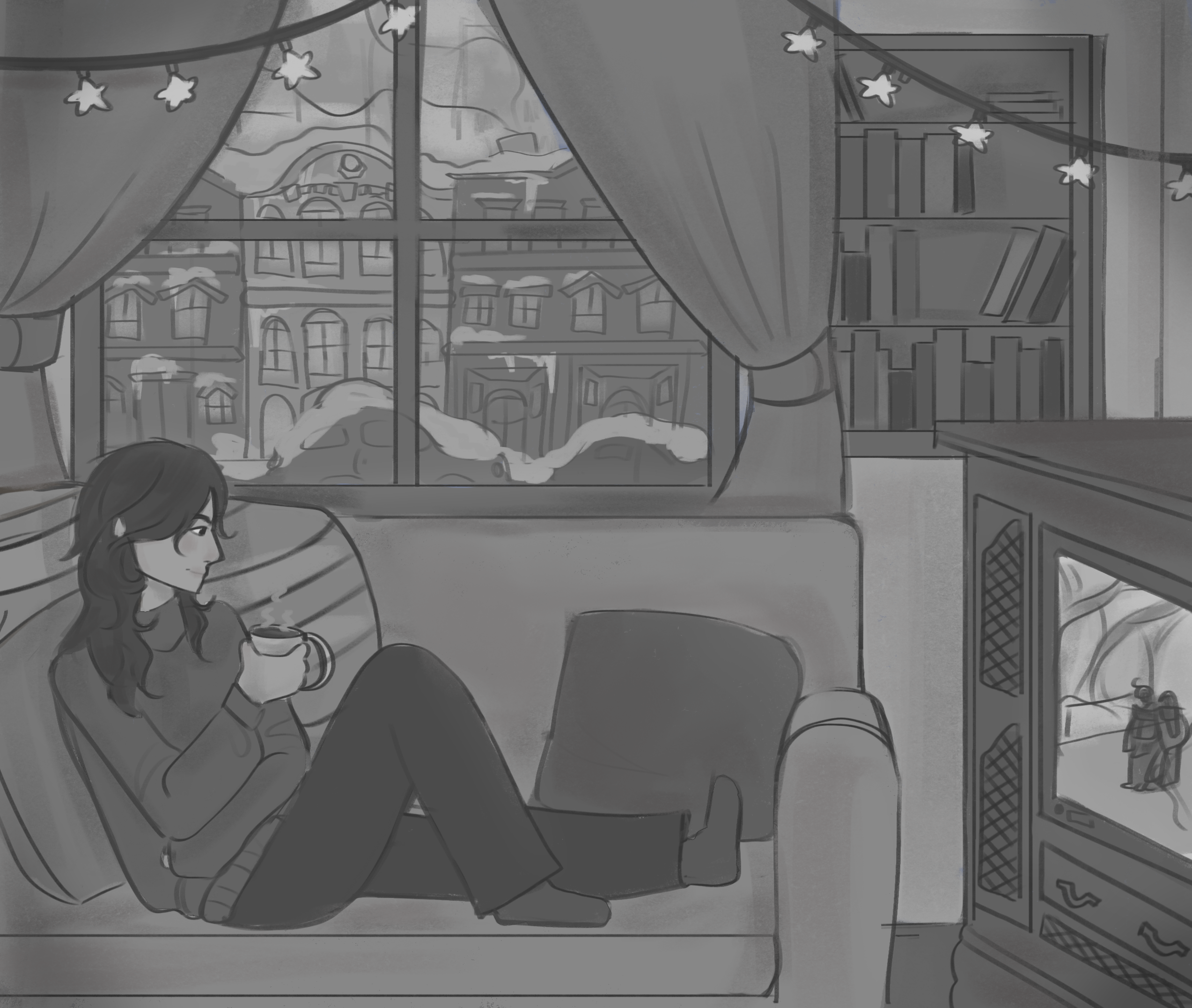



When winter arrives and snow piles up outside, a strong, familiar urge tends to overtake us: The desire to curl up with a good holiday movie. Whether with family, friends, or snuggled up alone, the act feels mandatory. Even solitary viewings feel like a communal experience, one grounded in shared rituals and familiar lines. The film selection becomes essential to capturing the essence of the merry spirit. But what is this seasoning that constantly makes us return to the same prototypes? Why are we so forgiving when rewatching the same tropes and predictable pinnacles over and over again?
Watching holiday movies feels more like a ritual than a true discovery of an old classic. Nothing is ever particularly jaw-dropping, nor is it meant to be. Most of the time, we are watching not to critically analyze but rather for the feeling that these films revive. With Home Alone’s enduring popularity, the exaggerated performances and implausible scenarios are not flaws of the film, but part of its charm. We are tied to that first experience, the one of initial discovery that made us feel so comfortable and cozy behind the TV. In a sense, it is a way of coming home: Looping back to an old version of ourselves and spending a bit of time with them. This familiarity explains why we condone so much of what we would otherwise be so critical of. Poor performance? Awkward dialogue? Formulaic and foreseeable ending? You name it, we let it slide. Holiday movies act as emotional safety nets, and it is difficult to tear yourself away from something that promises warmth and reassurance.
This genre of movies is, more often than not, about community, love, and friendship. Their narratives weave these familiar spheres together, usually by introducing some anxiety or emotional distance at the beginning and resolving it neatly by the end. Conflict is rarely permanent; misunderstandings are easily forgiven, and loneliness does not linger very long. Love Actually crystallizes this objective: Its narrative and tone consistently shift, yet audiences still love it for its mosaic of affection and reconciliation.
Resolution often relies on an idealized version of reality, where viewers get to escape their own lives for a couple of hours and indulge in comforting fantasies. This escapism becomes particularly relevant during politically or socially anxious times, when the holidays, and by extension holiday movies, offer the mind a chance to rest and disconnect.
However, these idealized narratives tend to promote the same values: Generosity, forgiveness, and the preservation of a compact family unit. While these themes are comforting, their repetition raises questions about who is included and excluded from the holiday ideal. The insistence on traditional structures can promote a subtle form of conservatism, reinforcing the status quo and sidelining alternative family models or lived experiences. In this way, the very predictability that makes holiday movies comforting can also limit their representational scope.
Temporality also plays an important role in shaping our outlook on holiday films. Part of what makes them pleasurable is not only what is on screen but the conditions under which we watch them. Being bundled up under the blankets while it’s snowing outside enhances the experience; the same movie would feel strangely hollow after a sunny day at the beach in the middle of July. Holiday movies are inseparable from their season. They are designed to slow us down, to match the rhythm of winter, and to invite a collective pause.
No matter when you come looking for them, the seasonal classics will always be there for you when you need them. It may be that the secret ingredient in their success lies less in cinematic quality than in their ability to accompany our emotional agendas, and that is, perhaps, what truly makes a good holiday movie.


