


In many Black communities, ‘auntie’ is not just a family title, but a mark of respect given to women who serve as pillars of their community, regardless of blood ties. They serve as nurturers and mentors to the youth, creating protected spaces where members of their community can dare to dream. Though their labour often goes unacknowledged, its impact is deeply felt by their loved ones. Aunties’ Work: The Power of Care at the McCord Stewart Museum, created by fashion designer and researcher Nadia Bunyan, honours the resilient care networks forged by these matriarchs in Montreal’s Black communities.
As the founder of Growing A.R.C., a nonprofit that builds community through interaction with material culture and sustainability practices, Bunyan designed the exhibit to embody the core values that guide her work. She made community collaboration central to her creative process, working closely with Montreal’s Black community. Through 21 audio interviews, Bunyan invited members to share their own experiences with their aunties and reflect on the impact of their care. This process gave her a clear understanding of how these figures keep their community united through acts of love and care.
The exhibit’s first section, “Bodies of Care,” features three spotlighted mannequins, each representing a different decade: the ‘70s, ‘80s, and ‘90s. Bunyan explained in a conversation with Alexis Walker, hosted by the museum, that the mannequins and their placement recreate the comfort and safety of entering a room and being greeted by one’s aunties. A lace doily motif decorates the wall behind the mannequins, a detail Bunyan’s interviewees consistently recalled seeing in their aunties’ homes. As a result, the doily motif appears in every section of the exhibit. The mannequin embodying the ‘80s wears a yellow blouse and pants ensemble that once belonged to Bunyan’s mother, adding a personal touch to the installation.
The “Materialities of Care” section displays borrowed belongings, including garments, books, and CDs, revealing how Black matriarchs influence different facets of life for their loved ones. A touchscreen also allows visitors to gain further insight about the pieces—their source, the stories they tell, and their cultural significance.
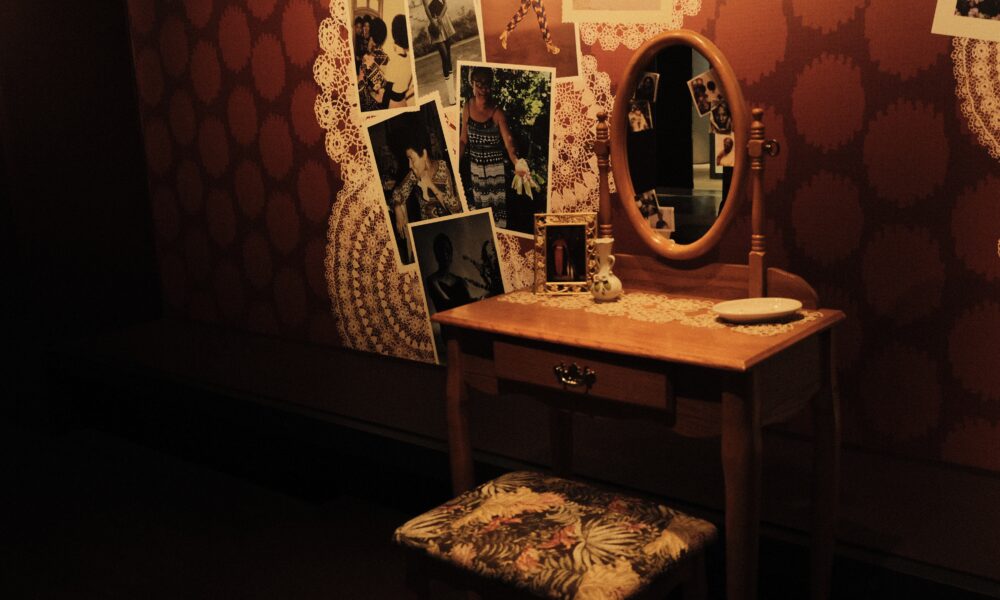
A vintage vanity anchors the “Reflections and Continuity of Care” section. The piece sits within a halo of pictures of various aunties, dating from the ‘70s to the present day, creating a sense of being watched over by these nurturing figures. The vanity’s mirror reminds visitors that they, too, are a reflection of the work of aunties and invites them to consider how they can continue the cycle of care for the generations to come.
Lastly, the “Discussions of Care” section features a video projection of a roundtable discussion between some of Bunyan’s interviewees. As one walks through the exhibition, the voices of community aunties and of the people who have directly felt the impact of their care can be heard. In the interview clips, they share their fondest memories with these matriarchal figures.
Bunyan’s overall work also touches on a social, cultural and political facet of Black communities. While the selected pieces represent symbols associated with aunties, they equally reflect the respectability politics present within the Black community, under which the social scrutiny Black people face manifests in a concern with self-presentation. However, through the love and care that the aunties impart, this deep attention to their appearance shifts into a sense of pride surrounding their identity.
At the end of the exhibition, a private nook offers notebooks and pens for visitors to write down their own reflections on how aunties have shaped their personal lives. Bunyan explained that this section positions itself as a contrast to the ephemerality of art expositions. Through the words on the pages, the experience of the exhibit is immortalized.
Aunties’ Work: The Power of Care runs until April 12, 2026, at the McCord Stewart Museum, located on rue Sherbrooke.


