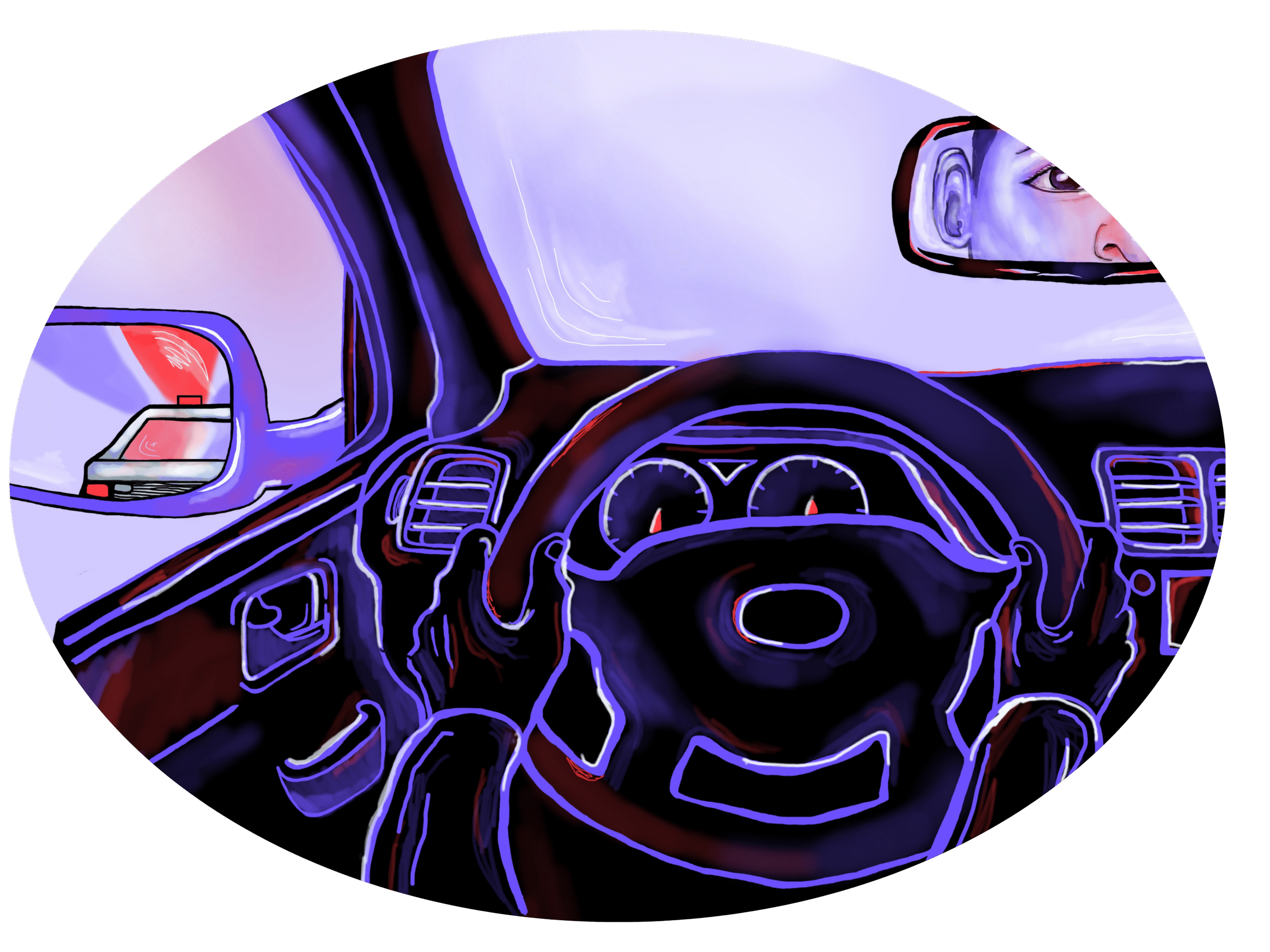



On the afternoon of April 2019, Joseph-Christopher Luamba was driving to Collège Montmorency for a study session when a police cruiser coming from the opposite direction turned around to pull him over. After running checks, the officer let him go without issuing a ticket. In the 18 months following his driver’s licence issuance, Luamba was stopped more than ten times. Each time, he was let go without so much as a fine. Luamba’s experience is not an anomaly, but a view into a broader pattern of how ‘random’ traffic stops operate for Black motorists in Quebec when a law allows police to stop drivers without cause, without criteria, and without accountability.
On Jan. 19 and Jan. 20 of this year, the Supreme Court of Canada (SCC) heard arguments for //Luamba v. Quebec//. Should the Supreme Court rule against Quebec, it could set a precedent with broader consequences for other provinces that employ similar traffic stop regulations. Currently, random or arbitrary stops are permissible in all other provinces, which continue to operate under the 1990 Supreme Court precedent set in //R. v. Ladouceur//.
Two lower courts have already ruled these stops unconstitutional. Quebec Superior Court Justice Michel Yergeau ruled in October 2022 that Article 636 of Quebec’s Highway Safety Code—the provision authorizing random traffic stops—violates sections seven, nine, and 15 of The Canadian Charter of Rights and Freedoms, which guarantee liberty, security, protection against arbitrary detention, and equality rights. The Quebec Court of Appeal unanimously upheld that decision in //Attorney General of Quebec v. Luamba// in October 2024. Given the Court of Appeals decision that the negative impacts of random stops on the Black community outweigh the benefits to the public of letting them continue, random traffic stops have been suspended in Quebec since April 2025.
Now, Quebec’s Attorney General and Minister of Justice, Simon Jolin-Barrette, is asking the Supreme Court to overturn those rulings, arguing that police need this power to ensure road safety. Interveners, including the Canadian Association of Chiefs of Police (CACP) and Mothers Against Drunk Driving (MADD), have joined in support, arguing that random mobile stops are more effective at catching impaired drivers than stationary checkpoints. But this framing pits road safety against civil rights, as though protecting one requires sacrificing the other, creating a false binary that obscures what is actually at stake: Whether a discretionary police power that has been proven to enable racial profiling can be justified under the Charter.
//When ‘random’ stops are anything but//
Quebec officials and supporters of their case in //Luamba// describe these as ‘random’ traffic stops—but the data tells a different story. When police are free to stop any driver for any reason—or no reason at all—the pattern remains consistent: Black and Indigenous drivers are stopped at rates vastly disproportionate to their share of the population. What Quebec calls discretion, the evidence establishes as discrimination.
Since 2022, Quebec police forces have begun collecting race‑based data on who they stop, but many have been reluctant to publish the results—a reticence that speaks volumes about what those numbers are likely to show. Data from Laval, Quebec’s third-largest city, showed that Black people were subjected to 19.7 per cent of police stops despite comprising only 8.9 per cent of the population. In Montreal, a 2019 report spanning data from 2014-2017 found Black people were approximately 4.2 times more likely to be stopped by the Service de police de la Ville de Montréal than white people, and Indigenous people 4.6 times more likely.
Harini Sivalingam, director of the equality program at the Canadian Civil Liberties Association, stressed that there is nothing neutral about how this power operates.
“I want to be clear, there’s nothing random about these stops,” Sivalingam said in an interview with //The Tribune//. “We’re not talking about a structured program to check sobriety. What we’re talking about is a police power that just enables anyone, at any time, anywhere to be subjected to what we feel is an unconstitutional stop by police.”
The harm, she stressed, runs far deeper than momentary inconvenience. At trial, Black individuals described the psychological toll of being stopped over and over again—persistent sleep loss, reluctance to leave home, anxiety, and a deep erosion of trust in a police force that targets, rather than protects, their communities. Luamba himself testified that whenever he sees a police cruiser, he instinctively prepares to pull over.
“The harm doesn’t stop at the roadside,” Sivalingam explained. “It doesn’t stop before or after. The harm is ongoing—the anticipation, the fear and the anxiety of being pulled over is very real.”
Sivalingam also pointed to how young Black children are taught from early ages how to interact with police to protect themselves. These conversations, as a routine part of the Black experience in Canada, are themselves an indictment of the practice of ‘random’ stops—and a reminder that what’s at issue in //Luamba// is not just how police interact with drivers, but how the law structures everyday life for entire communities. Instead of building confidence in public safety, these traffic stops under Article 636 continuously undermine it.
//A manufactured safety dichotomy//
Quebec’s defence centres on grounds similar to those the Supreme Court accepted in 1990: Police need discretionary powers to keep roads safe, ignoring three decades of evidence on racial profiling that it has accumulated since. MADD has warned that striking down Article 636 could lead to increased injuries and death related to alcohol and drug-impaired driving. The CACP justifies random stops as an essential tool for promoting compliance with traffic regulations.
This framing, however, diverts attention from what the evidentiary record actually shows. In 2024, Quebec’s Superior Court, upheld by the Court of Appeal, found that the Attorney General failed to adduce evidence that random, suspicionless traffic stops improve highway safety, inadequately demonstrating a rational connection between this power and the government’s stated safety objectives.
According to Solomon McKenzie, counsel to the Canadian Association of Black Lawyers in //Luamba//, the expert record in the case is unequivocal.
“There’s been extensive expert evidence led in the case of Luamba,” McKenzie said in an interview with //The Tribune//. “All of whom have shown that this kind of unfocused, unstructured, and randomized stop of individuals is not effective policing. It does not result in reducing traffic infractions.”
Conspicuously, the rulings do not affect structured, program‑based roadside checkpoints, such as sobriety roadblocks, whose legality is expressly preserved in //Luamba// and which police can still use under designated road‑safety programs.
“I think what’s important is to recognize that you can have programs that reduce impaired driving that don’t result in this arbitrary power that enables racial profiling,” Sivalingam said.
The safety argument also obscures a crucial legal distinction: The difference between legitimate police discretion and arbitrary power. Lorne Foster, professor and director of York University‘s Institute for Social Research, has studied this intersection for over a decade.
“I do accept that discretion is necessary for officers to handle complex situations,” Foster explained in an interview with //The Tribune//. “But when you use discretion, it can also be influenced by implicit biases, and that can lead to racialized stereotypes.”
The difference lies in accountability, he says. “An example of arbitrary use of police power is when there’s no evidence-based monitoring, no standards, no transparency, and no civilian oversight.”
Article 636 provides none of these safeguards. It grants police unconstrained authority to stop any driver without cause, without criteria, and without review—precisely the conditions under which bias flourishes. This is not discretion exercised within limits; it is arbitrary power without accountability.
//The ‘Bad Apples’ Defence//
Quebec’s attorney general has argued that the problem lies not with the law itself but with individual officers who conduct “illegal interceptions” based on prejudice. The logic follows that the power to randomly stop is neutral—racial profiling results from its sporadic—not systemic—misuse.
But this distinction collapses under scrutiny. Racial profiling often operates implicitly. Without objective criteria governing who gets stopped, without data collection, and without oversight, there is no way to identify when a stop is discriminatory and when it is not. The law provides no mechanism to detect its own abuse.
“When Quebec claims stops are exercised without regard to race while refusing to collect or publish comprehensive race-based data, they’re just disabusing the public with their ignorance,” Foster said. “You have to somehow monitor that. You have to have an empirical, evidence-based tool to ensure that that is the case.”
His point is simple: A government that does not collect adequate race-based data cannot credibly insist that race plays no role in how a power is used.
“By permitting unfettered discretion, the law makes it impossible to distinguish between its permissible operation and its unconstitutional abuse, so that racial profiling remains both pervasive and legally invisible,” Sabrina Shillingford, who represented the Black Legal Action Centre before the Supreme Court, said in an interview with //The Tribune//.
This is precisely why the ‘bad apples’ defence fails. As McKenzie put it in an interview with //The Tribune//: “The full phrase is a bad apple spoils the bunch. The literal phrase in English is that if you let bad actors fester inside a system, they ultimately corrupt the entire system.”
//What’s at Stake//
Quebec is asking the Supreme Court to accept that the speculative benefits of random stops outweigh their documented injustices.
“The evidence that we do have shows that Black people are being disproportionately stopped and are suffering actual harms. At a certain point, it starts to prioritize the hypothetical safety of some versus the very real safety of Black individuals who are being targeted,” Shillingford said in an interview with //The Tribune//.
The implications extend beyond traffic stops. The justice system functions as a race-making institution—one that actively constructs and reinforces racial categories through its operations. When Black drivers are stopped at rates far exceeding their share of the population, they are disproportionately exposed to criminalization. This produces statistics showing higher rates of criminal involvement—statistics that then get cited to justify the very policing practices that produced them.
The SCC striking down Article 636 would not, on its own, dismantle this cycle. But upholding it would constitutionally entrench one of its key mechanisms—signalling that police powers enabling racial profiling can survive Charter scrutiny so long as governments invoke road safety. It would effectively ratify the false safety‑versus‑rights binary Quebec has cultivated, treating the mental‑health harms, the erosion of trust, and the everyday fear described by Black drivers as an acceptable price of doing public safety.
“This isn’t a hard case,” Sivalingam said. “It’s very clear-cut. The law disproportionately harms racialized people, undermines equality, and doesn’t enhance public safety. It can’t be justified.”
For Black drivers like Luamba, this case is not about an abstract balance between rights and safety. It is about whether the law will continue to sanction a power that has taught them to brace every time a cruiser appears in the rear‑view mirror, to teach their children how to manage encounters with law enforcement that are treated as inevitable, and to live with the ongoing anxiety that those encounters can happen at any moment, without cause. The SCC cannot undo the years in which ‘random’ stops have normalized that reflex for Black communities. But it can start by refusing to continue constitutionally underwriting it.


