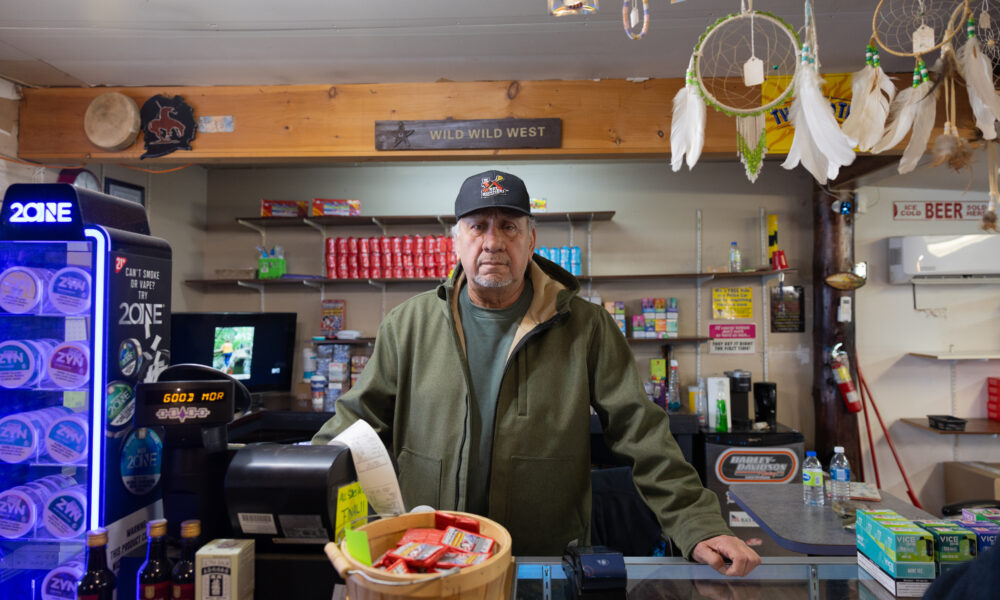

On a strip of land in Kahnawà:ke, where drivers speed toward the Honoré Mercier Bridge on Route 207, Jason Diabo’s Wild West Smoke & Vape shop now sits boxed in by a newly carved bypass road that diverts traffic from his storefront.
In October 2025, the Mohawk Council of Kahnawà:ke (MCK) issued Diabo an eviction notice. Since then, a rotating group of community members has gathered in their shop daily, prepared to intervene if enforcement arrives.
For those keeping watch, the dispute is part of a concerning pattern in Kahnawà:ke: Years of opaque land deals, an industrial project involving contaminated soil, and the expanding jurisdiction of the MCK—whose authority, community members say, has stretched far beyond its original sphere.
“Do govern yourselves accordingly”: Diabo’s eviction notice
Diabo, who suffered from health issues following his work doing cleanup at Ground Zero, later invested his settlement into his roadside shop, which he has since operated for over 20 years. Diabo originally leased the land from a private owner under a five-year agreement, with the option to renew for an additional five years.
In an interview with The Tribune, he shared that when MCK bought the land in 2013, the former owner stipulated Diabo’s renewal clause must be carried over. Instead, the council allowed his lease to lapse without negotiation.
“They cancelled my contract in 2019. It was supposed to be renewed after five years, [but] they didn’t ask me to renew,” he said. “They said my lease is terminated […] with no just cause.”
The eviction letter, obtained by The Tribune, gave Diabo 30 days to vacate the property or face removal by “any and all remedies available,” at his own cost and expense.
According to Diabo and several residents present during The Tribune’s visit to Kahnawà:ke, the MCK and Tewatohnhi’saktha (Tewa), the Economic Development Commission of MCK, used community funds of around $1.3 million CAD to purchase the 17-acre lot on which Diabo’s shop lies, without holding required consultations with the community.
“I invested all my money in this place,” Diablo said in an interview with The Tribune. “I built this whole place with my partner, literally with our hands.”
Diabo’s niece, kwetiio, is one of the Kanien’kehá:ka Kahnistensera (Mohawk Mothers), the group currently in a legal dispute with McGill over allegations of unmarked Indigenous graves on campus. kwetiio has been helping her uncle navigate his potential eviction. She shared that the MCK’s lack of consultation with Kahnawà:ke community members violates Mohawk consensus-based protocol under the Haudenosaunee Great Law of Peace, which the Band Council has pledged to uphold.
“When land is purchased from a person with a certificate of possession, the land process is that it goes back to the people, not to a corporation like Tewa or MCK. It is supposed to be for the use and enjoyment of the people,” kwetiio clarified in a written statement to The Tribune. “In this case, the community was never consulted.”
For MCK to make land decisions, it must acquire a Band Council Resolution to submit to Indigenous and Northern Affairs Canada for approval. kwetiio told //The Tribune// that these kinds of resolutions should be brought to the community for discussion, but MCK did not inform the community.
Furthermore, it was later revealed in court that Tewa and MCK had made an agreement with the Quebec government, under which Quebec would return land acreages to the Mohawk community—land that already belongs to the Haudenosaunee—in exchange for no interference with Transport Quebec’s construction plans for Route 207.
“When asked in court, Marissa Leblanc (executive of Tewa operations) said that Tewa could be leasing the land to someone and collecting revenue if Jason vacated the premises,” kwetiio wrote.
Other residents reaffirmed this sentiment in interviews with The Tribune, stating that MCK’s acquisition and eviction procedures in Diabo’s case illustrate a broader pattern of council decisions being made without community consent.
Diabo’s eviction notice itself ended with a final line that some residents described as “threatening”: “Do govern yourselves accordingly.”
Band Council and traditional governance
While the MCK operates as Kahnawà:ke’s official governing body under the Indian Act, its authority remains a subject of contention. The Act imposes a federally designed band council system—accountable to the Canadian government—on Kahnawà:ke’s community, rather than using the consensus structure outlined in the Great Law of Peace, in which clan mothers select chiefs.
Many Kahnawà:kero:non—Kahnawà:ke community members—argue that major land decisions, including purchases, leases, and industrial agreements, must follow these principles of collective choice instead of Indian Act procedures, which they view as colonial administrative structures rather than structures of legitimate governance.
“The Band Council creates the illusion that they can make laws, that they can sign on our [communal] behalf, […] [but] they’re not lawmakers,” kwetiio said. “They don’t have any legislative power. They don’t have power over us as individuals.”
“It sounds like a conspiracy movie”: Residents fear a hidden industrial agenda
MCK has publicly described the highway project built outside of Diabo’s shop as water and sewer infrastructure improvement for residents in the area. However, residents believe the project has an unpromoted purpose: Enabling industrial truck traffic linked to the JFK Quarry company, a gravel and asphalt operation just down the road.
Several residents said they were unaware of any agreement between the MCK and the JFK Quarry company involving contaminated soil until documents suggesting a relationship were circulated at a recent council meeting. Solterra, an environmental services company, lists the JFK Quarry company site in Kahnawà:ke on its website as a “coming soon” contaminated soil facility.
The Tribune could not independently verify the documents pertaining to an alleged contaminated soil agreement between the MCK and the JFK Quarry company, and the MCK did not respond to request for comment in time for publication.
“Why is this so important, my little spot I have here?” Diabo asked. “It’s because of [MCK’s] highway. They want to modify the highway so over 30,000 trucks can pass here within the next 30 to 40 years to fill the quarry with contaminated soil.”
Concerns about contamination are not isolated to Diabo’s property. In April 2025, The Eastern Door reported that families living near the JFK Quarry company site have suffered rashes, persistent coughing, nosebleeds, and dust coating their houses and yards. Some community members such as Kerry Diabo also mentioned independent testing results in conversations with The Tribune, indicating that their groundwater samples showed elevated manganese levels—which pose serious health threats, especially for children.
“[Manganese is] all over this area […] [in] the air, the trees, the water,” while pointing toward land he remembers playing on as a child. “Vegetation doesn’t grow [anymore].”
Jason reaffirmed this, describing the environmental effects already taking place on the land.
“There was all this wildlife, […] turtles that used to lay eggs underneath my porch. No more because of the road.”
The MCK’s selective enforcement and unclear authority
Residents also expressed frustration with what they view as heavy-handed MCK enforcement in Kahnawà:ke land disputes, with MCK relying on Band Council-appointed, police-like Peacekeepers. kwetiio recounted a situation where officers entered her property during a cannabis-related dispute.
“They came in like they were on Spike TV,” she recalled. “Instead of serving us properly, they made an example of us so nobody else would assert their rights [….] When they came on [my mother’s] land […], she [said], ‘I thought you’re supposed to be peacekeeping.’ [They] said, ‘Nope, we’re police’ [….] They train with the RCMP.”
Diabo’s eviction notice stands in uneasy contrast to how other land disputes are handled in Kahnawà:ke. In a 2020 letter reviewed by The Tribune, the MCK informed resident Angus Brian Lahache, who was involved in a private encroachment dispute, that the MCK “does not currently have a judicial mechanism” for civil matters, advising him to seek recourse through the external Quebec court system. Residents argue that this inconsistency—strict enforcement in some cases, deference to outside courts in others—leaves individuals feeling both overpoliced and underprotected, with no clear path for resolving disputes.
“My uncle, every day, lives with this [uncertainty],” kwetiio said. “He wakes up wondering, ‘Is today going to be my last day of work?’”
Beyond Route 207
As work on Route 207 continues and community mistrust of MCK lingers, residents say their daily presence at Diabo’s shop is both practical and symbolic: A refusal to let a community member face eviction alone, and a challenge to Band Council decision-making processes that they view as undemocratic. For them, community is not an abstract value, but an active practice that entails mobilizing, showing up, and demanding that major developments reflect collective will.
“[We] don’t have the luxury of not asserting [ourselves],” kwetiio said. “Because then, we would be non-existent.”
Across the river, McGill’s ongoing legal battle with the Mohawk Mothers has raised similar questions about the sincerity and integrity of Indigenous consultation, and about whose voices are heard and respected in land-related decisions. In both cases, the stakes are about more than one building or one project; they concern the meaning of Indigenous community governance and the obligations of institutions operating on unceded territory.
The Route 207 dispute is one more reminder that community is not something simply invoked at ceremonies or in land acknowledgements, but something negotiated—and defended—every day.
“[The Band Council has] no business to do what they’re doing,” one resident shared. “They have to ask the people, and they didn’t.”
A previous version of this article more broadly described the certificate of possession process, stated that the MCK used community funds of around $2 million CAD to purchase the 17-acre lot on which Diabo’s shop lies, and did not mention Tewatohnhi’saktha’s specific involvement in land purchasing in Kahnawà:ke. In fact, clarifications from kwetiio were necessary to accurately inform paragraphs 9, 12, 13, 14, and 15, and to adjust the community funds figure to $1.3 million CAD. The Tribune regrets these errors.


