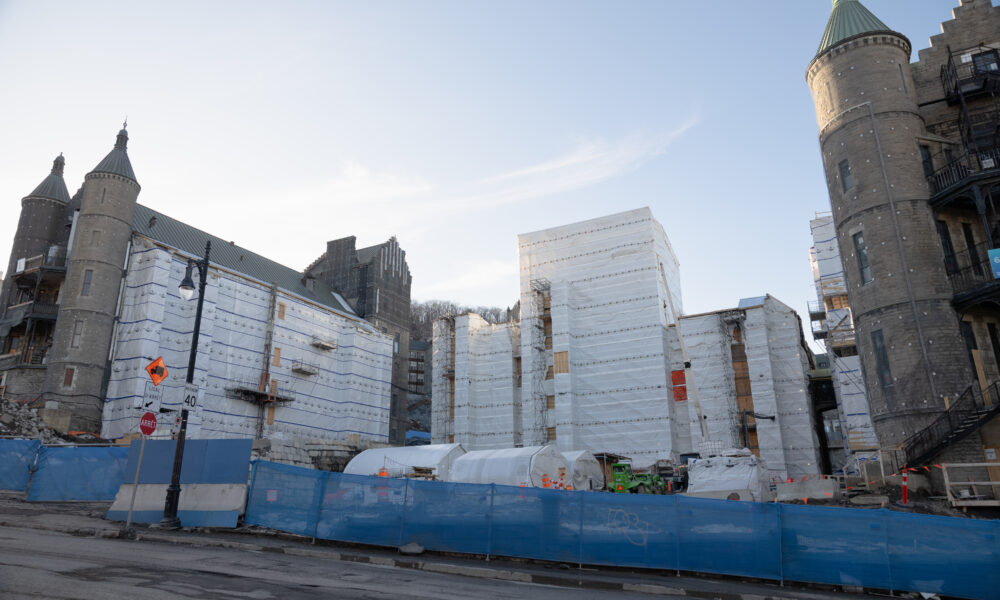

On Feb. 6, after an 18-month study of McGill’s proposed Sustainability Park at the Royal Victoria Hospital (RVH) site, Quebec infrastructure firm CDPQ Infra estimated that the project would cost $845 million CAD. The project proposes the construction of 1,150 student housing units and further structural evaluation due to advanced degradation in several buildings. The Société Québécoise des Infrastructures (SQI) has stated it will not move forward with the project in its current state, citing concerns about funding and investments.
The recent survey and the completion of decontamination at the site’s main pavilions mark a major step forward in the project’s four-year progression, which aims to sustainably address the university’s demands for shared public spaces and student housing.
Despite these proposed benefits, the project has faced major controversy since renovation began in 2015. According to Indigenous activist group Kanien’keha:ka Kahnistensera (Mohawk Mothers), there is plausible evidence that the site contains unmarked Indigenous human remains, and further excavation without proper archaeological oversight could destroy them. RVH has also come under fire for its role in the MKUltra program, where classified psychiatric experiments took place at the Allan Memorial Institute following World War II. The Mohawk Mothers, along with survivors of MKUltra, allege that some of the victims were Indigenous children taken from residential schools.
Despite the SQI’s investment coming into question, McGill has continued its development of the Sustainability Park. McGill’s Media Relations Office (MRO) wrote to The Tribune that the project is still progressing as planned.
“The McGill Sustainability Park—a state-of-the-art research, teaching, and learning hub dedicated to Sustainability Systems and Public Policy—is moving forward, as planned, with an expected opening date of 2029.”
Previously known as the New Vic Project, the Sustainability Park has taken different forms since the RVH was decommissioned in 2015. Aiming to curb the university’s space deficit, the project seeks to renovate the hospital’s original pavilions, with the rest of the hospital under the SQI’s purview. The acquisition of the RVH pavilions in 2014 likewise aimed to redevelop the space into an academic hub for graduate students with an estimated construction time of five years. It wasn’t until September 2020, while the hospital functioned as a temporary shelter for the unhoused during COVID-19, that the New Vic project was submitted to the SQI as a centre for sustainability.
The Allan Memorial Institute (AMI), the psychiatric wing of the Royal Victoria Hospital founded in 1943, is now known for the CIA-led, Canadian-backed MKUltra program headed by Ewen Cameron. From 1957 to 1964, the Institute, with assistance from McGill, was home to subproject 68, tasked with experimenting and producing a ‘truth drug’ against Chinese and Soviet spies, ‘depatterning’ patients with extensive electroshock treatment, prolonged, drug-induced sleep, and LSD. Over the project’s seven-year history, hundreds of patients went through the AMI’s doors unaware of the experiments they were participating in, leaving many permanently scarred.
Following the program’s end, a vast majority of the project’s documents were destroyed by CIA director Richard Helms, kept away from the public. In 1977, a number of the project’s files were found, revealing some of its major features. Professor in the Department of Social Studies of Medicine, Annmarie Adams, detailed some of the remaining documents’ findings, leaked by the New York Times.
“The article outlined how isolation, LSD, and electroshock treatments had been used to uncover traumatic life events and aberrant behaviour at the Allan [Memorial Hospital],” Adams described. “According to some sources, patients were recorded by hidden cameras and watched from viewing booths. In 1988, nine former patients sued over their unwitting participation in what they described as unethical experimental procedures.”
In the following decades, many survivors have come forward demanding reparations. Aside from compensation in 1988 by the Canadian Supreme Court, no formal recognition of the experiments has been granted. Last summer, survivors and their relatives sued the Canadian government for damages, demanding recognition from both the Canadian government and McGill University for the injuries they incurred through the program. As of March 2026, the case is ongoing.
Since the earliest proposals of the New Vic Project in 2015, the Mohawk Mothers have called for McGill to halt construction work to allow future searches for burials beneath RVH.
The Mohawk Mothers have fought an ongoing legal battle to conduct archaeological research into Indigenous burials beneath RVH, citing the Truth and Reconciliation Commission’s enabling of investigations into residential school burials. In a written statement to The Tribune, the Mohawk Mothers emphasized that their initiative to secure these remains is crucial to Kaianerehko:wa (the Great Law of Peace).
“We will never stop looking after our children from all generations, present, future and past. We
can’t stop, and we won’t! It is our cultural duty and responsibility under kaianerehko:wa and we will fulfill it. We can never stop loving and caring for our people of the past, present and future until we are completely satisfied that we carried our duties and responsibilities to the satisfaction of the Kaianerehko:wa [….] We have no choice but to continue caring for our earth mother and our children.”
In October 2022, the Quebec Superior Court ordered an injunction against McGill to stop excavation of the RVH site to conduct archaeological searches into human remains. However, according to the Mohawk Mothers, the ensuing research that summer was highly questionable.
The Mohawk Mothers criticized careless archaeology, the use of destructive equipment on dig sites, and the university’s inconclusive research on bone fragments found at the site. The Mohawk Mothers also questioned the university’s sudden closing of the investigation in 2023.
“McGill-SQI […] unilaterally decided and announced ‘the first phase of the investigative work on the site of the New Vic Project [had come] to a close,’ while the binding recommendations by the Panel were not all implemented.”
The university has ultimately ceased further investigation despite evidence of the potential presence of human remains. The Mohawk Mothers petitioned for another injunction against McGill in the summer of 2025, hoping to restart an archaeological investigation amid increasing construction on the site. The group called for negotiations with McGill and SQI to resolve the issue outside of court.
“We are currently working to amend our application for an upcoming hearing on the merits of our case that will be heard in the Superior Court of Quebec, if we have to get to that again,” the Mohawk Mothers wrote. “In the interest of minimizing the strain on the Court and all parties, we also extended an invitation to McGill and SQI to sit together and discuss how we may be able to find some common ground outside of litigation.”
MRO wrote that the university engages with the recognized governing institutions of local First Nations when addressing issues affecting Kanien’kehá:ka rights and cultural practices.
“Our efforts to foster reconciliation and Indigenous representation at McGill are undertaken in partnership with the governing institutions of local First Nation communities, including their traditional and elected leadership,” the MRO wrote. “And while we respect that there are Mohawk citizens and members of local communities who have differing views regarding their own governance structures and systems, when it comes to matters pertaining to the rights and cultural practices of Kanien’kehaka that may be impacted by McGill, McGill has a responsibility to engage with the Nation through its longstanding elected and traditional governments.”
However, despite the university’s efforts to maintain relationships with Indigenous communities and initiatives, the Mohawk Mothers are not recognized as a governing institution within this framework. The Mohawk Mothers criticized this distinction as a colonially imposed institution.
“The ‘elected leadership’ [McGill is] referring to is the Band Council,” explained the Mohawk Mothers. “As we and other Indigenous people all around Turtle Island keep reminding, the Band Councils are colonial institutions forced through the Indian Act: They are a genocidal device designed to undermine our traditional governance systems.”
The Mohawk Mothers further argue that the Band Council does not speak for the Kahnistensera nation as a whole and said that members of the longhouse community have not been contacted or consulted by McGill or the Quebec government.
“Of all longhouse people we have been sharing with regarding this struggle, no one has ever been contacted, let alone consulted, by McGill or Québec! Us Kahnistensera are not alone in this fight, the men’s fire is behind us and we are continuously in discussion with them too. To be honest, it doesn’t seem McGill has anyone in our communities to consult or to collaborate with!”


