


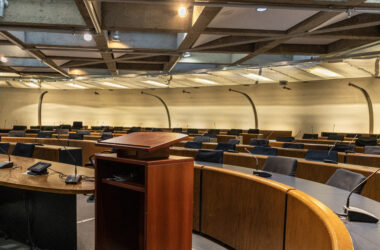
On Feb. 2, the McGill Institute for the Study of Canada (MISC) hosted a lecture titled “Determining new international and domestic orders: Reflections on modern Canada’s endurance and more so resilience as Black and West Indian.” The lecture was given by Cecil Foster, a professor at the Department of Africana and American Studies at the University at Buffalo.
Daniel Béland, a professor at McGill’s Department of Political Science and MISC’s director, began the event with a land acknowledgement, along with a brief description of Foster’s work and McGill’s initiatives during Black History Month.
“Each year, Black History Month at McGill brings together students, staff, faculty, alumni and community members through […] [opportunities] to learn, reconnect and celebrate Black communities’ contributions to education and research,” Béland said. “[Foster] is a leading author, academic, journalist, and public intellectual. His work speaks about the challenges that Black people have encountered historically in Canada and their efforts to achieve respect and recognition for their contribution to what is now a multicultural Canada.”
Béland then passed the microphone to Foster, who began by highlighting the presupposition that Canada’s social resilience comes from its historical and perpetual whiteness—whether it be Anglophone, Francophone, or a combination of the two. Foster then presented his counterargument, claiming that Canada’s history and political structure today reflect a longstanding British West Indian heritage.
“From even its earliest days as a settler colony, Canada was inherently Black,” Foster said. “To this day, a social justice model of development based on Diversity, Equity, and Inclusiveness reflects Canada’s undeniable historical, cultural, and British West Indian heritage. This is an identity that dominant Canada always tried to deny in preference for the whiteness imposed through structural and institutional conformity and corruption.”
Foster then made a connection to Prime Minister Mark Carney’s speech at the 2026 World Economic Forum Meeting. In his speech, Carney implied that many people in the world live under the illusion that current domestic and international orders produce justice for everyone. Foster referred to Donald Willard Moore, a civil rights activist who publicly criticized Canada’s racist immigration laws in 1954, suggesting that Carney acknowledged Canada’s fundamental Blackness.
“Although not seen so directly, Carney was implying [that] Canada is fundamentally Black in its cultural values, expressions, and aspirational mores and ethos,” Foster said. “Could Carney have had in mind the words of the Black porters and those of the Negro Citizenship Association, [who] […] challenged the Canadian government not to be afraid of the changing times and the noisiness that comes with changing social orders?”
Foster then mentioned Carney’s speech at the Citadelle of Quebec just two days after the World Economic Forum Meeting, where Carney recounted the Battle of the Plains of Abraham. He framed it as a pivotal point in history when Canada chose accommodation over assimilation, recognizing its two founding peoples—the English and the French. Foster criticized such a narrative, arguing that it erases Black contributions in Canada.
“These are ethno-nationalist narratives presupposing and even defending the centrality of whiteness and the marginalization of all non-whites, in effect sidelining all other peoples in their various forms and ethnicities [and] racialized Blackness,” Foster said. “British soldiers and sailors in steaming ports like Montreal, Quebec City […] were demographically multicultural British subjects and prototypical modern Canadians. Most of them were Black with their home bases in the British West Indies [….] With the technological change to introduce trains, as the sleeping car porters on Canada’s railways that knitted Canada together, they had always a sense of belonging to Canada and always fought for inclusion and to be treated as equals to all Canadians.”
Foster then focused his lecture on a period during which there were repeated calls and appeals for the British West Indies to become part of the Canadian Confederation. Following the Slavery Abolition Act, many prominent Canadians wanted to establish a single political jurisdiction of British colonies in the Americas. The proposal did not materialize, as the population of the British West Indies was predominantly Black, while Canada officially portrayed itself as white. Foster highlighted that the British West Indies in 1838—when Black people were considered free members of society for the first time—were a leading example of changing social orders.
“To be a Negro meant to not have a country of belonging,” Foster said. “A single jurisdiction, among other things, would help create an order where freedom would confront enslavement, [where] British values of inclusion and diversity […] [would confront] American values of exclusion, white assimilation and individualism. Two different moralities [sought] to establish a single dominant order [….] In Frederick Douglass’s view, the British West Indies epitomize, worldwide, the highest ideals of human freedom and dignity, and was a model of societal nationalist formation to be copied throughout the Americas by the 1860s.”
Foster then quoted a speech from 1957 presented by former chief minister of Jamaica Norman Manley, in which Manley pointed out that the British West Indies were able to answer the ‘race question’ before many other countries.
“I dare to say that the West Indies have travelled hundreds of years ahead of large parts of the world in solving the problems of how people of different races and origins can live together in harmony,” Foster quoted. “One has only to look around this room to comprehend that we have completely exploded the myth of racial superiority, and we are rapidly progressing to a higher level in that field than most countries know, because with us, it is ceasing to be a matter of tolerance. For a tolerance itself presupposes that there is something to be tolerated, and it ceases to be a matter of acceptance, because acceptance in itself presupposes that there is some problem to overcome and some difficulty to be accepted.”
Foster ended his lecture by encouraging the audience to revise established narratives of Canadian history, emphasizing how Black communities are not merely contributors but foundational to the establishment of modern Canadian values.
“As we live in academically stimulating times, there are challenging times, but only if we continue to live the lie of dominant narratives,” Foster said. “This is an opportunity to think of all of our separate ethnicities and nationalities […] as examples of how humanity’s dignity has always fought the established enduring social orders [….] Canada was always Black, and its multicultural values and ideals that now set it apart are those developed similarly […] in the former Black British West Indies.”
The event then moved on to a Q&A session. Debra Thompson, associate professor in McGill’s Department of Political Science, questioned whether Black understandings of freedom are commensurate with multiculturalism in Canada.
“[Can] the equation of all that comprises Black understandings of freedom and radicalism that frequently are imagined beyond the boundaries of any nation state, and certainly beyond the boundaries of liberal democracy or capitalism, really be rolled into multiculturalism?” Thompson asked.
Foster responded by highlighting that we must remove institutional boundaries when considering multiculturalism.
“If you start with the notion that the nation is of the people demographically and not institutionally, then it can work,” Foster said. “It might very well mean, as is being attempted now in Canada and elsewhere, the radical dismantling of many of the institutions. That’s the only way you can bring about reconciliation [….] You start by the will of the people, so that the nation becomes a projection of the will of the people, rather than the nation being an ethno-nationalist notion where people are forced or slotted into the nation, and those who don’t meet a specific criteria are excluded.”
Nadia Alexan, founder of the non-profit Citizens in Action, spoke next. She commented on the shifting political power of the wealthy, and how the current global order is increasingly shaped by elite interests rather than the true will of the people.
“The biggest danger we have now is the billionaires who have hijacked our governments. They are not content with influencing the government. They now want to be the government,” Alexan said. “It’s unbelievable what is going on, and that’s the danger […] as long as they keep making profits and cannibalizing the world.”
Foster emphasized that the initiative which started in the British West Indies and the Americas may facilitate new perspectives on international issues.
“As we think about the future, the lessons that we can learn from the experiences that have been developed in no other part of the world than in the Americas […] gives us a kind of a uniqueness,” Foster said. “We can look at all of these things and try to make sense of them and maybe share some of our experiences […] as to how some of these things might be overcome.”