
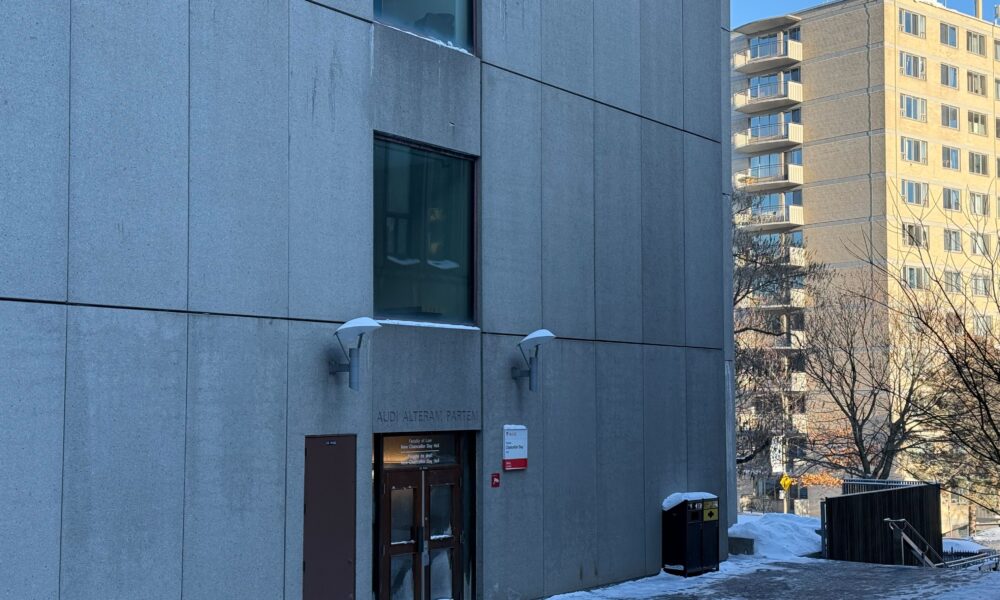



On Wednesday, Feb. 4, Annie Bunting, professor of Law and Society at York University, hosted a discussion at the McGill Faculty of Law’s Centre for Human Rights and Legal Pluralism (CHRLP) entitled “Knowledge production and gender justice in post-conflict Africa” at New Chancellor Day Hall.
Bunting opened the presentation with a background on her past work in international feminist law, including her role as the Chair of International Gender Justice at York University.
“I started as a Boulton fellow here at McGill back in another century, which is such an amazing program,” Bunting said. “I am really glad to be engaging with all of you, especially at the Centre for Human Rights and Legal Pluralism because the [work done here] fits really nicely with my own.”
Bunting then explained her experience working on the Conjugal Slavery and War Project from 2015 to 2020, a project that documented cases of forced marriage during times of conflict to establish a system of reparations for survivors of gender-based violence.
“The coalition was monitoring international criminal tribunals and their prosecution of gender crimes, starting with the international criminal tribunal for Rwanda,” Bunting said. “The special court for Sierra Leone in 2008 found forced marriage to be its own heading of a crime against humanity. This was the impetus for this further research project.”
Bunting then shifted her focus to the Kinshasa Declaration, made at a Survivor’s Hearing on reparations during November 2021 in Kinshasa, the capital of the Democratic Republic of the Congo. To help create this document, Bunting assembled survivors and non-governmental organizations (NGOs), and secured financial backing from 12 African countries.
Bunting emphasized the number and diversity of goals presented during the hearing, explaining how she, the survivors, and the NGOs involved in the creation of the declaration came to the hearing with different outcomes in mind.
“I’m interested in the tracking of these crimes against humanity, especially forced marriage,” Bunting said. “You have survivors [who] are very concerned about school fees for their children, about medical fees, about reintegration. So, you have really quite disparate goals for this event.”
The event then transitioned to an open discussion, during which McGill Law Professor René Provost explained how language barriers impacted the drafting of the declaration.
“One of the challenges we encounter is that the vocabulary used to talk about sexual relations in some African languages tends to be metaphorical, which posed enormous challenges when we convert that to the language of international or criminal law,” Provost said.
Next, McGill research fellow and Board of Displaced Internationals member Yana Liubymova spoke on the connection between sexual violence and conflict through her experiences with the war in Ukraine.
“Unfortunately, we have numbers and numbers of survivor cases, and unfortunately, the statistics are growing. But, we improved our legislation and have a special program for survivors,” Liubymova said. “The displacement process is absolutely linked with the survivors of sexual violence in war.”
Bunting concluded by emphasizing the need for a focus that expands beyond individual survivor narratives, tackling the systemic issues themselves that enable gender-based violence.
“I don’t want to leave the impression that we should overly rely on survivor testimonies or individual harm, because I think that can limit our thinking to not engage in substantive and structural redress. And that’s not an easy thing, right? It’s not easy to talk about what structural change looks like,” Bunting said. “These individual narratives exist within this broader communal push for recognition and reparations and for substantive change.”