It’s easy to imagine Chevalier Avant Garde’s new LP, Resurrection Machine, providing the backdrop to a modern day sci-fi film, in the vein of Blade Runner.
The vocals are buried deeply behind synthesized sounds, making it hard to distinguish individual lyrics. However, the intimate, husky, whisper-like voice is irresistibly spellbinding—at times it seems the singer is speaking in an exotic language.
This is especially true in “Nowhere” and “When We Meet.” The haunting gravelly vocals on the tracks have certain qualities that bring back memories of The Moody Blues’ “Nights in White Satin” with a much darker edge.
That dark edge grows throughout in the album. Songs like “Killing Fields” invoke images of industrial abandonment and cold mechanisms of machinery. It is slightly jarring when they are juxtaposed by the more seductive sounds of “When We Meet” and “Rose Rider.” The shorter preludes interspersed between the longer songs, like “Five of Cups” and “Temenos” follow a similar pattern, wherein the listener is jolted awake from the stupor of the previous song.
The album moves into a strong ending with “Rose Rider,” a short but powerfully potent song. The haunting voice emulates the monophonic sounds of plainchant, most commonly performed by monks at churches. Rather than a religious image, however, Chevalier Avant Garde evokes a clearly dominant sexuality.
In Ressurrection Machine, Chevalier Avant Garde organically capture the dichotomies of nature: birth and death, vulnerability and strength, pain and pleasure, love and hate. It cannot be married to one particular genre, though it can be said that a new revival of ‘trip hop’ (the genre of groups like Portishead and Sneaker Pimps) has begun. Catering to a myriad of fantasies and emotions, Chevalier Avant Garde have crafted an album that delivers a complete bodily listening experience.
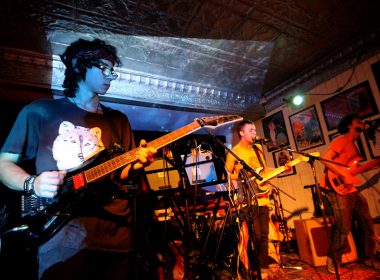
Colin MacDougall, guitarist and co-founder of Ottawa-based indie-electro outfit Fevers, has loved music ever since he developed fine motor skills.
“I’ve been playing music since I could bang notes out onto a piano,” he says. “My faith in wanting to be a musician has never died, and being in FEVERS has given it a boost.”
MacDougall and fellow band members Sarah Bradley (vocals, keys), Martin Charbonneau (keys, guitars), Jim Hopkins (bass), and Mike Stauffer (drums, sampling) all brought this devoted attitude to their debut album released last month, No Room for Light, as well as their own refreshing brand of the ubiquitous electro-rock sound.
FEVERS will unleash their musical stylings at POP Montreal this week, with a show at Club Lambi on Friday. For MacDougall, a McGill Management graduate, this is a chance to return to Montreal—the city that he playfully says casts a “shadow of cool” on Ottawa—and the place he originally relocated to because his songwriting collaborator moved there.
While living in Montreal—a time that coincided with the meteoric rise of the city’s indie darlings Arcade Fire—MacDougall explored the its music scene, played gigs at Barfly, and admired the cultural variety of McGill’s student body.
“You kind of go in with a conception of what type of person is going to be studying business […] I went in thinking I would be the token liberal lefty, […but] I was really impressed with the diversity of the students studying there.”
These days, MacDougall and the rest of FEVERS are dedicated musicians who support themselves by working outside the band. According to MacDougall, this is mostly due to Canada having a somewhat less than hospitable environment for musicians who wish to earn a living playing their songs.
“[Canada is] a small market,” he says. “[It’s] really far apart, and you have to spend a lot of money to get from city to city.”
Despite these difficulties, MacDougall remains enthusiastic about making music, and is unafraid to admit that the band sounds exactly how it is often classified: indie-electro. Similarly, he humbly welcomes the frequent comparisons to fellow Canuck band Stars.
“I’ll take that any day of the week,” claims MacDougall. “They’re a very inspirational band […and] they’ve put the Canadian music scene on the map internationally.”
Although he admits that touring is integral to a fledgling band’s success, MacDougall’s heart currently lies in in-studio production, rather than live performance.
“My favourite part used to be getting up in front of the crowd, rocking the house,” he says with a laugh, “But right now, album writing and recording is what excites me the most.”
Thankfully, he’s good at it too. When “No Room for Light” was released this summer, it was met with positive critical attention. FEVERS released a music video for the main single “Pray for Sound,” which chronicles the relationship between a young woman in an unhappy straight relationship, and her much happier lesbian lover.
For the time being, “proud Ottawa boy” MacDougall will remain based in the nation’s capital, which he says enables the band to delve into Franco-Canadian realms more frequently (a couple members of FEVERS are bilingual), and maintain a strong connection between both of Canada’s current music centres—Toronto and Montreal.
As for FEVERS’ future? “We’re taking it in three month chunks at a time,” explains MacDougall [.…] As long as I can keep writing records and putting them out there, and playing shows whenever we can, I’ll be a pretty happy dude.”
FEVERS performs at Club Lambi (4465 St Laurent) at 10:00 p.m. on Friday, Sept. 27. Tickets are $8 in advance, and $10 at the door.
This summer, researchers from McGill University and the Montreal Neurological Institute (MNI) made headlines when they revealed the world’s highest resolution 3D model of the human brain in the June 20 issue of the journal Science. The model, which took nearly a decade to develop and is composed of one terabyte of data, has been dubbed the “BigBrain atlas.”
The atlas is a technical milestone in the field of human brain mapping because of its micron-scale resolution, which scientists achieved by using a microtome to meticulously slice the post-mortem brain of a 65-year-old woman into 7,404 slices—each 20 microns thin. This extensive process was led by Dr. Katrin Amunts, a researcher from Jülich, Germany. Her team stained and digitized each slice with a high-resolution scanner before sending the data to researchers in Montreal.
Dr. Alan Evans, co-developer of BigBrain and a McGill professor at the MNI, led the venture to statistically analyze each slice and reconstruct a comprehensive 3D model of the brain. He explained that this was the slowest part of the whole process.
“You have 7,404 slices of saran wrap all wrinkled, crinkled, ripped and torn, and somehow you have to take all of that data and stitch it back together again into a coherent three dimensional entity that is useful,” Evans said.
The reconstruction process was possible due to advanced statistical and computational tools. Evans’ team developed new software in order to clean, reconstruct, and register their data in 3D. One platform, called CBRAIN, allowed the group to manage their terabyte-sized data set and granted them access to the network of High-Performance Computing (HPC) facilities distributed across Canada. Without the use of these supercomputing facilities which allow large datasets to be processed on multiple computers in parallel, the project would have taken several more years to complete.
Researchers at the MNI can browse the BigBrain atlas on a large computer screen made up of four screens placed together. The database was also made publicly available online in order to promote research and the development of new neurological tools. Data is streamed on-demand to clients all over the world using a program called Atelier3D, which has previously been used to visualize works of art—including the Mona Lisa—in three dimensions.
“BigBrain […] can be used to redefine traditional brain maps that date back to the 20th century.”
The atlas will, in all likelihood, become known as the world’s most detailed reference brain. All brains are slightly different in shape and size, so neuroscientists use reference brains to compare data collected from different individuals on a standard template. Current templates, however, were acquired using Magnetic Resonance Imaging (MRI) and are limited in their resolution to the millimeter scale. This means that once zoomed in, each pixel will be equal to 1 x 1 x 1 mm of real life brain space. If the same is done with the BigBrain atlas, however, the pixel dimensions are 20 x 20 x 20 microns, which is smaller than the diameter of a strand of hair. This level of resolution allows neuroscientists to visualize brain structures at a near-cellular level.
The advantage of having such a high-resolution mapping template is that data from a wide range of sources can be integrated and modeled at a a highly detailed level. For instance, molecular, genetic, and cytochemical data can be modeled in addition to low-resolution data acquired by modalities such as Positron Emission Tomography (PET) and functional MRI (fMRI), which acquire functional information about the brain as opposed to structural information.
Erin Mazerolle, a post-doctoral fellow in the McConnell Brain Imaging Centre at the MNI who uses MRI data in her research, explained the benefit of having a high-resolution brain template.
“It’s important for us to consider that the structures and functions we observe at the scale of millimeters with MRI actually result from much smaller structures,” she said. “BigBrain is an important step towards linking MRI findings to the microscopic scale, so that we can start to appreciate the underlying complexity that is otherwise not accessible with MRI.”
Another significant implication of the BigBrain atlas is that it can be used to redefine traditional brain maps that date back to the 20th century, such as the Brodmann atlas. This atlas, which was published in 1909 by German anatomist Korbinian Brodmann, is still the most widely used method of delineating the human cortex. However, it was limited by the technology of the era and was therefore based on properties of cells that could be seen through a microscope. The BigBrain atlas, in comparison, could be used to develop any number of brain maps based on structural or functional criterion extracted using computational methods.
Evans said he was pleasantly surprised by the feedback from the neurosurgical community. He described the reaction of Dr. William Feindel, a 95-year-old pioneer in the field of neurosurgery based in Montreal, when he first saw ‘BigBrain.’
“He was sitting in front of the screen exploring the amygdala and the hippocampus and saying he had never conceived of being able to do this because he was used to looking at a two-dimensional plate of the hippocampus,” Evans explained. “Now he’s moving backwards and forwards and up and down and it was delightful to see the reaction of someone of his stature.”
Feindel explained that the BigBrain could eventually aid neurosurgeons by allowing them to precisely implant depth electrodes, which are small electrodes used to record electrical activity from the brain to localize the focal point of a seizure or stimulate the brain to provide therapy for conditions such as Parkinson’s disease or clinical depression. Currently, neurosurgeons use a stereotaxic atlas—a mathematical map of the brain—as a guide when implanting electrodes. However, stereotaxic atlases are not three-dimensional.
“You have three dimensions available, but not simultaneously, so you look at a horizontal section of the brain or a sagittal section or a coronal section, but you can only do that separately. With […] BigBrain you can see them all together at the same time, so you have a confluence of information that you just can’t get on the other atlases. That’s why [this technology] represents a big advance.”
Since the BigBrain atlas was created using a single brain, as opposed to other reference brains that were created by averaging together hundreds of brain maps, a commonly asked question is whether it can be used to capture differences between brains. Evans responded that with the high-performance computational strategies possible today, the atlas can be warped into any statistical brain space.
Scientists use a microtome to create thin slices of the human brain. (Courtesy of the Brain Imaging Centre, Montreal Neurological Institute and Forschungszentrum Jülich)
“You can superimpose it on the average brain so that it is sitting in a statistical space that represents a population, but it retains the high-resolution detail that’s in the brain. You can get the best of both worlds at that point.”
Evans mentioned that there is still work to be done in the continuous refinement and spatial registration of the data.
“When you look at the BigBrain data set at the level of MRI, it looks fantastic. When you go in finer, you start to see the imperfections in the alignment of the individual slices.” These imperfections were caused by rips and tears that occurred during slicing as well as differences in the amount of staining across slices.
Evans’ group will continue to work on improving their current data set while they begin collecting data for future brain atlases. Potential projects would be to create 3D brain atlases for different types of brains such as a male brain, a young brain, and a diseased brain. There is also the potential to create a BigBrain atlas demonstrating the white matter tracts of the brain. Although the first data set took a decade to produce, future data sets will be finished much quicker because the technologies required to do so are now in place.
The BigBrain atlas is part of Europe’s Human Brain Project, a €7 billion venture to model the brain. Although the Human Brain Project predates Obama’s Brain Research through Advancing Innovative Neurotechnologies (BRAIN) initiative, both projects will take advantage of the latest computing technologies to collect and integrate data about the human brain, and are indicative of a growing trend in neuroscience in which large-scale supercomputing has become indispensible to research. As new technologies continue to be developed, BigBrain will only become more useful as a tool for neurosurgery, teaching and research. For now, it represents a major technical achievement in its own right, and a giant step forward in the quest to model and simulate the human brain.
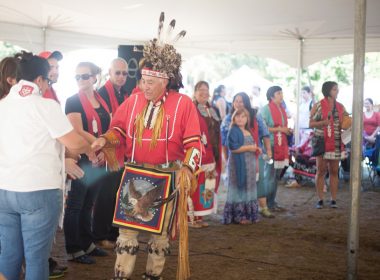
On Friday, the McGill First People’s House hosted its 12th Annual Pow Wow, a day of traditional dancing, singing, and ceremonies honouring the Indigenous population of McGill and Montreal.
According to Paige Isaac, the coordinator of the First Peoples’ House, the event is designed to offer students and faculty the chance to learn about Indigenous culture, and it provides a venue for local Indigenous artisans and vendors to sell their goods. The Pow Wow has been a staple of the McGill Fall semester since it began in 2001.
“We encourage everyone to come: the McGill community, their families, the Montreal community,” Issac said. “We invite many Native organizations in the city [….] It’s a gathering and a celebration of Indigenous culture.”
This year, live workshops on the art of Indigenous craft-making were added to the Pow Wow, as well as more local Indigenous artists selling their goods.
“I think people are going to notice … a lot more local Aboriginal artists and vendors, selling their own crafts and such,” she said. “We did some outreach to make sure that we had a lot more local vendors.”
Towanna Miller, a first-time vendor at the McGill Pow Wow, was selling handmade traditional Iroquois crafts. She said that the presence of local vendors at such an event would help build relationships between Indigenous students at McGill and those already living in the area.
“I like sharing our culture with students,” Miller said. “The students are eventually going to be business owners in Montreal, and it’s good that we’re neighbours […] and we have cultural exchanges.”
(Wendy Chen / McGill Tribune)
The effort to reach out to more local Indigenous artisans is one of many changes that Isaac hopes to implement in coming years.
“I would really like to see a lot more students in full regalia dancing for the Pow Wow [and] even expanding on our Aboriginal alumni honouring ceremony,” she said. “I’d really like to increase awareness […] and get in touch with a lot more of our alumni and create and expand and enhance that part of the ceremony.”
Marne Deszo, a long-time Montreal resident who attended the Pow Wow for her first time this year, said she was impressed with the amount of culture and passion that the performers were able to convey through their acts.
“I wanted to come here today because my heart goes out to our First Nations neighbours, and I don’t know what to do about their problems,” she said. “What I saw today was phenomenal. I love their costumes, and the passion that they dance with, and I’m really interested in introducing my granddaughter to First Nations art and culture.”
The Pow Wow kicks off McGill’s third annual Indigenous Awareness Week, which runs until Sept. 27.
Looking for their third consecutive win, the McGill Redmen (2-2) hosted the Sherbrooke Vert et Or (1-3) on Friday night for the Red Thunder ‘Fandemonium’ night. Sherbrooke grabbed control of the game early and did not ease up on route to a 45-26 win over McGill.
In the first quarter, the Vert et Or offence cut through the Redmen defence with unmatched ferocity, racking up 21 points and 109 of their 174 passing yards. Head Coach Clint Uttley credited this horrendous start to the tough transition from the grass to artificial turf from their game in New Brunswick last week.
However, the defence picked it up after the first quarter and held the Vert et Or to just three points in the second and third frames. Senior linebackers Alexandre Bernard and Stephan Osman led the team with 10 tackles each, while outside linebacker Jesse Briggs added the team’s only takeaway when he ripped the ball right out of the hands of a helpless Sherbrooke receiver. Unfortunately, McGill’s offence was ineffective, converting just five first downs in the opening half.
Despite coming off an RSEQ offensive player of the week award, senior quarterback Jonathan Collin was less than stellar with a 52 per cent completion percentage and two interceptions. After Collin’s second interception, he was pulled in favour of second year quarterback Pierre-Luc Dussault in order to spark the offence. The decision paid off as Dussault proceeded to bring the team within five points while recording 207 passing yards and 41 yards on the turf, including a twoyard touchdown rush of his own. Just as it seemed like the Redmen might come back, Dussault made his only mistake of the game, throwing a costly final quarter interception at Sherbrooke’s 24-yard line which was returned 92 yards for the score.
“I think it worked out for the most part,” Uttley said. “The interception for [a] touchdown, that [was] unfortunate but that’s a young guy making a mistake [and] that’s the only way they learn.”
Beyond Dussault, McGill’s running game was nearly non-existent. After three conseutive 100-yard rushing performances, sophomore running back Luis Guimont-Mota struggled mightily, netting only one yard on nine attempts. The only significant running play came from freshman Pelle Jorgen who had a 10-yard rushing touchdown late in the fourth quarter. Coach Uttley attributed the lack of running success to injuries on the offensive line.
McGill’s special teams had a fairly strong day despite a blocked punt that led directly to an easy touchdown pass for the Vert et Or. Samy Rassy, U3 Engineering, was kept busy with 10 punts for 357 yards, including two punts that were downed inside Sherbrooke’s 20-yard line. The highlight of the night came from sophomore return specialist, Jean-Philippe Paquette, who returned a Vert et Or punt 74-yards for a Redmen touchdown. The return decreased Sherbrooke’s lead to only five, which was the closest McGill came in the match as they fell to the Vert et Or 45-26.
Although Sherbrooke’s offence and defence were strong throughout, it was clear that sportsmanship was not a part of their game plan. With 41 seconds remaining in the game, a player on the Vert et Or was disqualified and proceeded to make a vulgar gesture to the 1700 fans in attendance. This lack of sportsmanship was topped on the game’s final play as Sherbrooke Head Coach and McGill graduate David Lessard chose not to take a knee on the game’s final play. Instead, the Vert et Or ran the ball for a 76-yard touchdown.
Next week, the Redmen travel across town to take on the Concordia Stingers (0-4) in the Montreal Shrine Bowl, where the Stingers will look to avenge their earlyseason loss to McGill.
Last Thursday, Dean of Arts Christopher Manfredi held a meeting to update students, faculty, and staff about the ongoing plan to restructure the use of space within the Faculty of Arts. Called People, Processes, and Partnerships (PPP), the project intends to reduce administrative inefficiencies and help the faculty deal with reduced resources stemming from budget cuts.
The space restructuring initiative was introduced last April but has undergone substantial change since then due to criticism of the project. The question and answer session was attended by over 50 McGill community members.
Currently, each department in the Faculty of Arts has its own specialized administrative staff. The original PPP floor plan proposals concerning the Leacock departments looked to consolidate administrative services along functional lines, mostly concentrated on the third floor of the Leacock building. The new version will include the creation of six “integrated service groups,” each of which will be responsible for one or more of the faculty’s 16 departments.
Some of the project’s steps have already been implemented this summer, including the move of East Asian Studies to Sherbrooke 688, which was done in order to facilitate its administrative integration with the department of Languages, Literatures, and Cultures. The relocation of other departments will be delayed until next summer to avoid disruptions in the middle of an academic term.
According to Manfredi, this project has become even more necessary due to the unanticipated success of the voluntary retirement program (VRP), a university-wide cost-cutting measure implemented over the summer. He stressed, however, that the project is also taking active measures to reduce the workload on administrative staff by streamlining existing processes.
“The other part of this process course is […] looking at what we do, how we do it, and whether there are things we can stop doing, or steps in the process we do now that we no longer need to do,” Manfredi said.
Some attendees voiced concern that the plan still puts excessive burdens on staff. Currently, most staff members specialize in knowing a single department in great depth, but this plan would expect them to service multiple departments’ needs with that same level of expertise.
In addition, some attendees raised concerns about groupings, which were determined based on distribution of work, rather than department size. For example, one group includes only Social Work, while another contains History, Philosophy, and Polical Science.
“I’m concerned about the way that hubs are functioning in terms of the sizes of programs,” said Allan Hepburn, chair of the English department. “My AO [Administrative Officer] has already retired, and I’m losing my undergraduate coordinator at the end of the year. So I’m particularly concerned about the just distribution of workloads among the admin staff that are left.”
Manfredi said there will be training to ensure that all staff are able to provide the necessary services to students.
“Obviously there’s going to be a learning curve […] but I have complete confidence that all our administrative and support staff have the capacity to learn multiple program requirements,” Manfredi said.
The faculty’s reorganization will also affect the way students access departmental services. Arts Undergraduate Society (AUS) President Justin Fletcher highlighted the importance of ongoing consultation to ensure that students are still provided with the resources they need.
“It is critical that the AUS and the departmental associations continue to be involved and contribute their feedback so that these changes benefit students,” he said.
The restructuring of the Leacock Building will also see interior space in the building dedicated to student space, according to Manfredi. How this space will be used, however, is left to the discretion of the departments. Associate Dean Gillian Lane-Mercier has been holding discussions with departments to help guide the planning of these spaces.
“This should be more of an in-house discussion, so we’re not trying to micromanage how these spaces will actually be re-thought,” Lane-Mercier said.
Fletcher also stressed the potential benefits that this space allocation represents for students.
“Student spaces are critical on campus, as many of our student associations do not have offices,” Fletcher said. “Students are always looking for additional places to study and to lounge between classes.”
Manfredi said there will be bulletin boards going up in Leacock to receive student feedback about particular elements of the plan as the project moves forward.
The summer growing season is coming to an end, but there is still time to celebrate the delicious vegetables provided by the warm weather—corn, tomatoes, cucumbers, and much more. This riff on tabbouleh salad draws inspiration from traditional flavours, but also incorporates delicious in-season produce. This Levantine Arab dish is a healthy and satisfying way to enjoy this time of year.
Ingredients
1 cup bulgur (can be substituted with couscous or rice)
3 chopped tomatoes
1 chopped and peeled cucumber
1 diced red or white onion
1 cup cooked corn
4 minced cloves of garlic
½ cup chopped parsley
½ cup red wine vinegar (use less vinegar for a less sour flavour)
3 tablespoons extra-virgin olive oil
¼ cup freshly squeezed lemon juice (about ½ a lemon)
salt and pepper to taste
Instructions
1. Cook bulgur or rice according to directions on package.
2. Chop tomatoes, cucumber, onion, garlic, and parsley.
3. Combine all vegetables with bulgur/rice.
4. Add vinegar, oil, lemon juice, and other desired seasonings.
A lot has been made recently of the proposed Quebec Charter of Values and the limiting of conspicuous religious symbols worn by public servants. The most interesting element of this is the differentiation between “cultural” and religious symbols, with crosses and Christian iconography claiming an exclusive place as part of the cultural landscape of Quebec.
I don’t find the Parti Quebecois (PQ) proposal—or those who support it—evil or morally disgusting in the way that it has been generally portrayed by anglophone journalists and commentators. I sympathize with the Quebecers who feel that their province, particularly the island of Montreal, is becoming something that they no longer recognize. Cultural change can be frightening. However. I do think the charter, and the broader ideology it represents, is deeply misguided on two levels. The Parti Québécois does not understand the culture of Quebec, nor the more abstract idea of culture itself.
There are two ‘Quebecs.’ One Quebec is the one that we McGill students know. This is Montreal, a cosmopolitan, diverse, global, city. The sounds and smells of Montreal are not those of Trois-Riviéres or Shawinigan. Another Quebec exists outside of our city, with different ways of life, sets of values, and culture. The Quebec that exists outside of Montreal is beautiful and culturally rich, but fundamentally different. We cannot force the same cultural principles onto two different ways of life.
When I hear the words “Quebecois culture,” no unified image of what that might be comes to mind. The Quebec that I know is Montreal. The culture that I know is multi-ethnic, fluid, and worldly. Apparently, that isn’t Quebec. Everything about the city that I live in and the lifestyle I lead is apparently unauthentic, since it doesn’t match up to some romantic, pastoral vision of a bygone Quebec. In the Quebec I know, burqas, niqabs, turbans and stars of David, the latter of which are symbols people often wear non-religiously, are just as much a part of the culture that I see around me as the cross atop Mont Royal. The smell of shwarma is just as prevalent as the smell of poutine and “pizza-ghetti.” The mélange of French, English, and so much more, is Montreal’s identity, its culture, its heart.
Culture is not a government mandate. Culture is reflective and symbolic of our society. Forget about making immigrants into ‘real’ Quebecers or maintaining ‘real’ Quebecois culture. The city is already culturally different from the rest of Quebec. Culture is only authentic if people live it. Nobody ever has any right to tell others that their way of life is ‘unauthentic.’ Lives people are actually living are always more real and authentic than an imagined ideal. How could we ever privilege an imagined, bygone past (in terms of Montreal) over the real lives that people lead?
The most significant problem with the PQ ideology is a complete misunderstanding of what culture means. Culture is the product and expression of the lifestyles and beliefs of our society. It is something that comes from people, not something imposed upon it. It is the organic expression of collective attitudes and principles. In this sense, to privilege one culture over another is impossible. We cannot be against one type of culture or for another. To sacrifice one culture on behalf of another is to sacrifice the very freedom that makes cultural expression possible. The PQ is not in favour of Quebecois culture over other forms of culture. The PQ is against culture, period.
The ‘two solitudes’ exist not just between Quebec and Canada, but within Quebec itself. We must remember that culture is a product of society, and that two fundamentally different societies cannot have the same monolithic culture imposed upon them. There is nothing wrong with the Quebecois culture that the PQ idealizes. The problem is (for Montreal), ironically, that it is an ill fit.
My bedroom window overlooks Mount Royal. I see the cross light up every night. I consider it a beautiful symbol of Quebec and Montreal. It represents a part of this city’s past and people. However, if that beautiful cross becomes the only ‘culture’ mandated by the government as appropriate, it will no longer be an expression of Montreal. It will lose its value and beauty as an expression of the people. It will be something imposed on us rather than made by us. That is not culture. I do not want to look at that cross and see freedom and identity nailed upon it in sacrifice. We must not let that cross become a crucifix. The PQ do not realize that they are not only destroying the culture of immigration and multiculturalism, but that, in doing so, they are destroying Quebec.
This past Saturday, the McGill Redmen attempted to extend their winning streak to three games in their home opener at Percival Molson stadium. Having edged-out both Sherbrooke and Université de Montréal by uncharacteristically narrow margins, the team claimed a more decisive victory against the Concordia Stingers, winning the match 35-28.
McGill started slowly and soon fell behind after Concordia’s Joseph Fulginiti converted a kick. This lit a fire under the Redmen as they finally awoke from their slumber and responded with a try of their own, courtesy of senior fullback Cameron Perrin, who went on to tally a total of 15 points during the game.
Turnovers were undoubtedly an issue for the Redmen, but Assistant Coach Ian Baillie has an optimistic outlook for the team’s progress.
“We took care of the ball a lot better than we have the last little while,” Baillie said. “We have to continue to build up our handling skills.”
Concordia mounted a bit of a comeback in the second half, keeping the pressure on McGill. Fans were on the edge of their seats with two minutes to go in the match, watching the Redmen fight to hold onto a 30-28 lead.
Sophomore flanker Konstantin Born spoke about the team’s motivation during the game.
“I mean, it’s always hard against Concordia,” he said. “For the last three years we [have played] against Concordia in the finals, so it was a big game for us today. Especially as the first two games of the season didn’t go that well. We really wanted to show that […] we can do better than that and beat Concordia today.”
The Redmen managed to open up the lead in the dying minutes of the game, closing out the match 35-28.
The Redmen lost a number of valuable starters last year, including fly-half Connor McKenzie, and prop Alex Sunell who was team captain for the past three years. With former assistant coach Eric Van Sickle taking on the head coaching position, as well as the roster losses due to graduation, McGill is on a rebuilding path.
“We’re young, we have a lot of inexperience,” Assistant Coach Baillie said. “But the guys that are still around–we have a number of really good leaders. They’re bringing the young guys along, but absolutely, there are some guys that you feel their absence when they’re gone [….] Guys [are] playing out of position and learning new roles. [They] have embraced it and are getting better and better each week.”
McGill seems to be on the right track. This is the team’s widest victory margin of the season, and they’re all focused on continuing that pattern, according to Born.
“The rucking was really good today. We were all going in [and] we were fighting for the ball. We had a couple of really good runs from our backs—both [the] forwards and backs worked really well together,” he noted. “We have a lot of new guys in, so the communication has to get a little better, but [this game] was really great. I mean, there are a couple of challenges coming up for sure, but in general, I think we’re doing well [and] going the right way.”
The Redmen are poised and ready to take on the Bishops Gaiters at home this coming Thursday. Focused on winning their eighth consecutive RSEQ title, the team should continue developing their younger talent and remain a dominant presence in the league.
We are all familiar with the feeling of dismay when opening the fridge to an empty shelf. In response to that problem, refrigerators may soon be able to place an order for delivery all on their own, according to Kevin Ashton, a British technology pioneer.
In 1999, Ashton proposed the term the ‘Internet of Things,’ which refers to uniquely identifiable objects and their virtual representations in an Internet-like network. In other words, with new technologies, regular household devices like refrigerators can now ‘hop’ onto the Internet. One way this is accomplished is through a machine-readable sensor or RFID (Radio-frequency Identification), allowing objects to communicate with any other service with a virtual presence on this massive network.
Other current technologies like QR codes (Quick Response code), barcodes and NFC (Near Field Communication) are also potential linking agents, that too, could connect various devices to the Internet. In fact, an increasing number of devices can be connected in this way.
“We have a clear vision: to create a world where every object—from jumbo jets to sewing needles—is linked to the Internet,” writes Helen Duce, director of RFID technology at the University of Cambridge. “Compelling as this vision is, it is only achievable if this system is adopted by everyone, everywhere. Success will be nothing less than global adoption.”
Lost in all this excitement is the additional burden of an already increasing security threat to any device that is connected online. When only computers could hook up to the Internet, users grappled with problems of viruses. Then came smartphones that added onto the problem of vulnerability to hackers who could potentially steal all your contacts, photos, and account information.
The complexity this new network poses leaves several gaping holes for hackers to enter and wreak havoc. At a cryptography and information-security related conference in San Francisco known as the RSA conference, Philippe Courtot, CEO of Qualys says, “We are faced with a dual challenge of not only a secure infrastructure that is rapidly changing, but we now have to prepare for the Internet of Things”.
Projections from Cisco, a leading company in networking, estimate over 50 billion devices will be connected devices by 2020. The implications of this growth involve a new role for traditional manufacturers. Companies will now have to also manufacture these ‘connected devices.’ Hence, the onus of Internet security will in part fall on them.
A solution to preventing such online vulnerabilities lies in creating modular designs for the hardware and software used in these devices. By separating various components of the system into independent modules, the entire system is not safe even if one module is hacked. For example, if there was a breach into the entertainment system at your home, the hacker would not gain access to other modules in the home such as the one that controls the locks, the lights, etc.
Open security standards like TLS (Transport Layer Security) and OAuth are better alternatives as security protocols on these new connected devices than having each manufacturer develop their own propriety software. These are largely more reliable because they have been tested extensively by the online community.
In the end, we as consumers must exercise caution in terms of connecting devices and sharing information. A refrigerator that can order groceries is a novel idea, but if it has access to your credit card information and the ability to open the door to let the delivery guy in, things could get a little out of hand. This is where a little skepticism and caution can go a long way.