Latest News

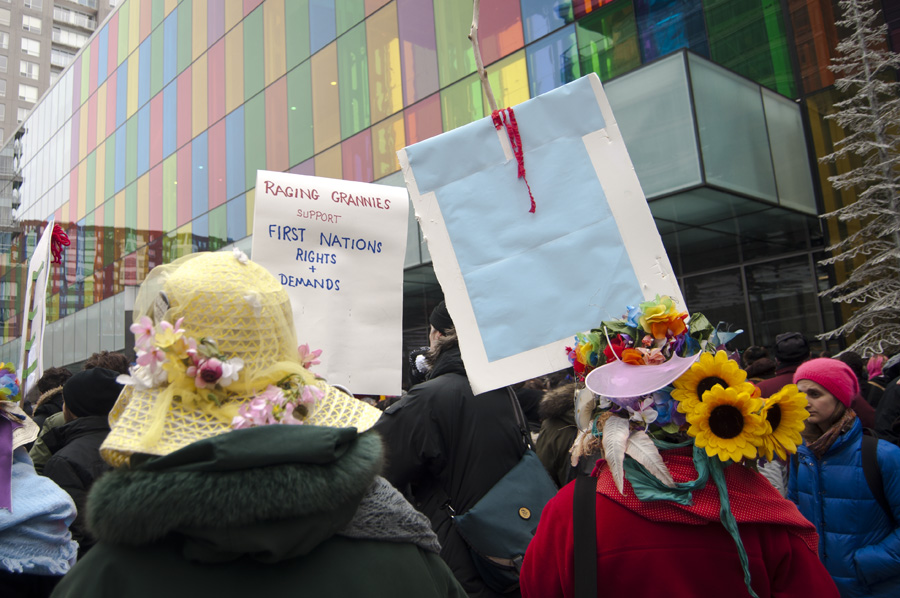
The protest began with a drum circle. (Simon Poitrimolt / McGill Tribune)
a, News

Idle No More reaches Montreal

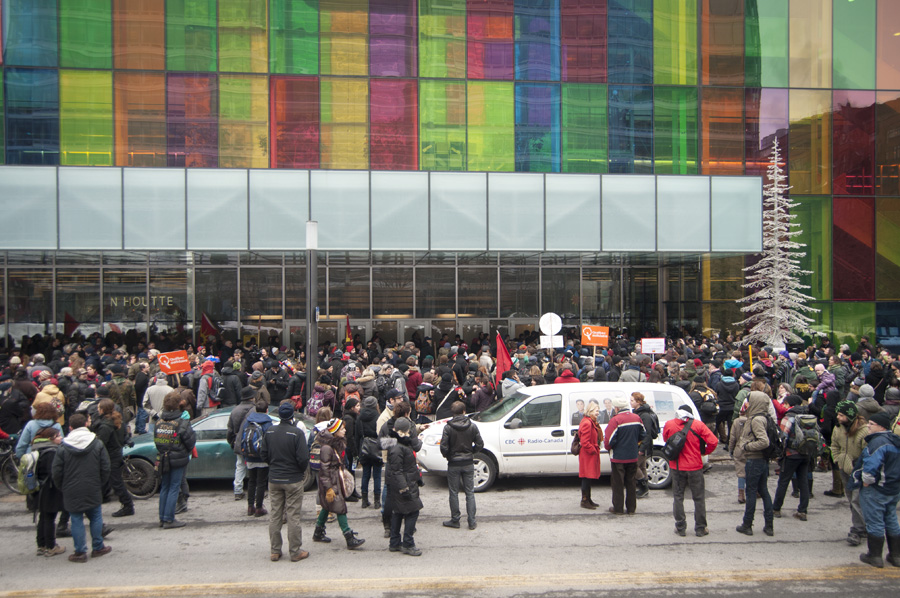
Approximately 1,500 people gathered in front of the Palais des Congrès last Friday to show their solidarity with Canadian First Nations and Chief Theresa Spence, who has been on a hunger strike for the past month in protest of the federal government’s stance on Indigenous rights. Following a traditional round dance, the crowd marched through downtown Montreal.

This event was part of Idle No More, a growing grassroots movement advocating for Indigenous rights in Canada. The movement began last November, when four women in Saskatchewan used Facebook and the title “Idle No More” to draw attention to the ways in which Bill C-45—commonly known as the second omnibus budget bill—erodes Indigenous communities’ control over their land.

Bill C-45 changes legislation for more than 60 government acts. The main concerns of the Idle No More movement are the changes made to the Indian Act, the Environmental Assessment Act, and the replacement of the Navigable Waters Act with the Navigation Protection Act.

These legislation changes speed up the approval process for leasing Indigenous land, and remove protection from the majority of Canada’s rivers so that pipeline and power-line installation firms no longer need to prove that their activity will not damage a navigable waterway.

Friday’s protest attracted a diverse, multi-generational crowd. A group of elderly women were among the demonstrators, wearing brightly coloured hats and holding signs demanding that Prime Minister Stephen Harper listen to Indigenous Peoples’ concerns.

“[This movement has] been a long time coming,” a senior participant, who would only be identified as Marguerite, said. “The government and private corporations have a duty to always consult with First Nations.”

In front of Palais des Congrès on Friday, the crowd joined hands and formed a series of circles where participants turned and stamped in time to the beat of hand drums.

Two students from Dawson College handed out red felt feathers to protestors. Jeffrey Graham, an executive of Dawson’s student union, explained that he had found the ideafor the feathers online.

“We just converted a few of our red squares in our office into red feathers,” Graham said.

“[Idle No More] is kind of like a continuum to the Occupy movement and the student movement,” a student in the Concordia School of Community and Public Affairs, who would only be identified as Crystal, said. “[But it is] different because it is in response to a direct attack on First Nations people.”

Crystal also explained that she wanted to take part in the Idle No More movement because she is of Métis descent.

“My family doesn’t practice Aboriginal [customs], but I feel really connected to the land, like all Canadians I guess,” she said.

For many supporters of Idle No More, Indigenous people’s concerns are integrally linked to Canadian environmental concerns.

“We really feel strongly that our resources need to be protected, and [First Nations] peoples have always been advocates for our land,” Graham said.

The Facebook event for Friday’s protest emphasized the importance of seeing Idle No More as an inclusively Canadian movement, rather than one aimed only at Indigenous populations.

“[This is] a movement that is ready to demand an end to Harper’s relentless legislations that amount to nothing less than an outright assault on the fabric of this country,” the Facebook event page said.

Over the past two months, Idle No More protests, rallies, and teach-ins have taken place nation-wide. One of the movement’s more controversial tactics has been blockades of railway lines.

Reactions to Idle No More’s protest tactics have been mixed. U3 environmental science student Maida Hadziosmanovic’s VIA Rail train was delayed for four hours on her way back to Montreal from her home in Oakville, Ontario after Christmas.

“Though I support the cause, I did not support the protesters as they were affecting people who have nothing to do with Harper’s decisions,” Hadziosmanovic said.

“There are many other ways of getting the government’s attention,” she continued. “In my opinion, they probably ticked off a lot more people than they would have if they approached the movement differently.”

SSMU Vice-President External Robin-Reid Fraser attended Friday’s protest. She said SSMU does not have an official position on the Idle No More movement, but students will have the opportunity to learn about and discuss the issues during the “Intro to Quebec” week SSMU has planned for Jan. 21-25.

Photos by Simon Poitrimolt

a, News

McGill student files grievance over protocol on protests

On Dec. 11, 2012, U3 Philosophy student Eli Freedman filed a complaint with the McGill Senate Committee on Student Grievances against the draft of a permanent McGill protocol on demonstrations, assemblies, and protests. The grievance calls for the draft protocol to be nullified immediately, and for Vice Principal (Administration and Finance) Michael Di Grappa and Provost Anthony C. Masi to issue a formal, public apology to the McGill community.

The draft protocol is an evolution of a provisional protocol implemented on Feb. 12, 2012, following a five-day student occupation of the sixth floor of the James Administration Building. The draft protocol, which was released to the McGill community on Nov. 30, outlines permanent parameters for how protests and similar activities may occur on University premises, and under what circumstances they would or would not be condoned.

Critics of the draft protocol, including Freedman, have condemned the document as vague, open to interpretation, and for stepping on the rights of McGill community members to express political dissent. Freedman argues that it potentially violates “students’ human rights covered under international and provincial law.”

“It clearly follows from … the Charter of Students’ Rights that there exists a special fiduciary responsibility between the University and students to ensure that students’ rights are not infringed upon through administrative decisions,” Freedman wrote in the document submitted to the Committee on Student Grievances.

“It is an unacceptable breach of trust on behalf of the respondents to restrict the fundamental freedoms of all students in response to the actions of a small number of students,” he argued.

Freedman explained that his motivation for filing a complaint goes beyond the nullification of the draft protocol.

“The protocol really just makes [explicit] what was already implicit—[the McGill administration’s] lack of will to tolerate disruption,” he said. “The goal is to … get rid of what is explicit, [but also] to change what has [been] and still is implicit … to make it possible for protestors in the future to create [change].”

Freedman described his experience with compiling and filing a student grievance as “very frustrating.” Freedman met separately with McGill Ombudsperson Spencer Boudreau on Feb. 12, and former associate dean of arts (student affairs) Andre Costopoulos on Oct. 17, to discuss the provisional and draft protocols, respectively.

“[My meetings with them] were pretty fruitless,” Freedman said. “It’s quite ambiguous what the actual [draft] protocol means … [Costopoulos] told me that, in his capacity as Associate Dean, he would never even use the protocol, because it’s unclear what it means or what level of authority it has.”

Freedman is currently waiting for an official response to his complaint from the Senate Committee on Student Grievances.

In the meantime, Freedman has taken further action, and requested that Costopoulos—who is now Dean of Students—and Professor Paul Thomassin, chair of the Committee, ask that the Board of Governors (BoG) delay their vote on the adoption of the protocol, which is scheduled for Jan. 29.

“There’s no rush to make the Protocol permanent,” Freedman said. “[The Board] shouldn’t vote on a [protocol] that [does not] meet McGill’s requirements now that it’s been challenged.”

As he has not yet recevied an official response from the Committee, Freedman does not believe Di Grappa and Masi have read his grievance.

Students’ Society of McGill University (SSMU) President Josh Redel said he and SSMU Vice-President University Affairs Haley Dinel—who both sit as student senators on McGill Senate—are working on their reaction to the draft protocol’s presentation to Senate on
Jan. 23.

“We are working on ways of figuring out what more students think before saying [our position],” he said. “I am confused as to the need to have a protocol such as this, especially one that attempts to define ‘peacefulness.’ I think trying to define ‘peacefulness’ in such a dynamic environment … is an exercise in futility.”

Freedman said he believes student senators will form a strong opposition to the protocol on Jan. 23, and he hopes that McGill professors will also stand up against the document.

According to Freedman, a protest against the protocol is planned for Jan. 23.

The McGill administration could not be reached for comment.

a, News

Brown professor David Egilman questions asbestos research

On Jan. 4, David Egilman, a clinical professor in the department of family medicine at Brown University, debated members of the McGill community on the topic of asbestos research at McGill. The presentation, which  Egilman called a “counter-conference,” meant to address a talk given by McGill Epidemiology Professor Bruce Case earlier that day.

According to Egilman, the purpose of the counter-conference was to “present critical information to the public regarding McGill’s ongoing refusal to address damning evidence of asbestos research improprieties, and improper conduct by former Chair of McGill’s Epidemiology Department, Dr. [John] Corbett McDonald.”

Egilman focused primarily on discounting the body of research done by McDonald and his team of researchers into Quebec asbestos mines from the 1960s to the late 1990s. In a paper published in 1998 that McDonald co-wrote, he indicates that, when taken at face value, the data he collected proves there is a protective effect of asbestos.

“That means asbestos protected against the effect they were studying, and the effect they were studying was lung cancer,” Egilman said.

According to Egilman, McDonald’s research is still used today by asbestos companies to advocate for the use of asbestos in countries like Brazil and India.

“This is a policy problem,” Egilman said. “This is not some esoteric academic issue. Asbestos is being sold, and mined, and dumped in developing countries.”

Egilman expressed his belief that the only way to prevent this research from being used by asbestos companies is for McGill to withdraw the 1998 paper.

McGill professors who attended Egilman’s talk debated with Egilman on this point, arguing that Egilman is targeting the wrong place to get the paper withdrawn.

“Your job now is no longer with McGill University,” Eduardo Franco, McGill’s interim chair of oncology, said. “If this is truly an important job at hand for the advocacy you propose, which I think is misdirected, I would work in a different direction with advocacy groups and with professional sciences … [your job] is with the journals.”

Franco also expressed the belief that the university should not withdraw the paper because it can provide insights into research flaws that could be helpful for the future.

Egilman alleged that certain data linking asbestos to cancer was disregarded in the study, which he said altered the results significantly.

“When the data started to show asbestos caused lung cancer rather than protected against lung cancer, [McDonald’s team] stopped,” Egilman said. “If they couldn’t delete the data that didn’t make sense, they just threw it away … This is not arbitrary. This is done with a purpose.”

According to the CBC, McDonald received nearly one million dollars from asbestos companies as funding for his research. CBC released a documentary in February 2012 that argued that asbestos companies influenced McDonald’s results.

Last year, McGill conducted an internal investigation into McDonald’s research. The investigation was led by McGill’s Research Integrity Officer Abraham Fuks, who concluded that no research misconduct had occurred. Some McGill professors defended McDonald’s research when Egilman argued that the results of the research in question may have been manipulated.

“McGill has already investigated itself, and has come up with the final conclusion that there was no evidence of wrong-doing,” Franco said. “This was based on the reality of how you [conducted] research back at that time.”

Wayne Wood, an occupational health lecturer at McGill, also expressed concerns with Egilman’s accusations. He accused Egilman of twisting the words of McDonald’s conclusions.

“I think the presentation is flawed,” Wood said. “I didn’t react with the same amount of outrage as [Egilman] simply because I do not over-interpret the statements as [saying] something that they were not intended to say.”

Wood pointed to Egilman’s accusation that McDonald had said there was a “protection factor” with asbestos exposure.

“[McDonald] didn’t say there is a protection factor,” Wood said. “He said ‘taken at face value’—in other words, if you didn’t know better and you just looked at the data, it might suggest there is a protection factor. But he didn’t say there was a protection factor. You did.”

Egilman said he was pleased with the debates that occurred during his presentation following the talk. He also said it has been difficult getting his message through to members of the McGill community.

“I think it’s hard to call the emperor out,” Egilman said, in reference to McDonald. “I’m not going after McDonald. I am trying to get the truth out about a study in a way that … will make sense.”

Egilman paid for a room in the Faculty Club himself in order to speak. Six scientists from both the United States and Canada sent a letter to Joseph Cox, the coordinator the Epidemiology Seminar Series, requesting that Egilman be given time to present alongside Case. The request was not granted.


a, News

SSMU Council calls on TaCEQ to demand États Généraux

During the Students’ Society of McGill University’s (SSMU) first Legislative Council meeting of the semester, Council called for the Quebec Student Roundtable (La Table de concertation étudiante du Québec, or TaCEQ), of which SSMU is a member association, to organize an États Généraux on the role of education in Quebec society, separate from the Education Summit scheduled by the provincial government for February.

An États Généraux is a broad consultation about a specific issue commissioned by the government.

SSMU Vice-President External Robin Reid-Fraser presented the motion to Council.

“I’ve reached the conclusion—and I think there are a lot of groups who feel similarly—that the process of the Education Summit that we have going on right now is not as big as it could be,” Reid-Fraser said.

She also expressed disappointment with how little time the Parti Québécois (PQ) has given student associations and other groups to prepare for the Summit by announcing it in November. Reid-Fraser further expressed frustration with the Summit’s apparent lack of structure at this point–despite the many meetings that have been held by the PQ with various student associations, and other members of the education community to create a framework.

“I feel like we are at this really important time in a lot of ways, and the conversations we are having [in these meetings hosted by the government] are just not enough,” Reid-Fraser continued.

Reid-Fraser originally wanted Council to call on TaCEQ to hold an alternative education summit, but came up with the idea of organizing an États Généraux, after talking with  Simon Charonneau, a SSMU political attache and press secretary.

She explained that the États Généraux would be put on by the National Assembly, and would be a much longer process—one that could take up to twelve to eighteen months, or as long as the consultations need to be completed. According to Reid-Fraser, consultations would occur across the province with many different groups from the university community.

A few councillors expressed concerns about calling an États Généraux at this time.

Alexandra Allaire / McGill Tribune

“[An] États Généraux may make sense. But I think we ought to be far more prepared before we call on the government to conduct one,” he said. “We ought to think carefully about what we would like to get out of it, who we would like to be heard, and what areas we would like the États to focus on.”

SSMU Vice-President Clubs and Services Allison Cooper said she would like more information on what an États Généraux would entail. She motioned to send the original motion back to the External Affairs Committee to be re-examined. Cooper’s motion did not pass.

Music Representative Katie Larson supported both the original motion and the idea of an États Généraux.

“I think this is the most moderate, logical … way of going about the education issue,” Larson said. “I don’t see what the problem is, honestly. If you are going to represent students on Council, I think we should easily be passing this.”

Reid-Fraser also brought forth a motion that would call on TaCEQ to demand an audit of spending for all universities in Quebec at the government’s Summit in February.

“The idea with this [motion] is that there would be a process to fully see where universities use money, where they are spending the money that they have right now, does that make sense, and comparing universities across Quebec,” Reid-Fraser said.

Science Senator Moe Nasr pointed out that the university already undergoes an audit, and that a better alternative might be to look into government university funding.

“Why don’t you add [to the motion] to request the government to have an impartial third party audit on its university funding management because … the issue isn’t where university spending is going—it’s how funding is being mismanaged,” Nasr said.

After a discussion of whether or not an audit is the appropriate measure to be called for, Reid-Fraser proposed that the motion be tabled indefinitely, so that she could conduct further research and consultations.

a, News

PGSS hosts education summit to prepare for PQ summit

Students, faculty, administrators, and other members of the educational community within, and outside of McGill debated diverse aspects of the role of post-secondary education in Quebec, and at McGill, in early December. The two-day education summit was organized by the Post-Graduate Students’ Society of McGill University (PGSS), and the Students’ Society of McGill University (SSMU).

According to PGSS Secretary General Jonathan Mooney, the summit was intended to promote discussion on topics that will be under scrutiny at the upcoming Quebec summit on higher education, which the Parti Québécois has said will be held in February.

“We felt that in the aftermath of last year’s conflicts and in anticipation of the Quebec summit, it was important to have a nuanced discussion about important topics regarding higher education in Quebec,” Mooney said. “It’s valuable to hear different perspectives on these topics because it offers stakeholders a chance to explore these complexities, and try to think of creative solutions.”

PGSS Vice-President External Errol Salamon said the PGSS originally intended to create a document based on discussion at the summit, but have changed their plans due to low attendence and the cancellation of several guests, such as  representative from ASSÉ.

“That said, we are reviewing some of our policies (and hoping to create policies) about key issues, including tuition and ancillary fees, which we hope to pass in Council this semester,” he said. “The summit will certainly inform our positions.”

In one panel, Mooney moderated a discussion that focused on the question of who “should” finance universities. Panellists included McGill Principal Heather Munroe-Blum, SSMU Vice-President External Robin Reid-Fraser, former PGSS Vice-President External Mariève Isabel, and Professor John Galaty, the former president of the McGill Association of University Teachers (MAUT).

Much of the discussion focused on how tuition costs affect students’ ability to attend university. Reid-Fraser argued that increasing tuition prices decrease accessibility, and pointed to higher tuition as a barrier for the social mobility of those from lower income families.

“Even if you have financial aid, there is … the fear of accumulating debt, particularly in a position where the economic picture is not very stable; and it’s not guaranteed that students coming out of university with an undergraduate or graduate degree are going to be able to move quickly into the workplace and pay off that debt,” she said.

Galaty, however, argued that free or low tuition is “inequitable” in certain ways.

“What the present tuition system represents is a massive benefit to those families that are more wealthy, because essentially, they are able to achieve a level of tuition payment, which is equivalent to those who have true financial need,” he said. “If you have a very low, stable tuition fee, what you’ve done is provide tuition relief to all those who don’t need it.”

As a way to potentially minimize this problem, Galaty pointed to American university applications, where students must submit a form that allows the university to identify those who are in need of financial assistance. He said another option is to give tax credits for tuition on a graduated scale that refunds money to those of lower income backgrounds.

According to Isabel, society as a whole benefits greatly from the education of students. She cited a study by the Fédération étudiante universitaire du Québec (FEUQ), which states that every dollar the Quebec government invests in a graduate student returns $5.30.

Munroe-Blum expressed agreement that certain groups of students should receive financial support, including research, masters, and PhD students, as well as “qualified students” who can’t afford to pay otherwise. She said students should pay “to the best of their ability,” but also emphasized the diverse factors that affect a student’s ability to go to university.

“The social milieu has a far greater impact on who goes to university than tuition,” Munroe-Blum said. “Frankly, I am very concerned about the results of the educational system, and I think something we really need to focus on is actually looking at who graduates. Do those who are the first in their family to go to university graduate?”

Reid-Fraser concluded by drawing attention to the complex nature of barriers to secondary education, and the need to extend the discussion of accessibility beyond tuition.

“Financial barriers are a very important thing to continue to talk about, but another long-term project is to re-envision how we make the information … available [here] to people who maybe can’t sit through lectures every day or learn from a book as easily,” she said. “I know a lot of friends who did not go to university, simply because their learning style is not suited to being in a classroom, and yet, there is so much valuable information that we get when we’re in a classroom or at a university.”


a, News

What happened last week in Canada?

Teacher strike cancelled in Ontario

On Jan. 9, Ontario Education Minister Lauren Broten imposed a two-year contract on teachers and support staff under Bill 115, a controversial anti-strike bill. Ontario teachers’ unions argue that the legislation is unconstitutional, and have declared their intention to contend it in court.

Elementary school teachers initially announced that they would stage a one-day “political protest” against the decision last Friday, but the plans were discontinued after the Ontario Labour Relations Board ruled that the protest would be illegal. Under Ontario labour laws, engaging in illegal strike actions can result in a penalty of up to $2,000 per person and up to $25,000 for a trade union.

The timing of the ruling, which came at 4 a.m. on the day of the planned protest, caused confusion among parents and school boards, since several schools had declared closure in anticipation of the protest. As a result of the ruling, many boards decided to open schools, with only eight of 72 Ontario school boards opting not to hold classes on Friday.

Harper meets with Assembly of First Nations

Last Friday, Prime Minister Stephen Harper met with members of the Assembly of First Nations (AFN) following nationwide protests as part of the Idle No More movement.

Attending First Nations leaders included Attawapiskat First Nation Chief Theresa Spence, whose hunger strike has been raising awareness of Indigenous issues and support for the Idle No More movement since it began in December 2012.

After the meeting, AFN National Chief Shawn Atleo expressed optimism about their progress, saying that “for the first time, [Harper] provided a clear mandate for high-level talks on treaty implementation.”

However, some Chiefs have criticized the government for failing to meet their demand for a joint meeting with both Harper and Governor General David Johnston.

During the meeting, demonstrations continued across Canada in support of the Idle No More movement. Leaders have said there will continue to be protests in the coming weeks, and Spence will continue her hunger strike until her original demand for a joint meeting is granted.

Applebaum fights corruption

In the next few weeks, Montreal will have a new anti-corruption unit designed to investigate city affairs, according to an announcement made by Mayor Michael Applebaum on Jan. 11. The group, which will be the first of its kind in Canada, will consist of 20 members. Although most employees will be Montreal police officers, the unit will exist and act independently from the city.

The new unit is called Escouade de protection de l’intégrité municiaple (EPIM, or the Squad to Protect Municipal Integrity). Estimated costs for its first year of operation are $3 million, including costs for paying staff and establishing EPIM’s headquarters.

With this move, Applebaum said he seeks to send a warning to “profiteers and schemers,” who attempt to manipulate construction contracts to their benefit. Although some members of the official opposition party Vision Montreal have asked if this step comes too late given the history of corruption in Montreal, many members have praised Applebaum for creating an additional barrier to the spread of corruption in the city.

Government bureaucrats caught cheating

According to documents uncovered last week, Ottawa officials reprimanded almost 60 federal bureaucrats for allegedly plagiarising on an exam in a 2010 job application for a government position in the information technology sector.

Instances of plagiarism are normally kept confidential due to privacy concerns. However, one applicant decided to challenge the accusation in federal court, causing the records to be released.

The exam was distributed over the Internet to more than 2,000 applicants. Although applicants were allowed to use the Internet during the test, they were prohibited from copying and pasting text into their exams. Those who marked the test alleged that almost one in every twenty people who filled out the test had plagiarised in this manner.

The bureaucrats were not fired for their actions; however, they received reprimands, and were halted in any potential job advances. In addition, the government informed the applicants’ superiors of their plagiarism on the exam. Critics point to this incident as an indication that plagiarism in government is a greater problem than acknowledged.

Military planes may have defects

Questions arose last week regarding the threat posed by counterfeit Chinese parts in the cockpits of some of the Hercules planes recently bought by the Canadian military.

CBC News alleges that the counterfeit electronic chips could cause the instrument panels of the aircraft to turn blank during flight. If these parts become defective, Canadian military pilots risk flying blindly into combat zones without important information such as altitude, speed, location, or fuel supply.

The CBC says it has received documents, indicating that the military became aware of the counterfeit parts as early as July 2012; but the military has not disclosed the information, despite a CBC News investigation. The Department of National Defence denies that the parts pose a threat, but notes they will replace the parts as necessary.

Neither the manufacturer nor the electronics company that made the system has provided comments on the allegations.


a, Arts & Entertainment

Haiku Reviews: Holiday Films

Chris

Life of Pi

Shot with utmost care,

Every frame is priceless art;

Beauty incarnate.

The Hobbit

One book—three films. Why?

Jackson’s winded, winding tale:

All filler, no fun.

Zero Dark Thirty

Steely, steel-cold work;

Not war song, but elegy.

Apolitical.

Django Unchained

Slavery and race

Subject to Q’s mockery—

Shameful; a disgrace.

Ilia

Hyde Park on Hudson

Borderline incest,

In plot like flat June champagne.

King George visits too.

This is 40

Turning forty, huh?

Near broke; wife nags; Viagra.

At least you’re not dead.

Gangster Squad 

Riddled with bullets

Made of highest grade boredom.

Gosling still handsome.

Django Unchained

Waltz, DiCaprio

Make love to the camera;

Foxx penis steals show.


Salman Rushdie, a man on the run. (www.thesamueljohnsonprize.co.uk)
a, Arts & Entertainment

A Valentine’s day sentence: an author’s fight for freedom

On the morning of February 15, 1989, two unknown men knocked on Salman Rushdie’s door. The day before, a mortally ill despot in Tehran had issued an edict condemning all those involved in the production of Rushdie’s most recent novel, The Satanic Verses. The Valentine’s Day fatwa concluded in a morbid command: “I ask all the Muslims to execute them wherever they find them.”

When the author answered his door, the two men explained that they were members of the Metropolitan Police’s A Squad, the division responsible for all personal protection in the UK. A journalist told Rushdie that Ayatollah Khomeini’s fatwas were a dead letter. The men, however, explained that his life was now under serious threat—one level below that of the Queen.

Rushdie’s recent memoir, Joseph Anton, chronicling his state-guarded life over the course of 12 years, is unceasingly captivating. Beginning with his upbringing as a scholar and an atheist, through to his attempts to examine Muhammad in a distinctly human light, Rushdie writes of the intellectual curiosity which spurred his penning of The Satanic Verses. To his pain and surprise, less than a fortnight after its publication in Britain the Indian government buckled to pressure from two Muslim MPs, and banned it. In the next six months, India would welcome Bangladesh, Afghanistan, Saudi Arabia, Thailand, and (in a rare show of unity) Pakistan to its comity of censorship. In most of these cases, it is almost certain that no native language translations were available, and that few officials had made even the most cursory examination of the book.

Western liberal democracy issued an even more timorous response. Barring a small group (writers, friends, and politicians, whose ranks included Susan Sontag, Gunter Grass, and Vaclav Havel), many declared Rushdie’s work to be disrespectful, and therefore, rightfully convicted by the laws of cultural relativity. In a show of admirable religious solidarity, the Pope, the Archbishop of Canterbury, and several eminent rabbis all declared Rushdie in the wrong. The Prince of Wales, not to be outdone, stated that the author was a bad writer who cost Britain too much to protect. One couldn’t help but wonder just what exactly it was that Prince Charles had accomplished to merit not only his inordinately costly safekeeping, but his complete financial support.

The author, forced to choose a new name (Joseph Anton is the amalgamation of Joseph Conrad and Anton Chekhov) and scuttle from one property to another, writes his recollections with brilliant, vivid indignation. In beautifully melodic passages, Rushdie wonders how an Iranian theocrat could sentence a British national to death. Milton once wrote, “He who destroys a good book, kills reason itself.” Had his fellow writers forgotten these prescient lines? Using third person, and thereby largely avoiding the solipsism that a slighted man’s memoir may lapse into, Rushdie describes the nightmare of daily life with admirable honesty.

By and large, the whole affair was handled—be it on the part of writers such as John le Carré or politicians such as Tony Blair—with a craven servility. Another of Rushdie’s books provides an alternate, yet equally apt title for this tale: Shame.

Joseph Anton is available from Random House, $34.95

For Etoroma, the world is his stage. (Evan Shay / Courtesy of Etoroma)
a, Arts & Entertainment

McGill alumnus, marching to the beat of his own drum

You live in Upper Rez. You have an 8:30 a.m. class at the bottom of the hill and you’re just rolling out of bed at 8:15. You throw on your shoes, dash outside, and sprint down the steep, slippery, slush-covered University Street. As you slide into your seat in the nick of time, you realize you forgot your homework. Sounds like a pretty standard morning for a first year.

But imagine—in addition to this—that you had spent the preivous night, from midnight to 4 a.m., in the recording studio. Later that day you’d be practicing with both of your music groups and then at night you’d have a gig at a well-known jazz venue in Montreal. Juggling school and a professional music career? Not so standard. But just five years ago, this was the life of drummer, composer, and now McGill alumnus, Efa Etoroma Jr., who is set to appear on the cover of the upcoming issue of Muzik Etc./Drums Etc. magazine.

Raised mainly in Edmonton, Etoroma came from a musical family that first noticed his talent at age three, when he started banging out rhythms on his father’s head. By the end of high school, he had received numerous music awards, traveled throughout Canada and the United States to perform and study, and was on his way to McGill’s prestigious Schulich School of Music.

Etoroma looks back at his years at McGill as a time of great inspiration. Joining fellow jazz students, Dan Reynolds (piano) and Conrad Good (bass), Etoroma started the Efa Etoroma Jr. Jazz Trio, which eventually went on to play at the Montreal Jazz Festival main stage in 2011.

“Within the first few months of being at McGill, we just kind of made a connection,” Etoroma says about the trio.

Focusing on acoustic jazz, the group recorded an album called Before and After, a compilation of traditional, smooth jazz with a hint of modern flair.

Etoroma is “always looking for new sounds,” which led to the establishment of his second music group—an experimental hip-hop collaboration called Ruckus. Their album, Round One, is an upbeat blend of hip-hop, jazz, funk, soul, electronica, and Latin music.

“It was a fusion of different styles into this contemporary version of hip-hop,” Etoroma explains.

The members of the group would incorporate different sounds that were inspiring them at the time into their compositions to form an unique amalgamation. One unceasing source of excitement for Etoroma was Montreal itself.

“It was a challenge, you know, to stay focused in a really exciting city,” Etoroma sighs. “But it was inspiring at the same time.”

He recalls fondly some of his favourite places in the city to hear music, including Upstairs Jazz, Jello Martini Lounge, Brutopia, and of course, the many stages of the Montreal Jazz Festival.

The past few years have been a whirlwind of success for Etoroma. Two years ago, he played for the Montreal Drum Fest, a prestigious annual festival that showcases some of the best percussionists in the world. For Etoroma, playing for this specific community consisting solely of drummers was a challenging, but extremely important moment in his career.

“It was a big step for me,” he chuckles, recalling that the members of the drum community “are super-critical … because they know what’s up.”

Due to this exposure, Etoroma just signed an endorsement with Yamaha Drums Canada. In doing so, he has joined an incredible rank of drummers—several of whom are internationally famed. Being a part of this group will, without a doubt, open a number of doors for the young artist.

Today, Etoroma is based in Edmonton, where he leads a new group—the Etoroma Trio. Along with his brother on vocals and guitar and a bassist, Edwin Alvarado, Efa is exploring a more pop-oriented sound than he has before. Keep an ear out—for you’ll undoubtedly hear from from Etoroma in the future.

Read the latest issue

Read the latest issue