Latest News

a, News

McGill Principal plans to revise campus security measures

On Nov. 23, Principal Heather Munroe-Blum accepted all three recommendations to revise the Code of Student Conduct and security on campus from Dean of Arts Christopher Manfredi’s Report of the Open Forum on Freedom of Expression and Peaceful Assembly. In an email to the McGill community, Munroe-Blum detailed the steps that the administration has already taken—and will continue to take—to implement these recommendations.

Munroe-Blum mandated Manfredi’s report following Dean of Law Daniel Jutras’ report on the events of Nov. 10, 2011, when an occupation of the James Administration Building ended with riot police dispersing and pepper-spraying students on campus. The Principal asked Manfredi to chair a series of open-forum sessions where students, faculty, non-academic staff, and senior administration could discuss campus issues, including the right to peaceful assembly on campus.

Published on Oct. 8, Manfredi’s report describes the key discussions and concerns conveyed at the four open-forum sessions, which took place between March 1 and May 2, and provides three recommendations based on that dialogue. These recommendations include the clarification of several clauses in the Code of Student Conduct, the revision of the Provisional Protocol, and a review of McGill Security Services’ training program.

In response to Manfredi’s first recommendation regarding the Code of Student Conduct, Munroe-Blum said she has created a working group specifically mandated to deal with this issue. She has asked professor Lydia White, associate provost (policies, procedures and equity), to chair the group.

Munroe-Blum has mandated that the working group consider Section 6.3.1 of Manfredi’s report, which discusses the use of masks and other forms of concealed identity within the context of a protest. The Principal asked that the group bring recommended amendments of the Code to the McGill Senate in February or March 2013. Senate will formally consider recommended amendments in March or April 2013.

In an email to the Tribune, White commented on the challenge of making changes to the  Code.

“Terminology can sometimes be open to multiple interpretations,” White wrote. “This is one of the issues that we will have to consider.”

According to White, three student senators will sit on the work group—one undergraduate, one graduate, and one Continuing Studies—whose names will be proposed by the Senate Nominating Committee. She said the group’s first meeting will probably occur in mid-December or early January.

Munroe-Blum also addressed Manfredi’s recommendation that “the ‘James Protocol’ should be revised or reconsidered with a view towards adopting a less restrictive approach to access and security.”

“Changes have already been implemented, and further work is currently under way on making physical changes to the first floor of the James Administration Building, so that visitors to the building are admitted quickly and efficiently while maintaining the safety and security of the approximately 300 people who work in the building,” Munroe-Blum wrote.

Munroe-Blum confirmed that she has accepted Vice-Principal (Administration and Finance) Michael Di Grappa’s proposal to revise the James Protocol, which includes rules and procedures for scheduled and unscheduled visitors to the James Building, as well as further suggestions to facilitate access for frequent visitors.

According to Di Grappa’s proposal, the James Protocol is open to revision.

“The Protocol will be reviewed once we have a chance to evaluate effectiveness of the changes being made to the entrance,” Di Grappa wrote. “[It] will also be reviewed periodically to ensure it meets the needs of [both] our community [and the James Building] personnel.”

Regarding Manfredi’s recommendation that Security Services review their training program, Munroe-Blum said she has accepted Di Grappa’s suggested two initiatives. These include a training program “to ensure that Security Services personnel … have a full understanding of the Code of Student Conduct,” and regular meetings between the Dean of Students and Security personnel starting in December. The purpose of these meetings is to ensure a common understanding of Security Services’ roles and procedures, to improve the nature and accuracy of incident reports, and to maintain open communication on matters related to the disciplinary process.

Munroe-Blum  also provided an update on the Provisional Protocol regarding demonstrations, protests, and occupations on McGill’s campuses.

“Work is under way on adapting the Provisional Protocol into a permanent protocol, and a first draft will be sent on Nov. 30 … to the McGill community for comments and suggestions,” she wrote.

Munroe-Blum said suggestions will be integrated into a document, that will be presented to Senate on Jan. 23, 2013, and to the Board of Governors on Jan 29, 2013.

Students’ Society of McGill University (SSMU) Vice-President Haley Dinel’s was pleased to hear that Munroe-Blum had embraced Manfredi’s recommendations. However, she believes that much work remains. Dinel also expressed several concerns with regard to White’s work group and the James Protocol.

“The [work group] is smaller than I imagined … I would [have] liked to have seen more students [in the group] because it is an issue that is absolutely critical for us at this juncture with the university,” Dinel said. “My concern with the [revised] James Protocol is that is does not address the [issue] that the building is closed off … there is still perceived, and often real, separation between the James Building and the rest of campus.”

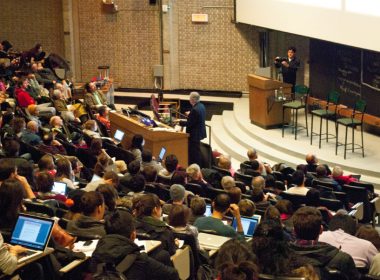
Robin Reid-Fraser led the discussion. (Michael Paolucci / McGill Tribune)
a, News

Students voice education grievances at SSMU summit

Last week, the Students’ Society of McGill University (SSMU) held a series of consultation sessions to prepare for the Parti Québécois’s (PQ) summit on higher education planned for February 2013. Led by SSMU Vice-President External Robin Reid-Fraser, the three sessions covered many topics, including student representation at McGill, and out-of-province and international students’ concerns about their place in the student movement.

SSMU will be represented at the provincial summit through the Quebec Student Roundtable (Table de concertation étudiante du Québec, or TaCEQ).

According to Reid-Fraser, these consultations are to air students’ concerns, which SSMU will bring to TaCEQ, who will subsequently take these concerns to the summit.

Although much publicity around the summit centres on the topic of tuition, Reid-Fraser said SSMU’s events also aimed to engage students in other topics.

“With the student strike and everything that was happening last year … there is a lot of focus on the issue of tuition,” Reid-Fraser said. “There are so many other things about universities. There are students who weren’t super engaged with the issue of tuition, but might have other concerns.”

Michael Paolucci / McGill Tribune

Students brought up the topic of student representation, and voiced frustrations with the current format of student representation in McGill’s administration and governance structures.

“[McGill] is supposed to be a public institution,” said Lily Hoffman, U3 arts, as a response to Reid-Fraser’s discussion of students sitting on committees to appoint new provosts and principals. “We’re all supposed to have access in attending, but that equals access to affecting how it’s run.”

Other students expressed frustration over what they saw as student apathy at McGill.

“In my experience at McGill, we appear to have a small portion of students invested in governance and politics—those [who] are serving as elected officials [and] officers of faculty associations and SSMU, and those who continuously show up and speak their minds at General Assemblies,” said SSMU Speaker Nida Nizam. “Other than that, it seems to be difficult to get the larger student body engaged in the process.”

Devin Dziadyk, science representative to SSMU Council, said  he thinks student apathy at McGill come from students putting course grades first.

“There is such a priority on academics above all else,” he said. “[There is] a perception that … the only [thing] that’s going to mean anything in the future is what your marks are,” he said.

A number of students also expressed concern over the status of out-of-province and international students within Quebec.

“When [tuition increases] impact non-Quebec students, do we get that kind of solidarity from the Quebec associations that wanted it from us during the strike?” Reid-Fraser asked.

She also said that she perceives ambivalence towards international and out-of-province students within TaCEQ, noting the weak response she receives from the organization when she suggests that they adopt an official position to reject an out-of-province tuition increase.

Although the PQ repealed last year’s tuition increases for Quebec students, they have not yet announced a decision regarding out-of-province and international students. Some students voiced fears that the recent repeal of the tuition hike, which was proposed by the former Liberal government, may be offset by an increase in out-of-province and international fees. This was the outcome following a previous student movement in 1996 during the PQ government of Lucien Bouchard.

SSMU’s series of consultation sessions, the first of their kind at McGill, ended last Friday. The Post-Graduate Students’ Society will hold a separate series of discussions on education in early December.

a, News

Minister of Higher Education suggests legalizing student strikes

Two weeks ago, Quebec Minister of Higher Education Pierre Duchesne proposed that the government grant student associations the legal right to strike.

Last spring, many student associations across Quebec voted to go on strike to oppose the former Liberal government’s proposed tuition increases. The Liberal government did not recognize these strikes as legal. Instead, it called the actions “boycotts,” which prompted the Quebec Superior Court to interpret student strikes as such.

The courts implemented over 20 injunctions against students who formed picket lines, as well as schools that cancelled classes. These injunctions mandated students to return to class, even if they were members of an association that had voted to go on strike. Not all of the court’s orders were respected, however. For instance, Cégep de L’Outaouais cancelled its classes in May despite court orders.

Duchesne has stated that the government’s insistence on referring to the events of last spring as “boycotts” only aggravated the situation, and disparaged some of the actions of the Charest government.

“The consequence was an important social crisis with long-lasting instability,” Duchesne told La Presse in French.

Duchesne has said that giving student associations the legal right to strike will create more stability in the province in the event of student protests against government actions such as tuition hikes. According to La Presse, Duchesne’s proposal will be discussed at the upcoming Quebec summit on higher education, which is scheduled to take place in February 2013.

Jérémie Bédard-Wien, spokesperson for L’Association pour une solidarité syndicale Étudiante (ASSÉ), said the association is concerned about the consequences of the government legislating student strikes in the same way as labour union strikes.

According to Bédard-Wien, labour unions only have the right to strike when it is time to negotiate a collective agreement. They cannot legally strike for political reasons.

“If the legislation [that Duchesne is proposing] is similar to the legislation of the right to strike for workers, then we would most presumably lose the right to strike in certain situations—for instance, political reasons,” he said. “This would really limit our reach.”

Bédard-Wien said that students would continue to strike for political reasons, regardless of any future laws that could legally limit this ability.

“Student strikes are legal right now,” he said. “They are legal because nothing makes them illegal …. Students enforce strikes because they believe in the power of collective decision-making and general assemblies. They don’t enforce strikes because it is legal or illegal.”

He also expressed concern about the law’s effect on the autonomy of student associations. The proposed law would require a student strike vote to be like that of a labour union, meaning it would have to occur by secret ballot and would need to pass by a majority vote.

“What’s important to notice is that such legislation would really infringe on the ability for student associations to govern themselves,” he said. “Students have the right … to choose what methods of voting they want to use.”

If student strikes were to be recognized under the law, students would also be legally permitted to prevent other students from entering classrooms. Furthermore, it would become more difficult for Quebec courts to provide individual students with injunctions allowing them to cross picket lines.

However, Bédard-Wien expressed disbelief that legalizing student strikes would stop the courts from handing out injunctions entirely. He referred, once again, to labour unions.

“Using the example of workers rights, many legal strikes [are] repressed eventually by injunctions,” he said. “Legislating the right to strike does not necessarily mean that you can no longer use injunctions …. The history of Quebec has many cases of this.”

According to La Presse, Liberal education critic Gerry Sklavounos has also criticized Duchesne’s proposal because Quebec taxpayers would continue to pay for services that no one would benefit from during a potential strike, such as heating, electricity, and professors’ salaries.

Students’ Society of McGill University Vice-President External Robin Reid-Fraser said that the Quebec Student Roundtable (Table de concertation étudiante du Québec, or TaCEQ), of which SSMU is a member association, has yet to take a position on Duchesne’s proposal.

“We … didn’t take a formal position on it because everyone felt like there needed to be more discussionamong our membership,” she said.

She noted that there could be positives to legislating student strikes.

“On the one hand the idea of creating some kind of formal legislation around it is interesting, particularly since this past strike saw, by far, the heaviest legal intervention of any in Quebec history,” she said. “If there is now a lot of precedent for restricting strike activities, then it may be worthwhile to put in place a framework of what is allowed, or at least some procedural aspects to make things clearer.”

She also said that she has a lot of questions that would need to be addressed before she could fully support Duchesne’s proposal.

Her many questions include what a legal framework would look like exactly and if students would be involved in helping to create the specifics of  the law.


Phone passwords are a simple data security measure. (i41.tinypic.com)
a, Science & Technology

CWTA creates blacklist for stolen mobile devices

By Sept. 2013, would-be thieves may not want to bother with cell phones and wireless devices. The Canadian Wireless Telecommunications Association (CWTA) is working with the Groupe Spéciale Mobile Association (GSMA) to create a global database—employing new strategies to fight cell phone theft. The groups hope these new strategies will eliminate any profit from selling stolen phones.

The GSMA global database is creating a “blacklist” that will deny service to lost and stolen phones. To make this strategy effective, the GSMA has coordinated with cell phone companies to ensure that they will cooperate. As of Sept. 2013, no mobile carrier in Canada will offer service to a blacklisted device.

To identify phones on this blacklist, the GSMA uses a very secure system. Each phone carries a unique serial number, known as an IMEI number, that identifies the device. Accessing this number is simple: dial *#06# on a cell phone. For most devices and networks, the number will automatically display on the screen.

The serial number is also printed on the back of devices, behind the battery, and can be accessed on the phone’s packaging. The number is important for reporting the stolen phone, so the GSMA recommends keeping a copy for reference.

All serial numbers are recorded and stored in the GSMA global database. Carriers currently access the number for statistics on which devices and features are most commonly used by consumers. With the new blacklist, the carriers will also be able to share this number to ensure that all networks know when a phone has been reported lost or stolen. The number is unique and cannot be changed­—even by resetting the phone or changing the SIM card—so it provides an extremely secure method for locating devices.

“The phones get on the blacklist when they are reported by the consumer to their carrier,” Ashlee Smith, communications manager at CWTA, said. “The carrier will then send the [serial] number to the global list and the device will … be blocked from accessing another network.”

To support this new level of security, the CWTA is also pushing for federal legislation.

“CWTA and our members are calling on the federal government to consider legislative measures that could augment industry solutions to contribute to the reduction of cell phone theft in Canada. This may include legislation that targets those who change [serial] numbers on devices,” Smith said.

Although having a phone  stolen is a financial loss, to many the real value of the device is the data within. To address this concern, the CWTA is using Public Service Announcements to spread awareness of mobile device theft to Canadians. In addition to the commercials, CWTA has created the website www.protectyourdata.ca, which provides detailed strategies for using mobile devices safely. The site provides information on the technology behind phones, how they work, and ways to become more ‘phone-smart,’ such as password protection.

Nanowires, like the one at center, could stimulate technological advances in computing. (vectorblog.com)
a, Science & Technology

Nano advances poised to change everyday technology

In the ‘nanoworld’ a human hair is huge: roughly 100,000 nanometres in diameter. Dr. Peter Grütter, a McGill University physics professor, has committed himself to understanding the miniscule realm of nanotechnology.

Dr. Grütter’s group develops microscopes used for research in the emerging field of nanoelectronics—tiny computers that use the nanometre structure of various systems to process, store, or transmit information.

This isn’t your average high school scope—the machine works by detecting intermolecular forces. It then uses the information to create an image, “by controlling the [intermolecular] forces, which are a function of distance, large separations create relatively smaller forces,” Dr. Grütter explains.

His team also applies these tools to a variety of other applications, including analyzing information processing in the brain (by studying synapses—the junctions between neurons), plastic deformations, charge generation in organic photovoltaic systems, and the limiting factors in lithium ion batteries.

It is a unique field involving close collaboration with other facility experts in fields such as “modeling, neurons, biochemical sensors in academia, and industry.”

Dr. Grütter was one of the founding members of NanoQuebec—a non-profit agency funded by the Quebec government that funds nanotechnology research.

The agency provides “fix[ed] funding to 11 laboratories, so that they can hire qualified personnel to run equipment in the labs, and they [also] fund university-based research projects,” Dolores Martinez, Scientific Director of NanoQuebec, said.

At McGill, NanoQuebec provided the first type of funding to two laboratories: the Facility for Electron Microscopy Research, and McGill NanoTools Microfab. They are also currently funding two research projects.

According to Martinez, NanoQuebec’s mission is to “support nanotechnology-enabled innovation.” Recently, for example, NanoQuebec funded the developers of an intelligent fiber that can detect blood, sending a distress signal if the wearer is injured.

Nanotechnology is an important field because of the “combination of interesting science and economic [or] societal impact, ” Martinez said. For example, adding nanoparticles to cement can make it stronger. Nanoparticles can also function as an effective drug delivery system for patients.

“[NanoQuebec does] great science internationally, applies it to important societal problems, and produces innovative products … NanoQuebec brings money to the table and engages people,” Martinez said.

At the nano level, “gravity is not really an issue,” she explains. Matter does not act as it does in our macro world. For example, surface tensions are disproportionately large, making water appear impassable.

“There is a tug-of-war between van der Waals forces and thermal agitation: huge van der Waals forces make nanoparticles extremely sticky and thermal forces make them bounce around erratically,” she said. Van der Waals forces occur at the molecular level, and are typically weak.

Another interesting element of the nanoworld, according to Martinez, is that “quantum effects start to play a role: a material’s optical, electrical, and magnetic properties will be affected compared to its bulk form.”

Transferring these properties to the macro-sized world could yield “new types of catalysts that are much more reactive, composites that are much stronger, extremely fast transistors based on quantum effects, high-efficiency fuel cells.” The ‘nanoworld’ offers an infinite number of potential applications.

Martinez believes Nanotechnology is essential in cultivating new technologies such as next-generation quantum computers, high-efficiency organic solar cells, magnetic nanoparticles for targeted drug delivery through the vascular network, and high-efficiency automotive fuel cells.

“Nanotechnology will transform our society, much the same way as the automobile or computers [did], but predicting the future, when and how this will happen, is not an exact science,” Dr. Grütter said.

a, Science & Technology

Why should I put plastic on my window in the winter?

In Montreal, the sound of ripping plastic is the first sign of spring, as the city tears off window coverings to let in the first warm breezes. Unfortunately, spring is a distant prospect, and the first cold breezes are just beginning their assault.

The basic science behind window coverings is heat transfer, a branch of thermodynamics that deals with the movement of thermal energy. The same laws that govern heat transfer through a window are also at work in your body, your toaster, and anywhere an object or fluid is hotter than its surroundings.

In general, two processes  cause heat to leak from your window. First, cold air near the window is composed of molecules that are moving more slowly than the warm air in the room; the warm molecules then collide with the cold, and transfer energy like a cue ball hitting a pool ball. This is called conduction. Like the cue ball, the warm molecules in the room are outnumbered by the cold ones outside. The second process, convection, occurs as the air cycles through the room. Since the cold air is denser than the warm air, it sinks—creating a current in the room that brings more warm air in contact with the cold window—speeding up the heat transfer and creating a layer of cold air on the floor.

Covering the window with plastic creates an isolated layer of air that slows heat transfer, which could also be achieved with a second pane of glass, a thermal curtain, or even a net full of stuffed animals. The choice of plastic is essentially an economic one. The quality of an insulator is measured by its thermal resistance, or R-value, which is related to how easily heat can move through the substance.

The most effective covers leave between 9.53 and 19.05 millimetres of air between glass and plastic, the thickest insulating layer with minimal convection currents. If the plastic isn’t completely sealed, convection currents can still move between the window and the room. While both a single-pane window and the air space have an R-value of approximately one (polyeurathane foam, a better insulator, has an R-value of 6.25), the combined effect of the plastic and window is still more effective than the window alone.

Heat transfer increases proportionally with the difference in temperature between indoors and outdoors, so as the weather grows colder, heat escapes more quickly. For those who cannot stand the idea of heat slowly leaking away, one fail-proof thermodynamic solution remains: keep your apartment the same temperature as the outdoors.

a, Opinion

Editorial Dissent—Ideals require solidarity, not indifference

The Tribune’s editorial board was split this week over the concept of legal student strikes. This dissenting editorial argues for students’ right to strike in light of the struggle for accessible higher education in Quebec. We do not agree with the position expressed in this week’s main editorial that the individual right to attend class supersedes the right of accessibile education, or that so-called “boycotts” are an effective and meaningful way to pursue collective action.

Gaps and questions certainly exist that require us to avoid the conflation of tuition-paying students with labouring workers. That being said, strikes are, in both cases, a valuable tactic of collective action in struggling for rights. They have often ensured that a majority is not only heard, but is taken seriously by those who hold institutional power. If not enforced, a strike is ineffective, and encourages those in power to provoke division amongst strikers and to ignore their demands. Student unions, given the right to strike, would likely need to be restructured or redefined in order to function fairly in a context that does not involve workers. Yet, the need to struggle collectively remains central in light of the continuing fight for accessible education in our society.

Free education in Quebec is recognized as a universal right and has been realized in sectors of education up to and including public cégeps. University education is also public, insofar as it is overseen and subsidized by the province. Some 49 per cent of McGill’s revenue comes from the provincial government, and 28 per cent comes from student tuition—a proportion that has increased yearly, nearly tripling since the early ’80s. The average student debt after graduation in Quebec today is $13,000.

[pullquote]“Education is not an individual pursuit based on our ability to buy degrees; accessible education is a way to grow as a society, and fighting for this right is a struggle for equality.”[/pullquote]

If education is truly a public service and a universal right, why is it that students here have been burdened financially for this right, above and beyond taxation? The notion expressed in the main editorial that, rather than voting on striking collectively, students should “boycott” classes—as though they were commodities—speaks to the growing reality in our society that education is not a right, but a product that can be bought and sold. The idea is this: those who pay should get their money’s worth. However, education is not an individual pursuit based on our ability to buy degrees; accessible education is a way to grow as a society, and fighting for this right is a struggle for equality. Such a struggle requires the ability to stand in solidarity and the willingness to take personal risks in order to maintain and further this accessibility that has advanced us in our lives.

This is a debate not only about the student right to strike, but about whether education is a privilege for those who can pay individually or whether it is a public right that should be guarded for all and advanced to society’s most vulnerable. The legal inability to stand in solidarity as students risks harming our peers and future generations because we cannot unite effectively in defense of Quebec’s ideals, even after a majority vote.

In the struggle for accessible education, powerful action is required. “Boycotts” are not only ineffective but self-defeating, because such a notion promotes individual indifference and reifies the notion of education as a commodity, rather than a right we must struggle to maintain. In demanding our rights, we must each face risks, but the benefit is immense for society and for the values we wish to see passed on to future generations.

Andra Cernavskis, Victor Temprano, and Samuel Reynolds participated in this dissent and agree with the views presented. Adrien Hu, Chris Liu, Carolina Millán Ronchetti, Elisa Muyl, and Adam Sadinsky did not align with either side.

a, Opinion

Individual access must be upheld in the right to education

Earlier this month, Parti Québécois (PQ) Education Minister Pierre Duchesne announced a plan to grant student associations the legal right to strike. While it was quickly rebuffed by some in the Quebec political scene, particularly those who saw the move as yet another attempt at political posturing on the part of the PQ, Duchesne’s proposal raises an important question. Though boycotts of classes at cégeps and universities this past academic year were commonly referred to as “student strikes,” they were not legally protected in the same way that labour strikes are. Rather, in the eyes of the government, the movement was composed of individual students’ choice to boycott class. As evidenced by the many injunctions brought against student associations over the spring, students were not permitted to prevent their peers from attending class.

In stark contrast, Duchesne’s new proposal would grant striking student associations permission to set up picket lines and the right to legally—and peacefully—block access to class.

We find Duchesne’s proposal troubling, in large part because we believe strongly in the individual right of students to attend class, even in the face of a majority strike vote. Education is a public service, and a majority of students voting to strike does not legitimize preventing access to this service. We value boycotting class as a powerful discoursive tool, but it is effective as civil disobedience, not as a legally enrishined right.

[pullquote]“We have a fundamental problem with allowing a majority of students to prevent access to education, even if this is with the view of ultimately improving accessible education.”[/pullquote]

We take particular issue with allowing student strikes to operate under a legal framework, because that would further legitimize student associations as final decision-making bodies for all of their constituents. Unlike labour unions, which people enter for protection and collectivization, student associations are more informal and represent a greater diversity of viewpoints. There is also the issue of consent—membership in most student associations is automatic and a necessary condition of attending university.

Legal student strikes hold more clout than boycotts. Of course, this is chief advantage cited by proponents, but the economics of a sanctioned student strike are hugely problematic. The all-or-nothing nature of a legal strike would likely lead to the closing of a university if half of the students voted in favour of such action. This means professors, administrators, and employees would all still be paid—at the public’s expense—for work no one would benefit from.  Much of this financial burden rests with taxpayers. Students certainly have the right to come together as a faculty or student association and collectively choose to boycott class; but they do not the right to put the burden of that decision on a third party, even if the tactic ultimately puts pressure on the government.

More importantly, legal strike action puts a larger part of that burden on dissenting students. During the boycott last year, all students continued to pay tuition. If it were legally sanctioned, students who chose not to strike would be paying for a service from which they would not benefit.

We have a fundamental problem with allowing a majority of students to prevent access to education, even if this is with the view of ultimately improving accessible education. There are other ways to achieve such a goal that do not involve harming our peers, including protests and political action. Enshrining this right in law would give it legitimacy; we don’t believe it deserves that legal recognition.

The Tribune editorial board also ran a dissenting editorial piece on this issue this week.

a, Opinion

State of the Liberal leadership race

Now that the American election is finally over, we can once again set our sights closer to home, where an interesting leadership battle is brewing in the Liberal caucus between Martha Hall-Findlay, Justin Trudeau, and more recently, Marc Garneau—who is expected to declare his candidacy very soon.

As things stand now, the Conservatives and New Democrats are playing it politically safe, each trusting that a cautious approach will lead them to victory in the next election. In contrast, the reduction to third party status has forced the Liberals to break this tedious pattern. They have attempted to distinguish themselves from the other parties by putting forward some innovative ideas with yet-to-be-determined results. The Liberals hope that these pioneering ideas will draw immediate attention to their upcoming leadership convention—attention which will later be parlayed into further electoral gains.

Sketch by Ben Ko
Sketch by Ben Ko

Justin Trudeau made a big splash this week by declaring himself unabashedly in favour of a Chinese petroleum company’s attempt to buy Nexen, a Calgary-based oil company. Meanwhile, the Conservatives have been hemming and hawing about the proposed deal, stating that they need to consider Canada’s economic interest, in defiance of the party’s supposed pro free market principles. Unsurprisingly, the New Democratic Party (NDP) has come out against the bill, arguing that it is selling Canada’s sovereignty, apparently unaware that this practice is common in all developed economies. Trudeau has also given tentative support to marijuana’s potential decriminalization in the future, a position that will likely prove popular amongst wide swathes of the population.

Martha Hall-Findlay has also swung to the right on some economic positions, declaring that the policy of supply management in the dairy and poultry sectors is an antiquated relic from Canada’s past. Marc Garneau has similarly been critical of the Tories’ economic stewardship, and he will likely run his campaign promising increased fiscal leadership.

All of the above seem to be incredibly tactical moves on the Liberals’ part. The Liberal Party of the ’90s is best remembered for its sensible economic policies that reversed Canada’s economic decline. While Canada has handled the recession better than most other Western countries, the Conservatives’ promise to balance the budget continues to be pushed back, and growth has been less than stellar these past few quarters. The Liberals seem to be positioning themselves as responsible fiscal conservatives with more liberal social policies—a ploy that they calculate is a winning formula.

However, there is still a lot more fine-tuning that the Liberals need to do if they expect to regain their position as Canada’s default ruling power. The Liberals must take the attitude that winning the next election would be an unexpected bonus, and that it is more important to broadly position the party for the future. The fiscally conservative message will go some ways in rehabilitating the Party’s Western support, although recent derogatory comments about the West continue to plague their efforts. The Grits must also find a way to win back traditional Liberal seats in Quebec. Having a native son such as Trudeau or Garneau at the helm would certainly help there.

What all Canadians can hope for is that a rejuvenated Liberal party will not only be a boon for Liberal supporters, but that their cohesive message will force the Conservatives and New Democrats to step up their game as well. The cautious approach taken by both the Conservatives and the NDP robs Canada of potentially impactful legislative accomplishments, and is not to the country’s benefit. So far, the Liberal leadership campaign has broken historical taboos around foreign takeovers, and criticized outdated economic practices that have not been challenged in a long time. A more open-ended and innovative political culture is desperately needed in these times, and the Liberal campaign is a great step on the path of redeeming our stodgy and monotonous election cycles.

Read the latest issue

Read the latest issue