Latest News

The jovial Julian Barnes. (Hendrick Speck / Flickr)
a, Arts & Entertainment

Books on books: award-winning authors share their insights

In his youth, Julian Barnes’ bibliophilia took on near-pathological proportions. Much like the shoe-obsessed, 2011’s Man Booker prize winner would spend the vast share of his disposable income on books, driving from town to town in search of secondhand treasures.

“I bought with a hunger which I recognize, looking back, was a kind of neediness: well, bibliomania is a known condition,” writes Barnes in the introduction to his upcoming volume, Through the Window: Seventeen Essays and A Short Story. In retrospect, this was a fortunate pursuit.

Reading Barnes is akin to engrossing oneself in a finely wrought tapestry of historical fact, wry wit, and astute criticism. The collection of pieces, which were first published between 1996-2011, deals largely—if, at times, tangentially—with the literary. From casting doubt on George Orwell’s literary honesty as an essayist (if you, like myself, struggle when coming up with pithy titles, I urge you to note the wickedly humorous name of this chapter), to praising Hemingway’s portrayal of the failed and the frail, Barnes offers the reader a heady mix of culture and history.

Barnes’ prolific reading habits form the backbone of the collection’s pieces. When discussing France’s love of Kipling, he draws not only on an obscure roman-à-clef called Dingley, l’illustre ecrivain—impressive, if only because no English translation exists—but recounts the contents of André Gide’s diaries on the topic of its authors, in addition to delivering several lively anecdotes. And, while he takes several potshots at Britain’s historic rivals—in describing the Fashoda Incident: “In July 1898, eight French and 120 Senegalese soldiers arrived at a ruined fort… having spent two years crossing the continent to get there.Frenchly, they set off equipped with 1,300 litres of claret, 50 bottles of Pernod, and a mechanical piano”—Barnes expresses a deep love for his neighbours. Almost half of his essays address the importance of French culture.

Yann Martel, who released 101 Letters to a Prime Minister earlier this month, cuts an odd figure next to Barnes. Unlike the London-dwelling Oxonian, Martel studied at Peterborough’s Trent University and traded metropolitan life for the bucolic calm of Saskatoon. Yet Martel also received the Man Booker for The Life of Pi, and remains its highest-selling author by an impressive margin.

In 2007, Martel began sending noteworthy books to Prime Minister Steven Harper every two weeks, in hopes of expanding his world view (and, of course, garnering a healthy dose of publicity). 101 Letters comprises of the correspondence (almost wholly one-sided) accompanying these literary suggestions.

Martel’s focus is less Western than that of Barnes: from Austen to Borges, through to Xun to Yevtushenko, he delivers an alphabet of world literature in short, chatty snippets.  While Barnes borders on the esoteric, Martel flirts with the colloquial: it is as if he is explaining the importance of each book to a good—albeit semi-literate—friend.

Although a plainspoken account is helpful to burgeoning readers, Martel’s salt-of-the-earth tone verges on the fatuous. Judging from his recommendations, Martel has an exemplary literary pedigree. In spite of his breezy epistles, he has a thorough understanding of the world’s workings, and feigning simplicity does not become him. Cringeworthy lines, such as “Since we have more time, why don’t we go back in time” fill the letters like the lyrics of an ‘80s synth-ballad (an aversion to which may explain Harper’s lacklustre response). Equally frustrating are the letters which fail to address their accompanying books. In the dispatch coupled with García Márquez’ Chronicle of a Death Foretold, for example, Martel makes little mention of the book at all. Instead, he chooses to rehash Orwell’s famous Politics and the English Language, while omitting all mention of the essay itself.

Both Barnes and Martel have an undeniable love for the written word. If you’re seeking beautiful prose and depth of insight, opt for Barnes. Otherwise, for a lavatory experience garnished with a Man Booker winner, opt for 101 Letters.

A selection of publicly generated images portray Montreal’s dynamic nature in CCA’s latest project. (journalmetro.com)
a, Arts & Entertainment

From protests to poutine, ABC:MTL introduces the city

There are the usual famous attractions—the view from Mount Royal, a stroll through Old Port, the obligatory late night poutine. Yet Montreal is a city of multiplicities that extend beyond its tourist tropes. The Canadian Centre for Architecture’s (CCA) newest project, ABC: MTL, offers an invitation to the deeper realities of Montreal.

While previous exhibitions at the CCA have focused on the city as an historical artifact, ABC:MTL speaks of Montreal as it is today—an evolving urban hub composed of various styles, structures, and social landscapes.

To meaningfully capture the nature of the metropolis, the CCA launched an open call for submissions in June 2012. Public submissions served as an integral feature in creating a comprehensive narrative that matched the CCA’s pluralistic vision.

Curator Fabrizio Gallanti notes that “for us, this is a form of democracy: the identity of one site is not the privilege of a few, but rather a perpetually unstable condition that is the result of a real polyphony of voices.” This perspective results in an exhibit from the everyman’s point of view, outside of the traditional top-down approach associated with urban space.

Out of 250 proposals, 90 contributions will be presented over the course of the project, which runs until March 2013. This longevity allows for ongoing submissions to accurately represent a city in flux. However, not all the submissions are new. Some works have been previously included in other galleries. Gallanti explains that ABC:MTL is “not obsessed with originality,” but rather concerned with how well the works describe the city today.

Videos, photos, architectural mock-ups, lectures, and performances constitute the first installment of the project, on view until the end of January. Together, they result in a mixture of media depicting the city’s most indelible impressions. The works touch upon both the abstract and physical elements of Montreal —the ephemeral hums and buzzes of daily life, the fleeting moments the metropolis holds, and the people, buildings, and places that define the present-day city.

The pieces range from immigrant interviews to cell-phone photography. Overall, the works remind us that Montreal is more than a city defined by numbers; it is its own unique entity with its own metabolism, heart, and life.

With the breadth of formats, the term ‘exhibition’ may be a misnomer.  Instead, ABC:MTL is a fully engaging experience. It is not a fixed exhibition, but an ongoing project with changing content. Public participation, lectures, and performances are equally valuable and relevant to the main gallery showing. An online component features all 250 works submitted, including a map that pinpoints the locations of the projects to promote city exploration. The complete project, therefore, encourages interaction and participation on all levels.

Discussion is also an important ingredient. Amidst the student protests of last year, the question of Montreal’s identity was thrown into the spotlight. ABC: MTL comes at a pertinent time of questioning who and what makes up its population.

“There was a high level of engagement, no matter what side people were on,” Gallanti notes.

ABC:MTL profits from this recent engagement, asking its audience to partake in self-reflection, conversation, and discussion. It’s a worthwhile visit; if not for its interesting aesthetic, historical and social qualities, then at least for inspiration. After all, they’re still accepting submissions.

ABC:MTL is showing at the CCA (1920 rue Baille). Public programs are mainly held on Thursday nights and weekends, with guided tours every Thursday at 5:30 p.m. (English) and 6:00 p.m. (French). Free admission for students.

a, Arts & Entertainment, Music

The Twilight Saga: Breaking Dawn—Part 2 Official Soundtrack

The press release promised “an intriguing and irresistible line-up of artists” including Passion Pit, Ellie Goulding, and Feist. But the soundtrack to Twilight—Breaking Dawn Part 2 could leave even the ‘Twihards’ disappointed.

The mood of the album is—for the most part—mellow: the majority of tracks are the sort of slow-building, emotion-charged ballads one may well expect from the soundtrack to a tween-age epic of drama and romance. While some tracks rely too heavily on this emotional element and fall formulaically flat (Green Day’s contribution certainly fits this bill), others communicate the beauteous and haunting—Iko’s “Heart of Stone” being the standout.

Unfortunately, the record lacks any of the consistency necessary to establish an overall tone. More upbeat tracks, such as St. Vincent’s richly-layered “The Antidote,” come across not as natural crescendos in the album’s progression, but as disruptions which make the surrounding songs seem frustratingly slow. Thus, the very tracks which keep monotony at bay detract from the whole.

While tracks may, and do, have individual merit, the whole is less than the sum of its parts. An emotional connection to the scenes that bore these tracks may make this album an evocative work through which fans may relive favourite moments from the film. But in itself, it does little to establish mood or assert itself as a cohesive piece. The result, while listenable, stagnates and ultimately disappoints. Twilight teases in all the right places, but in the end, leaves the tantalising promise of its list of contributors unresolved.

a, Arts & Entertainment, Music

Iamsu!: Suzy 6 Speed

On his new release, Suzy 6 Speed, Bay area rapper and producer Iamsu! trades the bass-heavy beats and dreamy stoner synths of the critically acclaimed spring release Kilt for high BPMs and an endless supply of carefully programmed snare claps. Su’s smooth, sing-song flow contrasts with the mixtape’s high-energy production, resulting in a fantastical animation typically absent in this style of rapping.

Unfortunately, more often than not, this briskness hides Su’s lyrical ingenuity and results in a tiring repetitiveness. Layers of samples and an unrelenting high-hat rattle drone out Su’s unique style and hinder his ability to form effective verses.

Despite this, Iamsu! shines on tracks like “Welcome Back” and “Mobbin,” where his ganja-influenced drawl juxtaposes beautifully with hard-hitting snare claps to create easily digestible rap bangers. Even so, Iamsu! sees the most success when the tempo turns down, emphasizing his impressive lyricism. On the tape’s best track, “Losin,” Su takes a simpler approach, rapping over a soft-spoken sample, reflecting on his rise to regional fame with an underground edge.

Although it’s fun to flop around to in the moment, Su’s new release fails to create the same meaningful experience as did Kilt. All in all, Suzy 6 Speed presents itself as a high paced, in-your-face party rager that has its moments of greatness—but for the most part, is left forgotten in the haze of the morning after.

a, Arts & Entertainment, Music

Chilly Gonzales: Solo Piano II

Canadian pianist and rapper Chilly Gonzales’ career has gone from strength to strength in the last few years. Since the release of his instrumental album, Solo Piano, Gonzales has collaborated with Feist and Peaches, performed with Drake, and released the electro-rap albums Ivory Tower and The Unspeakable Chilly Gonzales.

His latest record comes in similar form to Solo Piano—and is inventively named Solo Piano II. Despite the lack of nominal originality, there’s nothing stale about the music Gonzales creates. His playful instrumental style, famously featured on the Apple iPad adverts, is immediately apparent. The album opens with “White Keys,” a short and bright song which includes no sharp notes. This segues into the beautiful “Kenaston,” one of the many tracks which, despite being undeniably original, feel comfortably familiar. Highlights include “Nero’s Nocturne,” which rolls along in a steady rhythm, and the memorable “Othello.”

Gonzales recorded the album over 10 days in Paris’ Studio Pigalle, and the French influence is notable (Gonzales himself speaks the language fluently and has lived in Paris). At a recent performance in his hometown of Montreal, Gonzales explained the fancy naming of some of the songs.

“It might be pretentious to have songs named ‘Rideaux Lunaires’ on the album,” said the artist. “But let’s face it, ‘Moon Curtains’ just wouldn’t have worked.”

The music is less egotistical than its composer—the transitions on “Train of Thought” are clever, and the “Minor Fantasy” is particularly dark. Solo Piano II does not push any musical boundaries, but this need not be a criticism. Gonzales’ verve and charismatic style will undoubtedly keep attracting large crowds.

Malajube emerges from their geodome. (Joseph Yarmush / malajube.com)
a, Arts & Entertainment

Out of the cavern

Indie pop-rock band, Malajube—named after a mash-up of the words ‘maladie’ and ‘jujube’—has become somewhat of an icon in both their native Quebec and the rest of Canada for their musicality and ingenious approach to achieving fame.

An undeniably catchy blend of riffs, synths, and vocals makes the perfect recipe for a crowd-pleaser, attracting Malajube a following  both close to home, in the U.S., and as far away as Japan and Norway. They’ve become a fixture at music festivals, with previous appearances at Oshega, SXSW (and its Canadian counterpart NXNE), and countless other shows. Being able to unite those without a common language through a love of music is a skill that Malajube seems to perform effortlessly, with an entirely French repertoire.

Despite their success, the members themselves come from humble beginnings and played in various other bands before Malajube. According to Francis Mineau, drummer for the band, the group formed in 2004 “like any other band” and hasn’t looked back since.

Winning a Juno Award and garnering three Polaris Prize nominations, Malajube has released five full-length albums, with their latest being La Caverne (2011). For the recording of the album, the members went into hibernation in a cavern of their own—their personal, custom-made geodesic dome in northern Quebec—living in seclusion for months on end.

“It was the perfect place to not get bothered by anything because there wasn’t anyone else there,” says Mineau. Although the band no longer owns this hideout, Mineau hopes that they’ll consider experimenting with other ideas, highlighting that the experience may have been a singular one. “We tried it once and it was good but I think we should try something else.”

Since La Caverne, Malajube has been touring extensively and working on side projects, all the while staying true to their roots. The band has been praised for refusing to conform to the English norm for the sake of their non-Francophone fans. Instead of being intimidating, however, the language barrier actually strikes a chord with fans. Their lyrics encourage any English-speaking crowd to learn French, and fans can blissfully enjoy catchy tunes without needing to understand what’s going on.

Their last two concerts of the year, beginning this week, are Malajube’s last hurrah before the band take a short breather to work on side projects and come up with new ideas and music.

“[The break] shouldn’t be seen as a way to say that we’re tired of doing this,” says Mineau, indicating that they’ve still got their sights set on working towards the next Malajube album, sometime in fall 2013. “The plan is to make more music and to concentrate on a purpose—how we can offer something new.”

Malajube plays Corona Theatre on Wednesday, Nov. 28. Tickets are $28.15.

A dream catcher. (Sam Reynolds / McGill Tribune)
a, Science & Technology

Nightmares may be evolutionary survival tool

Nightmares have always been a dreaded human experience. In certain cultures, they were thought to be premonitions of the future. It was this ominous notion that prompted indigenous cultures to construct dream catchers. When a bad dream entered the dreamer’s sleep, the webbing of the dream catcher supposedly trapped this nightmare. The first light of morning then caused these bad dreams to melt away.

Despite our inherent fear of nightmares, current research has demonstrated that they may be a necessary and functional aspect of dreaming.

The Dream and Nightmare Laboratory, which is associated with the University of Montreal, and Sacred Heart Hospital, conducts research in the areas of the scientific study of dreaming and sleep disorders. While this laboratory does not interpret dreams or give sleep consultations, it aims to provide insight into the important psychological role that dreams and nightmares play.

The brain appears to apply the same neurological machinery during the night and day to examine past events. Dreams allow the brain to process conscious experiences and regulate emotions.

Over the course of the night, sleepers experience a variety of neurological and physical states, with the rapid eye movement (REM) sleep period being one of the most prominent. Dreams occur most frequently during REM period.

According to the researchers at the Dream and Nightmare Laboratory, this period of sleep is characterized by an emotional ‘surge’ that unfolds over time. Specifically, they believe that the content of one’s dream is used as a mechanism to regulate or contain this surge.

Essentially, dreaming reduces the intensity of the emotional surge, allowing these feelings to be processed through a series of dreams that unfold over successive REM periods of the night. In this manner, dreaming acts as a method of emotional problem solving.

Nightmares, like dreams, are connected to the REM sleep period. They occur when dreaming cannot contain the emotional surge, causing the dreamer to undergo disturbing and highly realistic mental experiences. Many can relate to the feelings of anxiety, fear, or terror brought on by nightmares.

Despite the inner turmoil they cause, researchers at the Dream and Nightmare Laboratory think that these bad dreams have a function. In cases of bereavement, for example, vivid images of the deceased may persist for years as hallucinations, illusions, and intense dreams. Dreams of the dead should not necessarily be feared. Nightmares like these may help individuals accept the reality of his or her loss and facilitate a sense of closure.

Nightmares are also an excellent indicator of one’s emotional state. “Whether or not a bereaved person finds dreams comforting likely is a reliable indicator of if the mourning is taking a favourable course,” according to a paper written by UdeM researchers Tore Nielson and Jessica Lara-Carrasco.

Craig Webb, a McGill graduate who has helped with dream and lucid dream research at both Stanford and UdeM, is the executive director of the nonprofit Dream Research and Experimental Approaches to Mechanisms of Sleep (DREAMS) Foundation. He has a similar view to offer.

“Whether bad dreams are full-fledged nightmares, anxiety dreams, or just a bit unsettling, they serve as ‘pressure-release therapy,’” Webb said in an interview with the site WebMD. He explained that, “nightmares are a very bitter but much-needed medicine.”

The DREAMS foundation postulates that nightmares serve an important purpose by sending the dreamer a valuable emotional message. In addition to an emotional check-up, nightmares may have also played an important role in evolution. In the past, dreams often warned people about dangerous situations. If a tiger killed in a nearby village, a nightmare would keep one anxious about that happening to one’s own village.

Research conducted by Erin Wamsley, a sleep scientist at Beth Israel Medical Center and Harvard Medical School, also supports the teaching function of dreams. Mainly, she focuses on the relationship between memory and the different stages of sleep. Both dreams in non-REM sleep and the vivid dreams of REM sleep are important in terms of teaching the dreamer based on experiences from the day.

This evolutionary role of dreams may explain why nightmares are still present in today’s society. It seems they are evidence of the role of dreams in an ancient fight or flight mechanism. With all these functions in mind, perhaps nightmares are not so undesirable after all.

Dr. Walter Willett thinks we drink too much milk. (Simon Poitrimolt/ McGill Tribune)
a, Science & Technology

Trottier Symposium serves up science to curious public

Last week, the McGill Office of Science and Society hosted the Lorne Trottier Public Science Symposium, a lecture series that brings science to the public.

Food: A Serving of Science featured four lectures on the science of diet and nutrition. The panelists explored topics ranging from fad diets to the enduring culinary misinformation spread by a 19th century chemist.

Dr. Walter Willett—Diet and Health: A Progress Report

The first speaker, Dr. Walter Willett, is a physician and nutrition researcher from Harvard University. Willett’s talk focused on the failings of North American dietary recommendations. He singled out the low-fat movement and milk consumption as two pieces of health advice that have been disproved by research.

In observational studies, the much-touted low fat diet has actually been linked to weight gain. The problem, according to Willett, is that North Americans simply traded refined sugars and processed carbohydrates for fats, to the detriment of their waistlines. Instead, dietary guidelines should focus on the type of fats and carbohydrates consumed.

He also showed the traditional—and current—Canadian recommendation of drinking two to three glasses of milk per day is not beneficial and may be harmful in some cases. While the guideline is touted as a bone health measure, studies  show that drinking milk does not reduce the risk of osteoporotic bone fractures.

Jeffery Blumberg—Evidence-Based Nutrition: The Problem of Proof

If you’re not sure whether or not to take vitamins, you’re not the only one. Jeffrey Blumberg, a professor of nutrition from Tufts University, presented his explanation for the constant contradictions between one vitamin study and the next.

While randomized clinical trials are regarded as the ultimate test, Blumberg argues that researchers shouldn’t be so quick to disregard observational studies, their less controlled counterparts. Randomized clinical trials are a tightly controlled test of a random group, generally used in the pharmaceutical industry. Half the participants are given the drug, and the other half, a placebo. In studies of nutritional supplements, Blumberg asserts, it is impossible (not to mention unethical) to deprive one group of vital nutrients, therefore the test can only compare two groups who are taking different doses of the supplement.

Blumberg believes researchers must develop better experimental methods to test nutritional variables. In the meantime, observational studies provide helpful guidelines that shouldn’t be ignored.

Jane Brody—Eat for Life: Separating Wheat from Chaff

“sGood nutrition is not rocket science,” according to Jane Brody, a New York Times columnist and author who has been dispensing nutrition advice for the last 30 years. While Brody is not a university-trained nutritionist, her background in biochemistry and relentless pursuit of the truth behind various diet fads and studies has earned her an international readership.

In her talk, Brody explained how to spot a bad fad diet, arguing that healthy eating habits have changed very little over the course of human history. She advised the audience to follow the advice of Michael Pollan, author of the Omnivore’s Dilemna who coined the mantra, “Eat food. Not too much. Mostly plants.”

Many of the questions following the lecture were directed to Brody, asking for everyday nutritional advice, although one brave audience member jokingly defended bacon—asking, “What’s moderation for bacon? Once a week? Once a day? Once a meal?”

Harold McGee—Playing With Food: Four Centuries of Science in the Kitchen

Harold McGee quit science for literature early in his academic career, only to find himself publishing a paper in Nature. His paper, on the science behind the French tradition of whipping egg whites in a copper bowl, was inspired by a Julia Child recipe.

A playful curiosity, and a preoccupation with the science of the kitchen, propelled McGee’s career as an author and amateur experimenter. In one case, puzzled by grease spatters that only appeared on the inside of his eye glasses, McGee set up eye glass ‘sensors’ throughout the kitchen to collect data on the strange phenomenon. It turned out that grease particles, thrown high into the air, were drifting down into his glasses from above as he bent over the pan.

McGee’s lecture gave an overview of science in the kitchen from its early beginnings to the current advances in restaurant cooking that include precision temperature cooking and extracting aromas using a device called a rotary evaporator.

One anecdote involved a 19th century chemist named Justus Lieberg, who initiated the popular notion that searing meat seals in its juices, a theory that seems logical considering practices like cauterization. Despite the fact that this theory can be easily disproved by watching juices run out of a seared steak, it is a persistent culinary myth that still appears in cooking text books: evidence that sometimes bad science is worse than no science.

a, Science & Technology

McGill hockey lab has high impact on gear

Your professor could be testing the hockey gear that you bought this season. Researchers in the McGill Ice Hockey Research Group perform tests for some of the biggest companies on the market, and are involved in numerous projects involving the safety and efficiency of ice hockey equipment.

One of the lab’s major projects is equipment testing. PhD candidate Ryan Ouckama and Dr. David J. Pearsall, of the McGill department of kinesiology and physical education, perform impact tests to compare ice hockey helmets by subjecting them to various types of forces. Companies send new helmet designs to the McGill Group for testing to determine if the equipment is safe for game use.

One way Dr. Pearsall tests a helmet is with the drop test.

“You have a controlled vertical drop and … in the head form … [you have] an accelerometer. The impact event must stay below a criterion threshold acceleration on impact that is considered unsafe in terms of what the head can sustain without traumatic skull injury,” he said. “More specifically, well below the 50 per cent risk level.”

The drop tests are performed under a variety of conditions, such as different temperatures and repeated impacts. Lower temperatures generally reduce a helmet’s impact cushioning effectiveness, but some helmets actually perform slightly better in the cold. These tests ensure that designers can meet players’ needs by scrutinizing the equipment under realistic conditions.

Dr. Pearsall’s lab also investigates the effectiveness of different foam densities inside of hockey helmets, comparing a range of materials including vinyl nitrile and polypropylene. The foam is designed to be crushed or deform upon impact. “The basic function of the foam is … to absorb as much energy instead of  your head,” Dr. Pearsall said.

Ouckama uses drop tests to measure the impact of a one metre drop with an array of sensors. He translates that data into a map showing force over the whole area of the foam.

Specifically, Ouckama is examining helmet resistance in two categories: focal force, which measures its ability to withstand impact in a specific area, and the maximum acceleration of the entire head. Helmets that are strong in one category aren’t necessarily strong in the other, which shows that there is some variability between helmets’ performance in preventing focal injuries versus their effectiveness against general blows to the head.

By next fall, Dr. Pearsall is hoping to extend the scope of the research with the hockey lab into other areas of investigation, such as the lower body protective equipment—bruising and fracture of lower body are among the most common sports injuries. He will apply the mapping technology to observe the equipment’s effectiveness in protecting soft tissues, like muscle and skin, hopefully finding areas where the gear can be improved.

The ice hockey lab has an immense number of projects, including performance of helmets and body gear, tests for international agencies, and other prospects like concussion research. “We plan to continue studying impact mechanics to better understand the mechanisms that relate to injury as well as identify means to reduce those injury risks.” Dr. Pearsall said.

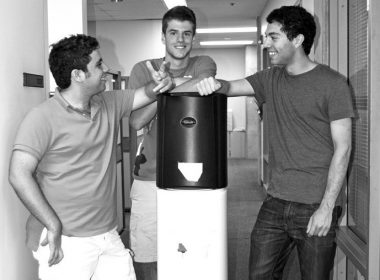
Jared Saks, Ari Soberano, Daniel Viner, and Shelly Sharp. (Photo courtesy of Jared Saks)
a, Student Life

Follow your dreams: McGill students give back

McGill students Jared Saks, U3 General Management; Ari Soberano, U2 Marketing; and Daniel Viner, U2 Finance; spent November 16th leading a day of sports activities at St. Gabriel, a local Montreal elementary school. The Tribune caught up with these students to pick their brains about the event, specifically what went into its execution, and how sports can be a powerful learning tool for youth.

McGill Tribune: So how did this whole idea come about?

Daniel Viner: For one of our classes, Social Context of Business, we were tasked with doing something that would benefit a community in the Montreal area. So we found a school called St. Gabriel’s that we thought would be right for this activity, and we love sports, so we decided we’d create a day of activities and sports, and connect it to a theme of ‘following your dreams.’

MT: Can you give me a basic idea of what you did for this event?

Jared Saks: There were about 60 kids, grades four to six. Kids were split into different teams, by colours, and we had  bracelets [that say ‘follow your dreams’ on them] for each team to identify [with]. We did dodge ball, soccer, [and] a game called ‘flicker ball’. We did British Bulldog, and some relay races.

Ari Soberano: They got a little tired during the day, so we wanted to [have] one rotation that could kind of be more relaxed. My games were more of sitting in circles and whatnot… ‘two truths and a lie,’ the ‘follow the pattern’ game… just to give a break [from the physical activity] throughout the whole day.

JS: At each of our stations we had sort of an underlying theme that we wanted to teach them. At one station, we wanted to teach them about teamwork, how it’s important in sports, and how you can use that in your life to follow your dreams. We talked about passion, we talked about determination.

DV: Also, we created a big banner that we left there, and that all the kids are going to sign, that says ‘follow your dreams.’ They’re going to hang it up in their gym on the wall, and it’ll always be there to remind them of the day. At the end of the whole day of activities, all the kids were given a little piece of paper, and they had to write down one word out of passion, determination, and teamwork. Then [they had to] write what that meant to them and the significance of it.

MT: So what made you choose sports as a vehicle to teach the kids about these values? 

JS: I think I can speak for all of us when I say that sports have been something that’s been very important in all of our lives. I know from my experience—I played hockey my whole life. I see the importance of teamwork, and I see the importance of passion. Whatever you want to do in your life, sports [are], like you said, a very good vehicle to learn these values and really drive you.

MT: So you said this started as a project for a class, and that the point is to create something that lasts. Have you thought about whether or not you’re going to do more work like this?

DV: The gym teacher, Shelly Sharp, already asked us—she said she runs a cooking class once a month at the school—if we’d be able to come in to help out [by] just playing with the kids. So I think it’s not necessarily the idea of continuing on the event, but just continuing a presence or an involvement.

JS: At the same time, I think we were also planning on speaking to our professor. Although we’re not in the class next year, we wanted to see if there [might] be students who could maybe do it again.

MT: How were the kids’ reactions to the activities?

JS: I think the kids liked us a lot. [When I introduced myself, I said,] “My name’s Jared Saks, and I’m 21 years old,” and all the kids went “Whoa, you’re 21! Whoa, you’re so old!”

AS: The kids loved the wristbands, every five minutes, the kids pretended to lose their wristbands so they could get a different colour.

MT: What did you find that you learned from this experience?

DV: Small acts of kindness really can make a difference. [The kids] might not remember us in a month, two months [from now], but just the fact that every time they walk in the gym, they’re going to see [‘follow your dreams’] up there, hopefully, somewhere down the road, they’re going to remember what they took from the experience.

JS: The level of happiness that kids had doing our event is something that I really think I’ll never forget.

AS: The fact that parents came out and supported their kids and supported our event made me learn that people really are involved in this school, and people really are involved in this community. That’s really going to shape these kids and hopefully put them on the right path.

Read the latest issue

Read the latest issue