Latest News

a, Arts & Entertainment, Music

Iamsu!: Suzy 6 Speed

On his new release, Suzy 6 Speed, Bay area rapper and producer Iamsu! trades the bass-heavy beats and dreamy stoner synths of the critically acclaimed spring release Kilt for high BPMs and an endless supply of carefully programmed snare claps. Su’s smooth, sing-song flow contrasts with the mixtape’s high-energy production, resulting in a fantastical animation typically absent in this style of rapping.

Unfortunately, more often than not, this briskness hides Su’s lyrical ingenuity and results in a tiring repetitiveness. Layers of samples and an unrelenting high-hat rattle drone out Su’s unique style and hinder his ability to form effective verses.

Despite this, Iamsu! shines on tracks like “Welcome Back” and “Mobbin,” where his ganja-influenced drawl juxtaposes beautifully with hard-hitting snare claps to create easily digestible rap bangers. Even so, Iamsu! sees the most success when the tempo turns down, emphasizing his impressive lyricism. On the tape’s best track, “Losin,” Su takes a simpler approach, rapping over a soft-spoken sample, reflecting on his rise to regional fame with an underground edge.

Although it’s fun to flop around to in the moment, Su’s new release fails to create the same meaningful experience as did Kilt. All in all, Suzy 6 Speed presents itself as a high paced, in-your-face party rager that has its moments of greatness—but for the most part, is left forgotten in the haze of the morning after.

a, Arts & Entertainment, Music

Chilly Gonzales: Solo Piano II

Canadian pianist and rapper Chilly Gonzales’ career has gone from strength to strength in the last few years. Since the release of his instrumental album, Solo Piano, Gonzales has collaborated with Feist and Peaches, performed with Drake, and released the electro-rap albums Ivory Tower and The Unspeakable Chilly Gonzales.

His latest record comes in similar form to Solo Piano—and is inventively named Solo Piano II. Despite the lack of nominal originality, there’s nothing stale about the music Gonzales creates. His playful instrumental style, famously featured on the Apple iPad adverts, is immediately apparent. The album opens with “White Keys,” a short and bright song which includes no sharp notes. This segues into the beautiful “Kenaston,” one of the many tracks which, despite being undeniably original, feel comfortably familiar. Highlights include “Nero’s Nocturne,” which rolls along in a steady rhythm, and the memorable “Othello.”

Gonzales recorded the album over 10 days in Paris’ Studio Pigalle, and the French influence is notable (Gonzales himself speaks the language fluently and has lived in Paris). At a recent performance in his hometown of Montreal, Gonzales explained the fancy naming of some of the songs.

“It might be pretentious to have songs named ‘Rideaux Lunaires’ on the album,” said the artist. “But let’s face it, ‘Moon Curtains’ just wouldn’t have worked.”

The music is less egotistical than its composer—the transitions on “Train of Thought” are clever, and the “Minor Fantasy” is particularly dark. Solo Piano II does not push any musical boundaries, but this need not be a criticism. Gonzales’ verve and charismatic style will undoubtedly keep attracting large crowds.

Malajube emerges from their geodome. (Joseph Yarmush / malajube.com)
a, Arts & Entertainment

Out of the cavern

Indie pop-rock band, Malajube—named after a mash-up of the words ‘maladie’ and ‘jujube’—has become somewhat of an icon in both their native Quebec and the rest of Canada for their musicality and ingenious approach to achieving fame.

An undeniably catchy blend of riffs, synths, and vocals makes the perfect recipe for a crowd-pleaser, attracting Malajube a following  both close to home, in the U.S., and as far away as Japan and Norway. They’ve become a fixture at music festivals, with previous appearances at Oshega, SXSW (and its Canadian counterpart NXNE), and countless other shows. Being able to unite those without a common language through a love of music is a skill that Malajube seems to perform effortlessly, with an entirely French repertoire.

Despite their success, the members themselves come from humble beginnings and played in various other bands before Malajube. According to Francis Mineau, drummer for the band, the group formed in 2004 “like any other band” and hasn’t looked back since.

Winning a Juno Award and garnering three Polaris Prize nominations, Malajube has released five full-length albums, with their latest being La Caverne (2011). For the recording of the album, the members went into hibernation in a cavern of their own—their personal, custom-made geodesic dome in northern Quebec—living in seclusion for months on end.

“It was the perfect place to not get bothered by anything because there wasn’t anyone else there,” says Mineau. Although the band no longer owns this hideout, Mineau hopes that they’ll consider experimenting with other ideas, highlighting that the experience may have been a singular one. “We tried it once and it was good but I think we should try something else.”

Since La Caverne, Malajube has been touring extensively and working on side projects, all the while staying true to their roots. The band has been praised for refusing to conform to the English norm for the sake of their non-Francophone fans. Instead of being intimidating, however, the language barrier actually strikes a chord with fans. Their lyrics encourage any English-speaking crowd to learn French, and fans can blissfully enjoy catchy tunes without needing to understand what’s going on.

Their last two concerts of the year, beginning this week, are Malajube’s last hurrah before the band take a short breather to work on side projects and come up with new ideas and music.

“[The break] shouldn’t be seen as a way to say that we’re tired of doing this,” says Mineau, indicating that they’ve still got their sights set on working towards the next Malajube album, sometime in fall 2013. “The plan is to make more music and to concentrate on a purpose—how we can offer something new.”

Malajube plays Corona Theatre on Wednesday, Nov. 28. Tickets are $28.15.

A dream catcher. (Sam Reynolds / McGill Tribune)
a, Science & Technology

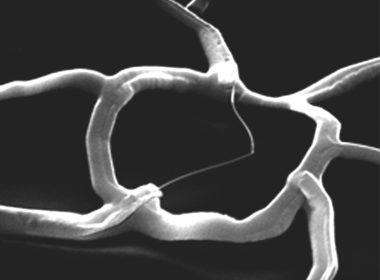
Nightmares may be evolutionary survival tool

Nightmares have always been a dreaded human experience. In certain cultures, they were thought to be premonitions of the future. It was this ominous notion that prompted indigenous cultures to construct dream catchers. When a bad dream entered the dreamer’s sleep, the webbing of the dream catcher supposedly trapped this nightmare. The first light of morning then caused these bad dreams to melt away.

Despite our inherent fear of nightmares, current research has demonstrated that they may be a necessary and functional aspect of dreaming.

The Dream and Nightmare Laboratory, which is associated with the University of Montreal, and Sacred Heart Hospital, conducts research in the areas of the scientific study of dreaming and sleep disorders. While this laboratory does not interpret dreams or give sleep consultations, it aims to provide insight into the important psychological role that dreams and nightmares play.

The brain appears to apply the same neurological machinery during the night and day to examine past events. Dreams allow the brain to process conscious experiences and regulate emotions.

Over the course of the night, sleepers experience a variety of neurological and physical states, with the rapid eye movement (REM) sleep period being one of the most prominent. Dreams occur most frequently during REM period.

According to the researchers at the Dream and Nightmare Laboratory, this period of sleep is characterized by an emotional ‘surge’ that unfolds over time. Specifically, they believe that the content of one’s dream is used as a mechanism to regulate or contain this surge.

Essentially, dreaming reduces the intensity of the emotional surge, allowing these feelings to be processed through a series of dreams that unfold over successive REM periods of the night. In this manner, dreaming acts as a method of emotional problem solving.

Nightmares, like dreams, are connected to the REM sleep period. They occur when dreaming cannot contain the emotional surge, causing the dreamer to undergo disturbing and highly realistic mental experiences. Many can relate to the feelings of anxiety, fear, or terror brought on by nightmares.

Despite the inner turmoil they cause, researchers at the Dream and Nightmare Laboratory think that these bad dreams have a function. In cases of bereavement, for example, vivid images of the deceased may persist for years as hallucinations, illusions, and intense dreams. Dreams of the dead should not necessarily be feared. Nightmares like these may help individuals accept the reality of his or her loss and facilitate a sense of closure.

Nightmares are also an excellent indicator of one’s emotional state. “Whether or not a bereaved person finds dreams comforting likely is a reliable indicator of if the mourning is taking a favourable course,” according to a paper written by UdeM researchers Tore Nielson and Jessica Lara-Carrasco.

Craig Webb, a McGill graduate who has helped with dream and lucid dream research at both Stanford and UdeM, is the executive director of the nonprofit Dream Research and Experimental Approaches to Mechanisms of Sleep (DREAMS) Foundation. He has a similar view to offer.

“Whether bad dreams are full-fledged nightmares, anxiety dreams, or just a bit unsettling, they serve as ‘pressure-release therapy,’” Webb said in an interview with the site WebMD. He explained that, “nightmares are a very bitter but much-needed medicine.”

The DREAMS foundation postulates that nightmares serve an important purpose by sending the dreamer a valuable emotional message. In addition to an emotional check-up, nightmares may have also played an important role in evolution. In the past, dreams often warned people about dangerous situations. If a tiger killed in a nearby village, a nightmare would keep one anxious about that happening to one’s own village.

Research conducted by Erin Wamsley, a sleep scientist at Beth Israel Medical Center and Harvard Medical School, also supports the teaching function of dreams. Mainly, she focuses on the relationship between memory and the different stages of sleep. Both dreams in non-REM sleep and the vivid dreams of REM sleep are important in terms of teaching the dreamer based on experiences from the day.

This evolutionary role of dreams may explain why nightmares are still present in today’s society. It seems they are evidence of the role of dreams in an ancient fight or flight mechanism. With all these functions in mind, perhaps nightmares are not so undesirable after all.

Dr. Walter Willett thinks we drink too much milk. (Simon Poitrimolt/ McGill Tribune)
a, Science & Technology

Trottier Symposium serves up science to curious public

Last week, the McGill Office of Science and Society hosted the Lorne Trottier Public Science Symposium, a lecture series that brings science to the public.

Food: A Serving of Science featured four lectures on the science of diet and nutrition. The panelists explored topics ranging from fad diets to the enduring culinary misinformation spread by a 19th century chemist.

Dr. Walter Willett—Diet and Health: A Progress Report

The first speaker, Dr. Walter Willett, is a physician and nutrition researcher from Harvard University. Willett’s talk focused on the failings of North American dietary recommendations. He singled out the low-fat movement and milk consumption as two pieces of health advice that have been disproved by research.

In observational studies, the much-touted low fat diet has actually been linked to weight gain. The problem, according to Willett, is that North Americans simply traded refined sugars and processed carbohydrates for fats, to the detriment of their waistlines. Instead, dietary guidelines should focus on the type of fats and carbohydrates consumed.

He also showed the traditional—and current—Canadian recommendation of drinking two to three glasses of milk per day is not beneficial and may be harmful in some cases. While the guideline is touted as a bone health measure, studies  show that drinking milk does not reduce the risk of osteoporotic bone fractures.

Jeffery Blumberg—Evidence-Based Nutrition: The Problem of Proof

If you’re not sure whether or not to take vitamins, you’re not the only one. Jeffrey Blumberg, a professor of nutrition from Tufts University, presented his explanation for the constant contradictions between one vitamin study and the next.

While randomized clinical trials are regarded as the ultimate test, Blumberg argues that researchers shouldn’t be so quick to disregard observational studies, their less controlled counterparts. Randomized clinical trials are a tightly controlled test of a random group, generally used in the pharmaceutical industry. Half the participants are given the drug, and the other half, a placebo. In studies of nutritional supplements, Blumberg asserts, it is impossible (not to mention unethical) to deprive one group of vital nutrients, therefore the test can only compare two groups who are taking different doses of the supplement.

Blumberg believes researchers must develop better experimental methods to test nutritional variables. In the meantime, observational studies provide helpful guidelines that shouldn’t be ignored.

Jane Brody—Eat for Life: Separating Wheat from Chaff

“sGood nutrition is not rocket science,” according to Jane Brody, a New York Times columnist and author who has been dispensing nutrition advice for the last 30 years. While Brody is not a university-trained nutritionist, her background in biochemistry and relentless pursuit of the truth behind various diet fads and studies has earned her an international readership.

In her talk, Brody explained how to spot a bad fad diet, arguing that healthy eating habits have changed very little over the course of human history. She advised the audience to follow the advice of Michael Pollan, author of the Omnivore’s Dilemna who coined the mantra, “Eat food. Not too much. Mostly plants.”

Many of the questions following the lecture were directed to Brody, asking for everyday nutritional advice, although one brave audience member jokingly defended bacon—asking, “What’s moderation for bacon? Once a week? Once a day? Once a meal?”

Harold McGee—Playing With Food: Four Centuries of Science in the Kitchen

Harold McGee quit science for literature early in his academic career, only to find himself publishing a paper in Nature. His paper, on the science behind the French tradition of whipping egg whites in a copper bowl, was inspired by a Julia Child recipe.

A playful curiosity, and a preoccupation with the science of the kitchen, propelled McGee’s career as an author and amateur experimenter. In one case, puzzled by grease spatters that only appeared on the inside of his eye glasses, McGee set up eye glass ‘sensors’ throughout the kitchen to collect data on the strange phenomenon. It turned out that grease particles, thrown high into the air, were drifting down into his glasses from above as he bent over the pan.

McGee’s lecture gave an overview of science in the kitchen from its early beginnings to the current advances in restaurant cooking that include precision temperature cooking and extracting aromas using a device called a rotary evaporator.

One anecdote involved a 19th century chemist named Justus Lieberg, who initiated the popular notion that searing meat seals in its juices, a theory that seems logical considering practices like cauterization. Despite the fact that this theory can be easily disproved by watching juices run out of a seared steak, it is a persistent culinary myth that still appears in cooking text books: evidence that sometimes bad science is worse than no science.

a, Science & Technology

McGill hockey lab has high impact on gear

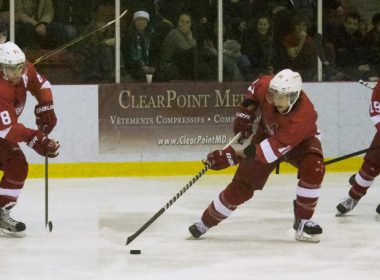
Your professor could be testing the hockey gear that you bought this season. Researchers in the McGill Ice Hockey Research Group perform tests for some of the biggest companies on the market, and are involved in numerous projects involving the safety and efficiency of ice hockey equipment.

One of the lab’s major projects is equipment testing. PhD candidate Ryan Ouckama and Dr. David J. Pearsall, of the McGill department of kinesiology and physical education, perform impact tests to compare ice hockey helmets by subjecting them to various types of forces. Companies send new helmet designs to the McGill Group for testing to determine if the equipment is safe for game use.

One way Dr. Pearsall tests a helmet is with the drop test.

“You have a controlled vertical drop and … in the head form … [you have] an accelerometer. The impact event must stay below a criterion threshold acceleration on impact that is considered unsafe in terms of what the head can sustain without traumatic skull injury,” he said. “More specifically, well below the 50 per cent risk level.”

The drop tests are performed under a variety of conditions, such as different temperatures and repeated impacts. Lower temperatures generally reduce a helmet’s impact cushioning effectiveness, but some helmets actually perform slightly better in the cold. These tests ensure that designers can meet players’ needs by scrutinizing the equipment under realistic conditions.

Dr. Pearsall’s lab also investigates the effectiveness of different foam densities inside of hockey helmets, comparing a range of materials including vinyl nitrile and polypropylene. The foam is designed to be crushed or deform upon impact. “The basic function of the foam is … to absorb as much energy instead of  your head,” Dr. Pearsall said.

Ouckama uses drop tests to measure the impact of a one metre drop with an array of sensors. He translates that data into a map showing force over the whole area of the foam.

Specifically, Ouckama is examining helmet resistance in two categories: focal force, which measures its ability to withstand impact in a specific area, and the maximum acceleration of the entire head. Helmets that are strong in one category aren’t necessarily strong in the other, which shows that there is some variability between helmets’ performance in preventing focal injuries versus their effectiveness against general blows to the head.

By next fall, Dr. Pearsall is hoping to extend the scope of the research with the hockey lab into other areas of investigation, such as the lower body protective equipment—bruising and fracture of lower body are among the most common sports injuries. He will apply the mapping technology to observe the equipment’s effectiveness in protecting soft tissues, like muscle and skin, hopefully finding areas where the gear can be improved.

The ice hockey lab has an immense number of projects, including performance of helmets and body gear, tests for international agencies, and other prospects like concussion research. “We plan to continue studying impact mechanics to better understand the mechanisms that relate to injury as well as identify means to reduce those injury risks.” Dr. Pearsall said.

Jared Saks, Ari Soberano, Daniel Viner, and Shelly Sharp. (Photo courtesy of Jared Saks)
a, Student Life

Follow your dreams: McGill students give back

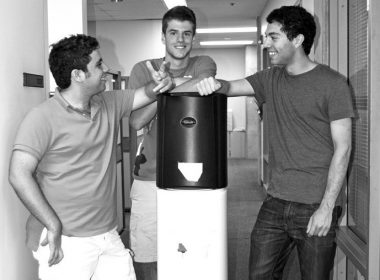
McGill students Jared Saks, U3 General Management; Ari Soberano, U2 Marketing; and Daniel Viner, U2 Finance; spent November 16th leading a day of sports activities at St. Gabriel, a local Montreal elementary school. The Tribune caught up with these students to pick their brains about the event, specifically what went into its execution, and how sports can be a powerful learning tool for youth.

McGill Tribune: So how did this whole idea come about?

Daniel Viner: For one of our classes, Social Context of Business, we were tasked with doing something that would benefit a community in the Montreal area. So we found a school called St. Gabriel’s that we thought would be right for this activity, and we love sports, so we decided we’d create a day of activities and sports, and connect it to a theme of ‘following your dreams.’

MT: Can you give me a basic idea of what you did for this event?

Jared Saks: There were about 60 kids, grades four to six. Kids were split into different teams, by colours, and we had  bracelets [that say ‘follow your dreams’ on them] for each team to identify [with]. We did dodge ball, soccer, [and] a game called ‘flicker ball’. We did British Bulldog, and some relay races.

Ari Soberano: They got a little tired during the day, so we wanted to [have] one rotation that could kind of be more relaxed. My games were more of sitting in circles and whatnot… ‘two truths and a lie,’ the ‘follow the pattern’ game… just to give a break [from the physical activity] throughout the whole day.

JS: At each of our stations we had sort of an underlying theme that we wanted to teach them. At one station, we wanted to teach them about teamwork, how it’s important in sports, and how you can use that in your life to follow your dreams. We talked about passion, we talked about determination.

DV: Also, we created a big banner that we left there, and that all the kids are going to sign, that says ‘follow your dreams.’ They’re going to hang it up in their gym on the wall, and it’ll always be there to remind them of the day. At the end of the whole day of activities, all the kids were given a little piece of paper, and they had to write down one word out of passion, determination, and teamwork. Then [they had to] write what that meant to them and the significance of it.

MT: So what made you choose sports as a vehicle to teach the kids about these values? 

JS: I think I can speak for all of us when I say that sports have been something that’s been very important in all of our lives. I know from my experience—I played hockey my whole life. I see the importance of teamwork, and I see the importance of passion. Whatever you want to do in your life, sports [are], like you said, a very good vehicle to learn these values and really drive you.

MT: So you said this started as a project for a class, and that the point is to create something that lasts. Have you thought about whether or not you’re going to do more work like this?

DV: The gym teacher, Shelly Sharp, already asked us—she said she runs a cooking class once a month at the school—if we’d be able to come in to help out [by] just playing with the kids. So I think it’s not necessarily the idea of continuing on the event, but just continuing a presence or an involvement.

JS: At the same time, I think we were also planning on speaking to our professor. Although we’re not in the class next year, we wanted to see if there [might] be students who could maybe do it again.

MT: How were the kids’ reactions to the activities?

JS: I think the kids liked us a lot. [When I introduced myself, I said,] “My name’s Jared Saks, and I’m 21 years old,” and all the kids went “Whoa, you’re 21! Whoa, you’re so old!”

AS: The kids loved the wristbands, every five minutes, the kids pretended to lose their wristbands so they could get a different colour.

MT: What did you find that you learned from this experience?

DV: Small acts of kindness really can make a difference. [The kids] might not remember us in a month, two months [from now], but just the fact that every time they walk in the gym, they’re going to see [‘follow your dreams’] up there, hopefully, somewhere down the road, they’re going to remember what they took from the experience.

JS: The level of happiness that kids had doing our event is something that I really think I’ll never forget.

AS: The fact that parents came out and supported their kids and supported our event made me learn that people really are involved in this school, and people really are involved in this community. That’s really going to shape these kids and hopefully put them on the right path.

a, Student Life

Bananagrams serve up bunches of fun

Bananagrams is a word game that has recently grown increasingly popular with the university student crowd. The game is reminiscent of Scrabble, but is played at a much faster pace. Each player takes a certain number of letter tiles from the ‘bunch’ in the centre of the table, and attempt to make a sort of crossword from them. Players keep taking tiles from the ‘bunch’ as they use them up, while keeping pace with whichever player is using up their tiles the fastest. Once there are no tiles left in the ‘bunch,’ the first player to use up their remaining tiles is the winner—provided the crossword passes inspection from the rest of the players. The McGill Tribune recently had the opportunity to interview Rena Nathanson, co-inventor—along with her father, Abe Nathanson—and president of Bananagrams. She provided much insight into the history of the game,  the family that started it all, and why it appeals to university students.

McGill Tribune: How involved was everyone when it came to creating the game? Did each member have a different role?

Rena Nathanson: We were all game testers! The rules came about through discussion. Pretty much everything in our family comes about through discussion. Everyone talks about everything a lot. Is this too hard? Is this too easy?

MT: How long did it take to make the game?

RN: [It happened] pretty quickly I would say six months to a year, from the idea that we had something [that people would want to buy], to having a finished product in our hands. Yeah, it was very fast. We lucked out and found suppliers very quickly who could do what we wanted.

MT: I understand that you consider things like cost and portability to be key components to the game. What made you focus on those aspects specifically? How else did you personally refine the game?

RN: Well, we looked at the market, studied other games out there, and wanted to make it affordable. We didn’t want to keep anyone from buying it. We wanted a broad spectrum of customers. Portability—that was a challenge, because a lot of big companies wanted to put it in a box; and they [wouldn’t manufacture the game otherwise.] But ultimately, they knocked on our doors, and said ‘okay, we’ll have it as it is.’ So portability was very key. It was also a very conscious ecological decision. We didn’t want more plastic and cardboard in the world.

MT: How was the 2006 London Toy Fair [the first showing of Bananagrams]? 

RN: That was crazy! I was in London, and my parents flew out for it. My kids helped: they came in banana costumes. We took orders from the moment the doors opened. We were not expecting it!

MT: What is so special about Bananagrams? What makes it different?

RN: I think, the portability, the playability, and [the fact that the game] is really fast. You can play one hand in five minutes; and I think the idea of no pencil, paper, board, scoring, is really attractive, particularly to a younger audience. They don’t get disheartened if they don’t win a match, so it’s very addictive and encouraging for kids as well. Also, what I think is very special about it is that, it can be played with people of different ages at the same time. I don’t think I can think of another game where everyone can play and still enjoy themselves [equally].

MT: How long did it take for the game to expand the way it did? I understand that you didn’t use any heavy advertising, a national sales force, or the help of being in the large retail stores. Was it all word of mouth?

RN: [It took] probably about two to three years. It went very fast. Because I think one person buys it, plays it with five or six people, then they all want it. It’s kind of a pyramid game. So we were very fortunate that we hit the perfect forum with it.

MT: Your father had said that he didn’t want to do business with the large retail stores, such as Toys “R” Us and Wal-Mart. Is this something that will remain true as the company develops? 

RN: Yes and no. We won’t do discount stores. We are commencing with Target, [and are] just about to commence next year with Toys “R” Us. We have found that we kind of have no choice. I think we have timed it carefully and it was a very conscious decision to not lift everything very quickly, and control the entry into the world with the independent [stores] and then with the larger stores. We wanted to be, and still [want to] be, loyal to all our independent retailers who have all been loyal to us as well. But there comes a point where, as a business, you have to grow.

MT: What does the future of Bananagrams look like? With electronic technology being such a big part of everyone’s lives, how do you see Bananagrams adapting to that? 

RN: We have an app that we are in the middle of re-designing. We are very excited about re-launching [it]!

MT: Do you have any tips on being creative with the game, or different ways to enjoy it?

RN: Well, that’s another unique thing about us. We’re always open to suggestions on different ways to play the game. We have a blogspot on our website where people can post their ways of playing and adapting the game. And I think that’s one of the beauties of our games—you can make them your own.

(Simon Poitrimolt / McGill Tribune)
a, Student Life, Student of the Week

Student of the Week

This student of the week was nominated for her active involvement within the McGill international development community. 

Q: Which Guinness World Record would you have the best shot at breaking?

A: The most chocolate consumed during finals.

Q: What’s your good luck charm?

A:  My watch. I wear [it] all the time, and if I leave the house without it on, I get a little paranoid. I start freaking out a little bit.

Q: If you were a club at McGill, which one would you be and why?

A: Though I’m not involved with them this year, [I would be] McGill Health. Maybe I’ll get involved next year [because] I feel like it’s important to have a balance and stay healthy. Keep a balance, so you can look back on these four years and not have the fifth floor of Schulich be the first thing that comes to mind.

Q: What reality TV show would you be perfect for?

A: “Secret Life of a Perfectionist.” I guess sometimes I have little mini-meltdowns, and in retrospect they’re always kind of funny. I feel like maybe people would get a little chuckle out of that; but at the time it’s pretty serious [to me].

Q: If you could be anywhere in the world right now instead of Montreal, where would it be?

A: Well I’m feeling a little homesick right now, so it would be nice to go back to Vancouver. But I am looking into doing an exchange next year, so I’m getting the whole Europe bug. Maybe England, [because] I have some family there.

Q: What’s your go-to stress-buster?

A: Calling up my parents, that’s a good one. They just put things in perspective.

Q: If you could only read one book for the rest of your life, what would it be?

A: There’s a really good book that I read: it’s by Mike McCardell—one of the Global TV news presenters. It’s called “Here’s Mike.” It’s just cute, he’ll be walking down the street and he’ll see a father and his daughter, and it’ll be something like the first time she’s riding a bike. He’ll write about [how] it’s just one of life’s little moments. It’s cheesy, but it’s a really happy book.

Q: What’s the best piece of advice you’ve ever received?

A: Last year—first year—was really stressful with all the new work and stuff like that. And I know it’s not really the most profound advice, but I remember around midterms, I just didn’t go out or anything like that, and my dad said, “Go out! Stop studying! Take the night off and go have a beer.” It’s true though, you have to balance in general just taking the time to have fun and then being productive when you have to get some work done.

Q: What’s one piece of advice you’d give McGill students?

A: An obvious one is balance. Get involved because coming out of first year you may feel like you’re in a groove, but there are always so many more opportunities. This year I’ve gotten a lot more involved, and I’ve met some great people.

Q: What’s one movie you’ll never watch again?

A: There was one called “Open Water.” It was about sharks. Just a waste of time. It was a lot of bobbing up and down in water, and it was just boring.

Q: Describe exam period in three words.

A: Oh my God. I think that would do it. Oh my God.

Q: What’s the first thing you think of when I say ‘Schulich’?

A: First year. Never again.

Q: What’s your biggest pet peeve?

A: When you open the door and a line of people come out, and don’t even acknowledge you. You’re just like “you’re welcome!” Personal doorman, that’s a big pet peeve.

Q: Who would star in the movie of your life?

A: Purely to boost my ego, but Zooey Deschanel is just so cute. She would be great; I would love to be portrayed by her.

Q: Why are you an asset to McGill?

A: I’m in a student network of economic development (SNED) and we get together and discuss foreign aid, micro-financing, and methods of economic development. I’m in international development, so that interests me a lot. It’s kind of important to get involved in clubs that pertain to what you’re studying, so you can get a more rounded out knowledge of [the subject]. To see how it’s practised so when you get out there you can see the opportunities where you can get involved. I’m [also] an intern at a local NGO. It’s not McGill but it’s all McGill volunteers and interns and stuff. It’s for the empowerment of female artisans in the developing world. It’s pretty new but I feel like I’m going to be involved with it for the next few years. Maybe not so much an asset to McGill per se, but maybe the community.

The Martlets raised money for breast cancer research. (Remi Lu / McGill Tribune)
a, Sports

Serving the platter to Laval: Martlet mistakes costly

The McGill Martlets hit the court on Friday evening looking to take down the Laval Rouge-et-Or after losing to them earlier in the month. The Martlets dressed in pink in support of the Quebec Breast Cancer Foundation for McGill’s annual Dig for the Cure Night. They had an energetic, but inconsistent performance in front of the packed stands at Love Competition Hall. Despite the solid effort, McGill (4-6) fell to Laval (8-2) for the second time this year, three sets to one.

Both the Martlets and the Rouge-et-Or started off strong in the first set, and traded points early on. However, the Martlets sagged following the technical timeout, paving the way for Laval’s scoring run. The Rouge-et-Or won the first set 25-19.

McGill turned things around in the second, however, creating an early lead before settling into a tight set with Laval. The Martlets relied heavily on scramble plays, and capitalized on their offensive opportunities to win the set 25-22. Fifth-year setter Marcela Mansure finished the match with 36 assists, many of which went to captain Geneviève Plante, who tacked on 13 kills and one ace in the game. Mansure praised McGill’s offensive approach against Laval.

“Hitting-wise, we did well. We tried different options. We weren’t [always] hitting the same thing because Laval is a team that adjusts very quickly. Our hitters were able to switch it around… [and] try different things,” Mansure explained.

After losing the third set in which the Martlets appeared disjointed due to defensive communication errors, McGill came out roaring to start the final game. With the crowd behind them, the Martlets battled the Rouge-et-Or on each point and hustled on digs, which led to offensive chances. However, their opponents played a stellar defence, and the Rouge-et-Or registered 7.5 team blocks to McGill’s two. In the end, Laval pulled away in the set, and won 25-19, despite a late rally by the Martlets.

McGill has been fairly inconsistent so far this season. At times, the Martlets have played smartly and efficiently on both offence and defence. However, Head Coach Rachele Beliveau recognizes McGill’s tendency to give up leads, or fall behind after making mistakes.

“We started [the game] really well. It’s when we started to miss some serves that we were [bothered] mentally. Then we didn’t play as intensively. And then we started [questioning ourselves] … and [when] we do that we are not playing the same game,” she said. “We still played a decent game, but not … the same fluid game.”

Plante agreed that the Martlets’ inconsistency has been crucial in their struggles as a team, and added that youth may be a factor.

“We were up and down all game. When we played together we were really strong, and I think it showed. We put the pressure on the other team, and they struggled with what we were doing,” she said. “But we’re a really young team, so it’s hard for us to stay consistent with our intensity.”

The Martlets need to fix some of their problems in their play if they wish to stake a claim for the RSEQ title. They must work on improving their serving percentage and first contacts, both of which are integral to executing game plans.

However, as the season wears on, the team—which boasts a good mix of youth and veteran talent—should begin to mesh and put together more consistent efforts.

McGill fell again to the Montreal Carabins on Sunday three sets to one. The team looks to bounce back on Nov. 23 against Memorial University at Love Competition Hall.

Read the latest issue

Read the latest issue