

Latest News

The referendum campaign period runs from Nov. 1 to 11, and polling will take place between Nov. 5 and 11. (Alexandra Allaire / McGill Tribune)
a, News

CKUT and M-SERT to run fee increase referendum questions

This fall’s referendum period for the Students’ Society of McGill University (SSMU) will include questions on increases in SSMU base fees for both the McGill Student Emergency Response Team (M-SERT) and CKUT, McGill’s campus-community radio station. The campaign period runs from Nov. 1 to 11, and polling will take place between Nov. 5 and 11.

Last year, the administration invalidated the results of two referendum questions by CKUT and QPIRG after deeming the questions’ phrasing to be “unclear”. The questions addressed both the organizations’ existence and a proposed change to make their fees only opt-outable in person. While CKUT was able to negotiate with the administration for the continued recognition of its existence, QPIRG ran another question during the Winter semester.

SSMU Chief Electoral Officer Hubie Yu said these concerns about the clarity of referendum questions have affected the way Elections SSMU, students, and the administration interact this semester.

“Students interested in submitting questions approached me early in the semester, and I’ve been working with them to ensure that questions each deals with only one issue,” she said. “In addition, the office of the Deputy Provost (Student Life and Learning) has a new form approval process to ensure that questions are implementable.”

CKUT

Following the invalidation of its 2011 referendum question, CKUT ran another, asking for its fee to become non-opt-outable. This referendum was unsuccessful. This year, CKUT seeks to increase its opt-outable student fee by $1, to be implemented in January 2013.

“The opt-outable fee hasn’t gone up since 1988, and the cost of running the station has gone up a lot since [then],” Carol Fraser, chair of CKUT’s board, said. “The $4 fee hasn’t increased with inflation, and we need increased funding [to maintain] our utility fees, staff, equipment, and transmitter.”

Currently, student fees are the largest source of revenue for CKUT. An increase in student fees would substantially affect CKUT’s operations.

CKUT Funding and Outreach Coordinator Caitlin Manicom emphasized CKUT’s benefits to students.

“CKUT provides great programming, extensive training, internships, work study positions, free concerts on McGill campus, free tickets to other Montreal concerts, and more,” she said. “It truly offers so much to the McGill community, and also helps promote McGill’s name in Montreal and across the world.”

M-SERT

Like CKUT, M-SERT is seeking a fee increase in this referendum period. Its question asks for a $0.50 increase for all full-time and part-time undergraduate students studying at the downtown campus, starting in the Winter semester of 2013.

M-SERT is the only student-run volunteer service that provides emergency first aid to McGill students and the Montreal community. It is regularly stationed at McGill residences, and covers McGill activities such as frosh, faculty association events, and intramural hockey games, as well as other events around the city. M-SERT also offers Red Cross first aid courses throughout the year.

Ahan Ali, director of M-SERT, said the increase will help offset costs the group has incurred from further investment in responders’ training.

“We are looking to continue to improve our service, and the supplies and equipment available at each of our response stations, [including] residences, main office, [and the] hockey arena,” Ali said. “We [also] want to restructure the allocation of our finances such that revenue [from our first aid courses] can be used to continually improve the quality of our [these] courses.”

Currently, M-SERT receives $0.25 per student each semester as part of the “Safety Network” fee within SSMU. It has also independently generated approximately 60 per cent of its operating costs through its Red Cross first aid courses, but its growth over the past five years has added “more and more financial strain,” according to Ali.

“We are currently operating at a sufficient level to provide quality first aid care to the McGill community,” Ali said. “The concern we have is being able to maintain [this quality] in the long term as we continue to expand.”

Ali said M-SERT is important for the McGill community because of its commitment to student life.

“M-SERT has responders on shift in Molson, covering Upper Rez, and in La Citadelle, covering Lower Rez, from 6 p.m. to 6 a.m. every night of the academic term,” he said. “We are dispatched through security to medical calls, and we carry oxygen, an automated external defibrillator, epi-pens, and many more first aid supplies regularly required when responding to the various incidences we are called to.”

M-SERT has formed a ‘Yes’ committee of roughly 20 people, and the committee chair is finalizing the methods and strategies for the campaign.

At the time of press, no ‘No’ committees had been organized for either question.

a, News

J-Board upholds AUS Referendum

Last week, the Judicial Board (J-Board) of the Students’ Society of McGill University (SSMU) ruled to uphold the Winter 2012 referendum for the Arts Undergraduate Society (AUS). Chris Bangs, U3 arts, filed the case against former AUS president Jade Calver and former AUS Chief Returning Officer (CRO) Victor Cheng last March.

“We recognize that the Respondents were at fault for violating the by-laws,” the verdict reads. “However, we do not find that these violations were so severe as to undermine the voting system and require the invalidation of the AUS Winter referendum.”

In his petition, Bangs raised concerns about alleged violations of six AUS by-laws. He argued that these violations compromised the results of the election, and asked that the J-Board invalidate the two questions for which he chaired the ‘No’ committee. One motion mandates the online ratification of decisions made by the AUS General Assembly (GA), and the other increases the number of votes needed to amend the AUS constitution to a two-thirds majority.

Design by Susanne Wang

The J-Board found that three of the six alleged by-law violations were justified. The AUS failed to ratify motions in both French and English, to give a minimum of six days for campaigning, and to advertise the elections in a student publication.

The J-Board explained that the third violation is “serious.” The AUS advertised the information in its listserv, which does not count as a student publication, according to AUS by-laws.

“Listservs, unlike newspapers, are not a medium through which students can voice their opinion,” the verdict reads. “Listservs do not have a reply mechanism equivalent to letters to the editor, for example. The very informational nature of listservs is therefore not conducive to debate in the way that newspapers are.”

However, the J-Board found these three violations provided insufficient grounds for the invalidation of the referendum, because the “reasonably informed voter” would still have had sufficient time to learn about the issues. In addition, the AUS by-laws allow Elections AUS to exercise its discretion when dealing with violations.

“The Respondents’ conduct, though not free from scrutiny, was indicative of a person mindful of its role in preserving the integrity of the elections all the while ensuring that the process runs smoothly,” the verdict reads.

Bangs expressed concerns over the verdict after the ruling was issued. In its consideration of the AUS’ failure to ratify the motions in both languages, the J-Board argues that Bangs did not submit the referendum questions, which meant that the J-Board could not assess the differences between the two.

“I do not have an official copy of the referendum questions, which were never sent out to the members,” Bangs argued. “That is something the decision did not recognize—I could not submit copies of the motion to the Judicial Board.”

Bangs said he is grateful the case has been resolved, but is also worried about the implications this ruling has for the AUS.

“While the CRO cannot, according to the Judicial Board, just ignore the by-laws, the J-Board believes that it falls on the members of the AUS to inform themselves of the minutia of the by-laws and document complaints at every infraction,” he said. “This leaves the AUS unaccountable for poor decisions.”

AUS President Devon LaBuik said that the J-Board case only affects the AUS in that this semester’s referendum period and GA were delayed. If the J-Board case had been successful, the delayed referendum period would have allowed movers of the invalidated motions to re-submit their questions.

LaBuik said the case has also affected the AUS’ approach during the referendum period.

“We’re being much more careful in acknowledging … the electoral by-laws,” he said.“We’re being very careful this time around and ensuring we’ve followed every rule in the book.”

Calver and Cheng could not be reached for comment.

a, News, SSMU

SSMU GA motions ratified

Last Thursday, the Students’ Society of McGill University (SSMU) released the results for SSMU’s first online ratification period, in which students voted for motions passed at the Oct. 15 SSMU General Assembly (GA). Both motions were ratified—one calling for the installation of a bouldering wall in the SSMU Building, and the other regarding renaming the SSMU Breakout Room.

Introduced this fall, the online ratification process allows students to vote on motions passed at the GA. Through the Elections SSMU website, students could watch a video of debate on a motion at the GA and then vote on its ratification.

The voting period ran from Oct. 18 to 25. According to the Elections SSMU results webpage, 2,931 (13.3 per cent) of 21,975 eligible voters cast a ballot, exceeding the 10 per cent quorum.

SSMU President Josh Redel was pleased with the online voter turnout, considering that online ratification is a new practice.

“I think that for … the first time, the rate was decent,” Redel said. “I certainly hope more people will turn out in the future, both in person and online.”

The motion regarding the bouldering wall—a student initiative moved by members of the McGill Students’ Outdoors Club (MOC)—passed, with 79.2 per cent of voters in favour of the motion. According to MOC President Sarah Solnit and past president Mark Kojima, MOC has been working on the project since last March.

The motion proposed that SSMU install a bouldering wall that is “accessible in price and location to all McGill students” in the SSMU Building. According to Solnit, the volunteer-run wall will most likely be located in the sub-basement of SSMU, although the official location has yet to be decided. For now, MOC is focusing on getting funding and creating a design for the wall.

“We’re about to start working with SSMU’s Vice-President Operations [and] we’re currently working on getting external funding,” Solnit and Kojima wrote in an email to the Tribune. “The MOC will be responsible for the initial financing. We’ll also be covering the running costs—largely insurance—which we will accomplish through some sort of fee system.”

Solnit also shared MOC’s plan to keeping the bouldering wall accessible to McGill students.

“Right now, we’re looking at charging a very cheap yearly membership rate and a collective-style operation, and also having open rock climbing sessions and workshops for a nominal daily fee,” she wrote. “Our prices would be a small fraction of what you’d find anywhere else. We’d be a service, not a business.”

Solnit said MOC hopes to get the wall up and running for the Winter semester, if possible.

The motion regarding the SSMU Breakout Room passed with 81.3 per cent in favour and proposed that SSMU rename the Breakout Room to the ‘Madeleine Parent Room,’ after the Quebec labour leader, gender equity activist, feminist, and McGill graduate. Parent devoted her life to battling social injustices and is particularly famous for organizing textile workers in the 1940s. She passed away in March.

SSMU Vice-President External Robin Reid-Fraser said that no other names were considered for the room, and explained the reasoning for proposing Parent’s name.

“We felt that because Madeleine Parent was a particularly significant figure in the history of Quebec and Canada, and because she passed away so recently, she would be a suitable person to honour with this gesture,” she said.

Details surrounding the official renaming of the Breakout Room have not yet been announced.

In order to encourage higher participation rates at future GAs and during online voting, Redel expressed interest in pursuing some additional strategies, such as introducing a new style of GA report and having better publicity about the purpose and benefit of GAs.

The Oct. 15 GA lost quorum after passing the bouldering wall and Breakout Room motions. As a result, four additional motions—regarding SSMU opposition to Plan Nord, ethical investment at McGill, opposition to Canadian military involvement in Iran, and support for accessible education—were passed by the assembly as a consultative forum.

According to Redel, the next steps for these four motions will be discussed at the SSMU Council meeting this Thursday.

a, News

SSMU plans for McGill education summit move forward

On Oct. 22, members of La Table de Concertation Étudiante du Québec (TaCEQ) met for a preliminary meeting in Quebec City to discuss the upcoming Quebec education summit, which the provincial government has slated to occur in early 2013. As the provincial summit draws closer, McGill students are also working to organize campus discussions of key issues regarding education.

TaCEQ is a federation of students associations—of which the Students’ Society of McGill University (SSMU) is a member—that aims to promote the interests of Quebec students regarding post-secondary education. Other members of TaCEQ include Laval University and Sherbrooke University.

“Universities are crucial for the future development of Quebec,” TaCEQ General Secretary Paul-Émile Auger said in a press release in French. “It is necessary to identify the real issues and get to the heart of the challenges facing post-secondary education. The actors who will tackle this challenge will put forward the interests of Quebec … this is the only way we can identify priorities for the future.”

While the Quebec education summit is still in its preliminary planning stages, and does not yet have a definite date, SSMU Vice-President External Robin Reid-Fraser said that SSMU is moving ahead with plans for an education summit at McGill. This would consist of several events taking place throughout November.

On Oct. 19, Reid-Fraser met with executives from the undergraduate societies for law, music, science, arts and science, and physical and occupational therapy to discuss the roles that faculties could play in McGill’s summit.

Reid-Fraser said the discussion resulted in a goal to have smaller, more informal events hosted by faculties during the first few weeks of November. Following these events, Reid-Fraser will bring a list of themes to SSMU council, which will represent the main topics students want to see discussed at the education summit. SSMU would also use these themes as the basis for a series of formal sessions that will resemble last year’s Strategic Summits.

“Most of [the faculty executives] feel like their members wouldn’t necessarily come to a big, structured SSMU [event] but might be down to stop in for coffee and a chat,” Reid-Fraser said. “They can at least start to get a bit more of a sense of the issues that their members are thinking about.”

Reid-Fraser also expressed hope for an interactive website or blog that McGill students could access during the events, although this is still in preliminary stages.

SSMU will then compile the information collected at McGill events into a document which they may either present to TaCEQ, or to the Quebec education summit itself, if SSMU is invited to participate.

Finola Hackett, president of the Bachelor of Arts and Science Integrative Council (BASiC), said BASiC Vice-President External has been holding office hours to hear students’ opinions on tuition increases and other topics of discussion for the Quebec education summit.

“It’s important for us to get a good idea of what BA.Sc. students’ views on the issues are before taking further steps on BASiC’s involvement in the summit,” she said.

Le Délit prepares its weekly issue at the office of the Daily Publication Society. (Simon Poitrimolt / McGill Tribune)
a, News

Daily Publication Society to hold existence referendum in winter

The Daily Publication Society (DPS), the student-run publisher of the McGill Daily and Le Délit, will not run its existence referendum until the Winter semester, at which time it will do so independently of the Students’ Society of McGill University (SSMU).

McGill requires student associations to hold existence referenda every five years to renew their Memorandum of Agreement (MoA)—a contract with the university that covers issues such as an association’s student fees. These referenda are usually run through Elections SSMU, which holds one referendum period each semester.

According to SSMU Chief Electoral Officer Hubie Yu, the DPS can run its referendum separately from SSMU because of its structure.

“The DPS is structurally different from SSMU clubs [and] services, as they’re a legally separate entity, and have their own MoA with McGill,” Yu said. “Clubs and services exist legally as part of the SSMU and are included in the SSMU MoA, so they won’t really be running their own questions.”

Deputy Provost (Student Life and Learning) Morton Mendelson said his office will work with the DPS before they run the referendum.

“We only learned late last week about the [DPS] running a referendum question independently from SSMU, and we are now looking into that issue,” he said.

DPS Chair Sheehan Moore said that the DPS has run two independent referendum questions in the past—an existence referendum in 2008, and a fee increase referendum in 2010.

“SSMU’s by-laws aren’t really designed for newspapers to run existence referenda through them, since editors aren’t allowed to serve on referenda committees under SSMU’s rules,” Moore said. “As an independent society we have membership that exceeds SSMU—for instance, we have some grad students.”

For the 2008 independent referendum, the DPS drafted its own by-laws for referenda, which they based on the SSMU by-laws. It also requires someone to act as an independent agent for their referendum. This year, the DPS has chosen Faraz Alidina, the elections coordinator of Elections SSMU.

Moore said the DPS made the decision to hold the referendum next semester based on time considerations.

“We wanted to make sure we had enough time to organize with our CEO, and familiarize ourselves with the process and our by-laws,” he wrote. “At the same time, we wanted to avoid conflicts with SSMU’s referendum schedule, students’ midterms, exams, etc.”

However, holding the referendum in the Winter semester does pose some risks for the DPS. If complications arise regarding a question, a failure to meet quorum, or a majority vote against the question, there may not be time to run a second question. Moore did not express concern regarding these possibilities.

“We’re in contact with the administration to ensure recognition of our result, and we’re confident that students will continue to support the existence of Le Délit and The Daily,” he said. “Ultimately, all that matters is that McGill recognizes the result, and that’s what we’re aiming for.”

—Additional reporting by Jimmy Lou.

a, News

New EUS senator appointed after previous senator’s resignation

Last Tuesday, Nikhil Srinidhi was appointed as another one of two student senators representing the Engineering Undergraduate Society (EUS) following the resignation of the previous senator, Edward Chiang, on Oct. 3.

Chiang resigned because his internship this semester at Research in Motion in Ottawa made it difficult for him to attend EUS and Senate meetings. Haley Dinel, Vice-President University Affairs for the Students’ Society of McGill University (SSMU), said she and Chiang had attempted to work around his schedule throughout September.

“I worked out a plan with [Chiang], during the summer months …  to [arrange] a feasible schedule, with the understanding that he would be on probation during September,” Dinel said.  “During that month, I consulted with EUS [executives] and council, as well as Senate caucus—which informed my decision to ask for his resignation.”

Chiang agreed with the decision and is appreciative of Dinel’s and EUS’s cooperation throughout the process.

“Not being physically on campus was becoming an issue,” Chiang said. “I tried to Skype in on the first EUS council, but it was hard to communicate properly. It was impossible for me to travel to Montreal from Ottawa twice a week. The general consensus from EUS [was] that I simply [could not] fulfill my role effectively.”

According to Dinel, the resignation of senators has occurred frequently in the past. Although faculty representatives to Senate are usually elected, the SSMU bylaws mandate that, in the case of a resignation, a new senator is chosen through an application process. SSMU senators interview candidates, and then select someone for the position by a majority vote.

Srinidhi said he looks forward to working on the Senate, and that his goals include improving the classroom experience of engineering students.

“I believe this will be the perfect way for me to work with like-minded colleagues at the helm of the student body,” he said. “I want to be a voice for the students at McGill—a voice through which they can see their concerns being addressed in a sincere yet effective way.”

a, News

Expert discusses Bo Xilai in context of Chinese legal system

Last Tuesday, the Asia Pacific Law Association of McGill (APLAM) hosted Pitman Potter for a lecture on the criminal case of Bo Xilai and the political and legal issues that surround it. Bo Xilai, a former Chinese politician who is now at the centre of the country’s biggest political scandal in decades.

Potter is a legal professor at the University of British Columbia (UBC) and HSBC Chair in Asian Research at UBC’s Institute of Asian Research. Holding advanced degrees in political science, law, and theology, Potter’s research focuses on Chinese trade and investment, dispute resolution, intellectual property, and human rights.

Known for both his charisma and ruthless ambition, Bo Xilai served as the Communist Party secretary of the Chongqing municipality until March, when he was removed from his post. Allegations against Bo include corruption and abuse of power. In August, his wife Gu Kailai was found guilty in the murder of Neil Heywood, a British citizen and family friend of the Bo’s. On Friday, the Chinese news agency Xinhua announced that a formal criminal investigation into Bo Xilai’s actions is underway.

In his lecture, Potter used the Bo Xilai scandal to exemplify the many ways in which political, social, and legal processes interact in China, which often differ from these interactions in the West. Much of the talk focused on dichotomies in the Chinese system, such as balancing guanxi (personal connections) with the desire for a legitimate and objective legal system.

Guanxi tends to be a gap-filler for the imperfections in the regulatory system,” Potter said. “There has always been this tension between how much you can bind officials by formal regulations, and how much you allow officials to have discretion in their decision-making, based on their training [and on] on their virtue.”

Another debate involves the health of markets versus public well-being.

“China places great attention on the right to development and the right to subsistence … which invites us to think about what sort of development [we are] talking about,” Potter said. “Are we talking about accumulation, or are we talking about distribution?”

Potter also highlighted the ways in which Western norms deviate from traditional Chinese social practices.

“If we look at the governance structures of [international institutions], they tend to be driven by European and North American norms of liberalism,” he said. “But that norm … is not universal. And it certainly [is] not traditional in China.”

“In the liberal paradigm, governments are responsible to the people,” he added. “In China, governments are responsible for the people.”

According to Potter, corruption is one aspect that is different in Chinese culture from Western cultural norms.

“We need to understand the embeddedness of [corruption],” he said. “And we need to understand without making value judgements … I think we have to look at local conditions, and we have to be very careful not to be judgemental about it because there’s a discourse in the West that says ‘all corruption is bad’ … I’m not saying it’s good, but I think we have to be really careful in understanding the embeddedness of this in a historical context.”

Many audience members reacted positively to the lecture. Colin Monk, third-year law, was particularly interested in Potter’s argument of the need to contextualize corruption.

“I liked when he was talking about how we should not understand corruption and transparency through our Western eyes,” Monk said. “We shouldn’t judge corruption as an [automatically] bad thing.”

Kai Shan, a second year law student and Vice-President Events for APLAM, said she approved of Potter’s method of inquiry, noting that his approach was “explanatory … instead of a judgmental one.”

“I really liked how Professor Potter used the Bo Xilai case to … contextualize the legal system of China,” Shan said.

Potter also offered some recommendations for those seeking to work and live in China.

“Always be [alert] to the fact that local conditions are not going to fit neatly into our little conceptual frameworks—and that’s a powerful and liberating experience.”

a, News

What Happened This Week in Canada?

2011 short-form census may skew language data

Prime Minister Stephen Harper’s decision to replace Canada’s mandatory long-form census with a voluntary survey may have skewed new language data derived from the 2011 short-form census.

Last week, Statistics Canada languages expert Jean-Pierre Corbeil analyzed the data, and observed a shift in the established patterns of linguistic change in Canada over past decades. The new data from the 2011 census indicates that between 2006 and 2011, the number of Canadians who speak neither of the country’s two official languages at home increased by 100,000. However, during that five-year period, more than 1.2 million immigrants moved to Canada.

Meanwhile, the number of people claiming to speak English or French, in addition to another language at home, grew by more than a million. According to the Globe and Mail, this discrepancy may result from the omission of questions regarding place of birth, citizenship, and immigrant status in the 2011 short-form census.

These new numbers may make it difficult to assess Canada’s linguistic development and to measure change in the country. Experts have warned that these data shifts will grow more complicated once Statistics Canada receives results from the voluntary survey next year.

Donation to Alberta’s conservative party receives criticism

Alberta’s official opposition party, the Wildrose Party, has called on the province’s Chief Electoral Officer, Brian Fjeldheim, to launch an investigation into the provincial Conservative Party’s 2012 election campaign finances.

According to the Globe and Mail, Edmonton billionaire and Oilers owner Daryl Katz gave the governing Conservatives a single-cheque donation for $430,000 in April. Alberta permits donations of no more than $30,000 to a political party during an election.

“The limits we have in place are designed to ensure nobody can exert undue influence … on those elected to government,” Wildrose Leader Danielle Smith wrote to Fjeldheim in a letter dated Oct. 25. “Their proper enforcement is essential to the health of democracy in Alberta.”

Further complicating matters is Katz’s role in the proposed construction of a $450-million hockey arena in Edmonton, as the NDP has accused Katz of buying the Conservative Party’s support. However, Alberta Premier Alison Redford has long opposed directly funding the project.

In response to calls for an investigation, Redford’s government has announced it will co-operate with an Elections Alberta investigation of the matter.

STM 2013 budget includes fee increases

This past Friday, the Société de transport de Montréal (STM) tabled its 2013 budget, which outlined increases in transportation fees for Montreal commuters. This will be the 13th consecutive fee hike since Mayor Gérald Tremblay took office in 2002.

The cost of an STM monthly pass will rise from $75.50 to $77.75, and the reduced monthly pass will increase from $43.75 to $45.50. However, the price of a single fare—currently $3—will not be altered.

According to the Montreal Gazette, STM Vice-Chair Marvin Rotrand said the fee increases will help offset the cost of over 100,000 additional hours of bus service in 2013, which will assist STM in reaching its goal of increasing ridership to 540 million by 2020—up from 405 million in 2011.

Municipal opposition parties have criticized the proposed price increases, arguing that they will not result in improvements in transportation, despite Rotrand’s claims.

Nova scotia questions race-specific elections

Non-African Nova Scotians are facing blame for allegedly defrauding the regional election of an African-Nova Scotian school board representative in the southwest of the province. As a result, the province has begun to re-evaluate the logistics of holding race-specific elections.

Nova Scotia has reserved political seats for minority groups since 1991, and is unique among the Canadian provinces for doing so. In Saturday’s election, citizens of African descent, or parents of children who are of African descent, were permitted to vote.

This past Saturday, 920 people voted in the election—a number, according to the losing candidate, Michael Alden Fells, that is almost larger than the population of eligible African-Nova Scotian voters in the region. According to the National Post, there are currently “no checks in place to prevent ineligible voters from casting a ballot.”

The current provincial NDP government released plans to end race-specific elections back in January.

Canada suspends flu shots

Health Canada has decided to suspend the distribution of Novartis flu vaccines across the country, following the pharmaceutical company’s discovery of tiny groups of viral proteins in several batches of vaccines produced at its plant in Italy.

All the flu vaccines purchased by Canada from Novartis—which are sold in the country as Fluad and Agriflu—come from the Italian production facility. Health Canada will launch an investigation into the situation, and has told doctors and clinics to stop administering Novartis flu shots in the meantime.

Although Novartis has agreed to hold off on the distribution of its vaccines while Health Canada carries out its investigation, the company is confident that its products are safe, having passed quality inspections.

“The aggregation of these proteins is not unusual in vaccines manufacturing,” the company said in their official statement.

Germany, Italy, and Switzerland have also suspended the distribution of Novartis products; however, no cases of illness linked to the vaccine have been reported in Europe to date.

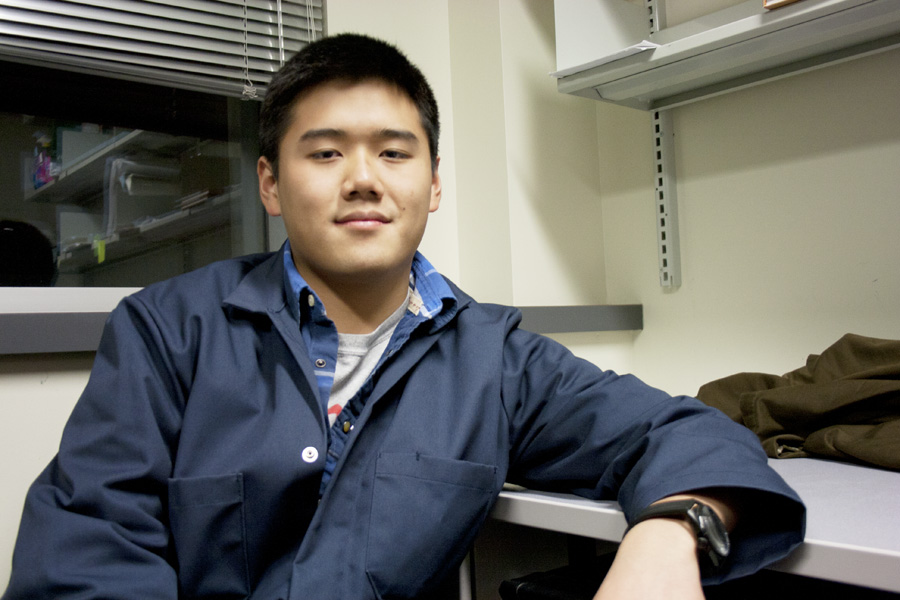
Joy Lizette Aguilar (Alexandra Allaire / McGill Tribune)
a, Student Life, Student of the Week

Student of the Week

Q: What is your secret talent?

A: I can sing, but nobody knows that.

Q: If you could say one thing to your hero, what would it be?

A: One of my heroes is Nelson Mandela. I would ask how he managed to survive his imprisonment without going insane.

Q: What’s your signature drink?

A: This is going to be really weird. Every night before I go to bed, I have a glass of milk with Baileys in it.

Q: What’s your go-to stress-buster?

A: When I’m stressed out, I pump up the music, lock my door, and dance insanely.

Q: Who’s your favourite NHL player?

A: The Sedin twins. Not just one. If I’m naming one Sedin twin, I have to name both Sedin twins. I have to be loyal to my home city.

Q: If you were a course at McGill, which one would you be and why?

A: Art of Listening. Just kidding! I’d be POLI 227 – Developing Areas, because I’m studying International Development. Plus, Rex Brynen teaches it; that’s important.

Q: Name a book you’ll never get sick of reading.

A: Can I name three? Blindness by José Saramago, The Killing Joke by Alan Moore, and The Fabric of the Cosmos by Brian Greene.

Q: What are you going to be for Halloween?

A: I don’t even know if I’m celebrating Halloween. I think I will curl up in bed instead. With Baileys and milk.

Q: Describe McGill in 3 words.

A: It is fun.

Q: If you could go back in time to any historical event, which one would you go to and why?

A: Hmmm…There’s a lot. The beheading of Queen Anne in the White Tower. I think it [was] early or mid-1500s, I’m not quite sure. I’ve visited the White Tower, so I think it would be cool to see one of King Henry VIII’s wives get beheaded there. I have a fascination with the White Tower.

Q: What fictional character would you most want to get a drink with?

A: Rorschach from Watchmen. That would be very, very interesting.

Q: What would you talk about with him over drinks?

A: The meaning of life. I would love [for] him to give me a tutorial of how he made his mask.

Q: What’s your favourite song of 2012?

A: “Punching in a Dream” by the Naked and the Famous. I don’t think it came out this year, but I just listen to it a lot.

Q: What’s your biggest pet peeve?

A: When people don’t give firm handshakes. Limp hands. When you’re trying to shake a limp hand, that’s not very welcoming.

Q: Where is next on your traveling bucket list?

A: Since I’m coordinating the next trip for IRSAM [International Relations Students’ Association of McGill], I’m looking into either Ecuador, Peru, Guatemala, Costa Rica, or the Philippines.

Q: What reality TV show are you perfect for?

A:  Amazing Race! That would be so cool!

Q: What’s the first word you think of when I say Halloween?

A: Slutty pumpkin! What else…Firefighter outfits, Watercan, and more slutty costumes!

Q: Name one movie you’ll never watch again.

A: American Psycho. I will never watch American Psycho ever again, nor will I watch A Clockwork Orange. Kind of a one-time viewing kind of thing.

Q: Describe your most recent awkward moment.

A: I do this a lot. When I feel like there’s no one on the same street as me, I sing loudly to my iPod, or I talk out loud to myself. But there’s been times where there have definitely been [other] people on the street. I wouldn’t be surprised if they thought I was half insane.

Q:  Who’s your favourite talk show host?

A: I have to say Stephen Colbert. I’ve been meaning to try his Ben and Jerry’s flavour, but I don’t know if they still make it.

Q: Why are you an asset to McGill?

A: Financially speaking…I’m an asset because I pay the tuition fees that keep this place running. Also, I love getting people involved with international development and philanthropic causes.

a, Student Life

How to survive Post-Tropical Cyclone Sandy

In the midst of Hurricane Sandy, heavy rain is expected in Southern Quebec, and western parts of the expecting possible snowfall. About 75 millimetres of rainfall is expected in the area, and winds may reach up to 100 kilometres per hour. With such conditions, power outages are a definite possibility for students here at McGill. So, the Tribune has compiled a comprehensive hurricane survival guide to get you through the potential storm.

To start, store some water and non-perishable food in your apartment. Keep a few jugs of water and a small supply of groceries on hand, enough to get you through a week. Things like granola bars, cans of soup, dried fruit, crackers, peanut butter, trail mix, juice boxes, and most importantly, marshmallows are all good choices. As a perk, all the candles around your apartment mean lots of opportunities to make s’mores. Also, try to open your refrigerator as little as possible to make your perishables last longer.

As far as other supplies go, batteries are your best friend. No power means chargers are useless, so keep those cell phones and iPods fully charged whenever possible, because you never know when your electricity could go. You’re going to need batteries for flashlights, portable clocks, and radios, which are essential for keeping yourself informed when your phone and laptop run out of power.

That brings us to the next point. Keeping yourself updated via radio, on power outages around the city, the status of the repair crews working on power lines, and any other issues that may arise from the harsh weather conditions, is extremely important. Knowing when you can expect your power back will be a huge priority—especially when you have to take those cold showers.

A basic first-aid kit is something every apartment should have in any event. If you haven’t had time to get one together yet, you might want to make sure you do that before the storm hits. A simple first-aid kit should include Band-Aids and gauze dressings of different sizes, tweezers, scissors, painkillers, a tensor bandage, an anti-septic cream like Polysporin, disinfectant wipes, tape, safety pins, and disposable gloves.

Check online for a more detailed list, but these are the basics you should have in your kit. Go ahead and put a kit together now, so you’ll have it in case anything happens due to Sandy, and if nothing does, then you’re prepared for the next year or so, should anything else come up.

During a strong storm, it’s suggested that you turn off all electronics except for one light, so that, when the power goes out, you will know when it comes back. This may be a bit extreme considering the storm we’re expecting, but just be careful around your electronics. Be sure not to light candles pre-emptively though, because they present a fire hazard if knocked over. Instead, wait until you have definitely lost power, and then light however many candles you need. Just be sure to remember where all the candles that you lit are located.

Should this hurricane prove to be nothing more than some heavy rain by the time it reaches Montreal, most of us will continue about our routines normally. However, heavy rains can affect driving conditions drastically, and as a pedestrian or cyclist, this can make travelling even more dangerous. At least the people in the cars have all that metal for protection; what’s sheltering you from the hydroplaning car careening towards you while you try to catch that yellow pedestrian light? Use more conservative judgement when crossing, because despite the best intentions of the always cool, calm, and collected Montreal motorists, lots of rain means horrible braking conditions, so it’s up to you to keep yourself safe. Take these tips, use your trademark McGill good judgement, and you will come out the other side of this storm as beautifully as you did that devastating earthquake.

Read the latest issue

Read the latest issue