Latest News

a, Sports

Around the Water Cooler

In case you spent your week preparing to jump back to Earth from space, here’s what you missed this week in the world of sports…

BASEBALL — Is there anything like October baseball? All four Division Series this year went the distance, and every night featured a different dramatic finish. San Francisco went into Cincinnati facing three elimination games at the Great American Ballpark, but channeled its memories of 2010 to take all three games in Ohio and eliminate the Reds. Speaking of recent champions, the Cardinals brought everyone back to 2011, erasing a 6-0 deficit to win the fifth and deciding game of their series against the Washington Nationals (who really shouldn’t have shut down Stephen Strasburg). In the junior circuit, the Yankees-Orioles series was headlined by the struggles of Alex Rodriguez and his replacement Raul Ibanez. Finally, the Oakland A’s’ magical run came to an end at the hands of the Detroit Tigers. The last three World Series champions will all take part in the League Championship Series, so if you want to root for an underdog, cheer for Detroit.

MEN’S SOCCER — Canada’s quest for the 2014 World Cup in Rio de Janeiro continues on Tuesday night as the Red and White play their final game of the third round of CONCACAF qualifying. A win or a draw against Honduras will be enough for the Canadians to progress to the final six or “hexagonal” round for the first time since 1997. Canada is positioned to qualify after a 3-0 victory over Cuba on Friday night at Toronto’s BMO Field. The Cuban team only fielded a squad of 11 players after four players went missing, three of whom were reported to be defecting to the United States.

BOXING — Orlando Cruz, a Puerto Rican featherweight boxer came out last week. The announcement made waves throughout the sporting world as Cruz is the first boxer to come out, and is one of the highest profile athletes ever to do so. Cruz’s announcement is significant, as he is still an active fighter. Other athletes, like former NBA player John Amaechi, have only revealed they were gay after retiring from competition. Cruz fights Jorge Pazos in Florida next week, and a win in the bout could give him a shot at the world title.

BASKETBALL — The NBA’s preseason got up and running this week with teams playing in the United States, Europe, and Japan. The Brooklyn Nets played their first game in the borough, debuting their new uniforms and logos. Of note for Montreal basketball fans: the Toronto Raptors will play the New York Knicks in a preseason game at the Bell Centre on Friday night for the second time in three years. Last time the Knicks came to Montreal, they practiced at McGill’s Love Competition Hall with the Redmen and Martlet basketball teams. Tickets for the game are still available and start from $25.

a, Sports

2012 MLB Awards

With playoff baseball underway, the MLB’s best individual performances from the season will be awarded in the coming weeks. A Tribune contributor  predicts who he thinks will take home the hardware. 

National League

MVP: Buster Posey

The San Francisco Giants finished last season with a disappointing 86-76 record, having lost their all-star catcher, Buster Posey, to an ankle injury. Fast forward to 2012 and Buster is back with a bang. Sporting career-best offensive numbers and batting percentages, San Fran’s clean-up hitter led his team to a division title amidst the steroid scandal surrounding teammate Melky Cabrera. Buster deserves this award for delivering as a leader and propelling San Francisco into the postseason.

Cy Young: Gio Gonzalez

Clayton Kershaw may have been practically unhittable, but Gonzalez was lights out. Gio posted a ridiculous 9.4 strikeouts per nine innings, leading all MLB starters. Similarly impressive is the meagre .206 batting average posted by opposing hitters—a Major League-leading mark as well. Gonzalez was clearly the Nationals’ best pitcher, and with 21 wins—another MLB best—he edges out Kershaw for the award.

Rookie of the Year: Wilin Rosario

Colorado may have just posted their worst record in club history, but the emergence of rookie Wilin Rosario should give Rockies’ fans something to look forward to. In fact, Posey may have a legitimate challenger for the status of best catcher in the National League in the next couple of years with Rosario in the mix. The Dominican Republic native was a bright spot for Colorado as he set a rookie franchise record, with 28 home runs in only 117 games.

American League

MVP: Mike Trout

While he didn’t win the Triple Crown like Miguel Cabrera—the other top MVP candidate—the batting numbers Trout brings to the table aren’t too shabby. He belted 30 home runs, and finished the season with an impressive .326 batting average. Also, Trout’s defensive play was superior to Cabrera’s, and he led the majors with 49 stolen bases. Though the Angels missed out on the playoffs, Trout’s emergence was the reason the team even contended for a spot. Did I mention he was a rookie?

Cy Young: David Price

Price had a strong September, in which he posted a 4-0 record, wrapping up a remarkable 20-win season for the Rays. His dominance is reflected in his 2.56 ERA, good for second among starters in the majors. Price is now in line to take home the award thanks to his best season of his career.

Rookie of the Year: Mike Trout

Can you possibly win the AL MVP, yet fail to bring home the rookie of the year award? This decision is a no-brainer. Trout was on top of the league and blew away all other rookies in the running.

a, Sports

Sports Briefs

Martlet Hockey: McGill opens Regular Season with a Win, Daoust Records Five Points in Victory

Ranked as the number two team in Canada in the inaugural CIS Women’s Hockey Top 10, McGill opened its RSEQ schedule with an authoritative 8-1 away victory against Concordia last Saturday. Second-year centre Mélodie Daoust led the way for the Martlets (1-0-0) with one goal and four assists. Joining Daoust in the three stars was Leslie Oles, who tallied two goals and two helpers, and Katia Clement-Hydra, who notched two goals and one assist.

McGill held the lead for all but the first 55 seconds of the game, as rookie forward Gabrielle Davidson scored her first CIS goal in the game’s opening minute. Two power play markers gave McGill a three-goal lead after 20 minutes. The game was 6-0 in favour of the Martlets by the time Concordia (0-1-0) tallied its first, a power play goal late in the second period.

McGill dominated the shot total, directing 44 efforts towards the Stingers’ goal, while Martlet goalie Taylor Salisbury stopped 22 of 23 Concordia shots in the victory.

McGill now heads south of the border for exhibition matches at NCAA opponents Dartmouth, Harvard, and Vermont. The Martlets open up their home schedule on Oct. 27 against the Carleton Ravens.

Martlet Soccer: Martlets split weekend games, McGill beats UQAM, loses to concordia 

Following a 6-0 start to their season, the Martlets came home to Molson Stadium on Thursday night hoping to get back in the win column against Concordia after recording a draw and a loss in their previous two games. However, the sixth-ranked team in Canada came up short again, as the Stingers (4-2-3) pulled out a 1-0 victory over McGill (7-2-1).

Despite the scoreline, the game was dominated by McGill and the team should have won easily. The Martlets directed 23 attempts towards the Concordia net, and keeper Saby Dagenais made six saves.

On Sunday the Martlets got back on a winning note with a definitive 4-0 victory over the UQAM Citadins. Hannah Rivkin, Melissa St. Onge, Kristina Pearkes, and Meghan Bourque all hit the scoresheet for the Martlets.

McGill’s win on Sunday put them back in second place in the RSEQ standings, one point ahead of the Sherbrooke Vert-et-Or. With four games remaining, the Martlets hold a seven point lead over Concordia for the final playoff spot. McGill takes to the field next on Friday night against the UQTR Patriotes.

Redmen Soccer: Redmen Streak Snapped, Sit fourth in RSEQ

The Redmen soccer team ran their unbeaten streak to three games on Thursday with a resounding 4-1 victory over the Concordia Stingers. Four different players scored for McGill (3-3-3), who sit in fourth place in the RSEQ standings.

Concordia (1-6-2) took the lead in the game’s 26th minute, but McGill responded with an equalizer just before halftime on a goal by rookie midfielder Henri Ashe-Taylor.

The Redmen broke the game open midway through the second half, as Jeremy Hurdle and Winston Pool scored 91 seconds apart to break the deadlock and add some insurance. Marc Palaci-Olgun iced the victory after he connected with a Hurdle corner kick.

The Redmen followed up the effort with a 2-1 loss to UQAM on Sunday.

The weekend results move the Redmen to fourth place in the RSEQ standings. They play their last regular season home game on Oct. 19 against UQTR.

McGill won the special teams battle, going 2-5 on the powerplay. (Simon Poitrimolt / McGill Tribune)
a, Sports

Redmen win first game in front of Homecoming crowd

The McGill Redmen had a  busy Homecoming weekend, facing off against two OUA East division foes. On Friday night, the Redmen’s slow start to the season continued, falling to Ottawa 4-2, and placing them at 0-3-0 on the year. This changed on Saturday night, when McGill (1-3-0) overcame a 2-0 Carleton Ravens lead to win its first game of the season, 6-4.

Carleton (0-1-1) came out firing and scored just 30 seconds into the first period. The Ravens were quick to the puck and strong defensively throughout the first frame. They blocked a number of Redmen shots, and looked like the more determined team. Carleton then scored again 12 minutes into the period, but McGill answered with its own tally just over a minute later, when the puck swung around to third-year defenceman Ryan McKiernan on the weak side, who fired the puck into the net.

The Redmen turned on the heat in the second period, scoring two goals in the first two minutes. Third-year forward Benoit Levesque slapped the puck past Ravens’ netminder Francis Dupuis to tie up the game, while Hugo Laporte continued the fierce attack by deflecting a shot into the net. McGill continued this pace throughout the second frame, creating a number of strong scoring chances. This culminated with another goal off the stick of first-year winger Max Le Sieur, bringing the scoring to 4-2 in favour of McGill.

Head Coach Kelly Nobes was very pleased with McGill’s perseverance, despite the team’s slow start.

“I think it’s a credit to our will and effort level that we chipped away at it and … got the lead back and held it for the rest of the game,” Nobes said.

The third period was definitely more physical, as both teams looked to set the pace. Carleton’s effort was far from over, and they dished out big hits and fired as many point shots as possible against Redmen goaltender Andrew Flemming. However, McGill’s chances paid off, as Jonathan Brunelle scored his third goal of the season, potting home a rebound off of Dupuis, and extending the Redmen lead to 5-2.

However, the large lead was short-lived, as the Ravens answered with two goals of their own, each within two minutes of Brunelle’s tally. Carleton’s intensity picked up, but the Ravens were called for a costly hooking penalty with just 10 minutes to go, giving McGill a powerplay opportunity. McKiernan took advantage and scored his second goal of the game, all but sealing McGill’s 6-4 victory.

Marc-Olivier Vachon, a second-year centre who assisted McGill’s last goal of the game, was happy with the progress the team made from the first period.

“I think we had a slow start but we bounced back pretty well,” Vachon said. “After that 2-0 lead, we pushed the pace and we scored a couple goals, and it was [on] the powerplay where we won the game.”

Two-goal scorer McKiernan was also pleased his team’s effort.

“I think we played Redmen hockey for sixty minutes and we got a good effort from the whole team today, which was really important,” he said.

Moving forward, however, McKiernan made it clear that the team still has a lot of work to do if it wants to become a serious division title contender.

“We are focusing on more cohesion. We are still relatively a young team, but we’re getting there,” he continued. “It’s a process and this is just one step in making things register.”

Coach Nobes noted that the first victory of the year is huge for his young Redmen team.

“Hopefully, it will give us some confidence and belief [for the rest of the season].”

The Redmen play exhibition matches against Harvard and Dartmouth next weekend during their short NCAA tour in the United States, before coming back home to battle Queen’s on Oct. 24.

Image from jackrandallphotography.com
a, Sports

In heaven at Angels Stadium

Since the departure of the Montreal Expos following the 2004 season, baseball fans in this city have had to look elsewhere for their fix of America’s pastime. Most are not Washington Nationals fans, though the team descends from the Expos franchise. I became a fan of the then Anaheim Angels, because of former Expos all-star, and my childhood hero, Vladimir Guerrero. Still faithful to the Halos, despite Big Daddy Vladdy’s departure, my father and I visited Angels Stadium in late August to see the team’s new #27 and MVP candidate, Mike Trout.

Last season, our father-son bonding expedition took us to Camden Yards in Baltimore to see the Angels play. Watching your team play in an opposing stadium is a very different experience from seeing them play at home. You form a connection with your fellow fanatics, but are the minority amongst tens of thousands cheering for the other side.

As we walked into Angels Stadium, something felt astonishingly different. Rather than receiving the dirty looks reserved for the enemy, I blended into the sea of Angels’ red in my vintage Guerrero jersey. The energy of the home crowd consumes you in a way nothing else can. It is powerful enough to make you truly feel at home, even though you might be over 4,000 kilometers away.

We entered through the left field gates, just as the home half of the first inning was about to begin. Though our seats were in the upper deck, we dashed to the standing room area along the third-base line, hoping to get a glimpse of Mike Trout, the Angels’ leadoff hitter.

Using my 6’4” height advantage, I peered over the bodies in front me, not wanting to miss a moment of the action. The rookie centerfielder Trout entered the day leading the American League with a .337 batting average. On the second pitch of the at-bat, Trout hit a frozen rope line drive into the rock pile beyond the centrefield fence. Fireworks erupted from the spot the ball hit, and the stadium went bananas.

The rock pile is Angels’ Stadium distinguishing feature. Complete with erupting geysers and trickling waterfalls, it was built during the stadium’s 1997 renovation, spearheaded by the Walt Disney Company after it became the Angels’ majority owner in 1996.

More significant was the stadium’s conversion back into a baseball-only venue. The facility had been expanded in 1980 to accommodate NFL football, as the Los Angeles Rams shared the playing field before moving to St. Louis in 1994.

The mezzanine bleachers in centrefield were pulled back to expose the San Gabriel and Santa Ana Mountains, providing a beautiful backdrop behind the scoreboard. Two gigantic Angels hats, size 649½, were erected outside the main entrance, welcoming fans to the new ballpark.

Distracted by the subtle beauty and distinct Southern Californian feel Angels’ Stadium exudes, our attention returned to the field in the bottom of the ninth by the Rally Monkey—a legacy of the Angels’ 2002 World Championship. With two men on and one out, Trout laced a single up the middle to even the score at 5-5. Torii Hunter, the very next batter, drove a sacrifice fly to deep center, scoring the winning run from third base.

What remained of the 39,000-person crowd exploded in sync with the fireworks from the rock pile. The halo around the 230-foot tall ‘A’ in the parking lot, illuminated only by an Angels victory, shone more brightly than the moon. Walking out, I felt like I was at home in Los Angeles.


a, Features

FEATURE: McGill Then and Now…

86-year-old Betty McCullough watched the televised celebrations of Queen Elizabeth II’s Diamond Jubilee this summer and thought back to one of her fondest memories as a student at McGill’s graduate school for nursing. At 25 years old, she’d clutched her camera as she waited amongst a crowd of students, staff, and faculty who had packed McGill’s campus for a glimpse of Princess Elizabeth and Prince Phillip in their visit to the university during their tour of Montreal in October 1951.

Her pictures of that day, Betty says proudly, are as good as any published in the newspaper or yearbook. But her black-and-white photographs of the royal couple are not the only fond memories she has of her time as a student in Montreal. As Betty opens her 1952 Old McGill yearbook, she reminisces about how different life was as a student of McGill in the 1950s.

A Royal Visit

“A motorcycle […] another; an expectant murmur passed along the crowd […] The shimmering, sky-blue limousine passed through the gates and moved slowly up the drive.” This excerpt from the 1952 yearbook shows how students chose to describe the royal visit on Oct. 30, 1951, just three months before Princess Elizabeth ascended the British throne.

Weeks of hard work prepared McGill for the royal visit. On the big day, banners, flags, and crests lined the campus, brightening the scene with McGill’s official red and white and MacDonald campus’ green and gold. The students who lined the campus were dressed in their traditional scarlet blazers, while faculty members greeted the royal couple in full academic dress.

According to the yearbook, an estimated 10,000 people lined the streets of McGill’s campus in order to catch a glimpse of the royal couple.

Elizabeth and Phillip entered the Arts Building to meet with top university officials and student leaders, view mementos of previous royal visits, and sign the convocation register. They were also presented with two specially printed copies of that day’s issue of the McGill Daily before leaving campus to continue their tour of Montreal and the rest of Canada.

From streetcars to subways

When Betty attended McGill, she lived in the town of Mont-Royal with her cousin. Living almost an hour’s commute away from campus wasn’t easy though, and Betty had to make use of the Montreal streetcar system to get to the university each day.

“It was quite a commute, you know, the old 65 [streetcar] going up the hill,” she says.

Other students had less orthodox methods of getting to school. One grandmother of a current McGill undergraduate student, declined to give her name but is known as ‘Nana,’ remembers her experience well.

“We used to hitchhike down everyday. Honest to goodness; we had the regular people who took us to school, the same people who went to work every day,” Nana says. “On the way back I rode the bus or streetcar.”

In the 1950s, Montreal’s extensive streetcar system was known as one of the most innovative in North America. The electrically powered streetcars featured a new pay-as-you-enter system, which meant that conductors no longer had to walk up and down the cars collecting fares—which had allowed some people to ride for free when cars were crowded. Pay as you enter was later adopted worldwide and remains in place in the majority of transport systems today.

As the 1950s progressed, however, Montreal’s public transit system underwent important changes. Later in the decade, the Montreal Transit Corporation started introducing buses to the city, since streetcars required more employees than buses and were harder to maintain during harsh Montreal winters. By 1959, all Montreal streetcar lines had been converted into equivalent bus routes. The metro system was not inaugurated until 1966.

Principal Frank Cyril James and the battle for university funding

While the amount students are expected to pay in tuition has changed significantly since the 1950s, Betty recalls that finding the money to foot the bill was just as difficult for many students then as it is now.

“Even in those days, when tuition was two hundred and some dollars, it was hard to come by,” she says. To pay the bills, she babysat her cousin’s two young children, and received free room and board in exchange.

Tuition has always been linked to university funding. One of the most valuable developments in McGill’s funding history was Principal Frank Cyril James’ successful lobby for federal funding for Canadian universities, like McGill, during his time in office from 1939-62.

For roughly the first century of its existence, McGill received only a small, token sum from government sources. This financial situation changed slightly in 1939, when McGill was promised additional financing from the Quebec government, but only a fraction of that sum was ever paid to McGill.

Following the outbreak of World War II, this statute was replaced by special wartime federal grants to universities, which took effect in 1951 and provided the full promised amount to McGill. After the war, federal funding offset the cost of the sudden influx of students by assisting universities that accommodated war veterans. With the looming prospect of additional costs in the wake of these grants, however, projections for McGill foresaw difficulty financing the growing university.

As both principal of McGill and chairman of the finance committee of the National Conference of Canadian Universities, the lack of federal aid was of paramount concern for James. In 1949, James met with then-Prime Minister Louis St. Laurent to urge the federal government to give aid to all Canadian universities.

The resulting Massey Commission found that Canadian universities, while growing to become an integral part of career training, were indeed facing a financial barrier that limited their ability to fulfill the needs of the nation. The federal government quickly accepted its proposal to pay each university a grant worth 50 cents to provinces per capita.

This federal agreement of 1952 would have a significant impact on university-government relations in the future, as it placed McGill on the same level as other Canadian universities, and provided, for the first time, an annual grant that was based on standardized regulations.

The building used at McGill for administration was renamed the F. Cyril James Administration Building in his honour following his death in 1973.

A growing student body

Looking at the map of McGill on the front cover of her yearbook, Betty remarks about how “foreign” the modern campus seems to her. In fact, only 28 per cent of the named buildings on McGill’s downtown campus were built prior to 1960. With the appearance of new buildings like Leacock, Otto Maass and the McLennan Library in the 1960s, the campus underwent a dramatic change in response to a growing need to accommodate more students.

“I don’t think it’s the same school at all,” Nana says, comparing her McGill to that of her grandchildren, “It’s so big. It’s like comparing a college to a university [in terms of size]—although it had been a university at the time.”

The 1950s were a period of growth for McGill, as the university received an influx of students that would permanently expand the student body. More students were attracted to universities because of a growing recognition of the institutions’ ability to prepare students for the working world. In addition, the Veterans’ Charter of 1944 allowed the many soldiers returning from World War II to receive free university education.

For McGill and other Canadian universities, these factors would have an enormous effect. In 1946, McGill had almost 8,000 students—a number that will seem quite small when compared to its current body of 30,000+ students. Student enrollment would almost double in the following ten years, exceeding 15,000 in 1967. The university’s student body overall had more than doubled during the 1950s as well, and the numbers would continue to rise thereafter.

This period of growth, however, would cause problems for the university during the 1960s, as McGill’s small campus was called on to accommodate more and more students every year. During the 1950s, McGill had only two student residences­—Douglas Hall and the female-only Royal Victoria College. In the early 1960s, the construction of McConnell, Molson, and Gardner Halls helped to accommodate the growing student body.

Although there are certain difficulties posed by today’s large student body, like class sizes and the accessibility of professors, the growth has also allowed for the diversification of the student body and facilitated intellectual developments and research. While the large population of McGill may remain a mixed blessing to current students, it is a defining part of McGill history, and the atmosphere of the university today.

A matter of gender

As a member of the graduate school of nursing, Betty’s university experience included high levels of female representation. Nana’s experience as an undergraduate was similar.

“We were half and half,” Nana says of classroom demographics, thoughshe said this varied according to faculty. “The odd [female was in these other faculties]. Even architecture.”

Indeed, in the 1950s, the gender divide was quite noticeable in some fields. In the graduating class of 1952, for example, there were no female students studying engineering, and only 5.7 per cent of the commerce class was female.

Not every faculty, however, contained such a large gender divide. In the Faculty of Arts, the amount of female graduating students actually outnumbered their male counterparts, with 64.8 per cent women (compare to the 66.6 per cent studying in 2011). In fact, women have outnumbered men in the faculty of arts ever since 1917.

In addition to the lack of female representation in certain faculties, MacDonald Campus offered women a science degree in “household science,” where they could study subjects including clothing and textiles, family and consumer studies, and food and nutrition.

McGill then and now

Although many changes to McGill in the last 60 years have been specific to the university, some changes are the result of wider trends in Canada and the rest of the world.

“[Students] can [now] sit and watch your lectures on your laptops—the library was the place we worked. There was no such thing as getting things online,” Nana says.

However, some aspects of university life remain similar for students today. Like many current McGill students, Betty says that her grades were not the most important aspect of her McGill experience.

“I don’t think grades are totally indicative of what you have learned, because a lot of us are not good at writing exams or term papers or doing research of that kind,” she says. “But because you had broadened your horizons [at McGill] you were better prepared to deal with clients and patients. The exposure to Montreal and McGill … I’ve never regretted it.”

From the campus’ layout to the student lifestyle and workload, the McGill experience has dramatically changed over the 60 years since the 1950s. While students may no longer hitchhike to school or pay two hundred dollars in tuition, a look back on this time period also reveals commonalities between the university experiences of different generations. As the university continues to develop and add to this history, McGill’s rich past continues to pervade the atmosphere on campus.

Click to see the feature!
Alexandra Allaire / McGill Tribune
a, News

Justin Trudeau announces Liberal Party leadership bid

Justin Trudeau is officially in the race to lead the Liberal Party of Canada. Following weeks of speculation, the eldest son of former Prime Minister Pierre Elliott Trudeau announced his candidacy at a rally of several hundred supporters in his home riding of Papineau on Oct. 2. Trudeau’s official declaration, however, preceded the rally in the form of a YouTube video that amassed over 21,600 views in 16 hours.

The Liberal Party has been under the stewardship of interim leader Bob Rae since the resignation of its previous leader, Michael Ignatieff. Ignatieff resigned following the May 2011 federal election, in which the Liberal Party won the lowest seat count in its history.

“We need to prove that we Liberals have learned from the past, but that we are 100 per cent focused on the future—and not the future of the party, the future of this country,” Trudeau said at the rally.

Trudeau’s address praised Canadian diversity and emphasized the need to strengthen and empower the middle class in order to jump start the economy and foster community relations. He also  criticized the approaches of other major federal parties.

“What is the response from the NDP? To sow regional resentment, and blame the successful. The Conservative answer? Privilege one sector over all others, and promise that wealth will trickle down eventually,” Trudeau said. “Both are tidy ideological answers to complex and difficult questions. The only thing they have in common is that they are both equally wrong.”

Trudeau also acknowledged the issue of Quebec nationalism. In his speech, he emphasized the need for national unity.

“Quebeckers have always chosen Canada because we know it is the land of our ancestors, who built this country from east to west,” Trudeau said. “They were here to write the first chapters of the great Canadian history of courage, liberty, and hope. Will we put this history aside now because people of other languages came after us with the same dream of building a better country? Of course not. Our contribution to Canada is far from over.”

Throughout the rally, Trudeau displayed his characteristic charisma.

“When was the last time you had a leader you actually trusted?” Trudeau asked. “Not just the nebulous ‘trust to govern competently,’ but actually trusted, the way you trust a friend to pick your kids up from school, or a neighbour to keep your spare front door key. Real trust—that’s a respect that has to be earned, step by step.”

Trudeau’s critics have questioned his short participation in politics.  He addressed this in a press conference following the rally.

“This is why we have a campaign—to answer these questions [of experience] and to show that the Liberal party merits confidence as an option for government,” Trudeau said in French. “That is not something that can be answered in a speech, but in the field, all over Canada.”

Trudeau also ruled out a coalition or a joint nomination with the NDP or the Green Party of Canada.

“I believe in an option that is not polarized around the edges, that is not bound to an ideology but is looking for the best possible way to serve all Canadians,” he said.

“[A coalition] is not necessary,” Trudeau continued in French. “Canadians need a party that will speak for all of Canada, not like the Conservatives, who draw an X over Quebec, not like Mr. Mulcair, who has drawn an X over Alberta.”

Following the party’s defeat in the 2011 elections, many have called for renewal in policy and leadership in the Liberal Party. William Cusano, former member and former first vice-president of the National Assembly of Quebec, pointed to Trudeau as an option to reinvigorate the party.

“[In the Liberal Party,] a lot has been done in one way for many years, from the top” Cusano told the Tribune. “I have a lot of confidence that with Justin, [the approach] is going to be from the day-to-day, up. That’s why I’m here.”

Some McGill students who were present at the rally said they enjoyed the opportunity to hear Trudeau speak and learn more about the candidate.

“I’m a big Liberal supporter, and though personally I think Martha Hall Findlay would be my favourite [candidate], Trudeau impressed me a lot tonight,” John Power, U3 arts, said. “[Trudeau presented] a lot of very pro-federalist points—and that’s what I like about the Liberals. I also liked how he focused on youth really early into his speech.”

“I think one of the big challenges in this type of [rally] is: How do you capture the incredible diversity of Canada while at the same time […] articulate what it is to be Canadian?” Gregory Frame, U3 political science, added. “And I think he walked that line very well.”

The race for the leadership of the Liberal Party will officially begin on Nov. 13, and the next leader of the party will be announced on April 13, 2013.

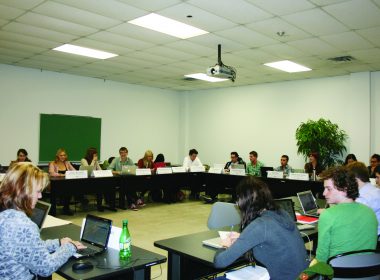
The PGSS October Council meeting. (Anna Katycheva / McGill Tribune)
a, News

PGSS Council discusses McGill and Quebec education summits

Last Wednesday, the Post-Graduate Students’ Society (PGSS) held its October council meeting. The meeting featured discussion about the upcoming Quebec and McGill Education Summits, and included a presentation by a representative from the Fédération Étudiante Universitaire du Québec (FEUQ).

The newly elected Parti Québécois (PQ) government is to hold a summit on education within 100 days following the Sept. 4 provincial elections. While no date has been specified, the summit is expected to occur sometime in early 2013.

As of now, the PQ government has not provided details for how the summit will be structured.

FEUQ representative Marc-André Legault explained to Council the purpose of the Quebec education summit, as well as what FEUQ is doing in preparation for the Summit. According to Legault, FEUQ wants to present the PQ with the students’ hopes for the summit.

“We have to use the momentum we have,” Legault said. “We want to do that summit, and push and advocate for [the] students of Quebec.”

FEUQ has proposed the creation of a presidential committee for the summit. It would oversee all aspects of the operation, including memorandums, recommendations, and consultations. In FEUQ’s vision, the committee would consist of four members: a student, a government representative, an administrative representative, and a faculty member.

(Anna Katycheva / McGill Tribune)

FEUQ is seeking recommendations for its proposal from its member associations. As a member association of FEUQ, PGSS offered their recommendations through a motion at council. External Affairs Officer Errol Salamon read aloud the recommendations.

PGSS’s suggested improvements to FEUQ’s current document include the creation of five partner groups in the summit, as opposed to the original three that FEUQ proposed. The motion also reads that each of the five groups should be composed of 20 per cent from each of the following categories: undergraduates, graduate students, representatives of the university community, government representatives, and external partners.

In addition, PGSS also asked that a fifth member—a graduate student—be added to the presidential committee, and proposed additional discussion topics for the summit that address international, out-of-province, and Anglophone students.

There was also a continuation of discussion around the logistics of having an Education Summit at McGill—a motion the PGSS passed at their September Council meeting.

“This past council motion for a Committee of the Whole was only to talk more about the specifics,” Gretchen King, PGSS equity commissioner, wrote in an email to the Tribune. “I think the rest will be planned by a sub-committee headed on the PGSS-side by the External Officer.”

King has been working with Salamon, SSMU Vice-President External Robin Reid-Fraser, and PGSS Secretary General Jonathan Mooney, on creating a McGill summit.

Salamon spoke of the team’s current vision of a McGill summit, which would take place in November.

“We want to do events related to the summit … one or two days per week in January,” Salamon said. “We would keep this as open as possible.”

(Anna Katycheva / McGill Tribune)

According to Salamon, the team would organize two types of events: large General Assembly-style events designed to pass motions and mandates, and smaller breakout sessions to facilitate discussion about issues on a smaller scale.

Though nothing has been set in stone to date, last Wednesday’s PGSS Council made some important headway in the organization of future education summits, and other events designed to bring the on-going discussion about accessible education to the McGill community.

a, News

Judicial Board hears case on AUS Winter Referendum period

On Oct. 2, the Judicial Board (J-Board) of the Students’ Society of McGill University (SSMU) heard the case of Bangs vs. Calver and Cheng, regarding the results of last winter’s referendum period for the Arts Undergraduate Society (AUS). The J-Board has 15 days to deliver a verdict on the case.

Petitioner Chris Bangs has asked the J-Board to invalidate two referendum questions for which he was the chair of the ‘No’ committee—“Online Ratification for the decisions of the AUS General Assembly” and “Amending the Constitution.” The respondents are former AUS President Jade Calver and former Chief Returning Officer of Elections AUS Victor Cheng.

J-Board hearings are intended to allow the justices an opportunity to hear and question both parties. Prior to the hearing, however, the respondents informed members of the J-Board that they did not wish to appear in this case, and consequently, would not attend the hearing. Neither party provided justification, thereby forfeiting their right to make submissions or arguments. Nevertheless, the hearing continued as scheduled.

“The plaintiff still has a burden of proof,” Chief Justice of the J-Board Joel Kwan explained. “[Bangs] still has to convince the board that the allegations are prevalent enough to make the conclusion that the petitioner is looking for.”

Bangs’ case for invalidating the two motions rests on the respondents’ alleged violations of six sections of AUS by-laws during last winter’s special referenda period. These include items concerning passing motions in AUS Council, translating the motions into French, and publicizing the polling times and location.

“The fact that the AUS failed to uphold its own by-laws is really disturbing for me,” Bangs said. “The fact that so many violations occurred in such a short amount of time is truly problematic.”

In particular, Bangs pointed to the AUS’ failure to distribute the amended version of the motions’ texts and their restriction of the campaigning period by four days, which he says could have affected the way students voted.

“These [motions] are things that really should be discussed, and change the fundamental way that [the AUS] is run,” Bangs said. “There’s really a lot of value in discussion.”

Bangs also said that the AUS failed to publicize the times and locations of polls, which he argued could have affected students’ ability to vote. In their petition submission, however, Calver and Cheng pointed to the high participation rate during the election period. The turnout for the special referendum period was 19.4 per cent of arts students, just under the 21 per cent turnout for the AUS winter elections.

“The Referendum Period was properly announced in a way that did not compromise the integrity of the vote, evidenced by the high voter turnout in the referendum,” Calver and Cheng wrote in their petition.

During the hearing, the J-Board justices questioned some of Bangs’ allegations, including his argument that the AUS Council speaker should have recounted the vote to approve the motions. Kwan questioned whether it was the duty of AUS members to ensure that the speaker counted correctly.

“Can the speaker not ascertain that without [counting the affirmative votes] one by one?” Kwan asked.

The justices also raised concerns about the relevance of Bangs’ argument that the speaker had a “history of making mistakes.”

In their petition submission, Calver and Cheng claimed that the decision to move forward with the election period was made at their own discretion.

“The actions taken by the respondents did not compromise the integrity of the Referendum Period, nor did they result in the disenfranchisement of the petitioner,” they wrote.

In addition, the respondents pointed to Bangs’ position as chair of two ‘No’ committees as his reason for filing the case. They also claimed that Bangs was determined to take the case to the J-Board without seeking other solutions beforehand.a

“All other measures for mediation were not respected by the petitioner,” Calver and Cheng wrote. “The petitioner was unwilling to find convenient times to meet with the respondents to discuss the matter.”

Calver and Cheng were unavailable for comment.

a, News

Philosophy Students’ Association to Seek Financial Independence from AUS

The Philosophy Students’ Association (PSA) is looking into the possibility of separating their finances from the Arts Undergraduate Society (AUS).

The PSA’s announcement came after the AUS’ decision earlier this semester to internalize faculty associations’ bank accounts. This means that the AUS would act as the PSA’s bank account, holding PSA’s money and checks.

The PSA raised concerns about the potential for this change to weaken its autonomy as an association. While the AUS has since offered a compromise, in which associations keep their external bank accounts but use an accounting software called Quick Books, the PSA is still considering separation from the AUS.

“The PSA is an extremely active group for our allocation size, so being able to fully control our finances is extremely important to us … in light [of] past AUS financial struggles,” PSA President Jonathan Wald said. “This is a process that has been tested at the Francophone universities and has worked very well for them.”

The PSA is therefore looking to form their own bank account—which must be approved by the provincial government­—and to be accredited to become the official representative of philosophy students at McGill.

Saad Qazi, AUS vice-president finance, said the PSA’s potential accreditation does not necessarily mean separation from the AUS.

“Financially, it would mean that the PSA can fix an assessment (fee) payable by each member of the PSA,” Qazi wrote in an email to the Tribune. “This assessment would be collected directly by [McGill] and disbursed directly to the PSA.”

According to Qazi, McGill currently distributes all arts students’ assessment fees to the AUS, which then distributes the fees to individual departments on a pre-established per capita basis. Wald said that even a low assessment fee would give the PSA more money than they currently receive from the AUS.

Qazi said it is too early to determine exactly how the finances of the PSA would operate following accreditation.

“It is very likely though that the university would ask the PSA to provide annual audits, as is the case for all other accredited student associations on campus,” Qazi wrote. “The PSA’s assessment would then have to be sufficient to cover the cost of providing an audit to the university.”

Should the PSA separate from the AUS, philosophy students would still be members of the AUS, said Wald, but their exact relationship would be determined through negotiations with the AUS.

According to Wald, PSA decided to pursue this course of action after a three-week-long series of meetings conducted on a consensus-basis, in order to ensure that the decision was widely supported. An accreditation vote would likely be run next semester, with the help of the Quebec government.


Read the latest issue

Read the latest issue