Latest News

a, McGill, News

SEDE facing financial woes, unable to secure adequate funding

McGill’s Social Equity and Diversity Education (SEDE) office may experience reduced programming in the future due to provincial budget cuts announced last winter.

“Like other departments and units on campus, we have been affected by a reduction in resources and staffing provoked by a number of factors,” SEDE Administrative Coordinator Juhi Sujan said.

Since its establishment in 2006, the SEDE office has provided training in equity, diversity, and anti-discrimination education, as well as school mentorship programs and opportunities for community engagement.

The office has also expanded to offer an Indigenous education program, a tutoring program for children in underrepresented neighbourhoods, and an annual Community Engagement Day, which attracted hundreds of McGill students to 20 different community service projects around Montreal this past October.

“We are extremely proud of how far the office has come since its beginnings,” Sujan said. “We are a small office, and have done the best we could with the available funds.”

Lack of funding, as a result of the provincial budget cuts that took place last winter, currently jeopardizes SEDE’s ability to staff and to carry out the many functions that fall under its mission. According to SSMU Councillors and Sujan, the fate of SEDE is uncertain if alternative funding is not found, or if McGill cannot support the office financially.

“I don’t think the whole office would fold,” Joey Shea, Vice-President University Affairs of the Students’ Society of McGill University (SSMU), said. “The SEDE office would exist, but their capacity to put on programming and the types of programming would be really limited.”

Among those who will be affected are those who work for SEDE, and those within McGill and the Montreal community who participate in and benefit from SEDE’s programs.

“Cuts are going to result in less services, less programs, and reductions to their already extremely stretched staff,” SSMU Clubs and Services Representative Zachary Rosentzveig said. “There is no fat to be cut at SEDE. Any cuts that come in would cut into meat and bone.”

Although SEDE is an office under the McGill administration’s jurisdiction, a motion passed at the SSMU Winter 2013 General Assembly mandates SSMU to support SEDE in gaining adequate financial support.

According to Shea, SSMU is currently undecided about the method through which they will fulfill that mandate. However, SSMU has specifically chosen not to create student fees to support SEDE.

“As much as we love SEDE and think that it’s so incredibly important to the university, it just wasn’t appropriate for us to ask students to pay for something that the university should be paying for out of its operating budget,” Shea said.

Currently, there are no alternative solutions to the funding problem, either within SSMU or on the administrative end. Meanwhile, Rosentzveig said there have been ongoing conversations between SSMU and the McGill administration to try to address the funding problems.

In her most recent SSMU Council report, Shea expressed that she would be holding a campaign in support of increased funding for SEDE.

“I don’t really know what form the campaign will take,” she said. “I imagine a letter-writing campaign to the [campus media outlets] from students in support, or directly to the provost of the university who sets the budget.”

a, Science & Technology

Scientists create the first customized, genetically engineered monkeys

Ningning and Mingming are not ordinary monkeys. From the exterior, their pink noses and furry faces make them appear as normal macaques, but at the genomic level, these brothers carry mutated genes.

Researchers at the Model Animal Research Center of Nanjing University in China reported the creation of the first genetically engineered monkeys with customized mutations last month. By inducing such mutations, researchers are one step closer towards acquiring the technology to recreate human diseases in monkeys. This would allow scientists to use primates, rather than mice and other rodents, as more realistic models of human disease. The twin macaques were born with mutations in two genes: Ppar-γ, which is involved in metabolism regulation; and Rag1, a gene required for healthy immune function. These mutations were targeted using a novel gene-editing platform called clustered regularly interspaced short palindromic repeats (CRISPR).

This innovative technology exploits an immune function found in bacteria that allows the researchers to target and destroy foreign and potentially dangerous DNA. Using a small guiding molecule called CRISPR RNA, the DNA-cutting enzyme Cas9 is targeted to the gene of interest, where it cleaves and modifies the target sequence. This technique is much more efficient than the genetic modification method currently used in rodents, which relies on spontaneous DNA exchanges to introduce mutations. Since primates reproduce much more slowly than mice, this low-efficiency technique is not a viable option in monkeys. And while genetic engineering in monkeys is a technique that has been attempted before, previous experiments used viruses that incorporated genes into random locations that could not be specifically targeted.

The team in China, led by the principal investigator Xingxu Huang, used CRISPR to alter genes in more than 180 monkey embryos before finally achieving success with the twin macaques. While modifications in these two genes do not represent a known disease condition, the monkeys provide a proof-of-principle for a technique that could have large effects in biomedical research.

This new animal model is anticipated to be extremely useful in the study of human diseases that cannot be adequately replicated in mice or rats, such as neuropsychiatric disorders.

“Although mice are giving us tremendous insight into basic brain biology and the biology of the disease, there’s still a big gap in between the mouse brain and the monkey brain,” said MIT’s Brain Institute Director, Robert Desimone, in an interview with the MIT Technology Review.

The CRISPR technology itself also has broad implications for the future of disease treatment. As a form of human gene therapy, CRISPR could one day be used to precisely swap out defective genes for their corrected counterparts. While we are likely still years away from seeing this technique being used in a clinic, it is clear that the biomedical research landscape is rapidly changing and bringing forward new technologies.

a, Men's Varsity, Sports

Basketball: Lacy lights up Laval with career-high 30 points

The McGill Redmen’s one-point lead looked fleeting heading into the half. As if on cue, their opponents, the Laval Rouge et Or, opened the third-quarter with two straight field goals, going up 36-32. It would be Laval’s last lead of the game.

Scrambling to halt their opponents’ momentum, the Redmen turned to reserve shooting-guard Thomas Lacy. Suddenly, Laval had no answers, as Lacy took control in a 79-53 victory for the Redmen.

Lacy erupted for 22 of his career-high 30 points in the third-quarter to go along with three rebounds, three steals, and one assist. His six three pointers fell one shy of the team’s single-game record, set by Yannick Chouinard back in 2005.

What began as a 10-0 run quickly turned into a monster 33-point quarter for the Redmen, during which the hosts outscored their opponents by 19 points to put the game out of reach.

“My legs felt pretty young tonight,” Lacy said. “I hit one and then I could feel my teammates trying to find me on the court. I could feel the guys on the bench standing up [….] Once those things start happening, the ball just goes in.”

With every swish, Thomas Lacy seemed to set his feet further and further from the arc, while the rowdy Redmen bench inched closer and closer to the hardwood. This was Lacy’s court. This was his time to shine.

McGill would put the game away in the last quarter, coasting to an easy win. Lacy exited midway through the fourth frame to a rousing ovation from the red-and-white crowd. Despite Lacy’s 6 of 11 outburst from three-point land, Redmen Head Coach David DeAveiro expressed more excitement about the 6’1” guard’s inside game.

“Although he shot [the ball] really well, he also had 12 points going to the basket,” DeAveiro said. “He’s had to expand his game [….] Any time you have a chance to go one-on-one you have to be able to score from all over.”

The Redmen dominated the glass throughout the game, out-rebounding Laval 49-36 on the strength of freshman forward François Bourque’s 10 boards. Bourque, the tallest member of McGill’s starting five at 6’5”,  battled all night against 6’9” Laval big man Boris Hadzimuratovic. Bourque’s play was instrumental in the third- quarter, giving his team multiple opportunities to stretch the lead.

While the Redmen shined on the boards they were mired in foul trouble for much of the early going, sending its opponents to the foul line 15 times in the first half.

“We got together at halftime and talked about playing defence without fouling and making adjustments on offence,” DeAveiro said.

Whatever wisdom DeAveiro imparted on his squad in the locker room, it seemed to click instantly, as McGill cut down on their fouls and stifled the Rouge et Or offence over the final two quarters.

“We kept them to 22 points in the second half,” DeAveiro said. “That’s what we do—we stop teams from scoring. When we do that, we get a chance to go out there and run and play unselfish [….] That’s how we found [Lacy] for open shots.”

With three games remaining before the playoffs, McGill (11-2) leads the RSEQ and will have a chance to repeat as regular-season champions with a win against second-place Bishop’s (8-4) on Thursday night at Love Competition Hall.


a, Arts & Entertainment, Music

Deep Cuts: songs for lonely hearts

Easy

Artist: John Newman

Album: Tribute

Released: October 14, 2013

John Newman reaffirms Britain’s knack for churning out artists with soul. “Easy,” following Tribute’s theme of rollercoaster romance, is a downhill moment on the ride. “Just another song/ Just another tale/ Of a broken heart” is the opening line of this brooding track, and as suggested, the content is not particularly poetic. Despite this, Newman manages to add a profundity to the lyrics with his powerful vocal rendering of the sentiment, starting small and tender, then escalating to a gut-wrenching chorus that makes the endlessly recycled heartbreak theme sound fresh again.

Touch

Artist: Daughter

Album: If You Leave

Released: March 18, 2013

If the music they make is in anyway reflective of their life experience, London trio Daughter are no strangers to misery—particularly when it comes to lost love. “Touch” poignantly captures the sense of disconnect and loneliness that comes with a broken heart. Vocalist Elena Tonra sings “I’m dreaming of strangers/ Kissing me in the night/ Just so I/ Just so I can feel something.” Whether or not you can relate, for a moment you sink into that dark place with her.

Stupid

Artist: Kacey Musgraves

Album: Same Trailer Different Park

Released: March 19, 2013

“Stupid” is a refreshingly unsentimental look at relationships that playfully condemns love in general. Though Musgrave’s vocals are not particularly powerful, her songwriting voice—full of matter-of-fact wit and companionable charm—manages to draw you in. This track, with its twangy acoustic guitar and relatable message will make you want to crank it up and stomp your feet as you revel in all its cynical glory.

Delicate

Artist: Damien Rice

Album: O

Released: February 1, 2002

Sometimes there’s nothing better than shutting off all the lights, curling up with some cozy blankets, and listening to some really depressing music. “Delicate,” a song about an unhealthy relationship, follows Rice’s tendency to seamlessly glide between bareboned acoustic ruminations to grandly orchestrated balladry. Though such dramatic production and heart-on-sleeve lyrics like, “So why do you fill my sorrow/ With the words you’ve borrowed” can often seem contrived, Rice’s delivery always feels pure and sincere. When the mopey mood strikes, no one is a better guest at your pity party than the king of lonely hearts himself, Damien Rice.

a, Student Life, Student of the Week

Student of the week: Rachel Simmons

You’d be hard pressed to find anyone at McGill who knows more about the inner workings of student politics than Rachel Simmons.

As parliamentarian for the Students’ Society of McGill University (SSMU), chief returning officer (CRO) for the Science Undergraduate Society (SUS), replacement speaker for the Post-Graduate Students’ Society of McGill University (PGSS), and speaker and CRO for the Education Undergraduate Society of McGill (EDUS) Council, Simmons certainly has her hands full.

In addition to these positions, Simmons is currently a first-year masters student in the research division of the Department of Family Medicine. The Montreal native is always busy, but for her, that isn’t necessarily a bad thing.

“I love [being] busy; if I don’t have a crazy amount on my plate I start looking for more,” Simmons says. “It’s a balancing act for sure [….] You get by every week, and you just try to get to Sunday [and] take it as it comes.”

It was during her undergraduate experience at McGill that Simmons’ passion for civic engagement started to burn. Despite playing an integral role in student government, Simmons has never wanted to take a representative position. She is more than satisfied in ensuring that the system runs smoothly.

“I actually have very little interest in politics,” she says. “I think student government is valuable and it’s excellent in doing what it does, but […] being a representative was not something I enjoyed as much as facilitating it. I’m more interested in making sure things happen [and] enabling people to do these positions and do these things.”

Simmons’ different roles all have a common thread – it is her duty to keep above the political fray and remain neutral even in the most ardent of debates. As speaker and parliamentarian, she ensures that proceedings are civil and motions are appropriate. As CRO, Simmons must both encourage candidates and make sure that they follow the election period rules. Given the personal nature of her positions, she is constantly tiptoeing on a tightrope that can be difficult to navigate.

“The hardest part is keeping yourself impartial [because] you get to know the people you work with as friends; [but when] you’re speaking or being parliamentarian […] it’s hard to make the distinction,” Simmons explains. “When you step into this room, you assume this position and you need to draw that line.”

Her responsibilities are that much greater due to her non-representative role. Being a neutral arbiter is tough for anyone who is engaged in politics or opinionated. However, Simmons realizes that her obligation is to the elected representatives.

“I am vocal. I do like to share my opinions, [but] I am not there to have an opinion,” she explains. “I am there to make sure everybody else is heard.”

Looking forward, Simmons hopes to combine her academic and extracurricular pursuits.

“We are starting a student government for family medicine […] so I’m working with the future student society of family medicine,” she says. “With SSMU, I’d really like to see the projects we started this year [to] be followed through [with].”

For the individuals who will step into the myriad of positions she currently occupies, Simmons urges that they persevere throughout the entire endeavor.

“Keep an open mind and keep on learning about it,” Simmons says. “You never stop learning about how to work with different people  […] and patience—you must have patience.”

McGill Tribune:  Robert’s Rules, a guide to parliamentary conduct, are an integral part of your job. Who is your favourite Robert?

Rachel Simmons: Robert(o) Luongo. That’s my favourite Robert right now.

MT: What was your dream job as a child?

RS: When I was three I wanted to be a palaeontologist; after that I started to be more realistic with my goals and wanted to be an astronaut. Only reasons I gave that up was [that] I was horribly motion sick and also physics was not my thing.

MT: If you could only eat one kind of food for the rest of your life what would it be?

RS: This is [something] I’ve thought about and come to terms with—different varieties of pasta, with different cheeses. No sauce, no tomatoes, just pasta and cheese together in different forms.

MT: What are your three most visited websites?

RS: I’m on Buzzfeed all the time, I’m on Facebook all the time, and currently I’m on olympics.cbc.ca all the time, all day, every day.

MT: Favourite song to sing to or dance to when nobody is watching?

RS: I am a sucker for Disney movies so I know the soundtracks for most of them off by heart. I will turn them on full blast while making dinner; Tangled, Frozen is a big one right now, Lion King classics if you’re in an old school mood.

a, Science & Technology

Consumers are the new energy resource

In 1946, the RJ Reynolds Tobacco Company initiated a new advertising campaign for Camels, one of the most popular cigarette brands in the United States. The slogan on the brightly coloured cases read: “More doctors smoke Camels than any other cigarette.” Today, Marlboro cigarette cases read: “Smoking causes mouth and throat cancer” with gruesome images of rotting teeth, clogged arteries, and hospitalized children, depending on the case. Over 50 years, a once massively popular and mainstream activity was transformed into a fringe culture viewed as repulsive by many. Thanks to the development of new technologies and mass media, the attitude towards energy efficiency may soon undergo the same radical change.

Since the 1992 Rio Earth Summit, a conference held by the United Nations to discuss environmental and sustainable development, climate change awareness has been prevalent in the media. Unfortunately, despite this media coverage, social norms surrounding climate change have not drastically improved.

Opower, a utility company founded in San Francisco, hopes that its new technological approach to energy conservation will help shift the current mindsets towards a more active attempt to reduce household energy consumption.

Alex Laskey, the co-founder of Opower, conducted an experiment with his team where he gave people one of three different messages on their doors about why they should try to save energy: “You can save $54.00 this month,” “You can save the planet,” or “You can be a good citizen.” According to the results of the survey, no one message showed a marked difference in generating incentive amongst consumers to change their energy efficiency habits. However, when Laskey added a fourth message, “Your neighoburs are doing better than you,” consumers quickly took action.

According to the results of the experiment, locals who were under the impression that their neighbours were turning down their air conditioning also turned down their air conditioning, resulting in a significant decrease in energy consumption of the area.

“If something is inconvenient, even if we believe it, persuasion won’t work,” said Laskey in a 2013 TED talk titled The Psychology of Saving Energy. “But social pressure? That’s powerful stuff.”

Based on this study in behavioural science, the company has designed a process by which it provides comparisons of energy bills between neighbours. Essentially, Opower mails their customers an energy bill with a customized energy report. The report includes a comparison of the household’s energy use to that of a similar neighbour’s in the area. Laskey hopes that this extra incentive will help spur locals to take action to reduce their energy consumption.

The energy bill also provides conservation and efficiency tips. A common complaint amongst consumers in the fight against climate change is a lack of direction towards what action they should take. The efficiency tips provide households with concrete solutions to reduce energy that are tailored to that house, creating a specific path toward action.

“By thinking not just about material sciences but about behavioural sciences, we could save two terawatts a year,” said Laskey in his TED talk. “This is more than enough energy to power every home in St. Louis and Salt Lake City for more than a year.”

“We can do so much better, starting by tapping into the power of social behaviour.”

a, Research Briefs, Science & Technology

Research Briefs — Feb. 18

Sea slugs and sex drugs

Last Friday was “Single awareness day” leaving many wondering how to find their soul mate. As it turns out, sea slugs may hold the key. For these saltwater snails, lovemaking is far from gentle and sweet: sea slugs stab their partners to procreate.

The slugs used a hypodermic device—like a hollow needle—to introduce chemicals into their partners which make them more willing to engage in sexual activity. The ‘love darts’ are coated with a substance that is suspected to play a critical role in the slugs’ procreation. Rolanda Lange, an evolutionary biologist from Monash University in Victoria, Australia, explained to National Geographic that the sex drug may act to prevent the recipient from digesting “the donor’s sperm and, instead, use it to fertilize the current egg batch.” Other functions include aiding in the slug’s post-mating recovery.

Lange added that sea slugs are not the only species to shoot sex drugs into their mates. A large number of snail species use similar strategies to promote mating with their partners. One example is the garden snail, which shoots a dart covered in mucus to stimulate the female’s reproductive system to contract, thus increasing fertility.

While this Cupid’s arrow system might seem random, its evolutionary purpose is quite directed, as sea slugs aim for the eye. According to Lange, in aiming for the head, sea slugs target the central nervous system sitting right behind the forehead. It seems these slugs are quite literally brainwashing their mates.


Results for malaria vaccine look promising

Researchers believe that a novel, effective malaria vaccine might potentially be available by the end of 2014.

The pharmaceutical company GlaxoSmithKline has released promising results from the phase III clinical trial of the RTS,S malaria vaccine candidate. Fifteen thousand infants and young children were followed up over 18 months, and these latest results suggest that with RTS,S, the percentage of malaria cases dropped by almost half in young children and by about a quarter in infants.  This vaccine has been in the works for more than three decades, but it has encountered many challenges. The problem with malaria is that it is not caused by a virus, but rather, by a complex evolving parasite that includes many different species.

The RTS,S vaccine, however, specifically targets Plasmodium falciparum, the most deadly species that causes malaria by integrating the parasite’s protein in the existing hepatitis B vaccine. Although not 100 per cent effective—this vaccine has the potential to be very useful when applied in combination with other anti-malaria incentives such as bed nets and insecticides.

Seeing as malaria is one of the hardest-hitting diseases in the world and affects millions of children per year, RTS,S brings renewed hope for the introduction of a  significant preventative measure.

a, Editorial, Opinion

The incredible shrinking university

Last week, the Arts Undergraduate Society (AUS) announced the introduction of a laptop lending program (LLP), similar to the program phased out by McGill’s library system at the beginning of this academic year due to budget cuts. The AUS’ part in this is commendable; they saw a service eliminated by the university yet desired by students, and stepped in to provide it. That is not our concern here. Rather, it goes towards the broader troubling—and seemingly inevitable—trend: the gradual shift in the burden of services and costs from the university to students, either through direct fees or student association fee increases.

This transfer of responsibility is not isolated to the LLP.  Last year, the Engineering Undergraduate Society (EUS) voted to enact its own fee­—the Engineering Undergraduate Support Fund (EUSF)—in an attempt to soften the blow of then-anticipated cuts to the university. The fee—$80 per year for full-time engineering students—was designed to be available to professors to pay for teaching assistants, support staff, and tutorial sessions based on the votes of a student committee. Similarly, last term, the Dental Students’ Society instituted a $2,500 per semester fee on incoming students to fund $800,000 of a $16 million faculty relocation. Another example came this Fall term, when McGill instituted a one-time $20 fee for students who accessed the university’s Mental Health Services. While this fee was rescinded after public outcry, the fact that it was considered and implemented in the first place is just another example of budget cuts trickling down to students.

The sweeping budget retrenchment holding its grip on McGill for the past year and a half is the main culprit behind the shift in costs. The unresponsiveness of the provincial government to the effects of these cuts signals that they are the reality for the foreseeable future. This forces a choice between further reductions in services and a shift of these service costs from the university to student associations. The question is in the implementation.

For one, student associations, especially those below the level of the largest, cross-faculty groups like the Students’ Society of McGill University (SSMU), and the Post-Graduate Students’ Society (PGSS), suffer from a lack of professionalization. The AUS executives, for example, are not paid, and essentially perform their duties on a volunteer basis. While they carry out their duties to the best of their abilities, any greater administration and institutional memory needed to carry out more services at the faculty level would likely also necessitate a compensated executive, as well as a permanent bureaucratic apparatus. Several faculty associations, including AUS and EUS, have a permanent office assistant or manager, but the responsibilities of this role will grow as student organizations continue expanding their services.

Furthermore, as evidenced by the infamous theft of $12,000 from the AUS after frosh several years ago, there are real concerns of accountability if student associations provide more services to students. High turnover at most student associations may also pose issues with the long-term sustainability of services, as opposed to university administration professionals.

With those caveats noted, there are also benefits to these services shifting to the student association level, such as more detailed awareness of student need and—theoretically—more opportunity for student input in funding decisions than the McGill bureaucracy provides. The increased importance of student executive positions, through their increased funding and greater mandate for service provision, may also lead to the oft-hoped-for increase in student political engagement.

In the long term, with the combined reduction in university funding and the increase in the student association role, there  should be a change in the ranks of bureaucratic structures at both levels. Students should not be funding McGill’s bureaucratic infrastructure for services the university is no longer offering. Redirecting these funds to help student associations manage their increased burden will eventually be a necessary step if this trend continues.

The shift in fees and provision of services from the university to students will likely continue apace as McGill continues to deal with budget cuts. However, with the right changes to student associations, the positive aspects to this trend can be maximized.

a, Martlets, Sports

Hockey: Martlets drop second straight to Carabins

The McGill Martlets and losing are rarely associated with one another. In his 14 years at the helm, Head Coach Peter Smith has built a formidable dynasty. The process has been consistent throughout; hard practices result in blowouts that lead to RSEQ championships, which are the stepping stone to medals at the CIS national championships. When the Martlets (18-2) dropped a 2-1 nail-biter to the Montreal Carabins (17-3) on Saturday in McConnell Arena, the aura of invincibility that surrounds the McGill Martlet ice hockey program was ever so slightly deflated.

The Carabins have proven to be a pesky opponent for the Martlets, flipping the script on McGill with wins in their two most recent matchups. In addition, Montreal knocked McGill out of the RSEQ playoffs last season in shocking fashion. The bitterness between the two squads was on full display for the 179 fans in attendance Saturday evening. Bodies were flying at each other in the physical affair; interference calls and body-checking minors combined for six of the 10 penalties handed out. According to Smith, the physical nature of the affair was fostered by the officiating.

“It was a result of the way that the referee was calling the game,” Smith said. “Our team tries to adjust [to] the way the ref is playing. I thought he let a lot of the physical play go, and both teams played within the guidelines that he set.”

Consequently, there were fewer power play opportunities for McGill to capitalize on. Still, the Martlets managed to outshoot their opponents 33-15. Goaltender Andrea Weckman, a fifth-year senior, was outstanding when called upon, but unfortunately was saddled with the loss, the only one of her RSEQ career. Ultimately, the Carabins’ goal opportunities were superior to those of the Martlets; both shots that went past Weckman were from the slot through heavy traffic.

“I thought [Montreal] did a good job [closing] down the shot lanes,” Smith said. “I thought we could have done a better job at finding seams and getting pucks on net.”

Despite the lack of scoring there were a few bright spots offensively for the Martlets. Leslie Oles, a senior winger and alternate captain, showed a sense of urgency on offence, putting her body on the line time and time again to ensure that her team maintained possession of the puck. Katia Clement-Heydra, a senior centre and alternate captain, was a wizard with the puck and almost had a chance to cut the lead when she danced past two flat-footed defencemen before being denied by Carabins’ goalie Elodie Rousseau-Sirois. The two stalwarts’ persistence paid off with 10 seconds to go in the game when Oles assisted on Clement-Heydra’s goal.

“We just put the puck on the net and crashed the net,” Clement-Heydra said. “We were just so happy. It felt good to finally get a goal because we were trying all night and it wasn’t going our way.”

With the regular season over, the Martlets’ sole focus moves to the semifinal of the RSEQ playoffs. The team will face the Concordia Stingers in a best- of- three series that begins Friday, Feb. 21 at 7:00 p.m. in McConnell Arena, a task for which the squad will undoubtedly be prepared.

“We have to keep going like we finished today—our last eight minutes of the game were amazing,” Clement-Heydra said. “We just need to go hard during practice, keep working on the good habits and details, and it should go our way.”

a, News

Thomas Mulcair criticizes rising cost of education

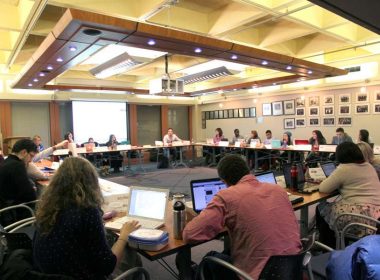
New Democratic Party (NDP) Leader Thomas Mulcair tackled issues facing the younger generation and the country during an event hosted by NDP McGill on Feb. 14.

Mulcair, who received his law degree from McGill in 1977, expressed enthusiasm for returning to his alma mater.

“I’m thrilled to be back here at McGill and in this room—I know how hokey it sounds, but it’s true,” he said. “My studies at McGill started in this room, just over 40 years ago.”

For the younger generation, Mulcair said education can pose unprecedented financial difficulties—in particular, rising tuition costs for university students.

“Twenty-five years ago, 82 per cent of the budget of Canada’s universities and colleges was provided by the government,” he said. “Today, it’s not rare to see students borrowing $50,000 to finish their degree.”

Although Mulcair did not give any specific policy measures, he said he would work to increase federal funding to post-secondary education.

According to Mulcair, problems with education are also prevalent in Canada’s Indigenous communities. While he denounced the Aboriginal residential school system of the past and the abhorrent conditions many Indigenous children experienced there, Mulcair also condemned the state of reservations today.

“First Nations kids receive 35 per cent less funding for per capita than other Canadian kids,” he said. “Conditions on reserves are perpetuating things like tuberculosis that should be diseases of the past [….] Those are problems that are easy to identify and they are also easy to fix if you make them a priority. Governing is about making priorities.”

Mulcair also spoke out against Prime Minister Stephen Harper’s health care plans, specifically criticizing his planned cuts of up to $36 billion in health care funding.

“The NDP introduced free universal health care in Canada, and that’s now generalized across the country,” he said. “We should fight to maintain it.”

He encouraged younger voters to more actively participate in the political sphere and emphasized the danger of not voting.

“What has been there in the past for your parents is now at risk for you,” he said. “Yet, 65 per cent percent of young people aged 18 to 25 didn’t vote in the last election.”

Attended by approximately 60 members of the McGill community, the event gave members of the McGill community the opportunity to ask Mulcair questions. When asked about potential Senate reform, he proposed the idea of elimination of the Senate as a whole.

“The abolition of the Senate is the simplest solution,” he said. “Unicameral parliament—the same thing in all of the Scandinavian countries—works.”

One U2 political science student, who asked to remain anonymous, disagreed with Mulcair about the Senate.

“Not even trying to reform a house that has accomplished numerous important tasks in Canadian politics is a disservice,” the student said. “Simply removing the Senate won’t stop the partisan bickering in parliament, which Mulcair is just as much a part of.”

Caleb Holden, president of the NDP club at McGill, said he was happy with the content of the discussion.

“I’m happy to see how much [Mulcair] touched on Indigenous issues in Canada,” Holden said. “I’m also happy to see him talk about things that are pertinent to students, such as student internships and some do-nothing elements of the budget that came out earlier this week. We need to have more policies geared towards our younger voters.”

Viviane Cheng, U1 Management, said she was surprised at Mulcair’s level of candour.

“After what he said, I’m sort of changing my views [about him],” Cheng said. “I think he is genuine and really does want the best for Canadians.”

Read the latest issue

Read the latest issue